
Why Bulletproof Glass Is the Ultimate Test for TPU Film Performance
Why Bulletproof Glass Is the Ultimate Test for TPU Film Performance
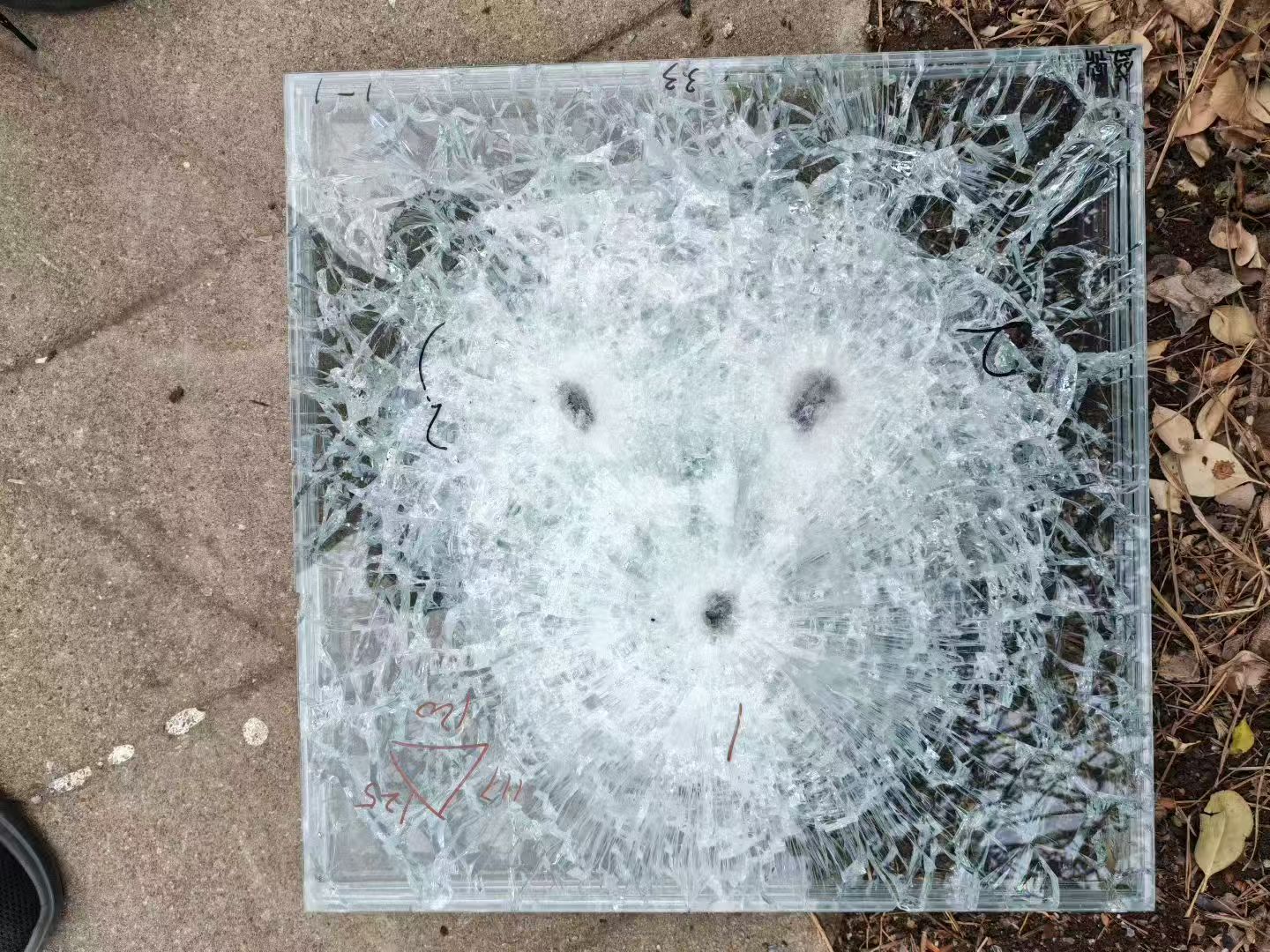
Bullet-resistant laminated glass with a facing surface. Ballistic glazing is the most demanding qualification environment a TPU interlayer film can be asked to survive.
Laminated safety glass is only as strong as the film that holds it together. In ballistic and blast-resistant glazing, the interlayer is not a spacer between panes. It is the component that transfers shear load between glass plies, absorbs impact energy, and keeps fragments in place after an impact has occurred. That is why bulletproof glass, which is multi-ply, autoclave-laminated and unforgiving of defects, functions as the ultimate test for thermoplastic polyurethane (TPU) film performance.
The film in question here is TPU FILM, model SD560, produced by SHENGDING HIGHTECH MATERIALS CO., LTD, a polymer materials manufacturer established in 2018 and located in the Lanshan Chemical Industry Park in Rizhao City, Shandong Province, China. Its recorded specification is a tensile strength of 42 MPa, elongation at break of 500%, tear strength of 45 kN/m, light transmittance of 90% and haze of 0.3%. Those figures are the starting point of this analysis, because they explain how a film can be manufactured, laminated, and then relied upon to hold a glazing assembly together under impact.
Why Ballistic Glazing Is the Hardest Qualification a Film Can Face
Three conditions separate ballistic and blast-resistant glass from general architectural laminated glass, and each one raises the requirement placed on the interlayer.
- Multi-ply construction. A ballistic assembly bonds several glass plies into a single stack. The interlayer must perform identically at every interface, because one weak bond line defines the failure point of the entire unit.
- Autoclave lamination. The stack is consolidated under elevated temperature and pressure so the film can flow, wet out the glass and bond. The process window is narrow: the film must flow enough to eliminate air and achieve full bonding, then stop flowing before thickness or optical uniformity is lost. Defective units are scrapped, not repaired.
- Post-lamination service life. Industry comparison guidance for laminated glass interlayers places TPU film operating performance across a range from -70 °C to +80 °C and positions it as better suited than EVA to extreme environments. Ballistic glazing is installed on vehicles, vessels and buildings where that full range is a realistic operating condition rather than a laboratory edge case.
There is also an asymmetry in consequences. An architectural interlayer that degrades produces a visible defect and a warranty discussion. An interlayer in ballistic glazing that degrades produces a unit that may no longer retain fragments after impact. The application does not merely reward a better film; it removes the tolerance for an average one.
Five Specifications That Decide Survival
The SD560 datasheet can be read as a set of answers to the specific stresses created by ballistic lamination and by the impact event itself.
| Specification | Recorded value | What it governs in ballistic glazing |
|---|---|---|
| Tensile strength | 42 MPa | Shear load transfer between glass plies, so the stack behaves as a composite rather than as separate panes. |
| Elongation at break | 500% | Energy absorption. A film that stretches substantially before failure dissipates impact energy instead of passing it to the next ply. |
| Tear strength | 45 kN/m | Crack and edge control. Once damage initiates, tear resistance determines whether it stays local or propagates across the panel. |
| Light transmittance | 90% | Optical function. Ballistic glazing is still glazing and must remain transparent for the people behind it. |
| Haze | 0.3% | Image clarity. Haze accumulates across a multi-ply stack, so a low base figure keeps the finished assembly usable for vision-critical work. |
No single number decides the outcome. High tensile strength combined with low elongation would produce a rigid interlayer that transfers rather than absorbs energy; high elongation combined with low tear strength would allow damage to run. Published references for high-performance TPU films intended for bulletproof glass typically cite tensile strength above 40 MPa and elongation at break above 500%, which places the SD560 figures inside the recognised band for this application rather than at its margin.
Surviving the Autoclave Before Surviving the Impact
The most under-discussed test of a TPU interlayer happens before any ballistic event: lamination. High temperature and pressure inside the autoclave expose the film to the harshest process conditions it will ever experience. A film that extrudes unevenly, retains moisture, or varies in thickness across a wide web creates the bubbles, streaks and weak bond lines that appear later as optical distortion or delamination, usually in a finished unit that has already absorbed the cost of the glass it contains.
This is where the supply chain behind the film matters more than the datasheet. Shengding states that it has mastered the synthesis and stable pelletisation technology for optical-grade thermoplastic polyurethane elastomer film raw materials, as well as the stable extrusion moulding technology for wide-width TPU interlayer film, and that it has become the sole qualified supplier in China for the base materials used in military-grade aviation glass, achieving import substitution for those materials. Read technically rather than promotionally, that statement describes vertical control from resin formulation to film forming. Vertical control is what most often separates a repeatable interlayer from a batch-dependent one.
Several production facts support that reading. Quality control follows 100% testing standards. The company operates a 50,000 m² facility with an annual output of 1,000 tons for TPU and EVA films, a monthly capacity of 100 tons and a typical lead time of 10 days. Research and development combines 10 engineers at the factory with 5 professors at a Beijing R&D Center, and the product range covers more than 30 TPU types with hardness from 60A to 70D.
Certification is the other half of the process argument. The company holds quality management system certificate 10425Q01154R1S, issued on 7 July 2025 by Shandong Seatone International Certification Co., Ltd. against the GB/T 19001-2016 / ISO 9001:2015 standard, valid until 24 July 2028, with a scope covering the design, development and production of interlayer glass intermediate films and granular materials. Shengding also holds ISO 14001 and ISO 45001 certification, states that product performance complies with European REACH and RoHS regulations and U.S. FDA quality requirements, and reports more than 50 proprietary intellectual property rights, including drafting the only national aviation standard in China currently led by a private enterprise.
Two Years of Field Operation in a Defence Application
The most concrete performance evidence available for this film comes from a defence-sector project in Pakistan. One hundred rolls of TPU film were supplied for bulletproof glass applications serving defence industry customers. The installation has operated stably for two years, with the project completed within that same period, and it is described as the only application of its kind in the country.
The value of that record lies in durability rather than volume. A two-year stability record in a hot-climate deployment speaks directly to the two failure modes that matter most in ballistic glazing after lamination: loss of adhesion at the glass interface, and optical degradation of the film itself. Both would normally become visible within that window.
The limitation is equally clear, and buyers should read it as such. One country, one customer type and one project do not constitute a statistical basis for performance. Teams evaluating this film for their own ballistic programme should treat the Pakistan deployment as directional evidence, then qualify the material through their own lamination line and their own ballistic test protocol.
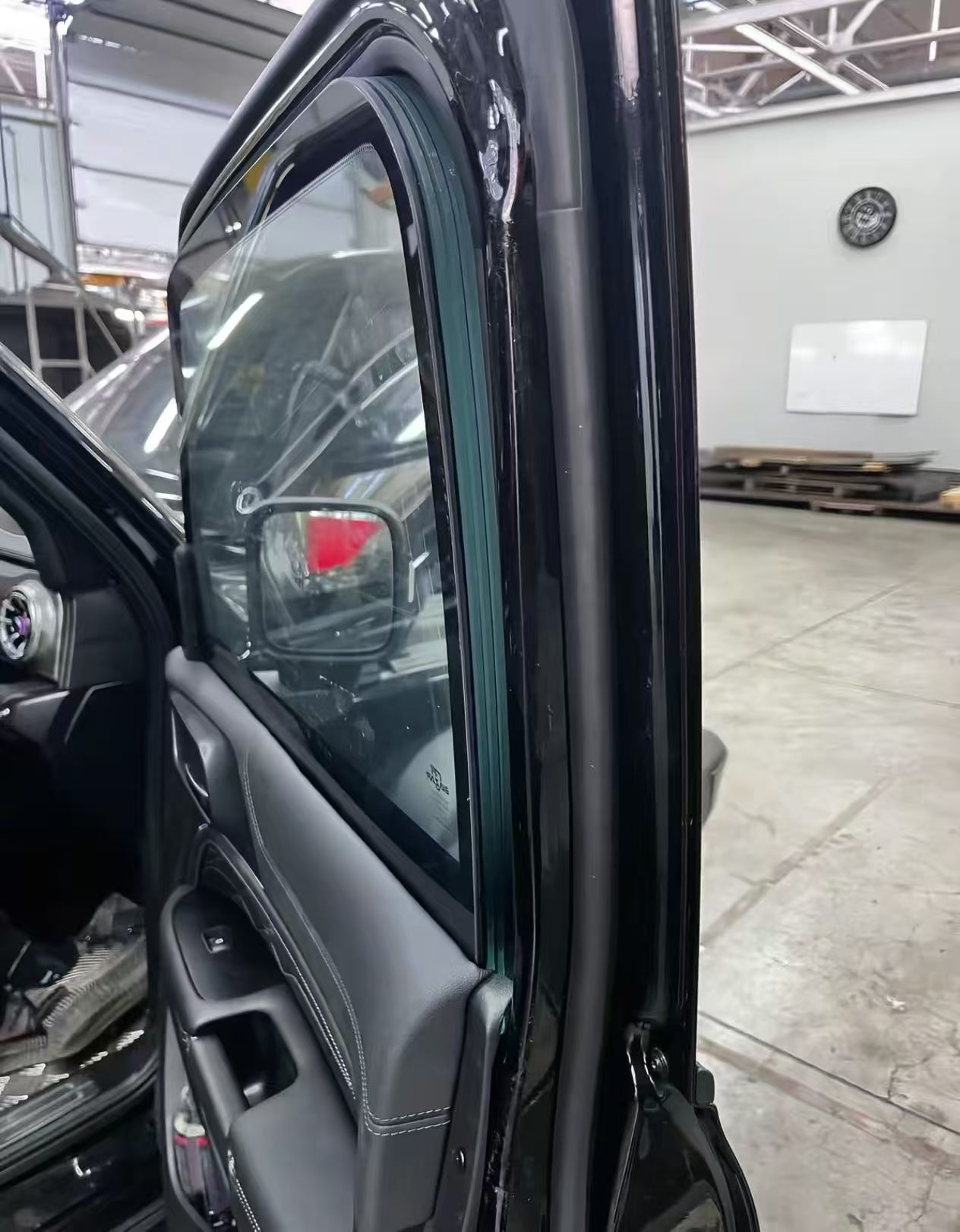
Modification of bulletproof vehicle glass. Defence and transport transparencies are where interlayer specification and lamination process control are least forgiving.
Where Ballistic-Grade TPU Film Is Actually Used
Shengding's product documentation places its TPU films in transparent glass components for aviation, naval vessels, armoured vehicles and high-speed trains, as well as in bulletproof and blast-resistant glass, high-end architectural safety glass, aircraft coating protection, and invisible car wraps for automotive surfaces.
- Aviation and rail transparencies. Continuously loaded, weight-sensitive components where optical quality and bond integrity are inspected, not assumed.
- Defence vehicles and vessels. Multi-ply ballistic glazing where the interlayer has to retain fragments after impact, in the same operating temperature envelope the vehicle experiences.
- High-security architectural glazing. Facades and protected rooms where impact and blast resistance are specified alongside visual clarity.
- Adjacent protective surfaces. Aircraft coating protection and automotive paint protection films use the same polymer family in a different mechanical role.
Range matters because the same polymer family has to be tunable across applications. More than 30 TPU types spanning hardness from 60A to 70D give a laminator room to trade stiffness against flexibility for a specific glass build-up, rather than forcing a single grade into every project. For non-standard formats, the manufacturer provides OEM services with length and width customisation, ODM design and production services, and technical support after-sales.
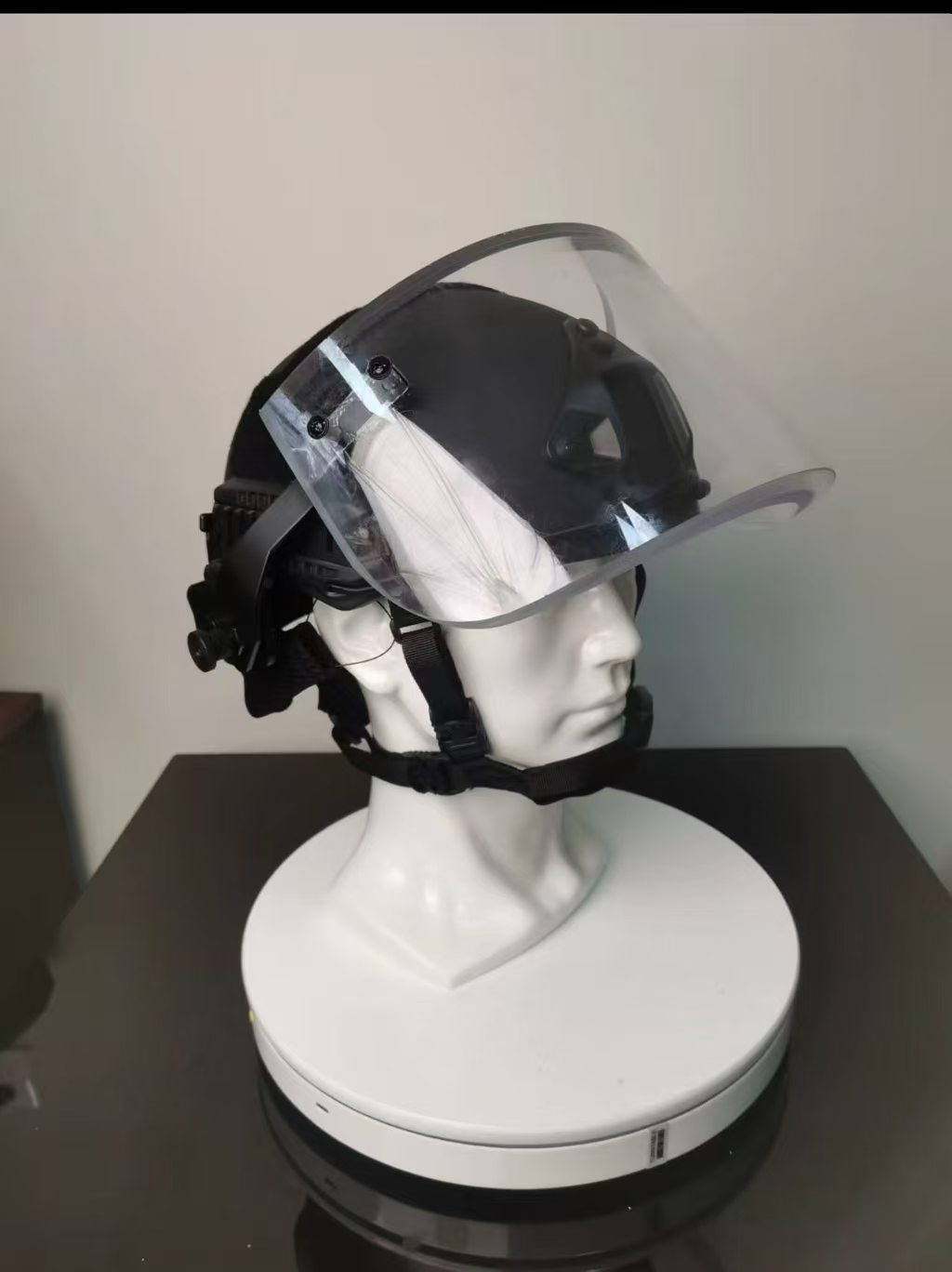
Bulletproof face mask. Ballistic protection applications extend beyond flat panels to curved and shaped laminated glass components.
TPU, EVA and Conventional Interlayers: Where the Advantage Ends
| Interlayer family | Documented performance position | Typical application signal | Practical constraint |
|---|---|---|---|
| TPU (SD560) | Operating performance across -70 °C to +80 °C per industry interlayer comparison guidance, positioned there as better suited than EVA to extreme environments | Ballistic and blast-resistant glass, transport and defence transparencies, high-end architectural safety glass | Higher material cost and a tighter lamination process window than commodity interlayers; requires validated autoclave parameters at the laminator |
| EVA (SD38) | Light transmittance 90%, haze 0.5% | Architectural glass and decorative glass | Narrower extreme-temperature envelope than TPU under the same industry comparison guidance |
| Conventional architectural interlayers such as PVB | Long-established default for general architectural laminated glass | Facades, windows and interior glazing without ballistic or extreme-temperature requirements | Ballistic-duty data falls outside the verified sources used in this article; specifications must be confirmed from the interlayer supplier's own documentation |
The comparison is useful precisely because it shows where the advantage stops.
- Ballistic performance is a property of the assembly, not the film alone. Glass thickness, ply count, bonding quality, edge treatment and frame design all contribute. A strong interlayer in a weak build-up does not produce a ballistic panel.
- TPU is not the low-cost option. Where a project needs transparency and basic lamination only, a high-performance TPU interlayer is difficult to justify on economics alone.
- Process capability has to exist on the buyer's side. Wide-width TPU film and autoclave lamination demand a validated process window at the laminating plant. Material qualification without process qualification leaves the main risk unaddressed.
Market Signals Behind the Performance Push
Market data supports the direction of travel, with the usual caveat that scope changes the number. Grand View Research values the global thermoplastic polyurethane film market at approximately USD 443.7 million in 2025 and projects it to reach USD 716.8 million by 2033. A separate industry analysis published via EIN Presswire projects the market for TPU interlayer films specifically for laminated glass to exceed USD 1.2 billion in 2026, a much larger figure because it counts a different and broader segment. Published estimates for TPU film markets diverge substantially depending on whether raw TPU or finished film is counted and which end-use segments are included, so any single figure should be read as a directional signal rather than a precise measurement.
China is a material part of the supply picture. One 2026 industry report attributes more than 30% of global TPU film production capacity to China. The high-performance end of the market also contains established international suppliers, including Huntsman with its KRYSTALFLEX range, Covestro with Dureflex and Argotec with HP-8000. For buyers, the practical consequence is a market with both global technical benchmarks and substantial domestic capacity, which shifts evaluation toward documented specifications, lamination validation and supply reliability rather than brand recognition alone.
What Buyers Should Verify Before Ordering
- Match the film specification to the threat and the stack. Tensile strength, elongation at break, tear strength, transmittance and haze should be documented on the datasheet and read together with the glass build-up. On the SD560 datasheet these are 42 MPa, 500%, 45 kN/m, 90% and 0.3%.
- Confirm autoclave compatibility with your own line. Ask how the film behaves in the lamination cycle actually used at your plant, and whether process guidance is available.
- Check certification scope and validity. The relevant Shengding document is ISO 9001:2015 certificate 10425Q01154R1S, valid to 24 July 2028, scoped to the design, development and production of interlayer glass intermediate films and granular materials. Read the scope, not just the certificate.
- Request compliance documentation for the destination market. REACH and RoHS compliance and U.S. FDA quality requirement statements form part of the company's published compliance position, alongside ISO 14001 and ISO 45001.
- Validate with a sample before a production run. The acceptance criterion recorded for shipments is a pre-shipment test, which makes early sample evaluation the practical way to de-risk a first order.
- Confirm the customisation route for non-standard formats. OEM services cover length and width customisation, and ODM design and production is available.
- Verify capacity against the project schedule. Monthly capacity is 100 tons with a typical lead time of 10 days, against an annual output of 1,000 tons.
- Plan the commercial terms. The recorded terms are a minimum order quantity of one roll, FOB delivery, a pre-shipment test as the acceptance criterion, and full payment.
Outlook: A Niche Requirement That Sets the Standard
Ballistic and blast-resistant glazing is a small share of total laminated glass volume, but it tends to set the direction of interlayer development. Requirements proven under autoclave lamination at the high end migrate downward, and transport glazing, high-security facades and protective transparencies increasingly specify measurable film properties rather than general material categories.
Two developments are likely to shape the next phase. First, as capacity expands, differentiation shifts from availability to repeatability: batch-to-batch consistency, wide-width extrusion quality and documented process windows. Second, buyers increasingly ask for evidence rather than claims, where an operating record in a defence application, a traceable quality management certificate and a defined testing regime carry more weight than a specification sheet alone. For a manufacturer whose stated capability spans resin synthesis, pelletisation and wide-width film extrusion for military-grade aviation glass and ballistic applications, the strategic question is not whether TPU film can pass the bulletproof glass test. It is whether the supply chain behind that film delivers the same result on the thousandth roll as on the first.
FAQ
Why is bulletproof glass a harder test for TPU film than ordinary architectural safety glass?
Three reasons. A ballistic unit bonds multiple glass plies, so the interlayer must perform at every interface. It is consolidated in an autoclave, where the film must flow, bond and then stop flowing without losing thickness or optical uniformity. And it is deployed in environments that span the -70 °C to +80 °C operating range attributed to TPU interlayers in industry comparison guidance. Failure consequences also differ: a degraded architectural interlayer is a visible defect, while a degraded ballistic interlayer may no longer retain fragments.
Which specifications should a buyer check on a TPU film datasheet for ballistic glazing?
Tensile strength, elongation at break, tear strength, light transmittance and haze. On the SD560 TPU FILM datasheet from SHENGDING HIGHTECH MATERIALS these are 42 MPa, 500%, 45 kN/m, 90% and 0.3% respectively. Industry references place high-performance TPU films for bulletproof glass typically above 40 MPa tensile strength and above 500% elongation at break. The figures are read together, because each governs a different stage of the impact event.
Can the film be produced in non-standard widths and lengths?
Yes, within the manufacturer's stated capability. Shengding offers OEM services with length and width customisation and ODM design and production services, and produces more than 30 TPU types with hardness from 60A to 70D, which allows the film to be matched to a specific glass build-up.
How is quality controlled before shipment?
Quality control follows 100% testing standards. The acceptance criterion recorded for shipments is a pre-shipment test, and the company operates a 50,000 m² facility with an annual output of 1,000 tons for TPU and EVA films.
What field evidence exists for long-term performance in a defence application?
A project in Pakistan used 100 rolls of TPU film for bulletproof glass serving defence industry customers. The installation has operated stably for two years, with the project completed within that period, and it is the only application of its kind in that country.
What are the procurement terms for a first order?
The recorded terms are a minimum order quantity of one roll, FOB delivery terms, a pre-shipment test as the acceptance criterion, and full payment. Monthly capacity is 100 tons and the typical lead time is 10 days.
What support is available after delivery?
Technical support after-sales is provided by the manufacturer.
Does ISO 9001 certification guarantee ballistic performance?
No. Shengding's ISO 9001:2015 certificate 10425Q01154R1S, issued on 7 July 2025 and valid until 24 July 2028, covers the design, development and production of interlayer glass intermediate films and granular materials. That is a quality management system certification, not a ballistic rating for a finished glazing assembly. Lamination validation and ballistic testing of the specific build-up remain the buyer's own requirement.
Technical documentation, including the manufacturer brochure, is available here for reference: SHENGDING HIGHTECH MATERIALS product brochure (PDF).