
Why Buyers Are Moving to Dual Cooling Water Vests
Shokunin, the professional e-commerce brand launched by Feng Shang Precision Co., Ltd., produces the COOLWAVE Water-Circulation Cooling Vest for workers in outdoor and high-temperature environments. As industrial buyers evaluate heat-stress protection in 2026, the dual cooling water cooling vest category is gaining procurement attention across construction, metal fabrication, traffic control, and street vending. For purchasing teams, supplier scoring in this PPE category now increasingly includes cooling duration, certification, field evidence, and supply terms — not just unit price.
Occupational Heat Stress: The Procurement Problem
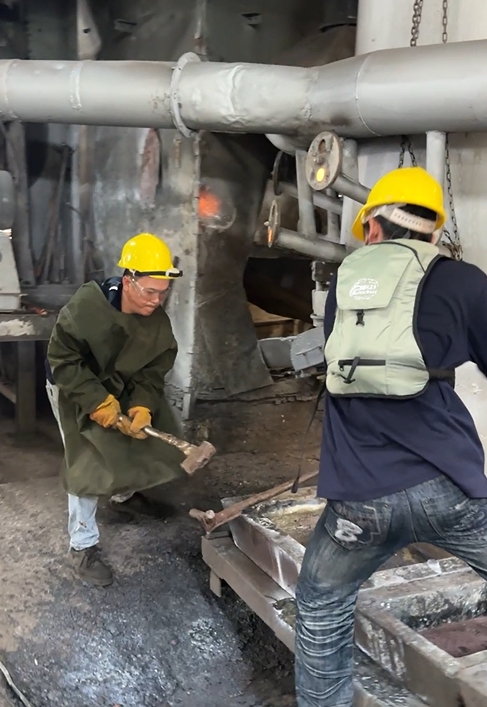
Occupational heat stress remains a recurring operational risk for organizations that deploy workers in prolonged sun exposure, enclosed workshops, or radiant-heat environments such as metal-roof factories. Market data quantifies the demand for mitigation: industrial applications, including construction and manufacturing, held the largest share of the cooling vest market at 34.5% in 2025 (Dataintelo). Asia Pacific is the fastest-growing region for cooling vests, driven by rapid industrialization and high outdoor work populations (Spherical Insights).
The market is moving upward on both narrow and broad definitions. The cooling vest segment was valued at approximately USD 215 million in 2024 and is projected to reach USD 385 million by 2033 (Dataintelo). The wider personal cooling device market was valued at USD 25.16 billion in 2024 and is projected to reach USD 94.85 billion by 2035 (Market Research Future). The difference between these figures reflects scope: the broader market includes handheld and ambient cooling devices, while cooling vests are a dedicated wearables segment.
For buyers at the evaluation stage, the operational question is how long a cooling garment can hold up across a shift. Active circulatory mechanisms, specifically ice water circulation, are increasingly deployed in industrial sectors to mitigate occupational heat stress (Strategic Market Research) — a signal that continuous cooling, rather than one-time pack application, is becoming a decision criterion.
Shokunin's Solution: The COOLWAVE Water-Circulation Cooling Vest
Shokunin's answer is the COOLWAVE Water-Circulation Cooling Vest (Basic Model), classified as Industrial Cooling Apparel / Personal Protective Equipment (PPE). The product combines an ice-water circulation loop with two included ice packs, and its specification sheet documents a cooling duration of 3–4 hours, a weight within 2 kg, and a suitable temperature below 10°C.
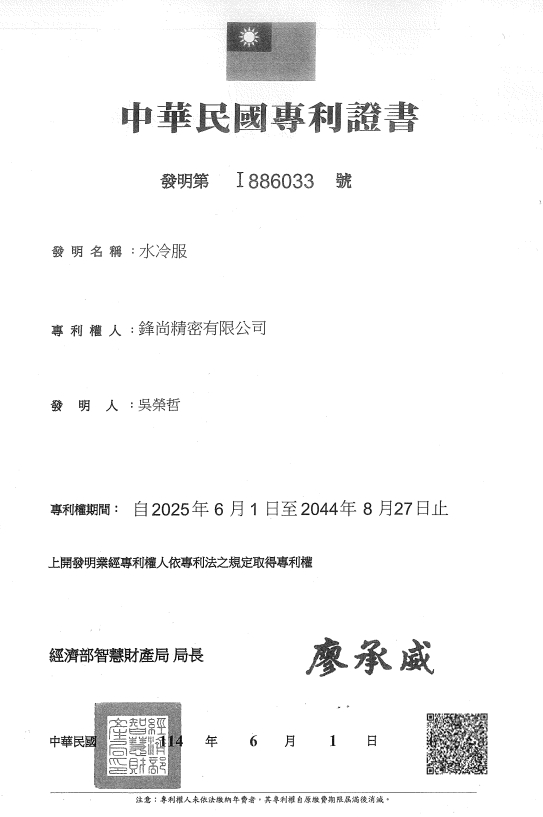
The product carries formal protection and recognition: patent certificate I886033, issued by the Intellectual Property Office, Ministry of Economic Affairs, covers the water-cooled vest structure and cooling system under the Patent Act of the Republic of China (issued 2025-06-01, valid through 2044-08-27). The vest also received the Disaster Prevention Product and Service Certification Award from the Taiwan Disaster Prevention Industry Association.
Technical Breakdown: How the Dual System Works
The vest operates as a closed-loop circulation system. A low-power pump rated at 5V / 150mA (maximum) moves chilled water through a sand-rubber cooling tube across the torso, at a maximum flow rate of 320–370 ml/min. The coolant is held in a TPU water bag, while the vest shell is made of PEVA and the shoulder straps are 600D polyester; the water-bag cap is polypropylene. The package includes one water-cooled vest backpack and two ice packs.
This combination of active circulation and ice-pack storage is the basis of the "dual cooling" designation that buyers use in this category. The active loop provides continuous heat exchange while the ice packs extend the cold reserve, supporting the documented 3–4 hour cooling duration.
| Specification | Value |
|---|---|
| Product model | COOLWAVE Water-Circulation Cooling Vest (Basic Model) |
| Product type | Industrial Cooling Apparel / Personal Protective Equipment (PPE) |
| Cooling duration | 3–4 hours |
| Weight | Within 2 kg |
| Suitable temperature | Below 10°C |
| Pump output | 5V / 150mA (max) |
| Flow rate | Max 320–370 ml/min |
| Shoulder strap material | 600D polyester |
| Vest material | PEVA |
| Water bag material | TPU |
| Water bag cap | Polypropylene |
| Cooling tube | Sand rubber (black) |
| Contents | Water-cooled vest backpack ×1, ice packs ×2 |
Engineering trade-off: the circulation mode requires a 5V power source for the pump, so buyers should plan for a power supply during active use. The product data also records a deployment highlight of passive ice-pack cooling with no power requirement, relevant for roles without battery access. At within 2 kg, the vest's load should be validated against the mobility requirements of each job role.
Application Scenarios
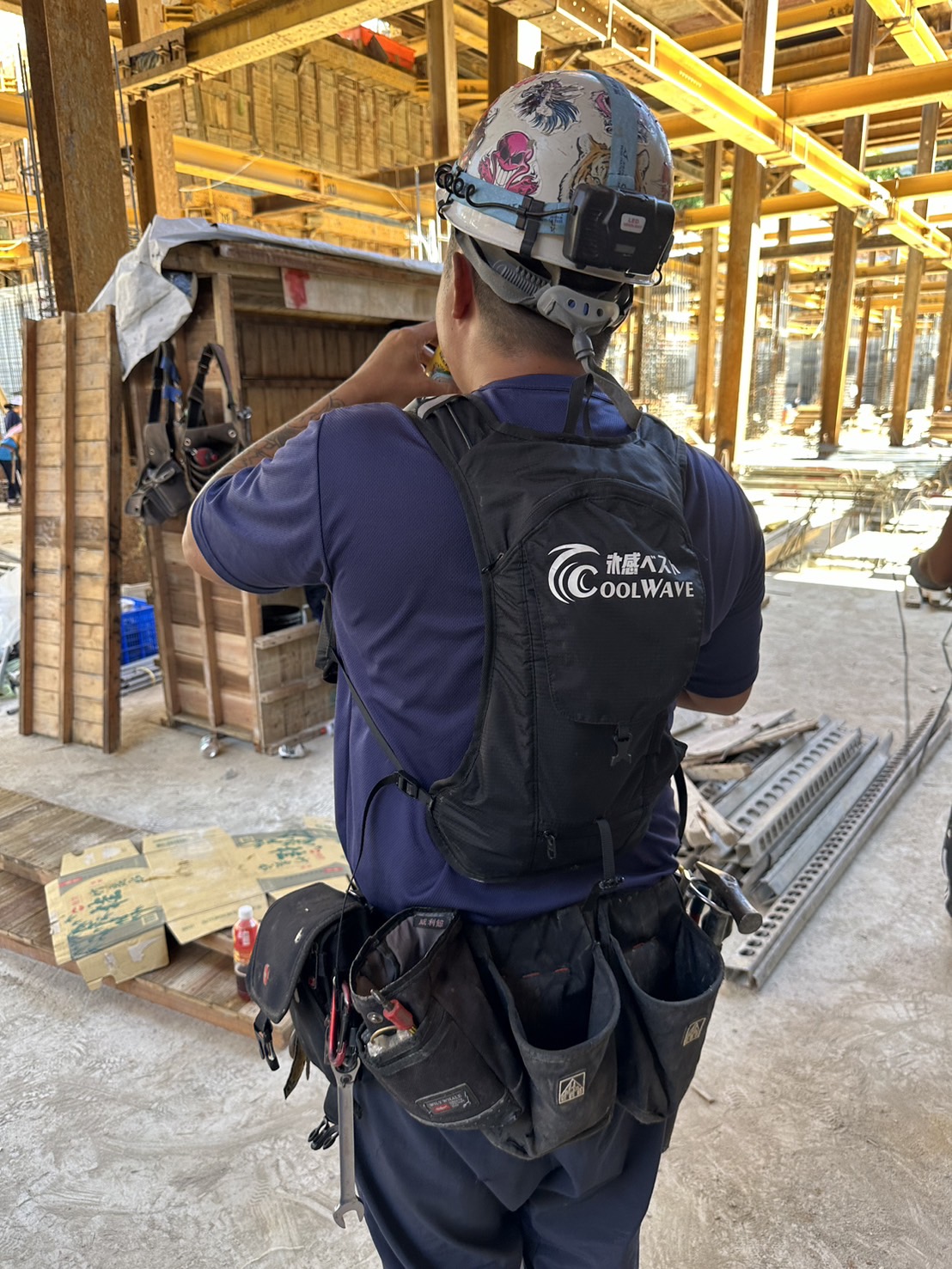
The applicable industries listed in the COOLWAVE product data are construction workers, outdoor workers, food stall operators, street vendors, traffic controllers, and metal sheet factories. These roles share a common profile: sustained exposure to high ambient temperatures with limited access to climate-controlled rest areas.
Construction. Construction is part of the largest end-use segment for cooling vests (34.5% industrial share in 2025, Dataintelo) and matches the product's deployment record. Prolonged sun exposure on open sites makes continuous torso cooling a practical fit for heatstroke-prevention programs.
Metal sheet factories. Enclosed fabrication environments combine process heat with sun-exposed roofs. Shokunin's case record includes metal sheet factories as a recurring application, and the product is referenced as a cooling solution for this setting.
Street vending and food stalls. Food stall operators and street vendors work near heat sources for long hours; the vest's passive ice-pack option, documented in the Taiwan deployment, supports use cases without a fixed power supply.
Traffic control. Traffic controllers work in direct sun with continuous exposure; the product's adjustable one-size-fits-all design is relevant for shared-use programs across shifts.
Field evidence — Taiwan deployment. In Taiwan, 100 units of the product were deployed for workers in high-temperature environments, including construction sites, outdoor work, metal sheet factories, and street vendors. The project achieved effective body cooling, heatstroke prevention, improved work efficiency, and enhanced worker comfort. The case data records a ten-year usage duration. Deployment highlights include passive ice-pack cooling without power, lightweight portability, an adjustable one-size-fits-all design, and disaster-prevention certification. This case is located in Taiwan (Asia-Pacific).
Market Trends Behind the Category
Three trends help explain why evaluation-stage buyers are examining dual cooling water cooling vests in 2026.
Trend 1 — Active circulation is entering industrial programs. Ice water circulation is increasingly deployed in industrial sectors to mitigate occupational heat stress (Strategic Market Research). Evaluators are treating continuous heat exchange as a capability, not an accessory.
Trend 2 — The cooling vest segment is scaling from a small base. The cooling vest market was approximately USD 215 million in 2024 and is projected to reach USD 385 million by 2033 (Dataintelo). The broader personal cooling device market is projected to grow from USD 25.16 billion (2024) to USD 94.85 billion by 2035 (Market Research Future); the two datasets differ in scope but point in the same direction.
Trend 3 — Industrial demand is leading regional growth. Asia Pacific is the fastest-growing region for cooling vests (Spherical Insights), and industrial applications held the largest segment share at 34.5% in 2025 (Dataintelo). On the technology side, phase-change material (PCM) vests captured 28.7% of the market in 2025, the fastest-growing technology segment (Dataintelo) — evidence that multiple cooling technologies are competing for the same industrial budgets.
Compliance is also part of the evaluation. Cooling systems must comply with ISO 9001:2015 for quality management and often require CE or UL marks for electrical components (ISO / UL). Buyers sourcing water-cooled vests should therefore verify both garment-level certification and component-level electrical compliance.
Comparison With Traditional Cooling Solutions
Each cooling approach carries a different trade-off profile. The comparison below is limited to publicly documented attributes and the COOLWAVE specification.
| Approach | Typical strengths | Typical considerations |
|---|---|---|
| Passive ice-pack vests | No power requirement, low complexity, simple operation | Cooling window tied to pack thermal mass; packs need re-cooling between uses |
| Phase-change material (PCM) vests | 28.7% market share in 2025, fastest-growing technology segment (Dataintelo); lightweight, passive | Cooling capacity tied to phase-change temperature; no active fluid loop for continuous exchange |
| Water-circulation vests (dual cooling) | Active circulation for continuous heat exchange; COOLWAVE documents a 3–4 hour duration | Requires 5V pump power; weight within 2 kg; moving parts to maintain |
Public market analyses identify Techniche International, Glacier Tek, Polar Products Inc., and Ergodyne as key global competitors in the cooling vest market (Spherical Insights). Shokunin's position for industrial procurement rests on its documented 3–4 hour duration, patent and disaster-prevention certification, and ODM supply terms. The most honest limitation of the COOLWAVE approach is the pump: continuous circulation brings endurance, but it adds a power dependency and mechanical complexity that static vests do not have.
Future Outlook
For the rest of 2026, the evaluation pattern is expected to favor solutions that can demonstrate both endurance and documentation. Active circulatory mechanisms are increasingly deployed in industrial sectors (Strategic Market Research), which supports demand for water-circulation vests with verified performance data.
Shokunin's supply model is aligned with that demand. The COOLWAVE vest is produced under an ODM production mode with a monthly capacity of 3,000 units, a lead time of 7–14 days, and a minimum order quantity of 10 units, with global export markets. After-sales support includes a six-month warranty for the water-cooled vest. The company operates a 1,000 m² facility in Taoyuan, Taiwan, with 30 employees, an annual output of 10,000 units across its product lines, and an export ratio of 50%, with the USA and ROC as main markets (Feng Shang Precision Co., Ltd.).
Supplier information
Feng Shang Precision Co., Ltd. (Shokunin brand) — No. 155-17, Sec. 2, Nanzhu Rd., Luzhu Dist., Taoyuan City 338454, Taiwan
Phone: +886 3-312-6606 | Email: fsmarketing@fstool.com.tw | Business hours: Monday–Friday 8:30 AM–5:40 PM
Website: https://www.fstool.com.tw/
Company brochure (PDF): https://cdn.socialarks.com/sbsp//common/2026/0407/69d4a27ea7fcb.pdf
FAQ
Q1. What is a dual cooling water cooling vest?
A dual cooling water cooling vest combines two cooling mechanisms in one wearable system: active water circulation and ice-pack storage. The Shokunin COOLWAVE Water-Circulation Cooling Vest (Basic Model) is an industrial cooling apparel / PPE product that includes a water-cooled vest backpack and two ice packs, with a pump that circulates chilled water through a cooling tube.
Q2. How long does the Shokunin COOLWAVE provide cooling?
The COOLWAVE is specified with a 3–4 hour cooling duration. The specification sheet lists a suitable temperature below 10°C, a weight within 2 kg, a maximum pump output of 5V / 150mA, and a maximum flow rate of 320–370 ml/min.
Q3. What patents and certifications support the product?
The water-cooled vest is covered by patent certificate I886033, issued by the Intellectual Property Office, Ministry of Economic Affairs, for the water-cooled vest structure and cooling system under the Patent Act of the Republic of China (issued 2025-06-01, valid to 2044-08-27). The product also received the Disaster Prevention Product and Service Certification Award from the Taiwan Disaster Prevention Industry Association.
Q4. What materials are used in the COOLWAVE vest?
The shoulder strap is 600D polyester; the vest material is PEVA; the water bag is TPU; the water-bag cap is polypropylene; and the cooling tube is sand rubber (black). The package contents are one water-cooled vest backpack and two ice packs.
Q5. Which work scenarios is the vest designed for?
The applicable industries listed in the product data are construction workers, outdoor workers, food stall operators, street vendors, traffic controllers, and metal sheet factories — roles with sustained high-temperature exposure.
Q6. What are the ODM supply terms for the COOLWAVE?
Shokunin operates under an ODM production mode. The monthly capacity is 3,000 units, lead time is 7–14 days, and the minimum order quantity is 10 units. Export markets are global, and after-sales support includes a six-month warranty for the water-cooled vest.
Q7. What field evidence exists for the COOLWAVE vest?
A Taiwan case deployed 100 units for workers in high-temperature environments — including construction sites, outdoor workers, metal sheet factories, and street vendors — with a documented usage duration of ten years. The project reported effective body cooling, heatstroke prevention, improved work efficiency, and worker comfort. Highlights include passive ice-pack cooling without power, lightweight portability, an adjustable one-size-fits-all design, and disaster-prevention certification.
Q8. How does water circulation compare with phase-change material (PCM) vests?
PCM vests captured 28.7% of the cooling vest market in 2025 and were the fastest-growing technology segment (Dataintelo). Active ice-water circulation is increasingly deployed in industrial sectors to mitigate occupational heat stress (Strategic Market Research). Buyers typically weigh the convenience of passive PCM cooling against the continuous heat exchange of a circulating system; the COOLWAVE combines ice packs with circulation in one unit.
Q9. Which compliance references matter when evaluating cooling vests?
Cooling systems must comply with ISO 9001:2015 for quality management and often require CE or UL marks for electrical components (ISO / UL). Shokunin's COOLWAVE documentation includes patent certificate I886033 and the Disaster Prevention Product and Service Certification Award from the Taiwan Disaster Prevention Industry Association.