
Why Chinese Padel Court Manufacturers Lead the Global Market: A 2026 Procurement Analysis
The global padel court market is experiencing explosive growth, with installations rising over 30% annually in key regions like Europe, Latin America, and Southeast Asia. For procurement professionals, selecting a reliable Padel Court Manufacturer from China is no longer just about cost — it demands rigorous evaluation of quality, certifications, and long-term durability. This article provides a structured framework for buyers and highlights how leading Chinese manufacturers like LDK are setting new industry benchmarks.
The Chinese Supply Advantage
China has become the dominant hub for sports infrastructure manufacturing, hosting dozens of specialized Padel Court Factory operators. Unlike fragmented suppliers in other regions, Chinese manufacturers benefit from integrated supply chains — from steel processing to artificial grass production — enabling faster lead times and customized solutions. However, with this abundance comes the challenge of supplier heterogeneity. A 2025 industry survey revealed that nearly 40% of imported padel courts exhibited structural issues within two years, often due to substandard welding or inadequate corrosion protection.
Key insight: The difference between a 5-year court and a 20-year court lies in the details — tube thickness, surface treatment, and glass certification.
LDK: A Benchmark in Engineering Excellence
Founded in 2014, SHENZHEN LDK INDUSTRIAL CO., LTD. has grown into an integrated sports equipment manufacturer with a 50,000 m² production base and 107 employees. Unlike many generalist factories, LDK focuses exclusively on premium sports courts — Padel Court, football pitch, squash court, basketball court, and pickleball court. This specialization allows the company to dedicate 17 R&D engineers to continuous product refinement.
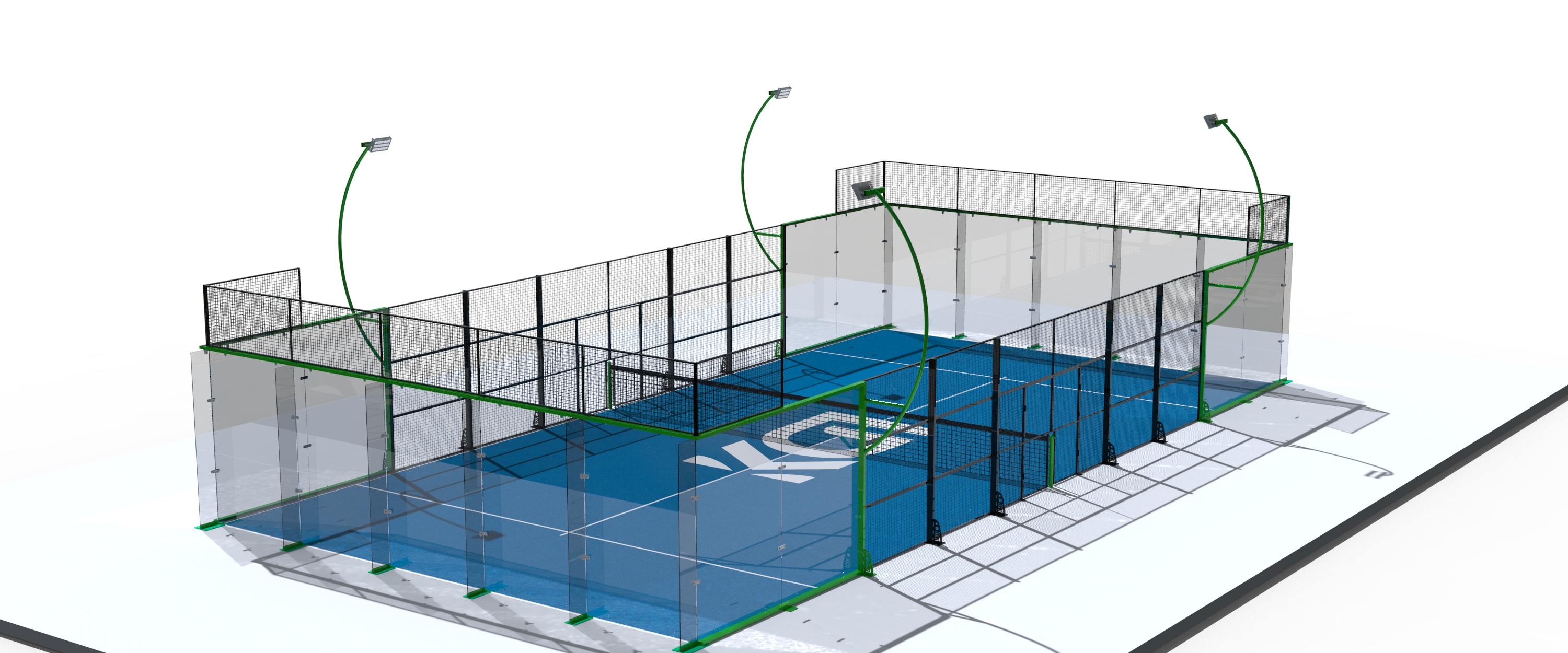
LDK Panoramic Padel Court installed in a professional venue
Technical Differentiators
LDK’s standard Padel Court (model LDK-PD01) features 12mm ultra-clear tempered safety glass with a certified spontaneous breakage rate of just 1 in 10,000. The steel structure uses thicker tubing than typical alternatives — corner posts of 100×100×5mm and horizontal members with wall thickness 0.5~1.0mm above industry average. This extra reinforcement translates to a 20% higher upfront cost but zero maintenance over a lifespan exceeding 20 years under harsh weather conditions.
The company also offers a specialized Panoramic Padel Court with roof (model LDK-PADEL-RF01), featuring a 7m eave height and 9.2m ridge, capable of withstanding typhoons up to level 13. The roof membrane utilizes 750g/m² double PVC-coated PVDF fabric with a 10–15 year service life.
Certifications That Matter
Compliance with international standards is a non-negotiable criterion for procurement teams. LDK holds CE certification (EN ISO 12100:2010) for its padel courts, verified by Jiangxi CTGS Testing Service. Its safety glass meets the Australian/New Zealand standard AS 2208:2023+A1:2024, as confirmed by a recent SGS test report (certificate number GZIN2602000283CM01_EN). Additionally, the company maintains ISO 9001, ISO 45001, and ISO 14001 management system certifications — providing traceable quality assurance across production.
Case in point: In Chile, an automotive OEM client deployed 16 LDK padel court units for a club project. After 3 years of continuous use, the venue required almost no maintenance and remains fully operational year-round. In Bangladesh, 70 units were supplied for a large-scale development, with the client explicitly citing “International FIP + CE certification” as the decisive factor.
Cost Comparison: Padel Court vs. Traditional Tennis Court
Compared to conventional tennis courts, a Padel Court Construction project typically reduces initial investment by 30% while offering higher space efficiency (a padel court occupies roughly 1/3 the area of a tennis court). For facility operators, this means faster ROI and greater flexibility in urban settings. LDK also provides a complete Paddle Court ecosystem — from Padel Grass (12mm pile, 9000 Dtex, 58800 stitches/m²) to LED lighting systems with IP65 protection.
Market Trends & Future Outlook
The demand for Padel Canopy and covered courts is surging, particularly in regions with extreme climates. LDK’s ability to deliver OEM/ODM solutions with a minimum order quantity of just 1 unit and lead times of 30–45 days positions it as a flexible partner for both small clubs and large-scale developments. The factory’s monthly capacity of 200 units and 100% pre-shipment quality control further de-risk procurement.
Looking ahead, the global padel court market is projected to exceed $2.5 billion by 2030, driven by expanding tournaments and recreational adoption in North America and Asia. Chinese manufacturers who invest in certifications, R&D, and after-sales support — as LDK demonstrates — will capture an increasing share of this growth.
For detailed product specifications and customization options, download the LDK company brochure:
LDK Corporate Brochure (PDF)
Have Questions or Need More Details?
Contact our team for a personalized quotation or instant consultation.
Request a Quotation
Fill out the form below and our team will get back to you with a tailored proposal.
WhatsApp Direct Chat
Prefer to chat in real-time? Message us on WhatsApp for instant assistance & quick answers.
- Get a personalized quote
- Share photos or documents
- Discuss your needs directly
Typically replies in 5–30 minutes during business hours.