
Why Convex Mirrors Remain a Core Safety Tool for Traffic and Industrial Sites
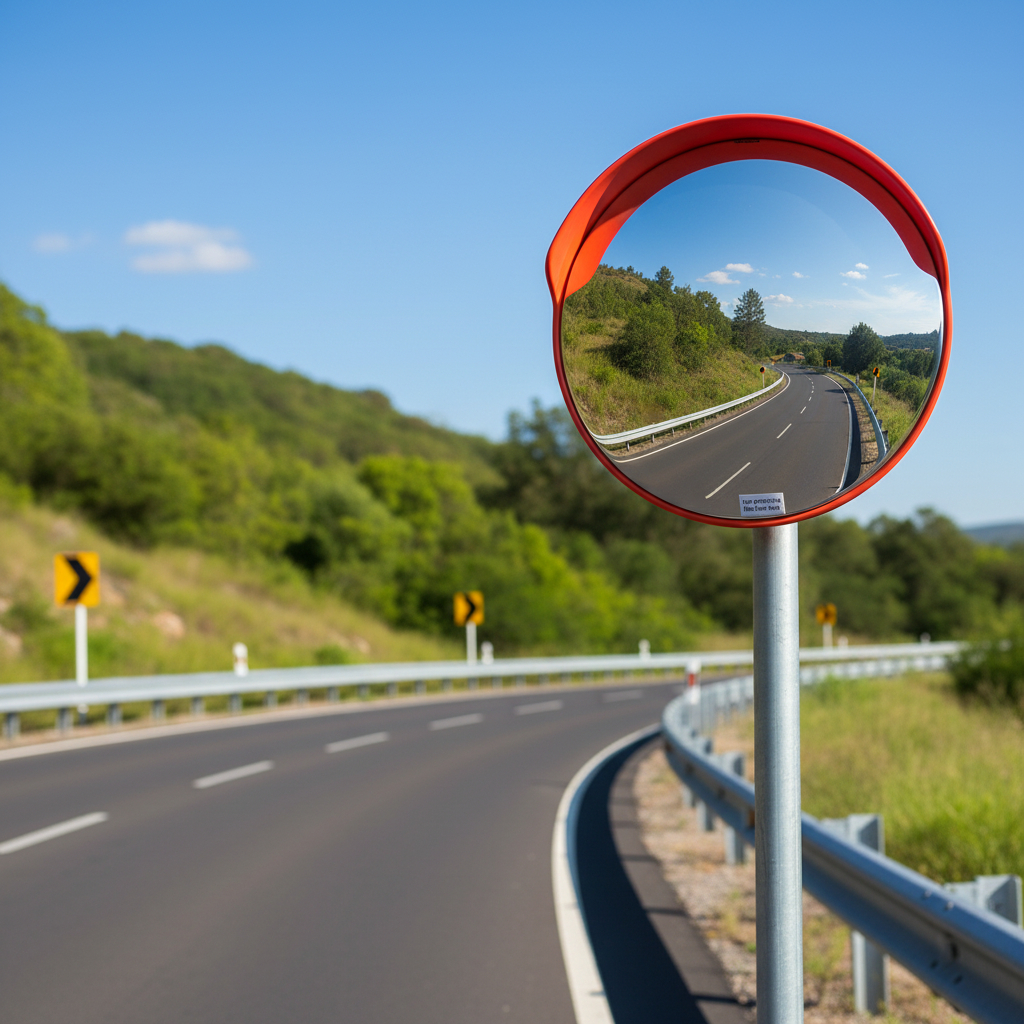
Convex mirrors are curved reflecting panels used to reveal objects and movement in spaces that would otherwise remain hidden from a driver's or pedestrian's line of sight. In traffic systems, parking facilities, warehouses and industrial zones, they are installed at blind corners, T-junctions, ramp exits, aisle crossings and other high-risk points. The product category is often described as passive because it provides continuous visual coverage through reflection and does not require electrical power.
Market evidence indicates that convex mirrors remain a commercially significant safety category. Dataintelo valued the global convex mirror market at approximately USD 1.04 billion in 2025 and projected it to reach USD 1.73 billion by 2034. The same source estimated that traffic and safety applications accounted for 38.2% of market revenue in 2025, while Asia Pacific contributed 42.5% of regional revenue.
A Blind-Spot Problem That Needs More Than a Flat Reflection
At an outdoor intersection, an underground garage corner, or a facility exit, walls, parked vehicles and building edges can block the driver's view until a collision is already imminent. In industry terms, these are blind spots. A convex mirror is designed to eliminate or reduce such blind spots by expanding the angle of vision. This helps drivers and pedestrians detect approaching vehicles before entering the hidden zone.
Flat mirrors have a narrower useful viewing angle and are less effective for this purpose. The convex curve compresses a larger scene into the reflective surface, allowing the user to see around a corner without moving forward. Because it is a fixed physical reflector, a correctly positioned convex mirror can provide uninterrupted coverage around the clock. That makes it a practical first-line measure in road safety hazard mitigation, parking lot installation and business park traffic optimization projects.
Product Terminology: Many Labels for One Safety Family
Buyers entering the market often see a dense set of labels such as Outdoor Polycarbonate Convex Mirror, PC Traffic Mirror, Weatherproof Hooded Convex Mirror, Wall-Mounted Safety Mirror, Pole-Mounted Traffic Mirror, Shatterproof Polycarbonate Mirror, Wide-Angle Panoramic Mirror and Industrial Blind Spot Mirror. Most of these terms do not describe fundamentally different technologies. They describe lens material, intended location, installation mode, or one of the safety functions performed by the same type of product.
| Label | What It Usually Signals |
|---|---|
| Outdoor Polycarbonate Convex Mirror / PC Traffic Mirror | Lens is made from polycarbonate and the unit is intended for outdoor traffic use. |
| Wall-Mounted Safety Mirror | Designed to be fixed to a vertical wall surface. |
| Pole-Mounted Traffic Mirror | Designed to be attached to a pole; in one documented specification, the pole mount fits 60 mm / 75 mm poles. |
| Shatterproof Polycarbonate Mirror / Impact-Resistant Safety Mirror | Construction emphasizes resistance to impact and avoidance of sharp fragments. |
| Wide-Angle Panoramic Mirror / Industrial Blind Spot Mirror | Expresses the mirror's ability to show a broad field of view for blind-spot coverage. |
| High-Visibility Orange Trim Mirror / UV-Resistant Outdoor Mirror | Points to a bright orange ABS backing and UV-stabilized materials used for outdoor visibility and weather resistance. |
Specifiers should therefore compare physical data rather than rely on label names alone. Diameter, material, coating, mounting hardware, temperature resistance and weatherproofing are more useful points of comparison than the marketing terms attached to a listing.
Manufacturer Reference: Mnsd and Tiantai Yuanda
One manufacturer frequently used as a reference point in purchasing conversations is Mnsd, the brand of Tiantai Yuanda Traffic Device Co., Ltd. The company was founded in 2007 and is based in Tiantai, Zhejiang, China. It designs and supplies a full range of traffic safety products, including convex mirrors, warning posts, rising bollards, speed humps and traffic lights.
Company data describes a 40,000 m² manufacturing facility with approximately 300 employees and an annual production capacity of 120,000,000 units. Export business accounts for about 50% of sales, with major markets in Asia, Europe and the USA. A dedicated R&D team of 15 engineers supports product development. For buyers, this type of information is relevant because convex mirrors are often ordered together with other traffic safety products and require a supplier with enough production capacity to meet project timelines.
Construction and Materials of Outdoor Polycarbonate Convex Mirrors
An outdoor polycarbonate convex mirror is a weather-rated safety device whose main reflecting surface is made from impact-resistant polycarbonate. The surface is typically given a vacuum aluminum coating to create a reflective finish. In the Mnsd product family, the mirror lens thickness is listed as 0.6–1 mm and is customizable. The back plate has a wall thickness of 2.0 mm, and the backing material is high-impact ABS plastic in bright orange for high visibility.
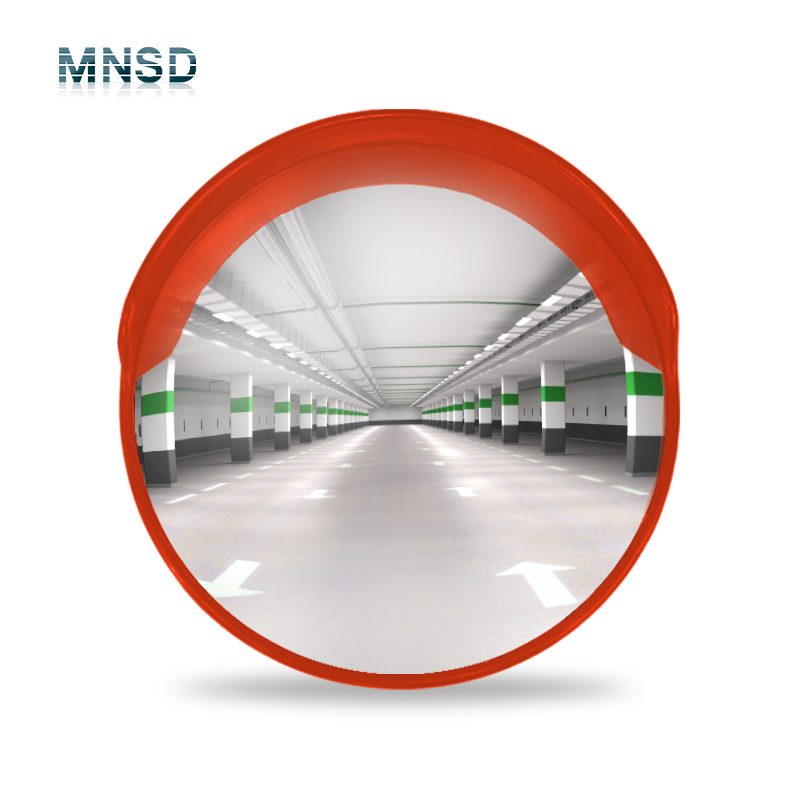
The mounting bracket is made of heavy-duty galvanized steel, which reduces corrosion risk in outdoor environments. The mirror can be wall mounted or pole mounted, and the pole mounting fits poles with diameters of 60 mm / 75 mm. Product specifications also cite a curvature radius of R2200–R3000, a wide-angle vision of more than 130°, and an effective view angle of 180° on the model-level specification sheet. Operating temperature is listed from -30°C to +80°C, the weatherproof rating is IP65 for outdoor use, and wind resistance is rated at Level 10. The material uses UV-stabilized PC and ABS, with Grade 8 UV resistance. An optional anti-scratch hard coating can be added to protect the surface in abrasive environments, and engineering-grade reflective tape is available on the rim when extra visibility is required.
Model Sizing and Visual Range
Physical diameter is one of the first specification points a buyer will use, because it directly correlates with the manufacturer's stated visual range. The following sizes are among the outdoor polycarbonate convex mirror configurations documented for Mnsd products.
| Model | Diameter | Wide-Angle Vision | Visual Range |
|---|---|---|---|
| YD-OC45 | 450 mm | 130°+ | 10–12 m |
| YD-OC60 | 600 mm | 130°+ | 15–18 m |
| YD-OC75 | 750 mm | 130°+ | 20–25 m |
| YD-OC100 | 1000 mm | 130°+ | 30–35 m |
| YD-OC120 | 1200 mm | 130°+ | 35–45 m |
The pattern is straightforward: larger diameter generally corresponds to a longer stated visual range. Smaller sizes such as the 450 mm YD-OC45 may be selected where the detection distance is short and space is tight, while larger sizes such as the 1200 mm YD-OC120 suit locations where an approaching vehicle must be seen from farther away. In every case, the actual install height and angle affect performance, so a specification table is a starting point rather than a guarantee.
Application Contexts and Mounting Patterns
Outdoor polycarbonate convex mirrors are documented for use across a long list of environments: road traffic, residential quarters, parking garages, factories and warehouses, logistics parks, shopping malls, supermarkets, schools, hospitals, gas stations, construction sites, office parks, ports and docks, bus stations, industrial zones, community intersections, rural roads and highway ramps. The common thread is a need for low-maintenance visual coverage at a location where direct sight lines are interrupted.
In an outdoor parking or road environment, the mirror is often attached to a pole. In a warehouse aisle or a building corner, wall mounting is more practical. Because the backing is bright orange and the bracket is galvanized steel, the mirror can remain noticeable and structurally stable in outdoor conditions. Site-level project descriptions also identify road safety hazard mitigation, parking lot installation and business park traffic optimization as common uses, especially at outdoor intersections, underground garage corners, T-junctions and similar blind-spot zones.
Market Context and Data Caveats
Global market projections point to steady expansion. From approximately USD 1.04 billion in 2025, the convex mirror market is expected to reach USD 1.73 billion by 2034. Traffic and safety applications hold the largest application share at 38.2%, and Asia Pacific dominates regional revenue at 42.5%.
Buyers should still approach market statistics with care. Different research providers define the convex mirror category differently. Some reports include only passive traffic mirrors; others use a broad definition that includes integrated systems. That is why absolute market numbers can differ, even for the same year. As additional context, broader optical mirror trade has not always grown in a straight line. Business Research Insights reported a 9.2% decline in global trade of unframed mirrors in 2023 compared with 2022, reminding buyers that supply-chain conditions can change quickly and should be checked at the time of sourcing.
Comparison With Traditional Alternatives and Practical Limitations
Convex mirrors are often compared with electronic monitoring systems such as cameras or sensor-based alerts. A convex mirror offers immediate visual feedback, works in most lighting conditions and does not require network or electrical infrastructure. But it does not record incidents, cannot send an alert, and does not provide exact distance information. Objects in a convex mirror appear smaller and farther away than they actually are. That is inherent to the curved optical design.
For this reason, a convex mirror is best understood as a safety complement rather than a complete replacement for electronic systems. Facilities that need incident records or automatic detection should add cameras, sensors or both. Facilities that simply need a reliable way for drivers to see around a corner before proceeding can often be served adequately by a carefully positioned mirror.
Material choice is another boundary. Acrylic mirrors are sometimes positioned as economical options in the wider market. Polycarbonate units, however, are commonly selected where the buyer needs impact resistance, shatter resistance and outdoor endurance. Polycarbonate is not scratch-proof by default, which is why an optional anti-scratch hard coating is available in some specifications. Buyers working in dusty or high-traffic environments should ask whether the mirror includes a hard coating and what maintenance is expected over its service life.
Future Outlook for Passive Safety Mirrors
Forecast growth for the global convex mirror market suggests that passive mirrors will continue to play a practical role in mixed safety systems. As electronic solutions become more common, the convex mirror is unlikely to disappear; its simplicity, low operating cost and all-day passive coverage remain useful attributes for traffic and facility managers.
The more likely change is in buying practices. Buyers will increasingly compare documented specification data rather than product names. Lens diameter, visual range, material composition, UV resistance, IP rating, temperature range, mounting hardware and optional coatings are becoming the common language between manufacturers and procurement teams. Suppliers who can state these parameters clearly will be easier to evaluate for long-term projects.
For reference, Mnsd and Tiantai Yuanda make a company brochure publicly available with additional background and product-line information: Open Mnsd / Tiantai Yuanda company brochure.
Frequently Asked Questions
What is a convex mirror?
A convex mirror is a curved reflecting device used to show objects in areas that would otherwise be hidden from direct sight. In road and industrial safety, it helps reveal blind spots at intersections, corners, parking ramps and loading areas.
What is an outdoor polycarbonate convex mirror?
It is a convex mirror with an impact-resistant polycarbonate reflecting surface, normally combined with an outdoor-rated backing and mounting system. In Mnsd product data, these mirrors use vacuum aluminum coating, high-impact ABS plastic backing and heavy-duty galvanized steel brackets.
How does a convex mirror eliminate a blind spot?
The curved surface expands the angle of reflection, compressing a wider scene into the mirror. A standard specification may show 130°+ wide-angle vision and a model-level angle of view of 180°. This allows a driver to see approaching movement around a corner without leaving the vehicle.
What mirror diameter should a site consider?
Diameter should be matched to the required visual range. Documented Mnsd models range from the 450 mm YD-OC45 with a 10–12 m visual range to the 1200 mm YD-OC120 with a 35–45 m visual range. The install height, viewing angle and distance from the blind spot all affect the final result.
Can a convex mirror replace electronic monitoring?
No. A convex mirror is a passive reflector. It does not record video, provide alerts or calculate exact distances. Electronic cameras and sensors can complement a mirror where the site needs evidence collection, remote visibility or automated warnings.
Where should a convex mirror be mounted?
Most outdoor polycarbonate mirrors can be wall mounted or pole mounted. In documented Mnsd specifications, the pole mounting fits 60 mm / 75 mm poles, and the bracket is made of galvanized steel. The final position should place the mirror so the driver can see the hidden approach before reaching the decision point.
What should a buyer check before ordering?
Check the mirror diameter, lens material, UV and weather ratings, temperature range, mounting method, bracket material, coating options and stated visual range. Also confirm whether the product is intended for outdoor use. For outdoor installations, an IP65 rating, UV-stabilized material and corrosion-resistant mounting hardware are useful baseline specifications.
Have Questions or Need More Details?
Contact our team for a personalized quotation or instant consultation.
Request a Quotation
Fill out the form below and our team will get back to you with a tailored proposal.
WhatsApp Direct Chat
Prefer to chat in real-time? Message us on WhatsApp for instant assistance & quick answers.
- Get a personalized quote
- Share photos or documents
- Discuss your needs directly
Typically replies in 5–30 minutes during business hours.