
Why Homogeneous Vinyl Flooring Fits Demanding Facilities
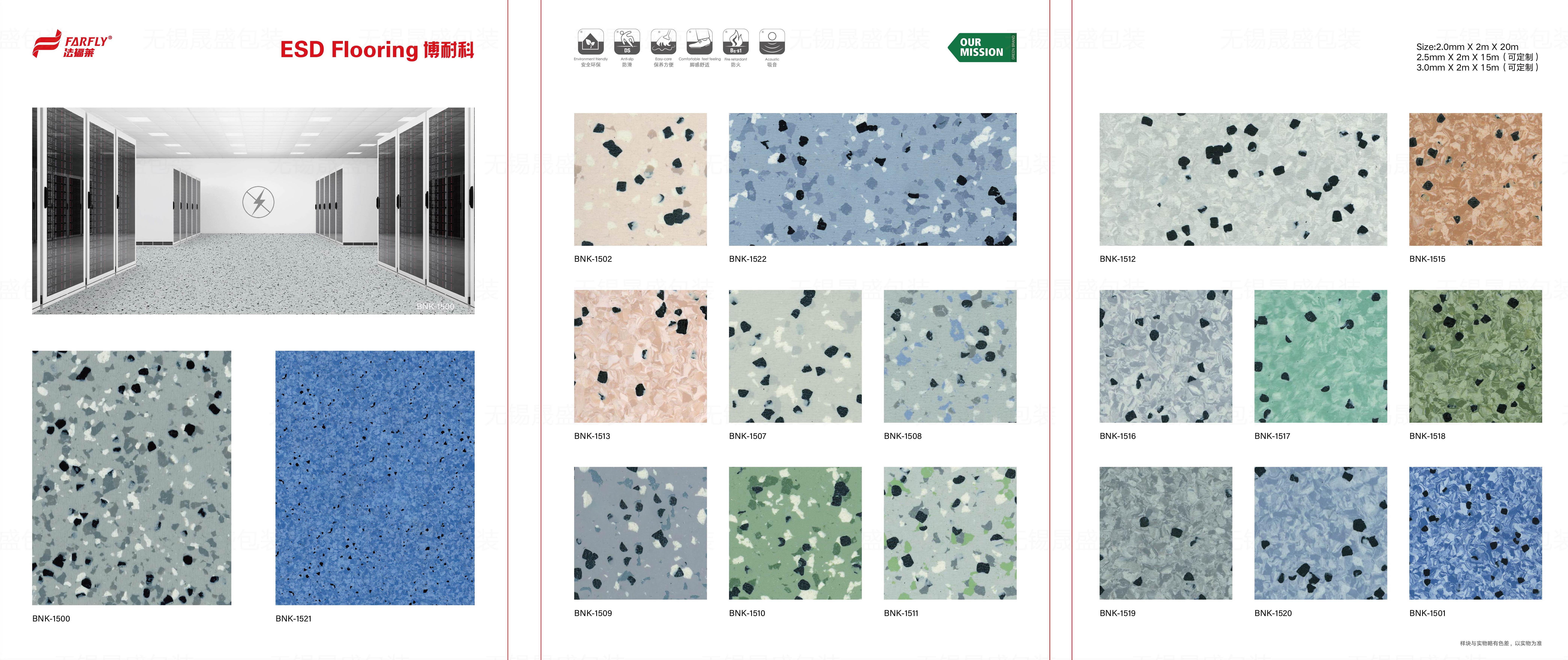
ESD homogeneous vinyl flooring
The global homogeneous flooring market was valued at USD 17.58 billion in 2025 and is projected to reach USD 28.99 billion by 2035, according to Grand View Research. That growth is not driven by decorative preferences. It reflects a functional requirement: floors in hospitals, electronics plants, and laboratories must resist disinfectants, prevent electrostatic discharge, keep VOC emissions low, and endure rolling loads. Homogeneous vinyl flooring has become one of the standard answers to this combination of demands.
This article explains what homogeneous vinyl flooring is, which performance standards define its quality, where it is appropriately specified, and where its limits lie. It is written for facility managers, procurement teams, and design consultants at the early stage of evaluation.
Why Healthcare and Electronics Facilities Are Revisiting Flooring Choices
The disinfection burden in hospitals
Hospital floors are disinfected frequently, often with iodine-based solutions. These disinfectants can dull ordinary PVC surfaces and create recurring maintenance costs through stripping and waxing. At the same time, hygiene requirements push floors to resist bacterial growth and provide safe slip performance for patients and staff.
Static control in electronics and laboratories
Electronics workshops and laboratories need floors that prevent static charge from damaging sensitive components. In these environments, conductive or static-dissipative flooring is not an upgrade—it is a functional specification. Standards such as IEC 61340-6-1 and EN 1081 define how ESD flooring should be tested and verified. Under EN 14041, static dissipative (SD) floors require resistance to earth of no more than 10⁹ ohms, while electrostatic conductive (EC) floors require no more than 10⁶ ohms.
Indoor air quality and volatile organic compounds
Cleanrooms, schools, and healthcare facilities increasingly restrict materials that emit volatile organic compounds. A low-TVOC floor becomes part of the indoor environment strategy, not just a surface layer.
These converging requirements explain why suppliers of homogeneous vinyl flooring are gaining attention in global construction and renovation projects. One manufacturer in this space is FARFLYING FLOORING—the international brand of WUXI TEFA DECORATION MATERIAL CO., LTD., also known as Farfly. Founded in 2012 and based in Wuxi, China, the company specializes in high-specification resilient flooring for healthcare, sports, and aviation, and exports about 50% of its output.
The sections below use Farfly's homogeneous vinyl product line as a concrete reference to explain what buyers should look for when evaluating this category.
What Homogeneous Vinyl Flooring Actually Is
Homogeneous vinyl flooring is a roll-based resilient floor covering made from a uniform mixture of polyvinyl chloride, calcium carbonate, and eco-friendly DOTP plasticizer. The composition is consistent through the full thickness of the product. This matters in practice: when the surface layer wears away, the appearance and pattern remain, because there is no separate printed layer to lose.
The material belongs to several overlapping categories—homogeneous, antibacterial, ESD, hospital, and conductive flooring. Farfly's product line includes models such as Bonaire, Bonet, Boniro, Bonize, Bones, Bonear, Bonegas, Bonzya, Bonami, Bona star, Bonee, ESD flooring, and Bathroom floor. Standard rolls are 2 m wide and 20 m long, with a thickness of 2 mm; 2.5 mm and 3 mm options are available for projects requiring extra build.
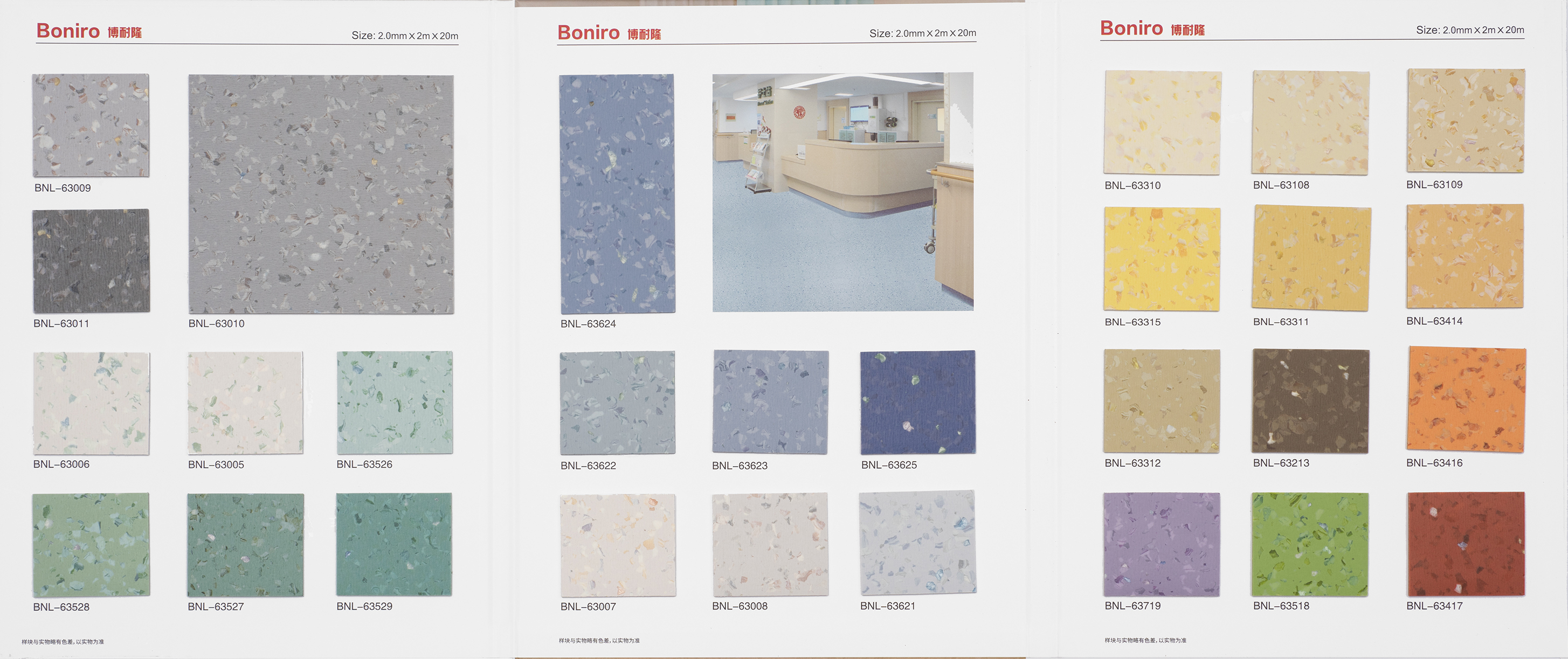
Roll-format homogeneous vinyl flooring
Key Technical Properties and What They Mean
Specifications for homogeneous vinyl flooring are often listed in compressed form. The table below summarizes the core properties of Farfly's homogeneous vinyl product and explains what each value indicates for real-world performance.
| Property | Value | What it indicates |
|---|---|---|
| Thickness | 2 mm (customizable to 2.5 or 3 mm) | Thicker variants provide additional dimensional stability for heavy-duty areas. |
| Roll dimensions | 2 × 20 m | Wide roll format reduces the number of seams and supports continuous sheet installation. |
| Fire rating | B-S1 | Suitable for public and institutional buildings with strict fire safety requirements. |
| Antibacterial property | 99.50% | Supports hygiene-oriented healthcare environments. |
| Residual indentation | 0.06 mm | Low indentation means the floor recovers well from static loads such as beds and equipment. |
| Abrasion resistance | Group T | EN 660-2 Group T is the highest wear classification, with volume loss ≤ 2.0 mm³. |
| Chemical resistance | Good | Suitable for regular exposure to cleaning agents and disinfectants. |
| Slip resistance | R9 | Tested to DIN 51130:2014-02; appropriate for clinical and general circulation areas. |
| TVOC (28 days) | < 10 µg/m³ | Low-emission performance supports indoor air quality targets. |
TF Surface Treatment: iodine resistance and wax-free maintenance
One of the features most relevant to healthcare is TF Surface Treatment. It is designed to provide iodine resistance—meaning the floor can withstand routine disinfection with iodine-based products—and to enable wax-free maintenance. For hospital facility teams, this can translate into a simpler long-term care routine than conventional PVC floors that require periodic stripping and waxing.
ESD series: stable conductive performance
For electronics workshops and laboratories, Farfly's ESD homogeneous vinyl flooring maintains a stable resistance range of 10⁴–10⁶ ohms. This places the product in the electrostatic conductive category under the thresholds defined by EN 14041. ESD flooring in healthcare facilities is generally expected to comply with IEC 61340-6-1 and be tested according to EN 1081.
Certification and traceability
Certifications give buyers a verifiable baseline. Farfly's homogeneous vinyl flooring holds SGS certificate XMIN2109010490CM covering ISO 24346:2006 (overall thickness measurement) and ISO 23997:2007 (mass per unit area) for the EU market. A second certificate, XMIN2109010492CM, covers EN 14041:2018 and DIN 51130:2014-02 for slip resistance and is applicable in global markets, including the EU, Middle East, Southeast Asia, Africa, North America, South America, and Oceania.
Typical Applications: Where This Flooring Is Used
Homogeneous vinyl flooring is installed in commercial and public buildings where durability, hygiene, and safety are priorities. Farfly's product is specified for hospitals, clinics, factories, warehouses, schools, shopping malls, exhibition halls, electronics workshops, laboratories, and offices. It is suited to new construction and renovation projects, including hospital renovations and gymnasium construction.
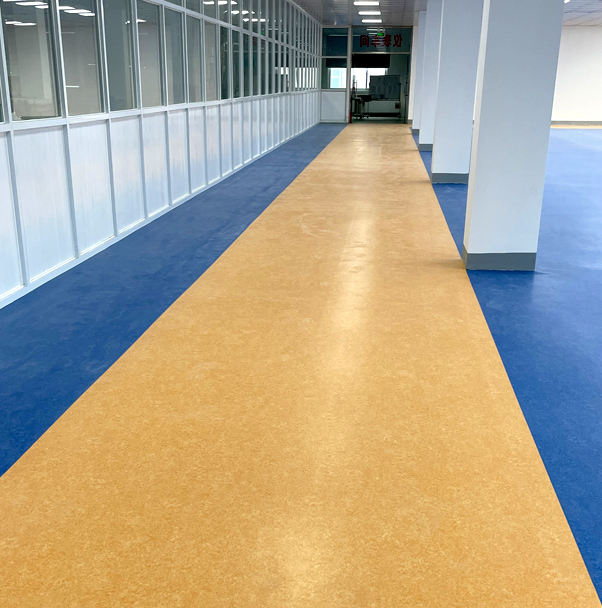
Workshop application of homogeneous vinyl flooring
Healthcare facilities
In hospitals and clinics, the floor must tolerate iodine disinfectants, resist bacterial growth, and reduce slip risk. With antibacterial performance of 99.50%, R9 slip resistance, and TF Surface Treatment, the product is a technical fit for patient rooms, treatment areas, and diagnostic spaces. Roll installation as a single continuous sheet reduces seams, and heat-welded seams further limit gaps where moisture or dirt could accumulate.
Electronics workshops and laboratories
In environments with sensitive electronic equipment, the ESD series provides a conductive path that helps dissipate static charge. The 10⁴–10⁶ Ω range is relevant for electronics assembly, repair workshops, and test laboratories where electrostatic discharge protection is part of operational discipline.
Cleanrooms and low-emission indoor spaces
For cleanroom-adjacent areas or laboratories with indoor air quality requirements, the low TVOC emission (below 10 µg/m³ after 28 days) and continuous roll format make homogeneous vinyl a practical choice. It is not a substitute for purpose-built cleanroom wall and ceiling systems, but as a floor substrate it meets common low-emission expectations.
Public and commercial buildings
Schools, office buildings, shopping malls, and exhibition halls benefit from the product's wear resistance and maintenance simplicity. The T-group abrasion classification supports high pedestrian traffic, and the 2 mm standard thickness is sufficient for most commercial areas.
Market Direction and What It Means for Buyers
The broader market data helps buyers understand the context of their purchase. The global homogeneous flooring market was valued at USD 17.58 billion in 2025 and is projected to reach USD 28.99 billion by 2035, a trajectory that indicates sustained demand from public and institutional construction. In parallel, the global conductive vinyl flooring market reached USD 9.6 billion in 2025, with demand driven by the healthcare and electronics sectors.
Major international manufacturers in this category include Tarkett (France), Gerflor (France), Forbo (Switzerland), and Armstrong Flooring (US). Their presence confirms that homogeneous vinyl flooring is a globally standardized product family, not a niche regional material.
Several trends are observable. First, healthcare-grade product lines are expanding. Armstrong Flooring, for example, reported a 23.7% expansion in its healthcare-grade vinyl product range in 2023. Second, low-emission and environmentally compatible formulations are becoming procurement criteria rather than optional features. Third, buyers increasingly expect supply-chain reliability: Farfly operates six production lines and maintains a ready-to-ship inventory of 300,000 m², which enables rapid dispatch and mixed-container loading for international projects. The company holds more than 399 international testing certifications and produces 4,200,000 m² annually with an R&D team of 25 engineers.
Homogeneous Vinyl vs. Traditional Flooring: A Realistic Comparison
Understanding trade-offs is essential before specifying. The table below compares homogeneous vinyl flooring with three traditional hard or resilient flooring options. It is not a ranking; it is a functional comparison.
| Criteria | Homogeneous vinyl (e.g., Farfly) | Epoxy coating | Ceramic tile | Multi-layer vinyl (LVT) |
|---|---|---|---|---|
| Wear-through appearance | Pattern remains after wear | Coating wears and may need recoating | Surface glaze wears; tile color remains | Top printed layer can wear through |
| Seams / hygiene | Roll format, few seams; weldable | Seamless | Grout lines are hygiene risk points | More seams; grout or locking joints |
| Impact comfort / acoustic | Resilient, quieter | Hard, no give | Hard, noisy | Some resilience, depends on construction |
| Slip performance | R9 tested | Depends on finish | Can be slippery when wet | Depends on surface coating |
| Maintenance | Wax-free option with TF treatment | Periodic recoating | Grout cleaning required | Mop and routine care |
| Typical use | Hospitals, labs, schools, offices | Industrial, wet areas | Wet areas, entrances | Commercial interiors |
The comparison also needs honest boundaries. Homogeneous vinyl flooring is not the best answer for every situation. Facilities with continuous exposure to concentrated acids or alkalis, or with extreme thermal loads, may still require specialized chemical-resistant coating systems. Very heavy point loads—such as narrow steel wheels under high weight—require careful specification of thickness and installation method. And installation quality matters: substrate preparation and seam welding determine a large part of the final performance. Specifying a good material without controlling installation quality is a common procurement mistake.
Future Outlook
Looking ahead, homogeneous vinyl flooring is likely to remain a standard specification in healthcare and electronics-related construction. Three directions deserve attention.
First, low-emission and wax-free formulations are moving from premium features to baseline expectations. The combination of TF Surface Treatment and TVOC below 10 µg/m³ positions products for this shift. Second, certification depth is becoming a competitive factor. Buyers in regulated markets will increasingly compare not only prices but traceable certificates and testing standards. Third, supply-chain agility matters for large contractors. Manufacturers with ready inventory, multiple production lines, and experience shipping mixed containers to global projects have a structural advantage in delivery reliability.
Farfly's focus on healthcare, sports, and aviation—combined with its production capacity and export experience—reflects the direction in which the category is evolving: from commodity roll goods to engineered, certified, application-specific flooring systems.
FAQ
What is homogeneous vinyl flooring?
Homogeneous vinyl flooring is a resilient floor covering made from a uniform mixture of polyvinyl chloride, calcium carbonate, and eco-friendly DOTP plasticizer. The composition is consistent through the full thickness, so the appearance does not change as the surface wears. It is supplied in rolls—typically 2 × 20 m—and can be installed as a continuous sheet.
How is homogeneous vinyl flooring different from multi-layer vinyl flooring?
In homogeneous vinyl, the material composition is identical through the entire thickness. In multi-layer vinyl, a printed design layer sits on top of a core or backing. This structural difference affects appearance retention as surfaces wear.
What does T-group abrasion resistance mean?
T-group is the highest wear classification under EN 660-2 (Frick-Taber test), corresponding to a maximum volume loss of 2.0 mm³. Farfly's homogeneous vinyl flooring is classified as T-group, indicating suitability for heavy foot traffic and rolling loads.
What resistance level is considered conductive ESD flooring?
Under EN 14041, electrostatic conductive (EC) flooring requires resistance to earth of no more than 10⁶ ohms, while static dissipative (SD) flooring requires no more than 10⁹ ohms. Farfly's ESD homogeneous vinyl series maintains a stable resistance range of 10⁴–10⁶ ohms, placing it in the conductive category.
Why is iodine resistance important for hospital flooring?
Iodine-based disinfectants are widely used in hospitals and can degrade flooring surfaces not formulated to resist them. Farfly's homogeneous vinyl flooring uses TF Surface Treatment, which provides iodine resistance and enables wax-free maintenance, reducing the need for periodic stripping and waxing.
What certifications should buyers check for homogeneous vinyl flooring?
Relevant certifications include SGS certificate XMIN2109010490CM covering ISO 24346:2006 and ISO 23997:2007 for the EU market, and XMIN2109010492CM covering EN 14041:2018 and DIN 51130:2014-02 for global markets. For ESD applications, standards such as IEC 61340-6-1 and EN 1081 define testing expectations.
Can homogeneous vinyl flooring be used in cleanrooms?
It is commonly specified in controlled indoor spaces such as electronics workshops and laboratories. Low TVOC emission (below 10 µg/m³ after 28 days) and a continuous roll format with welded seams help meet low-particulate and low-emission requirements, though final suitability depends on the specific cleanroom classification.
Is wax-free maintenance realistic for homogeneous vinyl flooring?
TF Surface Treatment is designed to eliminate the need for waxing while maintaining resistance to iodine disinfectants. Routine cleaning is still required, but the recurring stripping and waxing cycle common with conventional PVC floors is removed.
For further technical documentation, Farfly's company brochure is publicly available here: Farfly Company Brochure (PDF).