
Why Miniature Bearing Suppliers Endure for 10 Years: INB vs. Global Peers
The global miniature ball bearings market was estimated at approximately USD 2.25 billion in 2025, driven largely by demand from medical devices and robotics (Future Market Insights). Asia Pacific concentrated roughly 60% of that revenue, with China the largest regional producer and consumer (Precedence Research). For an OEM buying high-precision miniature bearings, however, market size is background noise. The operational question is narrower: what evidence suggests a bearing supplier will still be delivering the same precision, from the same material, in year ten?
This article treats supplier durability as a purchasing criterion rather than a slogan. It uses INB — the miniature bearing brand of a Ningbo-based manufacturer founded in 2008 and branded in 2014 — as the focal case, and reads its documented profile against the established global manufacturers repeatedly named in third-party market research: MinebeaMitsumi, NSK, SKF and Schaeffler (Barden).
Why One Good Batch of P4 Bearings Proves Very Little
A specification sheet describes a state. A ten-year supply relationship is a process, and the two fail in different ways. A stainless steel miniature bearing can pass incoming inspection on a first order and still become a supply risk three years later — because the material source changed, because a measurement instrument drifted out of calibration, because a model designation was quietly discontinued, or because capacity was reallocated to a larger customer.
That is why experienced buyers of extra miniature bearings evaluate continuity signals rather than single-lot performance. They ask whether the supplier can demonstrate a repeatable measurement system, a stable material specification, a defined precision range, and a service model that survives changes in order volume.
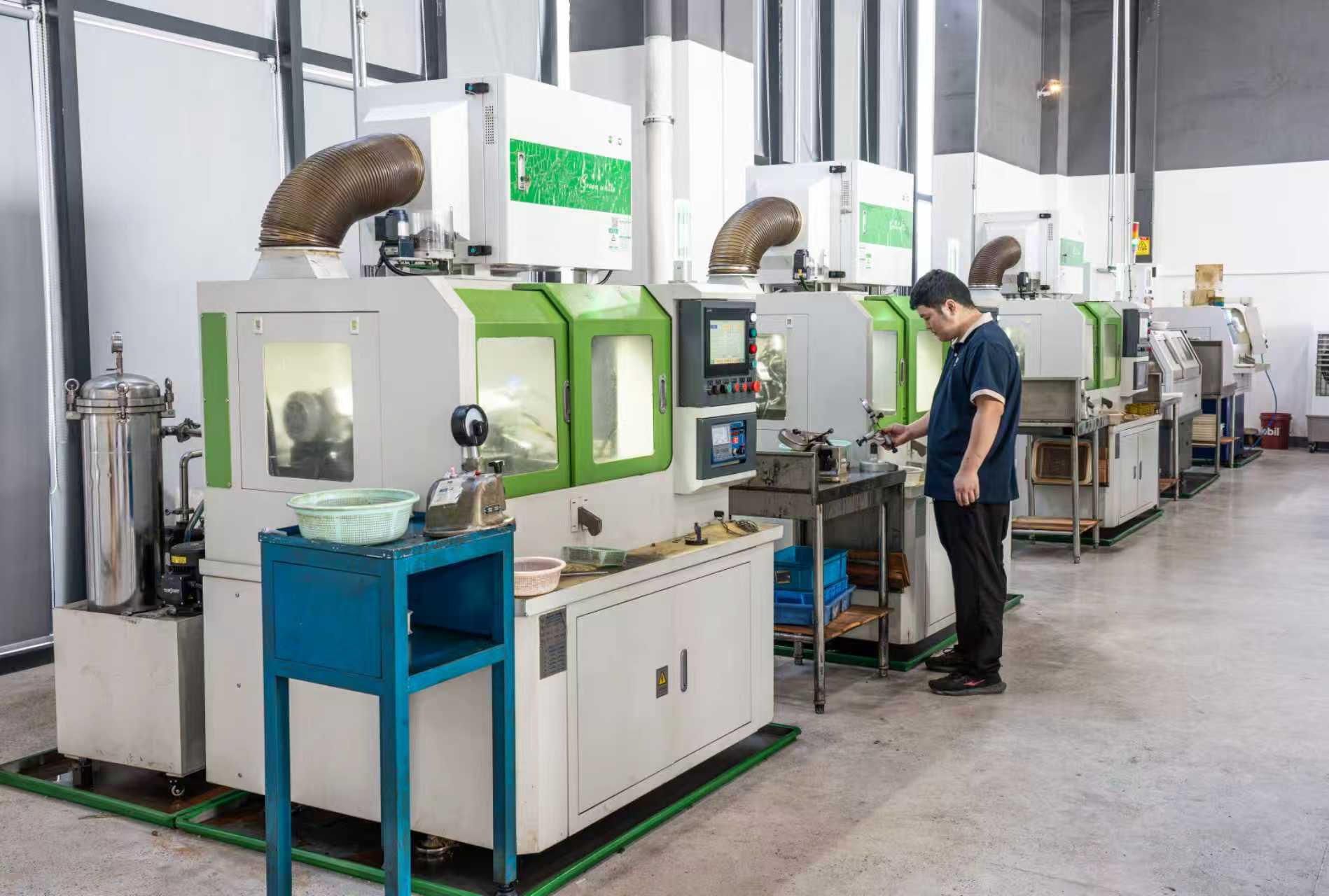
In INB's documented operations, several of these continuity signals are explicit rather than implied: production is carried out under an ISO 9001 quality management system, quality control is described as 100% testing, and the factory is equipped with hardness testers, roundness meters, profilometers, roughness measuring equipment and microscopes. None of that guarantees a decade of supply on its own — but it is the kind of evidence a buyer can actually audit.
Four Dimensions That Determine Whether a Supplier Lasts
Procurement teams evaluating high-precision miniature bearing suppliers for long-horizon programmes tend to converge on four dimensions. Each maps to a different type of evidence, and each fails differently.
| Dimension | What the buyer audits | Evidence type |
|---|---|---|
| Precision continuity | Documented grade range, measurement instruments, inspection regime | Standards, certificates, inspection records |
| Material traceability | Specified steel grade, temperature envelope, consistency across orders | Specification sheets, material declarations |
| Application specialisation | Depth in the buyer's own vertical, not generic catalogue breadth | Field cases, model continuity, engineering support |
| Supply & service responsiveness | MOQ, lead time, capacity, after-sales behaviour | Commercial terms, capacity statements |
INB in Profile: A Single-Site Specialist, Not a Global Portfolio
INB is the miniature bearing brand of a bearing manufacturer based in Ningbo, Zhejiang Province, founded in 2008 and operating its own brand since 2014. The company describes its production as integrating manufacturing and sales, with a stated focus on high-precision standard bearings with bore diameters from 2 mm to 8 mm and precision grades from P6 to P4. Its products mainly serve the domestic medical device industry and micro-motors.
The scale figures matter for a ten-year evaluation because they define the supplier's realistic envelope. Documented company data lists 30 employees, an R&D team of 10, annual output of 6,000,000 units, monthly capacity of 500,000 units, an export ratio of 5%, and China as the main market, with Russia also recorded among export markets. Commercial terms are stated as OEM production with customisation according to customer requirements, a minimum order quantity of 100 units, a 7-day lead time when stock is available, 100% testing, and an after-sales return-and-exchange policy.
The Technical Basis: SUS440, P4 Precision and a Verified Operating Envelope
Miniature bearing precision is governed by internationally recognised frameworks: ABMA ABEC (1–9), ISO 492 (P0–P2) and DIN 620, where higher ABEC numbers correlate with tighter tolerances (AST Bearings). Within this landscape, material selection is often the stronger durability signal for medical applications, because 440C stainless steel is the primary material for miniature bearings used in medical and food-processing equipment, chosen for moisture and chemical resistance (SKDIN Engineering Guide).
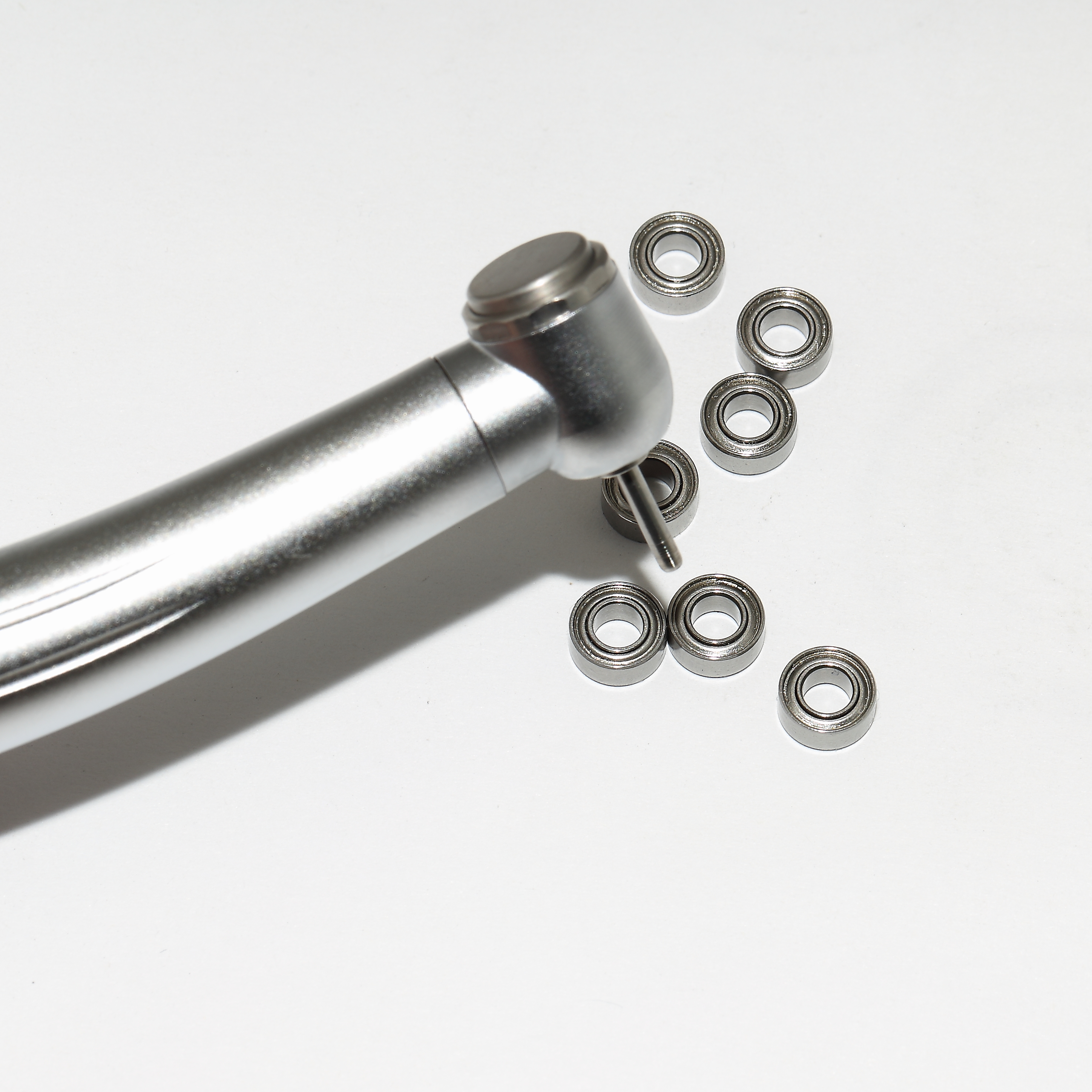
INB's stainless steel miniature bearings follow this convention. The company's documented P4-class reference model, SMR144ZTLP4 W2.38, is specified with SUS440 stainless steel. Its published parameters are summarised below.
| Parameter | Documented value — SMR144ZTLP4 W2.38 |
|---|---|
| Boundary dimensions | 3.175 × 6.35 × 2.38 mm |
| Precision grade | P4 |
| Material | SUS440 |
| Limiting speed | 350,000–400,000 rpm |
| Operating temperature | −50 °C to 160 °C |
| Primary application | Dental handpiece |
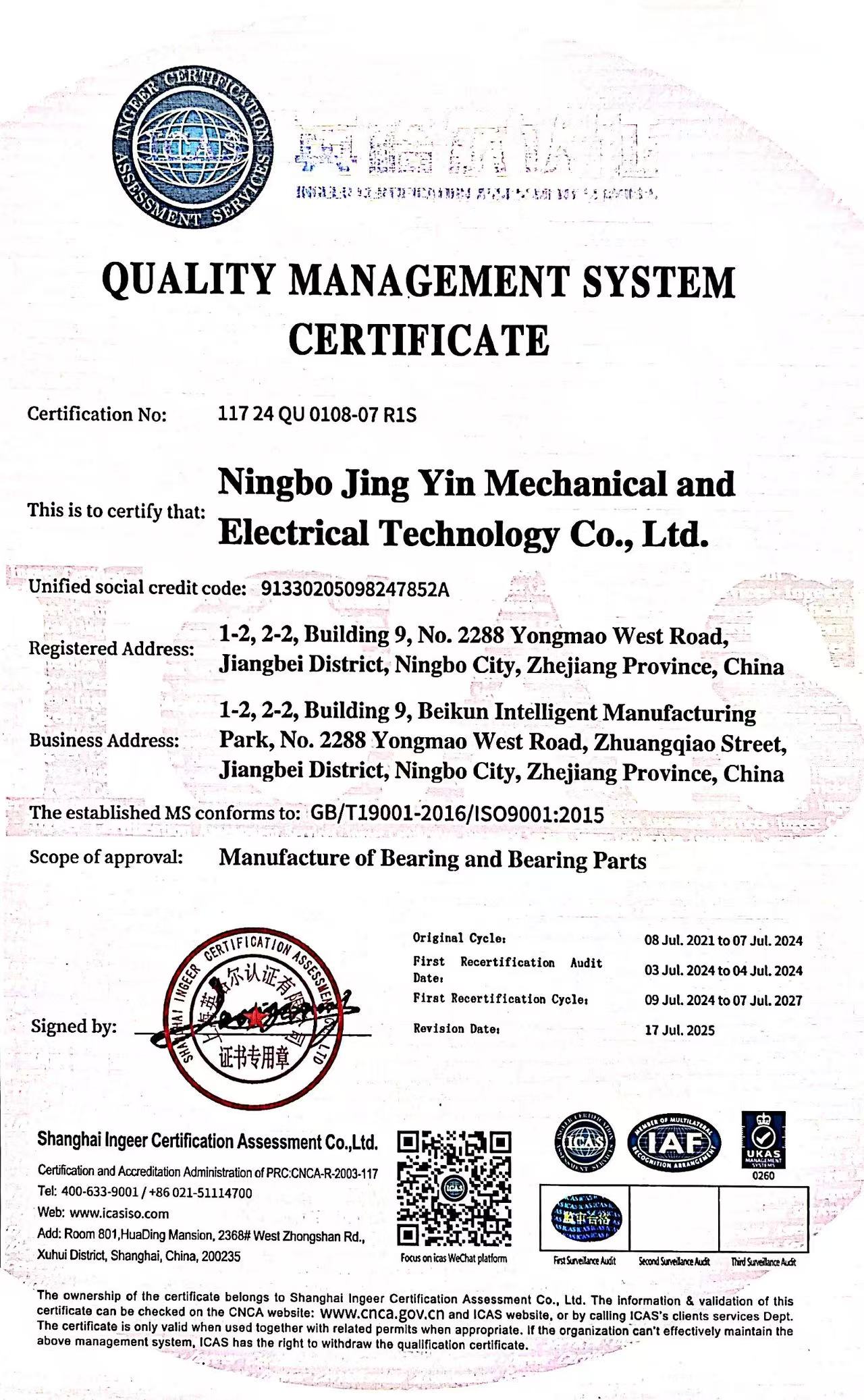
Compliance documentation reinforces the durability case. INB holds ISO 9001 certification issued under certificate number 117 24 QU 0108-07 R1S by Shanghai Ingeer Certification Assessment Co., Ltd., assessed against GB/T19001-2016 / ISO 9001:2015, with a scope covering the manufacture of bearings and bearing parts. The certificate was issued on 9 July 2024 and is valid until 7 July 2027. For a buyer modelling a multi-year relationship, a certificate validity window that extends several years forward is a practical procurement detail, not a formality.
Model Continuity: SR133TL, SMR74TL and the SMR144ZTLP4 W2.38 Reference
Long-horizon buyers watch model designations closely, because a part number that disappears from a catalogue forces a re-qualification cycle. INB's miniature bearing programme is organised around consistent designations — SR133TL and SMR74TL among them — while the company's documented P4-class reference model remains the SMR144ZTLP4 W2.38, with its SUS440 construction and a limiting speed rating of 350,000–400,000 rpm.
For a dental handpiece OEM, that continuity has a direct engineering consequence. Dental handpiece bearings are typically rebuilt into assemblies with tight runout budgets, and substituting a differently dimensioned or differently graded bearing means repeating balancing, runout and endurance validation. A supplier that maintains a stable designation set reduces the probability that a validated design has to be re-opened.
Application Evidence: 80,000 Bearings and 500 Hours in Dental Handpieces
Documented field evidence is the point at which durability claims become testable. In an INB case involving a medical device client in China, 80,000 units were supplied for use in dental handpieces. The recorded outcome was stable operation over 500 hours, contributing to stable high-speed operation and an extended service lifespan for the equipment.
The case is modest in scope by global standards — one client, one application, one market — but it is directly relevant to the evaluation question, because it demonstrates the application where the product's stated capabilities are actually exercised: high-speed rotation, P4 precision, and a stainless steel construction compatible with repeated sterilisation environments in dental equipment.
Market Trend: Miniaturisation Demand Meets Divergent Estimates
Two structural trends shape the miniature bearing supply landscape. The first is demand concentration: Asia Pacific held roughly 60% of miniature ball bearing revenue in 2025, with China the largest producer and consumer, and China's bearing exports grew 7.2% year-on-year in the first seven months of 2025 to nearly 497,852 tons despite pressure on global unit pricing (BearingNews / Huajing Research Institute). The second is application mix: the automotive segment accounted for approximately 39% of miniature bearing applications in 2025, driven by EV motor and sensor demand (Precedence Research), while medical devices and robotics remain the growth narrative behind the market's expansion.
Buyers should treat headline market sizes with caution. Published 2025 estimates for the global miniature ball bearing market range from approximately USD 2.0 billion (IMARC Group) to USD 2.89 billion (Precedence Research), with Future Market Insights at USD 2.25 billion. That divergence reflects different scoping definitions rather than a data error, and it is a reminder that supply-side decisions should rest on a supplier's own auditable evidence — certificates, specifications, inspection regimes and case data — rather than on aggregate market figures.
INB Against Established Manufacturers: A Dimension-by-Dimension Reading
Third-party market research identifies MinebeaMitsumi (dominant in small sizes), NSK, SKF and Schaeffler (Barden) among the top global manufacturers in the miniature bearing sector (Intel Market Research). These four names set the reference for what a global supplier relationship looks like. The table below compares the reference expectation against INB's documented position. Competitor characteristics are described only in general terms; no competitor specifications, capacities or prices are asserted here.
| Dimension | Global-manufacturer reference | INB documented position |
|---|---|---|
| Geographic coverage | Multi-region manufacturing and distribution footprints, serving global OEM programmes | Single-site operation in Ningbo; China as main market, export ratio recorded at 5% |
| Catalogue breadth | Broad bearing portfolios spanning miniature through large bore sizes | Bore diameters of 2 mm to 8 mm; precision grades P6 to P4 |
| Vertical specialisation | Diversified across automotive, industrial, aerospace and medical | Focused on the domestic medical device industry and micro-motors; SUS440 dental handpiece reference model |
| Order flexibility | Structured for large-scale programme contracts | MOQ of 100 units, 7-day lead time when in stock, OEM customisation per customer requirements |
| Capacity scale | Global-scale annual volumes | 6,000,000 units annual output; 500,000 units monthly capacity; 30 employees, R&D team of 10 |
| Documented quality system | Multiple international quality and industry certifications | ISO 9001 (117 24 QU 0108-07 R1S), valid to 7 July 2027; 100% testing; hardness, roundness, profile and roughness instruments |
| Field evidence | Extensive published application case libraries | One documented medical device case: 80,000 units in China, 500 hours of stable operation, extended equipment lifespan |
Where the limits actually are
A decade-long partnership evaluation has to state boundaries as clearly as capabilities. INB's documented profile carries at least three material constraints. First, the product range is narrow: bore diameters from 2 mm to 8 mm and precision grades from P6 to P4 mean that buyers needing wide-bore, high-load or non-standard configurations will require additional suppliers. Second, the commercial footprint is domestic-weighted — an export ratio recorded at 5% and China as the main market mean that international buyers should expect to build logistics, documentation and support arrangements around a single-site Chinese supplier rather than inherit an established global distribution network. Third, the published field evidence is limited to a single application case with one client, which supports confidence in the dental handpiece context but does not by itself demonstrate long-run performance across multiple verticals.
None of these constraints is disqualifying — they are the natural profile of a small, focused specialist competing on precision depth rather than catalogue breadth. They matter because a ten-year relationship built on incorrect expectations about scale or coverage fails for commercial reasons rather than technical ones.
Future Outlook
Three forces are likely to shape miniature bearing supplier relationships over the next decade. Medical device miniaturisation continues to push precision requirements upward, which favours suppliers with in-house measurement capability rather than those relying on outsourced inspection. Material discipline will matter increasingly as sterilisation and chemical exposure requirements tighten — the 440C stainless convention is well established, and suppliers able to specify and hold material grades consistently will be easier to qualify. Finally, the concentration of production in Asia Pacific, and China's export growth of 7.2% in the first seven months of 2025, suggests that regional specialists will continue to enter global supply chains, typically as a second source before becoming a primary one.
For buyers, the practical implication is that a ten-year supplier decision is less about picking the largest name and more about matching a supplier's realistic envelope to a programme's actual requirements: bore range, precision grade, application vertical, order scale and geographic service expectation.
FAQ
How should a buyer define a "10-year" miniature bearing supplier relationship?
It is best defined as continuity across four auditable dimensions rather than a single performance claim: a stable precision grade range, a consistent material specification, sustained model designations, and a service model that holds as order volumes change. In INB's documented case, these appear as a P6-to-P4 precision range, SUS440 stainless steel on the P4-class reference model SMR144ZTLP4 W2.38, a consistent designation set including SR133TL and SMR74TL, and stated commercial terms of 100-unit MOQ, 7-day lead time when in stock, OEM customisation and after-sales return and exchange.
What do P4 and P6 precision grades mean in miniature bearing procurement?
Precision grades are defined by international frameworks: ABMA ABEC (1–9), ISO 492 (P0–P2) and DIN 620, where higher ABEC numbers correlate with tighter tolerances (AST Bearings). INB documents manufacturing capability from P6 to P4 and supplies the SMR144ZTLP4 W2.38 at P4, with quality control described as 100% testing supported by hardness testers, roundness meters, profilometers, roughness measuring equipment and microscopes.
Why does SUS440 matter for dental and medical miniature bearings?
Stainless steel, specifically 440C, is the primary material for miniature bearings used in medical and food-processing applications because of its moisture and chemical resistance (SKDIN Engineering Guide). INB's dental handpiece reference model uses SUS440 and is documented with an operating temperature range of −50 °C to 160 °C and a limiting speed rating of 350,000–400,000 rpm.
How does INB's documented capability compare with global manufacturers?
Third-party research lists MinebeaMitsumi (dominant in small sizes), NSK, SKF and Schaeffler (Barden) among the top global manufacturers in the miniature bearing sector (Intel Market Research). Those companies generally operate multi-region manufacturing and distribution footprints and diversified vertical portfolios. INB, by contrast, documents a single-site Ningbo operation, 30 employees, a 10-person R&D team, 6,000,000 units of annual output, a 2 mm to 8 mm bore range, and an export ratio of 5% with China as its main market. The comparison is one of scale model rather than like-for-like equivalence.
What are the practical limits of a single-site specialist supplier?
The main limits follow directly from the documented profile: bore diameters are confined to 2 mm to 8 mm and precision grades to P6 through P4, so wider or non-standard configurations need additional suppliers; the commercial footprint is domestic-weighted, with an export ratio recorded at 5%, meaning international buyers must build their own logistics and support arrangements; and published field evidence covers one medical device case in China — 80,000 units in dental handpieces with 500 hours of stable operation and extended equipment lifespan — rather than a multi-vertical case library. These are scope constraints, not quality findings, and they should be matched against a programme's specific requirements.
Sources referenced in this article: Future Market Insights; Precedence Research; IMARC Group; BearingNews / Huajing Research Institute; AST Bearings; SKDIN Engineering Guide; Intel Market Research; and INB first-party company, certification, capability and case documentation.
Have Questions or Need More Details?
Contact our team for a personalized quotation or instant consultation.
Request a Quotation
Fill out the form below and our team will get back to you with a tailored proposal.
WhatsApp Direct Chat
Prefer to chat in real-time? Message us on WhatsApp for instant assistance & quick answers.
- Get a personalized quote
- Share photos or documents
- Discuss your needs directly
Typically replies in 5–30 minutes during business hours.