
Why RFH Steel S420 Dominates Formwork Frames: A Supply Chain Capability Proof
Formwork panels are bought on price and judged on pressure. The steel grade inside the frame, and not the plywood face bolted to it, decides how tall a wall can be poured in a single lift, how flat the finished concrete comes out, and how many cycles a panel survives before it is scrapped. That is why a material specification such as RFH Steel S420 has moved out of the engineering file and into the procurement conversation: it is one of the few supplier claims that can be checked, compared and repeated on the next order.
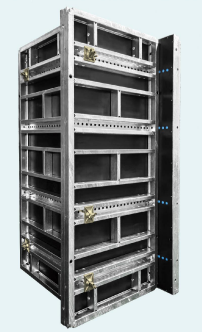
Heavy-duty wall formwork: the steel frame, not the plywood face, sets the permissible concrete pressure of the panel.
The Frame, Not the Panel, Sets the Ceiling on a Concrete Pour
Two formwork panels can look almost identical in a site photograph and behave completely differently under load. The difference usually sits in the frame: the steel grade, the wall thickness of the profile, and the surface treatment applied to it. Three performance limits follow directly from those choices.
- Permissible concrete pressure. Fresh concrete behaves as a fluid until it sets, and the pressure it exerts rises with pour rate, lift height and concrete temperature. A frame rated for up to 80 kN/m² tolerates a faster, taller lift than a frame rated at 60 kN/m² without the panel deflecting beyond what the specification allows. In the RFH steel range that distinction is published directly: the FW00A heavy-duty panel carries a permissible concrete pressure of up to 80 kN/m², while the FW00B light-duty panel is rated at 60 kN/m².
- Deflection and wall geometry. Wall flatness is decided while the concrete is still plastic. If the frame bends between tie points, the finished surface inherits that movement, and the correction is paid for later in plastering, filling or rework. Frame stiffness, not the plywood face, is what keeps a wall inside its dimensional tolerance.
- Corrosion and reuse. Formwork frames are stripped, stacked, transported and stored outdoors between pours. On humid, coastal or rainy sites, unprotected steel corrodes at the edges and inside closed sections, which shortens the service life of the most expensive part of the panel. Hot dip galvanizing is the standard answer, and it is the reason a formwork frame can be treated as a reusable asset rather than a consumable.
None of those three limits can be judged from a product photograph. They have to be stated by the supplier, matched to the pour, and then confirmed again on the next delivery. That is the point at which a material specification becomes a supply chain test rather than a technical detail.
What RFH Steel S420 Is, and Where It Sits in the Range
RIZHAO FENGHUA SCAFFOLDINGS CO., LTD. (RFH) is a manufacturer of concrete formwork and scaffolding systems based in Rizhao City, Shandong Province, China. Established in 1953, the company exports its entire output to international markets including the EU, the USA, Australia and South America, and states that it produces ten types of formwork across more than 80 specifications. RFH also states that its steel heavy-duty formwork is compatible with PERI TRIO, HUNNEBECK RASTO, DOKA FRAMI and TOPEC HARSCO systems.
RFH Steel S420 is the frame material named in the product documentation for the company's steel formwork models. It is the specified material for the FW00A heavy-duty wall, column and corner formwork, for the FW00B light-duty steel wall and column formwork, and for the FW00C wall formwork supplied with birch plywood or PP board. S420 is a high-strength structural steel designation rather than a general-purpose mild steel: it is selected where the frame has to hold a pressure ceiling without either deforming under load or becoming so heavy that it can no longer be handled on site.
The distinction matters because a steel grade is a supply chain statement as much as a structural one. Holding a consistent high-strength frame profile requires controlled cold forming, controlled welding, and a coating process that reaches the inside of closed sections. RFH states that its welding is controlled in accordance with the European standard EN1090 and that it holds the corresponding certificate, that its product acceptance criteria follow the international standards BS1139 and EN74, and that it holds 22 related certificates across the range, including EN 1065, EN74 and CE.
The Three Steel Profiles Behind the FW00A, FW00B and FW00C Frames
The RFH steel formwork range is not one panel offered in three sizes. Each model uses a different frame profile, and each profile is matched to a different pressure and handling duty.
| Model | Typical application | Frame material | Frame profile | Permissible concrete pressure | Surface treatment | Panel face |
|---|---|---|---|---|---|---|
| FW00A | Heavy-duty wall, column and corner formwork | RFH Steel S420 | 120 x 60 x 2.5 mm | Up to 80 kN/m² | Hot dip galvanized | 18 mm European birch plywood or plastic composite sheet |
| FW00B | Light-duty steel wall and column formwork | RFH Steel S420 | 121 x 20 x 1.8 mm | 60 kN/m² | Hot dip galvanized | 15 mm film faced birch plywood |
| FW00C | Wall formwork with birch plywood or PP board | RFH Steel S420 | 91.6 x 20 x 2 mm | Not published in the product specification | Hot dip galvanized | Birch plywood or PP board |
The 120 x 60 x 2.5 mm profile on the FW00A is a deep, closed box section, which is what allows that model to carry a permissible concrete pressure of up to 80 kN/m² while remaining a modular panel that can be assembled and stripped by hand or by crane. The 121 x 20 x 1.8 mm profile on the FW00B is a lighter, shallower frame intended for the 60 kN/m² duty, where total panel weight and manual handling matter more than the maximum pressure ceiling. The 91.6 x 20 x 2 mm profile on the FW00C sits between them in depth and is offered with either birch plywood or a PP board face, giving buyers a choice of concrete finish and face-life economics without changing frames.
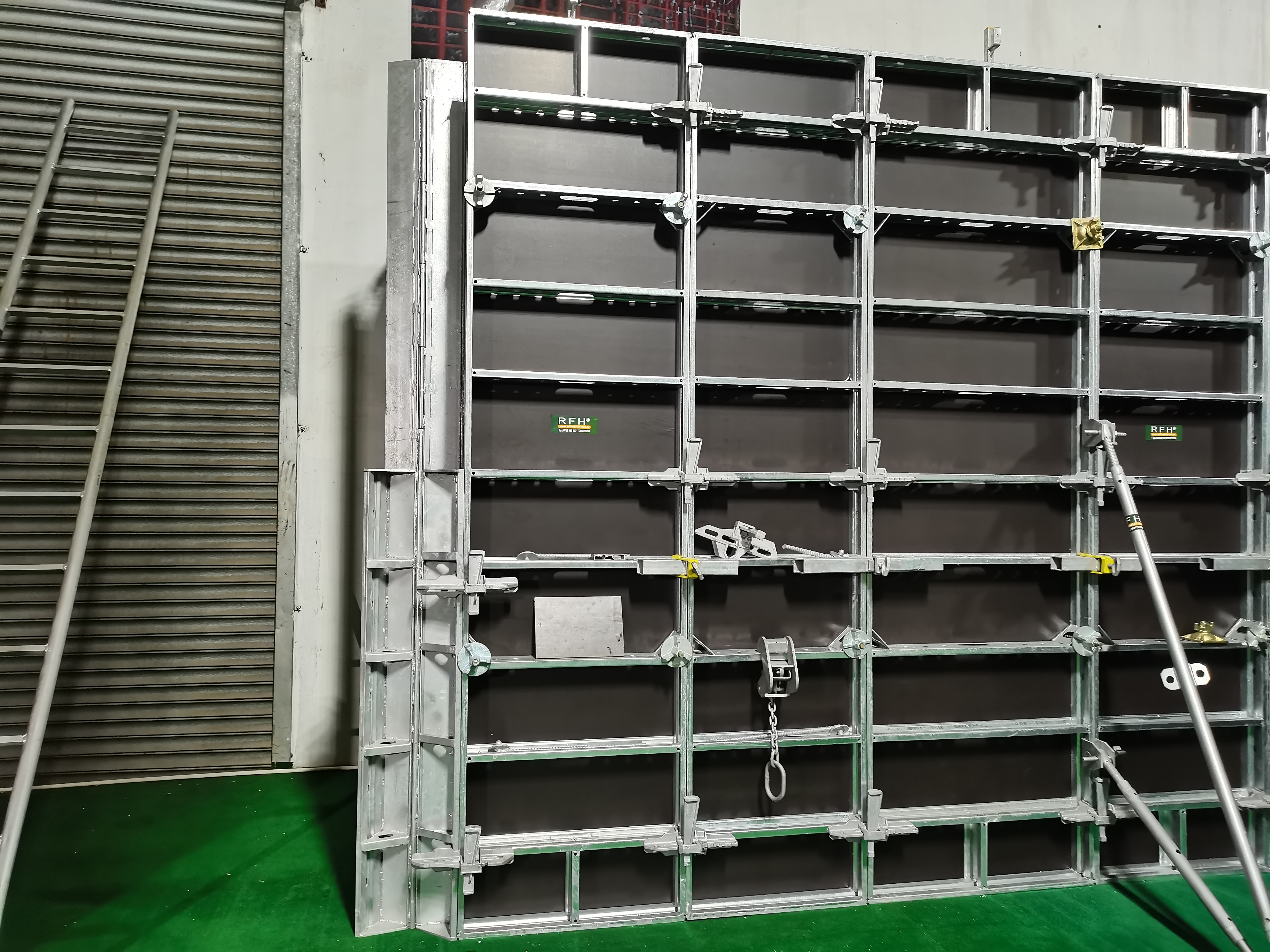
FW00B light-duty steel formwork: a 121 x 20 x 1.8 mm hot dip galvanized S420 frame rated at 60 kN/m².
Panel formats follow the same logic. FW00A is offered in heights of 3.3 m, 3 m, 2.7 m, 2.4 m, 1.2 m and 0.6 m with widths from 2.4 m down to 0.3 m. FW00B is supplied in heights of 3 m, 2.7 m, 1.5 m and 1.2 m with widths from 2.4 m down to 0.2 m. FW00C is produced in 1200 x 900/750/600/450/300 mm, 1500 x 900/750/600/450/300 mm, 2700 x 900/750/600/450/300 mm and 3000 x 900/750/600/450/300 mm formats. Other sizes are available, and RFH offers OEM and ODM supply with customization of height, width, colour and logo printing. The overlapping size logic means a wall can usually be assembled from standard panels before any custom frame is introduced, which keeps lead time and tooling cost down.
For contrast, the FW00D aluminium deck formwork uses a different material logic altogether: a 6005-T6 aluminium alloy frame with an 11 mm Baltic birch plywood deck bonded with phenol-formaldehyde resin, offered in panels up to 1800 x 1800 mm and intended for flat and inclined slabs, ramps and drains with an inclination of up to 8%. Aluminium is not a substitute for a 120 x 60 x 2.5 mm steel frame. It is a different tool for a different duty, and treating the two as interchangeable is one of the more common specification errors in formwork procurement.
Hot Dip Galvanizing and the Economics of Reuse
Every steel model in the range, FW00A, FW00B and FW00C, is finished with hot dip galvanizing. The treatment is applied to the frame as a whole rather than as a paint coat, and it is the main reason a steel formwork frame can be cycled, stored and reused across projects instead of being replaced after a small number of pours. RFH describes the galvanized steel frame as designed for long service life and high numbers of reuses, and states that panels can be handled manually on small jobs or lifted by crane for larger ones.
The practical consequences for a buyer are twofold. First, corrosion resistance is what allows steel formwork to be specified for outdoor sites with high humidity and repeated wet-dry cycles, which is the working condition RFH identifies for its wall formwork systems. Second, coating integrity becomes a maintenance item rather than a one-off factory decision. Galvanizing is a sacrificial coating: deep impact damage, gouges from stripping, and unprotected cut edges all reduce local protection, and frames stored in contact with standing water deteriorate faster than frames stacked on dunnage under cover. A buyer evaluating a reused fleet should therefore ask how the frame is protected during transport and storage, not only what the factory applied before shipment.
Where High-Pressure Steel Formwork Is Actually Used
The duty profile published for this class of wall formwork is specific: high-rise residential, commercial infrastructure and heavy civil construction, on outdoor sites exposed to extreme weather, high humidity and high concrete pour pressures. Typical project types include new structural builds, large foundations, high-wall vertical casting and subterranean concrete structures, where the formwork has to provide rigid structural containment, define precise wall geometry and hold dimensional control while the concrete cures.
The operating pattern is cyclic rather than static. Panels are assembled into modules, by hand for smaller areas and crane-assisted for larger ones; concrete is poured in sequence; the formwork is stripped mechanically once the concrete has gained sufficient strength; and the panels are repositioned for the next lift. That cycle depends on matched equipment: formwork tie rods, alignment struts, wing nuts, clamps, push-pull shores, crane lifting hooks and concrete vibrators. The system requirements that follow are high load capacity, strict deflection limits, corrosion resistance, and modular locks that remain reliable after repeated use.
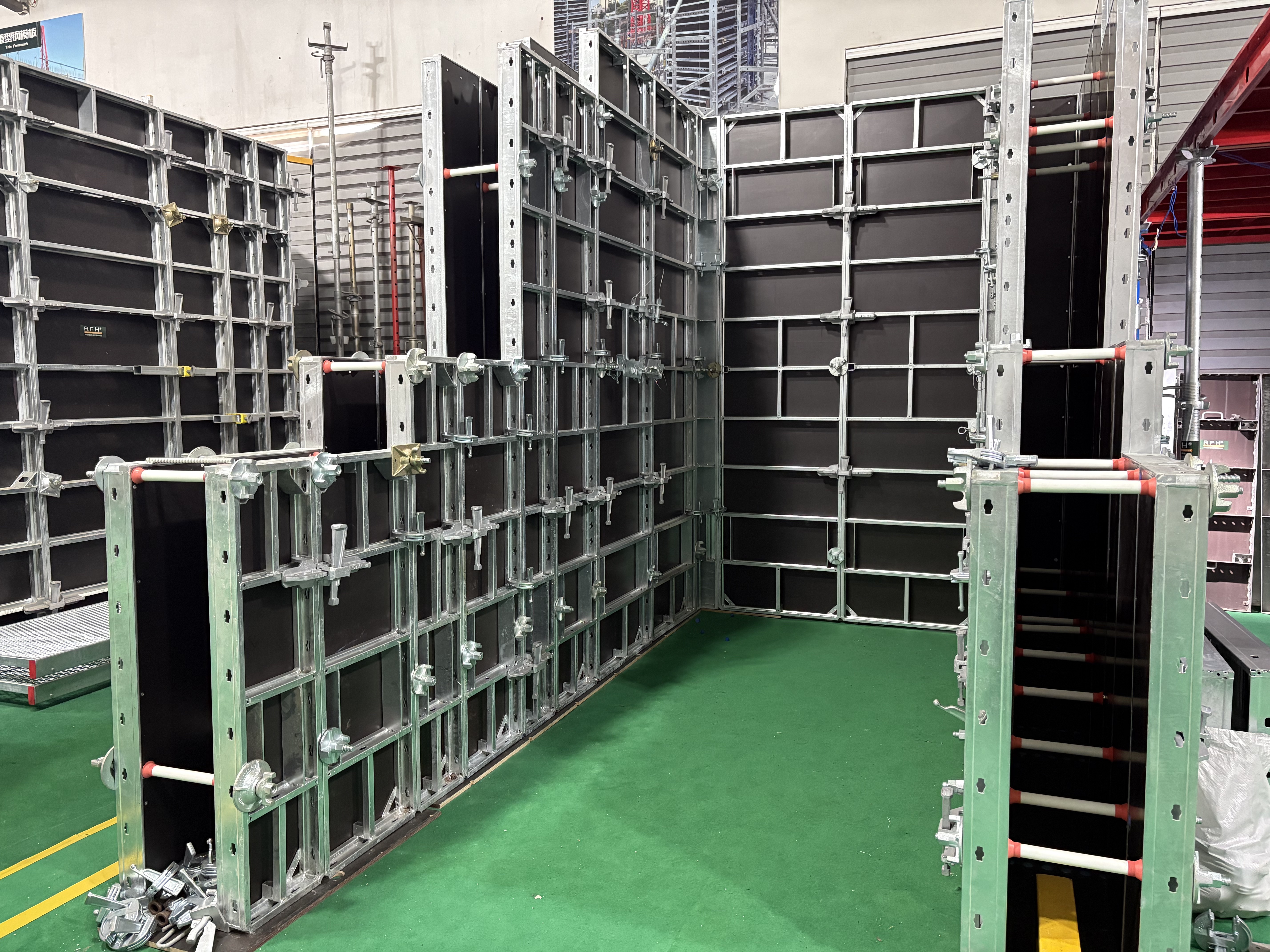
FW00C wall formwork uses a 91.6 x 20 x 2 mm S420 profile with a hot dip galvanized finish and a selectable plywood or PP board face.
Geographically, this application profile is common across Europe, the Americas, the Middle East, Africa and Oceania. RFH lists markets including the United Arab Emirates, Argentina, Austria, Australia, Belgium, Bulgaria, Brazil, Canada, Chile, Colombia, Germany, Denmark, Algeria, Spain, Finland, France, the United Kingdom, Croatia, Hungary, Ireland, Israel, Iceland, Italy, Jamaica, Mexico, Nigeria, the Netherlands, Norway, New Zealand, Peru, Poland, Portugal, Qatar and Russia.
What the Market Data Says About Steel Formwork Demand
Third-party market research gives useful context for why frame material has become a purchasing criterion rather than a technical footnote.
- The global concrete formwork market was valued at USD 8.9 billion in 2024 (Verified Market Research).
- Asia-Pacific held 54.7% of that market in 2025 (Fortune Business Insights), which places a large share of global formwork manufacturing capacity in the same region as RFH.
- Steel formwork represented 44% of all formwork units installed worldwide in 2024, ahead of timber at 37% and aluminium at 19% (Cognitive Market Research).
- In 2024, automated climbing formwork systems accounted for 28% of all installations, mainly in buildings over 50 storeys, according to an industry analysis report published by Cognitive Market Research.
- The top five formwork manufacturers, including PERI and Doka, hold approximately 44% of the global market share (Cognitive Market Research), leaving a substantial portion of the market served by specialised regional manufacturers.
- China's steel product exports, which include structural components for formwork, reached 110.7 million tons in 2024 (China Customs).
Two signals are worth separating. Steel's 44% installed share confirms that steel frames remain the default for high-pressure wall and column work, especially where reuse is expected over many cycles. The market concentration figure tells a different story: with the five largest manufacturers holding roughly 44% of the market, more than half of global demand is met by other suppliers, and the differentiator between them is rarely the shape of the panel. It is whether the frame material, profile and coating are documented and repeatable.
Instrumentation is moving in the same direction. Doka introduced DokaXact sensors in 2024 for real-time monitoring of concrete pressure on formwork, an indication that the industry is shifting from assumed pressure toward measured pressure. Once pour pressure is measured rather than estimated, the permissible pressure rating printed on a panel stops being a marketing line and starts being a number that either holds up on site or does not.
Steel vs Timber vs Aluminium, and Where Steel Stops Being the Right Answer
Material comparisons are often written as a ranking. In practice they are a trade-off, and the honest version of that trade-off names the conditions under which each material wins.
| Criterion | Steel frame formwork (FW00A / FW00B) | Timber formwork | Aluminium formwork (FW00D) |
|---|---|---|---|
| Share of global installed units, 2024 | 44% (steel, all types) | 37% | 19% |
| Benchmark cost, 2024 | USD 25-60/m² for large projects | USD 10-25/m² rental | USD 40-75/m² |
| Published pressure ceiling in this range | Up to 80 kN/m² (FW00A); 60 kN/m² (FW00B) | Not published in comparable form | Not published in comparable form |
| Handling | Manual for small jobs; crane-assisted for larger assemblies | Light components, labour-intensive assembly | Light enough for manual handling of large panels |
| Corrosion strategy | Hot dip galvanized frame | Depends on timber treatment and edge sealing | Aluminium alloy frame with bonded plywood deck |
| Typical best fit | High-pressure wall and column pours, heavy civil, foundations, high-wall casting | Low-rise and irregular geometries, short-run or one-off work | Repetitive slab cycles and high-rise floor plates |
The row that matters most in a procurement review is the last one. Steel is not the answer to every formwork problem. Where floor plates repeat and crane time is the binding constraint, aluminium systems are widely reported to achieve floor cycles as fast as four to five days in high-rise construction (Intel Market Research), and an aluminium panel light enough for one worker to carry changes labour planning on a tight programme. Steel frames carry more mass, and that mass is part of the price paid for the higher pressure ceiling.
Boundaries that should be stated openly
- The FW00B is not a substitute for the FW00A. A panel rated at 60 kN/m² should not be placed into a pour designed around the 80 kN/m² ceiling of the FW00A, even where the two share a common accessory family and similar panel geometry.
- A panel rating is not a system approval. The 80 kN/m² figure describes the permissible pressure on the panel. Tie-rod spacing, pour rate, bracing, concrete temperature and vibration still govern the actual load on the assembly, and falsework design principles of the kind set out in EN 12812 continue to apply.
- Galvanizing is protective, not indestructible. Impact damage and cut edges reduce local corrosion protection and should be inspected and treated as part of fleet maintenance.
- Weight is a real cost. Steel panels need crane assistance for larger assemblies; projects without crane availability at the right moment may be better served by a lighter system.
From Material Claim to Supply Chain Proof: Production, Testing and Certification
A steel grade claim is only as good as the process behind it. RFH's stated production base includes a factory area of 80,000 m² with a built workshop area of 40,000 m² and 260 employees, organised into more than ten production workshops covering cold bending, punching, welding, steel casting, electrostatic spraying and forging. The equipment base listed by the company includes four cold bending forming machines, twelve welding robots, six automatic welding assembly lines, one formwork profile forming assembly line and five semi-automatic forging assembly lines, with the workshops operating at automated or semi-automated level.
Testing is handled in-house. RFH operates a mechanical test laboratory and a chemistry test laboratory, which the company states are used to investigate and test purchased raw materials and products during production. Quality management is controlled under the ISO9001 system, and product acceptance criteria follow the international standards BS1139 and EN74.
The certification position is documented. The ISO 9001:2015 certificate held by RFH carries certificate number 00123Q310174R301, was issued by the China Quality Certification Centre (CQC) against GB/T 19001-2016 / ISO 9001:2015 on 11 December 2023, and is valid to 14 January 2027. Its scope covers the design and production of scaffolding, coupler and formwork for the global market, and the company states that formwork models FW00A, FW00B, FW00C and FW00D are covered. With EN1090 welding certification, CE marking and standards including EN 1065 and EN74, RFH states that it holds 22 related certificates across its range.
Commercial terms matter as much as certificates when a project is running to programme. RFH offers OEM, ODM and customized product supply, with customization of height, width, colour and logo printing; a monthly capacity of 1,000 tons; a lead time of 40 to 60 days; a minimum order quantity of 50 units; quality control based on 100% pre-shipment testing plus third-party inspection (SGS); and online technical support after delivery.
One documented RFH case covers municipal government and engineering contractor clients in residential and infrastructure applications, with 10,000 m² supplied against a project recorded under Germany and 1,500 m² under Singapore. RFH reports that the structural concrete phase was completed 20 days ahead of schedule, with lower crane rental and labour costs, and that the work met strict on-site safety regulations through integrated walkway brackets and certified crane lifting hooks. As with any single-source case record, supplier-reported outcomes are best verified against project documentation during evaluation.
Boundaries to Confirm Before an Order
Six checks turn the material claim above into a verifiable purchase decision.
- Pressure ceiling transfer. Confirm in writing which model, and therefore which profile, is quoted against each pour. FW00A at up to 80 kN/m² and FW00B at 60 kN/m² are different products, not different line items.
- Accessory compatibility at component level. RFH states that FW00A accessories are fully compatible with the original European TRIO system. Compatibility should still be verified clamp by clamp and tie rod by tie rod for the specific assembly being ordered.
- Face material selection. FW00A can be supplied with 18 mm European birch plywood or a plastic composite sheet; FW00B uses 15 mm film faced plywood; FW00C is offered with birch plywood or PP board. The face governs the concrete finish and the face replacement interval, not the pressure rating.
- Coating and storage plan. Ask how frames are protected in transit and on site, and how damaged galvanizing will be treated during the asset's life.
- Programme fit. A 40 to 60 day lead time and a 50 unit minimum order quantity have to be planned against the pour schedule, not discovered after award.
- Aluminium where appropriate. Where floor cycles dominate and crane time is scarce, the FW00D aluminium deck system may be the more efficient specification even though it carries no equivalent published pressure rating.
Future Outlook
Three directions look likely to shape the next buying cycle for steel formwork frames.
Measured pressure instead of assumed pressure. The introduction of DokaXact sensors in 2024 for real-time monitoring of concrete pressure on formwork points toward a market where pour data is captured and compared. Suppliers that publish a verifiable pressure ceiling, and can support it with frame material and profile documentation, are better positioned than those that publish a general capability statement.
Traceability from steel coil to galvanized frame. EN 12812 specifies performance requirements and general design for falsework used to support formwork, and ASTM C1074 remains the primary US standard for estimating concrete strength to determine when formwork can be removed. Both place a premium on documented material data and controlled processes, which favours manufacturers with in-house forming, welding and test laboratories over assemblers that buy finished frames.
Reuse economics as the deciding metric. With steel holding 44% of global installed formwork units in 2024 and Asia-Pacific holding 54.7% of the market in 2025, the competitive question is shifting from first-purchase price to cycles per frame. Benchmark pricing of USD 25 to 60 per square metre for steel formwork on large projects only makes sense if the frame is reused enough times to spread that cost, and reuse is a function of steel grade, profile stiffness and coating quality rather than of the panel face.
Reference document. RFH publishes its full formwork and scaffolding specification catalogue, covering product formats, materials and accessories, as a downloadable PDF: RFH New Catalogue (PDF).
FAQ
What is RFH Steel S420 in concrete formwork?
S420 is the structural steel grade specified as the frame material in RFH's steel formwork models. It appears in the product documentation for the FW00A heavy-duty wall, column and corner formwork, the FW00B light-duty steel wall and column formwork, and the FW00C wall formwork supplied with birch plywood or PP board. It is described in the specification as a high-quality, high-strength raw material chosen so that the frame holds its pressure ceiling without deforming under concrete load.
What concrete pressure can RFH steel formwork withstand?
Published permissible concrete pressures differ by model. The FW00A carries a permissible concrete pressure of up to 80 kN/m². The FW00B is rated at 60 kN/m². No comparable pressure figure is published for the FW00C in the product specification. The rating describes the panel; the load on the assembled system is also governed by tie-rod layout, pour rate, bracing and concrete temperature.
Which frame profiles are used across RFH steel formwork models?
Three steel profiles appear in the range: 120 x 60 x 2.5 mm for the FW00A heavy-duty panels, 121 x 20 x 1.8 mm for the FW00B light-duty panels, and 91.6 x 20 x 2 mm for the FW00C wall formwork. All three are produced in S420 steel and finished with hot dip galvanizing. The aluminium FW00D deck system uses a different frame material entirely, a 6005-T6 aluminium alloy with an 11 mm Baltic birch plywood deck.
Is RFH concrete formwork certified?
RFH holds ISO 9001:2015 certification, certificate number 00123Q310174R301, issued by the China Quality Certification Centre (CQC) against GB/T 19001-2016 / ISO 9001:2015 on 11 December 2023, valid to 14 January 2027. The certification scope covers the design and production of scaffolding, coupler and formwork for the global market, and the company states that models FW00A, FW00B, FW00C and FW00D are covered. RFH also states that its welding is controlled in accordance with European standard EN1090, that acceptance criteria follow BS1139 and EN74, and that it holds 22 related certificates including EN 1065, EN74 and CE.
How does hot dip galvanizing affect formwork reuse?
Hot dip galvanizing is applied to the FW00A, FW00B and FW00C frames as a whole rather than as a paint coat, and it is the treatment behind the corrosion resistance and reusability claimed for these systems. It supports use on outdoor sites with high humidity and repeated wet-dry cycles. It is a sacrificial coating, however: deep impact damage, gouges sustained during stripping and unprotected cut edges reduce local protection, so storage practice and damage repair affect how many cycles a frame actually delivers.
What are the ordering constraints for RFH formwork?
RFH offers OEM, ODM and customized product supply with customization of height, width, colour and logo printing. The stated monthly capacity is 1,000 tons, lead time is 40 to 60 days, and the minimum order quantity is 50 units. Quality control is based on 100% pre-shipment testing together with third-party inspection by SGS, and online technical support is provided after delivery.
When is aluminium formwork a better choice than steel formwork?
Aluminium and steel serve different duties. The FW00D aluminium deck system uses 6005-T6 alloy frames with an 11 mm Baltic birch plywood deck and panel sizes up to 1800 x 1800 mm, and is intended for flat and inclined slabs, ramps and drains with an inclination of up to 8%. Its panels are light enough for manual handling without a crane. Steel systems such as the FW00A are heavier but carry published permissible concrete pressures up to 80 kN/m², which suits high-pressure wall, column and heavy civil pours. Third-party data records aluminium systems reaching floor cycles of four to five days in high-rise construction, so where repetition and crane availability dominate the programme, aluminium is often the more efficient specification.
Have Questions or Need More Details?
Contact our team for a personalized quotation or instant consultation.
Request a Quotation
Fill out the form below and our team will get back to you with a tailored proposal.
WhatsApp Direct Chat
Prefer to chat in real-time? Message us on WhatsApp for instant assistance & quick answers.
- Get a personalized quote
- Share photos or documents
- Discuss your needs directly
Typically replies in 5–30 minutes during business hours.