
Why Silicone OCA Quality Control Can Decide Total Lamination Cost

Why Silicone OCA Quality Control Can Decide Total Lamination Cost
Display lamination is no longer a simple trade-off between optical clarity and cost. As cockpit displays grow larger, bend around center consoles, and operate under wider ranges of thermal and mechanical loads, the adhesive layer becomes a critical reliability factor. Optically clear adhesives based on silicone—often referred to as silicone OCA—have emerged as a serious alternative to traditional acrylic materials. Yet for procurement teams, selecting a silicone OCA is not only about comparing datasheets. The real question is whether the supplier can deliver the same adhesive performance consistently, batch after batch. This review takes a decision-stage view of quality-controlled silicone OCA: what it is, why quality management matters, how it is used in demanding display applications, and how its total cost compares with acrylic-based systems.
Where Traditional Acrylic OCA Reaches Its Limit
Acrylic OCA has been the default bonding material for many display stacks because of its cost profile, availability, and established supply chain. However, as display sizes increase, the mechanical behavior of acrylic becomes a constraint. Its relatively high elastic modulus means that when the display stack is exposed to thermal expansion, the adhesive cannot easily absorb the resulting stress. That stress can appear as mura, a non-uniform brightness pattern that is especially visible on large-area screens. Acrylic OCA also has lower molecular bond energy compared with silicone, which contributes to reduced weather resistance. In long-term outdoor or automotive use, acrylic-based lamination may suffer from high-temperature bubble rebound, yellow spots, and delamination. In addition, at elevated temperatures, acrylic OCA can generate higher odor and VOC emissions, a concern for vehicle cabin comfort and occupant health.
These failure modes translate into field returns, warranty claims, and increased quality costs for display manufacturers. The larger the display and the more extreme the environment, the harder it is for an acrylic adhesive to guarantee a long service life. This is the problem that low-modulus silicone OCA is designed to solve.
Opportunity: Low-Modulus Silicone OCA for Next-Generation Displays
Silicone OCA benefits from a polymer backbone that remains flexible over a wide temperature range. A low elastic modulus allows the adhesive to absorb stress caused by differences in thermal expansion between cover glass, sensor glass, and display panel. This stress absorption is key to preventing mura and bubble formation in large-size bonding. The resulting conformability also supports curved panels, irregular shapes, and narrow bezels, which are increasingly common in modern automotive interiors.
In addition to mechanical compliance, silicone OCA offers better weather resistance than acrylic. Where acrylic OCA may have a weather resistance range of about -40°C to 95°C, typical silicone OCA performance extends to at least -40°C to 120°C, with the ability to pass temperature cycling and 85°C/85%RH high-temperature high-humidity tests. Silicone chemistry also maintains lower dielectric constant values, which can reduce signal loss in displays with integrated touch and communication layers. For buyers, the opportunity is not just better initial optical quality, but lower field failure rates and a longer useful lifetime.
Brand Example: Polomo’s Quality-Controlled Silicone OCA
One supplier that has focused on this performance space is Guangdong Polomo New Materials Technology Co., Ltd., headquartered in Songshan Lake Industrial Park, Dongguan, Guangdong, China. Polomo was founded in 2002 and integrates R&D, manufacturing, and sales of polymer adhesive and functional film products. Its silicone OCA line includes models TS107, TS108, and TS109, positioned as all-climate adhesives for display lamination. The company reports a factory area of 90,000 cubic meters, a headcount of roughly 300, annual output of 10 million pieces, and an R&D team of 80 engineers. About 30% of its production is exported, underlining its focus beyond the domestic Chinese market.
What makes this example relevant to a decision-stage review is not the brand size but the process infrastructure behind the product. Quality management in silicone OCA cannot stop at a datasheet. The adhesive is a precision material that can absorb moisture, contaminants, or UV radiation if stored incorrectly. Polomo’s stated approach includes temperature- and humidity-controlled clean warehousing, strict control of light exposure and dust contamination, shelf-life management and inventory aging alerts, and standardized opening and storage procedures to prevent adhesive layer contamination. These measures are intended to keep the material within its defined performance window from the factory to the laminator.
Technical Specifications That Define a Quality Silicone OCA
For an engineer comparing silicone adhesives, several specifications are actionable. Polomo’s silicone OCA is supplied as a colorless, transparent solid with a thickness range of 20 to 2000 micrometers and a size range of 3 to 50 inches. Its elastic modulus is reported as 22±5, a relatively low value that supports stress absorption. The yellowness index (Δb*) is 0.03, while haze is below 0.3, and water absorption is below 0.3%. The dielectric constant at 1 MHz is 2.9. The adhesive is rated for an operating envelope that includes -40°C to 120°C, temperature cycling, high-temperature/high-humidity conditions, high-altitude negative pressure, vibration, strong UV exposure, and health-certified applications.
These parameters interact. Low modulus determines whether the adhesive can conform to curved glass without inducing stress. Low Δb* indicates the material will resist yellowing over a long period, which is critical for displays that receive direct sunlight. Low haze protects contrast and legibility. Low water absorption reduces the risk of outgassing and subsequent bubble nucleation. And a low dielectric constant is valuable when the display stack is used for high-frequency signal transmission.
Process sequence is another component of quality. A typical full lamination operation using silicone OCA follows these steps: remove the light release liner, apply the adhesive to the substrate, remove the heavy release liner, bond the cover glass to the panel with a heated lamination head, then autoclave. Each step requires careful control. If the alignment between liner and adhesive is off, or if the autoclave cycle is incomplete, the final optical quality will be compromised regardless of how good the original adhesive is. Therefore, when a supplier says its OCA is quality-controlled, it also needs to demonstrate that its material is consistent enough to make these process steps repeatable.
Application Landscape: Where Quality-Controlled Silicone OCA Fits
According to Polomo’s application guidance, its silicone OCA is suitable for automotive displays including center displays, digital instrument clusters, HUDs, passenger entertainment displays, rear-seat entertainment displays, armrest displays, streaming rear-view mirrors, and air-conditioning controllers. The material’s low modulus and weather resistance make it especially relevant for large, curved, or narrow-bezel display modules. In addition to automotive, the same adhesive is used in industrial touch displays, medical displays, smart home appliances, commercial displays, consumer electronics, aerospace, marine, and education systems.
In a full-lamination project, the OCA acts as the interlayer between the cover glass, the touch panel layer, and the display panel. This position means the adhesive must perform both structurally and optically: it has to hold the stack together against thermal shock and vibration, while remaining colorless and transparent. Because the adhesive is used centrally in the optical path, any contamination, bubbles, or uneven thickness will be visible to the end user. That is why quality control at the supplier level is inseparable from final product quality.
Market Signals: Why Silicone OCA Adoption Is Accelerating
Third-party market data adds further context. The global optically clear adhesives market was valued at approximately USD 2.1 billion in 2024, with automotive displays accounting for about 20% of revenue and industrial displays roughly 15%. The broader automotive silicone market is estimated at USD 10.2 billion in 2024, and silicone-based adhesives specifically are projected to grow at a compound annual growth rate of 8.8% from 2025 to 2032. Other analysts put the optical bonding materials market at USD 1.5 billion by 2031 with a 6.63% CAGR, or at USD 3.11 billion in 2026 with an 11.6% CAGR from 2026 to 2034, depending on scope. Asia Pacific alone captured 51% of the automotive adhesives market in 2024. While the exact numbers vary, they all point to increasing investment in display bonding, with silicone chemistry gaining share as display form factors become more demanding.
Silicone OCA vs Acrylic OCA: A Cost-Performance Review
The following table, based on Polomo’s comparative data, summarizes the differences that matter for display lamination decisions.
| Parameter | Polomo Silicone OCA | Acrylic OCA |
|---|---|---|
| Elastic modulus stability | Stable at high/low temperature | High modulus at low temperature |
| Δb* (yellowness index) | 0.03 | 0.5 |
| Dielectric constant (1 MHz) | 2.9 | >6.3 |
| Odor level | 2.5 | 3.5/4 |
| Weather resistance | -40°C to 120°C | -40°C to 95°C |
| Relative material cost | Comparable | Comparable |
| Yield / labor / equipment efficiency | Advantages in all three | Lower overall efficiency |
| Total cost of ownership | Lower defect and maintenance burden | Higher risk of quality claims |
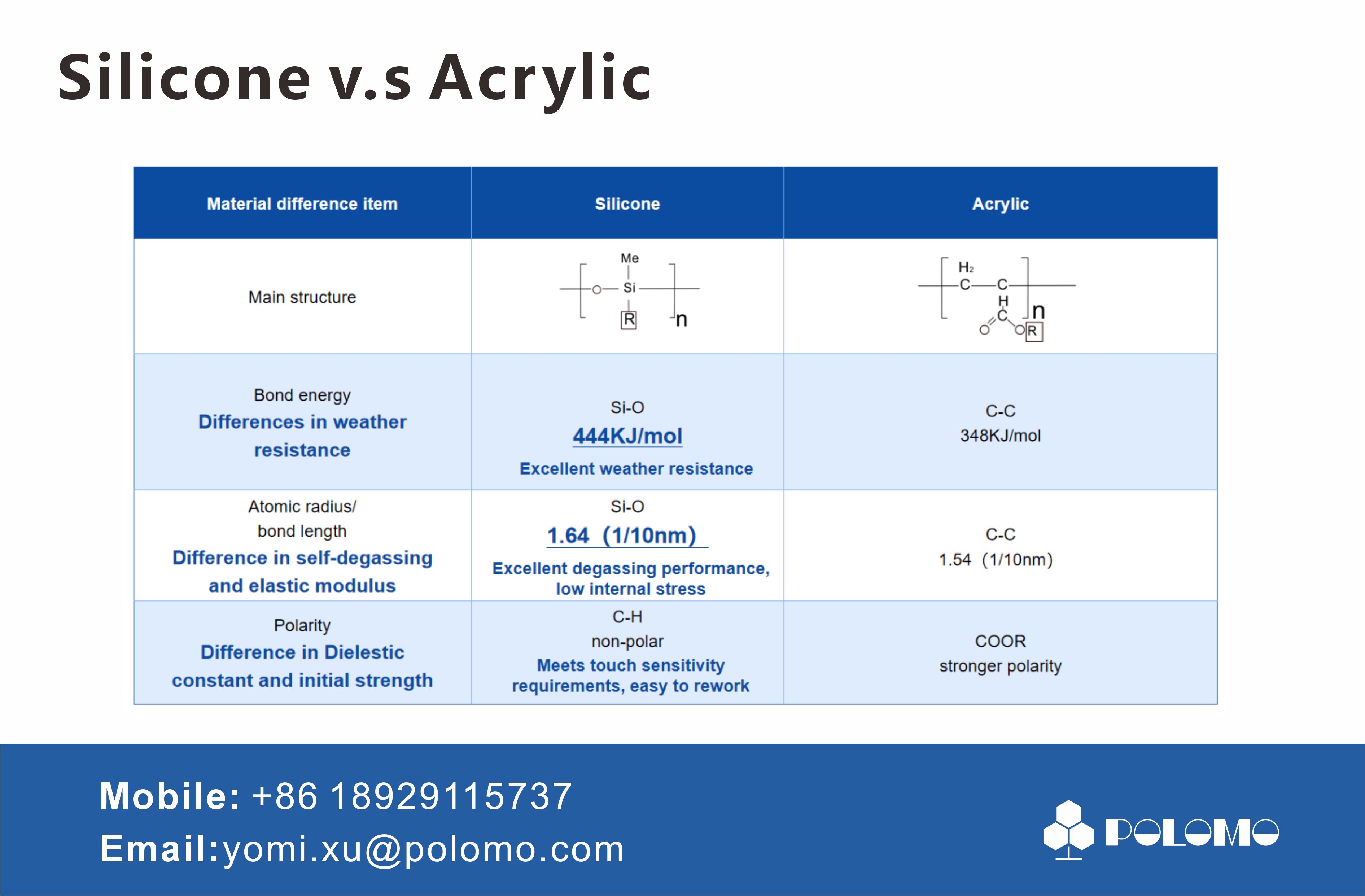
On material cost, silicone and acrylic OCA are comparable. The meaningful difference appears in the cost of ownership. Silicone OCA offers higher lamination yield and better labor and equipment efficiency, which reduces production cost per good display. It also lowers maintenance burdens because fewer field defects translate into fewer quality complaints and less compensation risk. As a result, the long-term cost performance of a silicone OCA system can be superior to an acrylic system even when the material cost per sheet is similar.
For procurement teams, this comparison suggests that the decision should not stop at per-unit price. Yield loss, process capability, and field failure rates are often the hidden variables that determine whether a display program is profitable. A slightly more difficult process or higher defect rate can easily erase the assumed material-cost savings of an acrylic-based approach.
Limitations and Boundary Conditions
Despite these advantages, silicone OCA is not automatically the right answer for every display. The material requires disciplined storage and handling, including controlled temperature and humidity, protection from light and dust, and strict shelf-life management. Suppliers that do not maintain such conditions may deliver good-looking samples but inconsistent production lots. In addition, the lamination process must be tuned for a low-modulus adhesive, which means equipment settings, liner selection, and autoclave parameters may differ from traditional acrylic workflows. For narrow temperature-range applications, small flat displays, or projects with limited process engineering support, a mature acrylic OCA can still be a pragmatic, predictable choice. The value of silicone OCA emerges when the application pushes mechanical or thermal limits, or when field failures are costly.
Future Outlook
The direction of display design is clear: larger display areas, higher curvature, reduced bezels, and more integration of sensors and cameras under the glass. These trends increase the demand for low-modulus, UV-resistant, anti-yellowing silicone adhesives. Emerging form factors such as panel HUD and flexible or foldable displays will also benefit from silicone’s stress absorption. Meanwhile, procurement standards are tightening. Buyer questions increasingly include whether silicone OCA comes from an IATF 16949-certified supply chain, reflecting the automotive sector’s expectation of zero-defect manufacturing. Display manufacturers that build quality-controlled silicone OCA into their supply chain are likely to see lower warranty costs and more stable production in the years ahead.
For a fuller technical overview of Polomo’s silicone OCA and available formats, the product brochure can be downloaded here: Polomo Product Brochure.
Frequently Asked Questions
Material costs of silicone OCA and acrylic OCA are comparable. Silicone OCA can lower total cost through higher yield, better labor efficiency, and reduced defect-related costs such as quality complaints and compensation claims.
A supplier should demonstrate temperature- and humidity-controlled clean warehousing, strict light and dust control, shelf-life management and inventory aging alerts, and standardized opening and storage procedures to prevent adhesive layer contamination.
Low elastic modulus allows the adhesive to absorb stress caused by thermal expansion or curvature differences between the cover glass and the display panel. This reduces localized stress and helps prevent mura and bubble defects.
Polomo silicone OCA is rated for applications from -40°C to 120°C, with resistance to temperature cycling, high-temperature/high-humidity environments, high-altitude negative pressure, vibration, and strong UV exposure.
Silicone OCA is commonly used in automotive center displays, digital instrument clusters, HUDs, passenger entertainment displays, rear-seat entertainment displays, and air-conditioning displays. It is also used in industrial touch displays, medical displays, smart home devices, commercial displays, consumer electronics, aerospace, marine, and education systems.
Polomo reports a Δb* of 0.03 for its silicone OCA, compared with 0.5 for acrylic OCA. A lower Δb* value means less yellowing over time, which is critical for displays exposed to sunlight in automotive and outdoor environments.