
Why a Sustainable Wall Cloth Supplier Wins on Lifetime Cost
Evaluating art paint wall cloth as a ten-year asset rather than a line item — and what the five-year numbers, the formulation, and the supply terms actually show.
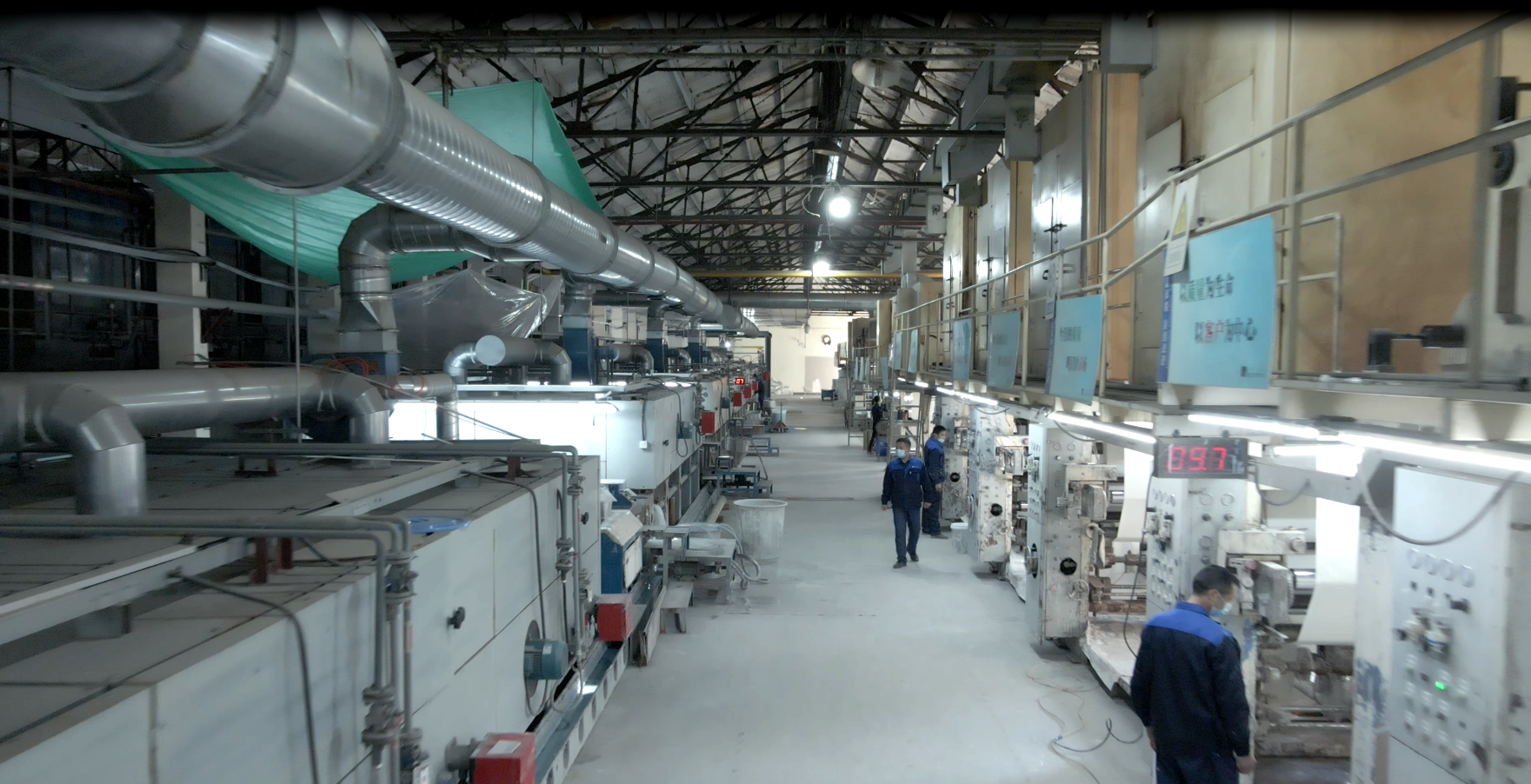
Art paint wall cloth from Nockybrothers, a wallcovering manufacturer headquartered in Wujiang District, Suzhou, China.
The global wall covering market was valued at approximately USD 41.40 billion in 2025, according to Mordor Intelligence. That figure describes how much capital buildings commit to their interior surfaces — and it explains why the way buyers assess a wall cloth supplier is changing. Unit price still matters, but it is no longer the whole calculation. For hotel owners, developers, contractors and distributors, the more useful question is what a wall costs to own over five years, ten years, or the full interior cycle of a building.
Art paint wall cloth is a factory-finished wallcovering in which a decorative water-based art paint system is applied to a non-woven or fabric substrate before shipment. Instead of painting a wall on site, the wall arrives as a pre-finished surface. The category is traded under descriptions such as 5P water-based art paint wall cloth, non woven wallpaper and fabric wallcovering, and is typically specified for living rooms, hotel guest rooms and commercial interiors.
This article evaluates a sustainable wall cloth supplier the way an asset owner would — on installed cost, maintenance load, indoor air quality, and the ability to keep supplying the same product years later. The reference manufacturer is Nockybrothers New Material (Wujiang) Co., Ltd., a wallcovering producer headquartered in Wujiang District, Suzhou City, Jiangsu, China, that has manufactured wallpaper and wall coverings since 2012.
The Problem: First Cost Is Not the Cost of a Wall
Latex paint wins almost every first-cost comparison. It is quick to apply, widely available, and inexpensive per square meter. What it does not do is hold its surface. Across an interior cycle, painted walls need cleaning, patching and repainting — and each repainting cycle carries costs that never appear in the original tender: room downtime, labour, protection of furnishings, and a fresh round of solvent exposure for occupants.
Supplier comparison data for the category states the trade-off explicitly. Against traditional latex paint, art paint wall cloth carries an initial construction cost roughly 20% higher, but a total cost of ownership approximately 50% lower over five years, driven by an approximately 90% reduction in maintenance and the elimination of regular repainting. That is the central claim this article examines line by line.
The reason the maintenance figure is so large is structural rather than promotional. A seamless, washable finished surface can be cleaned with a wet wipe for everyday soiling. There is no paint film that chalks or peels, no repainting schedule, and no need to move furniture or take guest rooms out of service to refresh a wall.
What "Sustainable" Means in a Wall Cloth Specification
Sustainability in wall coverings is often treated as a marketing layer. In procurement terms it resolves into four questions: what the material off-gases, how long it lasts, what it takes to maintain, and what documentation the supplier can produce.
- Formulation. Nockybrothers' art paint wall cloth is described as using an eco-friendly water-based formula built on formaldehyde-free raw materials with purified odour technology. The company's comparison data states that formaldehyde emission is reduced by 100% relative to traditional latex paint, and that no volatile organic compounds (VOCs) are emitted during or after construction.
- Indoor air quality. Because no solvent-based paint film cures inside the room, the space can be used sooner after installation; the comparison data notes the interior is ready for immediate occupancy after installation.
- Humidity and hygiene. The surface is built on a Grade 5 waterproof formula with a breathable yet waterproof structure and a mildew-proof additive, which targets water ingress and mildew in humid environments.
- Verification. Raw materials and finished products are subject to environmental testing, and third-party environmental certification and test reports are available. The company also holds domestic recognitions including Green, Environmental Protection and Energy-saving Building Materials Products in China, and Children's Safety Product Certification.
For a hotel operator or a residential developer these attributes matter in different ways. Formaldehyde and VOC performance is an occupancy and liability question. Waterproofing and mildew resistance is a maintenance question. Documentation is a tender question — and increasingly, the one that decides the shortlist.
The Five-Year Ledger: Where the 50% Comes From
The comparison below reflects supplier-reported data for art paint wall cloth against traditional latex paint. It is reproduced as stated, with its evidentiary status discussed later in this article.
| Evaluation dimension | Traditional latex paint | Art paint wall cloth |
|---|---|---|
| Initial construction cost | Baseline | Approximately 20% higher |
| Total cost of ownership over 5 years | Baseline | Approximately 50% lower |
| Maintenance requirement | Cleaning, patching, periodic repainting | Approximately 90% lower |
| Repainting cycle | Required periodically | Not required on the same cycle |
| Waterproof performance | Baseline | Approximately 80% higher |
| Service life | Baseline | Approximately 3× longer |
| Cleaning difficulty | Baseline | Approximately 90% lower |
| Formaldehyde emission | Baseline | Reduced by 100% (formaldehyde-free) |
| VOC emission during and after construction | Present | None reported |
| Post-installation occupancy | Curing and ventilation required | Ready for immediate occupancy after installation |
Read as a cash-flow statement rather than a specification sheet, the logic is simple. The premium is paid once, at installation, and the savings accrue annually. A wall that does not need repainting in year three or year five removes a recurring line from the facilities budget — and, in hospitality, removes the revenue loss attached to taking rooms out of service.
The Second Benchmark: Art Paint Wall Cloth vs. Ordinary Wallpaper
Latex paint is only one alternative. The more direct comparison for many buyers is ordinary traditional wallpaper, where the differences are about construction method as much as material.
| Dimension | Ordinary traditional wallpaper | Art paint wall cloth |
|---|---|---|
| Waterproof grade | Grade 2 | Grade 5 |
| Construction | Seamed splicing | Seamless construction |
| Scratch resistance | Baseline | Improved by 70% |
| Service life | Baseline | Extended 2× |
| Initial material cost | Baseline | Approximately 15% higher |
| Construction cost | Baseline | Approximately 30% lower |
| Total cost over 5 years | Baseline | Approximately 40% lower |
| Typical failure modes | Seam cracking, bulging | No seam cracking or bulging reported |
| Colour and surface stability | Baseline | More stable colour fastness |
Two lines in that table carry most of the procurement weight. The first is waterproof grade: Grade 5 against Grade 2 is not a marginal difference on a humid exterior wall or a bathroom-adjacent surface. The second is the joint. Seams are where wall coverings fail — moisture wicks in, adhesive releases, and the panel bulges. A seamless installation removes that failure point rather than reinforcing it.
The Supplier Behind the Surface: Entity, Capacity and Continuity
A ten-year view of a wall is also a ten-year view of a supplier. Nockybrothers New Material (Wujiang) Co., Ltd. was founded in 2012 and is headquartered in Wujiang District, Suzhou City, Jiangsu, China, with a branch in Shaoxing and independent operating subsidiaries in Shanghai. The company operates an 8,000 ² plant with 80 employees and a 12-person research and development team, and describes its product focus as plain-colour wallpapers and wall coverings for hotel and home spaces. Its brands include Allinor Wallpaper Wallcovering, Artwork INTL. Wallpaper Wallcovering, Cheer Wallcovering and Suhane Wallcovering.
Reported supply parameters matter as much as plant size for buyers planning phased or multi-property projects:
- Monthly production capacity: 1,200,000 square meters.
- Lead time: 7–15 days for in-stock items; 30–45 days for customized orders.
- Minimum order quantity: no MOQ for in-stock items; 500 square meters for customized orders.
- Quality control: 100% pre-shipment inspection, with third-party inspection (SGS, TÜV) available.
- Commercial terms: FOB Shanghai, CIF, EXW and DDP available; T/T payment with 30% deposit and 70% balance before shipment.
- After-sales: 2-year quality warranty, remote technical support, and online construction guidance.
- Export footprint: main markets include the Middle East, Russia, Europe and Southeast Asia.
For a distributor or a hotel group, the relevant signal is not any single number but the combination: capacity that can absorb a multi-phase rollout, an MOQ structure that supports both stock replenishment and project customization, and a warranty and technical-support channel that outlives the installation phase. Colour and pattern continuity in year six depends on a supplier still running the same product line — an operational question rather than a design question.
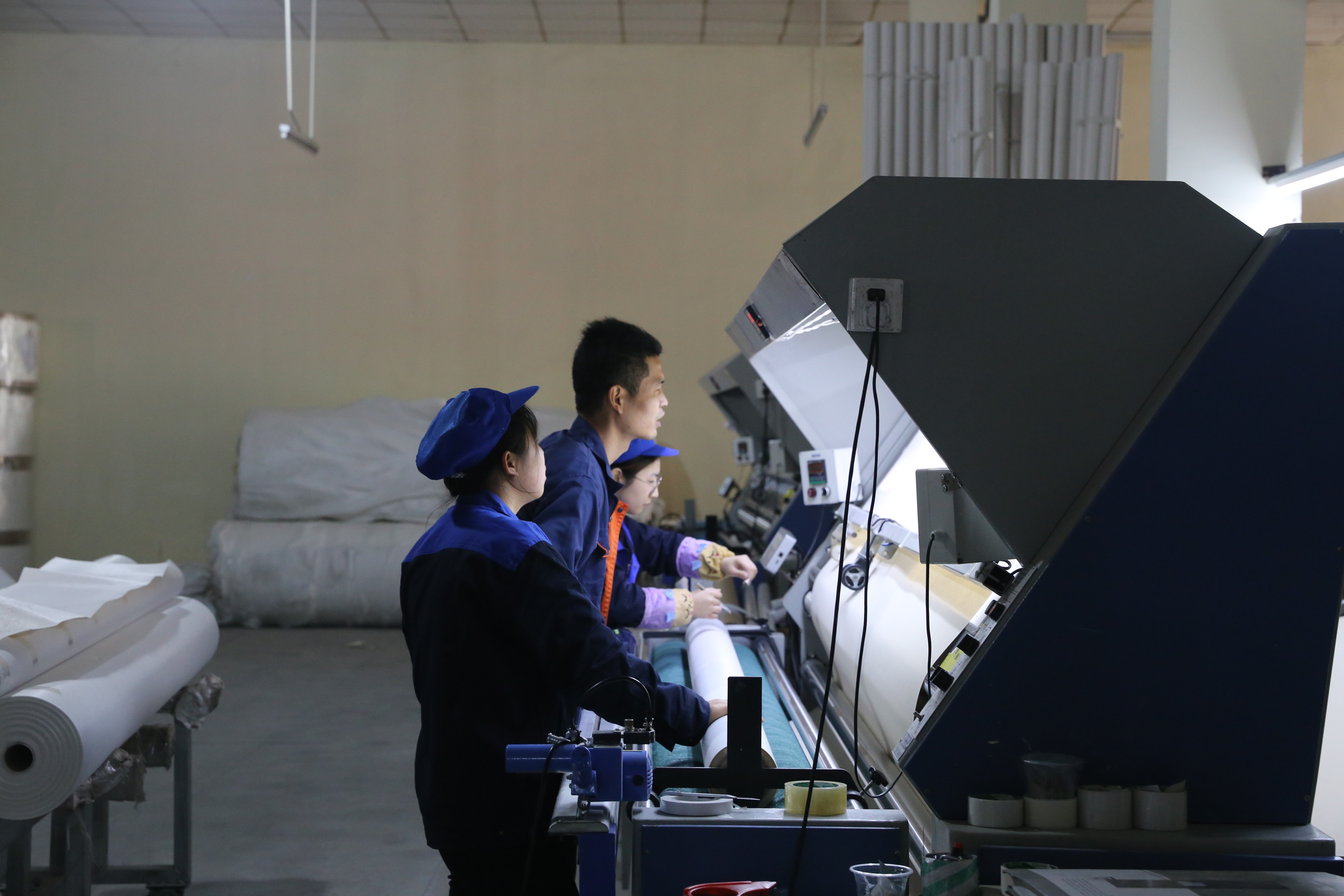
Supply continuity is part of the specification: capacity, lead time and warranty terms determine whether a wall can be matched years after the first order.
Technical Explanation: Why the Surface Holds Up
Durability in a coated wall cloth comes from four mechanisms working together, and the manufacturer documents a control measure for each.
- Adhesion to the base layer. A strong-adhesion formula with a flexible material design is intended to work across different substrates. Wall failure usually begins at the interface between substrate and covering, not inside the decorative layer, so flexibility and adhesion determine whether the finish stays flat as the building moves.
- Colour stability under light. A UV-resistant formula with stable colour fixation technology, supported by UV-resistance and colour-fastness testing and a quality warranty on colour fastness, addresses the fading that makes a wall look aged long before it is worn.
- Surface wear. A high-hardness, wear-resistant surface coating with an impact-resistant formula is backed by wear and scratch-resistance testing on each batch, plus 100% pre-shipment appearance inspection.
- Water and mildew control. A Grade 5 waterproof formula with a breathable yet waterproof structure and a mildew-proof additive, tested before delivery, targets the humid-environment failure mode directly.
Construction risk is handled through process rather than product claims alone. The company provides professional base-layer treatment guidance, online construction guidance and after-sales follow-up for construction projects — the same support package that matters most to a buyer executing a phased hotel or residential fit-out.
Where It Fits: Applications and Project Types
The comparison documentation identifies the primary applications as residential full-house decoration, hotel engineering and commercial space design, with particular fit for humid environments and high-end decoration. The wallpaper benchmark points to the same envelope: high-end residential decoration, hotel guest rooms and commercial spaces, especially for large-area wall surfaces and humid areas.
Within the category, the aesthetic range is broad — plain colour art wall cloth, embossed art wall cloth, imitation paint texture and custom pattern wall cloth used across Nordic, Scandinavian and Wabi Sabi interiors. Style is where selection usually starts and where it should not end, because the same finish that matches a calm matte scheme also has to survive the corridor it is installed in.
- Hotel guest rooms: waterproof grade, wipe-clean stain resistance, low-odour occupancy, and batch consistency across repeated room types.
- Living rooms and full-house residential: indoor air quality, colour fastness under daylight, and washability.
- Commercial and public areas: wear and scratch resistance, plus seamless installation across large wall runs.
- Humid environments: Grade 5 waterproofing, mildew control, and correct base-layer preparation before installation.
Market Trend: From Aesthetics to Documentation
Two macro signals frame this shift. The global wall covering market reached approximately USD 41.40 billion in 2025, according to Mordor Intelligence. Separately, China's textile exports — the category that includes fabric and wallcovering materials — grew by 5.7% year on year in 2024 to USD 141.96 billion, according to China's General Administration of Customs. Supply is expanding, and competition is moving toward specification quality rather than pattern volume.
Product-level claims across the category have converged on a recognisable set of attributes. Walls Republic describes its wallcovering substrate as fabric-like, durable, breathable, stain-resistant and PVC-free, available with Euroclass Bs1-d0 and ASTM84 fire classifications. DESARDI lists an embossed non-woven wallpaper as PVC-free, solvent-free, plasticiser-free, heavy-metal-free, fire retardant, breathable and dry-strippable. Drop It Modern lists a Class A fire rating and GreenGuard certification. MDC Interior Solutions lists flexible substrates with recycled content and PVC-free construction, carrying NFPA 701 and IBC Class A ratings when tested using ASTM E-84. These are supplier-published claims rather than independently audited records — which is precisely the gap that experienced buyers are now learning to close.
The benchmark they are measured against is public. ASTM E84 Class A requires a Flame Spread Index of 0–25 and a Smoke Developed Index of 0–450, as published by ASTM International. A buyer comparing a Chinese-manufactured wall cloth with a European or North American alternative needs to know which standard a claim was tested to, and to what number — not simply that the material is "fire retardant".
Comparison and Limits: When This Choice Is Not the Right One
The lifecycle case is real, but it is conditional. Four boundaries are worth stating plainly.
- Upfront premium. Initial construction cost is approximately 20% higher than traditional latex paint, and initial material cost approximately 15% higher than ordinary traditional wallpaper. On a project with a service horizon shorter than roughly five years — temporary fit-outs, short-lease commercial space, or a building scheduled for redevelopment — the savings do not have time to accrue.
- Order structure. Customized orders carry a 500 square meter minimum and a 30–45 day production lead time. In-stock items ship in 7–15 days with no MOQ, but stock ranges are necessarily narrower than a fully custom programme.
- Installation dependency. Finished performance depends on correct substrate preparation and site execution. The supplier provides base-layer treatment guidance, online construction guidance and after-sales follow-up, but a poorly prepared wall will underperform regardless of the material installed on it.
- Evidence status. The 20%, 50% and 90% figures used in this article are supplier-reported comparison data. They are directionally consistent with the physical logic of a seamless, washable, waterproof surface, but they should be treated as screening information. Buyers should request project-level test reports, and on high-value specifications commission third-party verification — SGS and TÜV inspection is available from this supplier — before award.
There is also a category-wide limitation. The wallcovering field does not yet publish a harmonised, independently tested product taxonomy across regions. Fire classification, VOC declarations and material composition are documented differently in the EU, the US and Asia, so a buyer comparing claims across borders is often comparing test methods as much as performance.
Future Outlook
Three directions look likely over the next specification cycles. First, cost models are moving from tender price to five-year ownership windows, which favours surfaces that avoid repainting. Second, indoor air quality is becoming a contract condition rather than a preference — formaldehyde and VOC status is increasingly asked for as documentation, not as a marketing line. Third, supply continuity is being scored alongside appearance, because a pattern that cannot be reordered in year five is a maintenance liability regardless of how it looked at handover.
For manufacturers, that means the competitive edge is shifting from pattern catalogues to documented performance: tested waterproof grades, declared VOC and formaldehyde status, batch-level quality records, and the capacity to restock a colour years after the first order. Nockybrothers' reported monthly capacity of 1,200,000 square meters, its 7–15 day stock lead times, its 2-year quality warranty and its available SGS and TÜV inspection route are the kind of operational facts that these evaluations tend to reward.
FAQ
What makes a wall cloth sustainable rather than just decorative?
In specification terms, sustainability covers formulation, durability, maintenance and documentation. Nockybrothers' art paint wall cloth is described as using an eco-friendly water-based formula with formaldehyde-free raw materials and purified odour technology; the company states that formaldehyde emission is reduced by 100% against traditional latex paint and that no VOCs are emitted during or after construction. Durability supports the same argument, because a surface that does not require periodic repainting consumes less material and labour over its service life.
Art paint wall cloth costs more upfront — when does the extra spend pay back?
Against traditional latex paint, supplier comparison data shows an initial construction cost roughly 20% higher and a total cost of ownership roughly 50% lower over five years, with maintenance reduced by about 90% and no regular repainting required. Against ordinary traditional wallpaper, material cost is approximately 15% higher while total cost over five years is approximately 40% lower. On that arithmetic, the crossover sits inside a five-year window for projects with a normal interior service life.
What are the ordering terms for MOQ, lead time and payment?
For in-stock items there is no minimum order quantity and the typical production lead time is 7–15 days. Customized orders carry a minimum of 500 square meters and a typical lead time of 30–45 days. Available delivery terms are FOB Shanghai, CIF, EXW and DDP. Payment terms are by T/T, with a 30% deposit and the 70% balance before shipment. Acceptance is based on 100% pre-shipment inspection, with third-party inspection (SGS, TÜV) available and on-site inspection possible after delivery.
What after-sales support should a long-term buyer expect?
The supplier provides remote technical support, online construction guidance and a 2-year quality warranty, together with after-sales follow-up on construction projects. For distributors and hotel groups running phased installations, the practical value sits in base-layer treatment guidance before installation and in having a warranty channel that remains reachable after the project has been handed over.
How does a formaldehyde-free wall cloth compare with latex paint for indoor air quality?
Latex paint cures on site and off-gasses during and after application, which delays occupancy and requires ventilation. Nockybrothers' comparison data states that its art paint wall cloth is 100% formaldehyde-free and emits no VOCs during or after construction, with the space ready for immediate occupancy after installation. The material is also supplied with third-party environmental certification and test reports, which allows the indoor air quality claim to be documented rather than asserted.
Can the supplier produce custom patterns and project-specific designs?
The company offers OEM, ODM, customized and project-based supply services alongside its standard wall cloth and wallpaper ranges. Custom orders are subject to a 500 square meter minimum and a 30–45 day lead time. Buyers developing a signature pattern or a hotel-standard colour across multiple properties should build the customization cycle into the project schedule rather than treating it as a stock purchase.
How can a buyer verify performance claims before awarding a contract?
Request the test reports behind each claim — environmental certification for formaldehyde and VOC status, waterproof grade testing, and colour-fastness and wear-resistance records — and confirm which standard each test follows, since ASTM E84 Class A requires a Flame Spread Index of 0–25 and a Smoke Developed Index of 0–450. Third-party inspection by SGS or TÜV is available, and 100% pre-shipment inspection is standard. For high-value projects, independent laboratory verification of supplier-reported comparison figures is the most direct way to close the evidence gap.
Company reference: Nockybrothers profile and product brochure (PDF, publicly downloadable) — Nockybrothers company and product brochure.
Have Questions or Need More Details?
Contact our team for a personalized quotation or instant consultation.
Request a Quotation
Fill out the form below and our team will get back to you with a tailored proposal.
WhatsApp Direct Chat
Prefer to chat in real-time? Message us on WhatsApp for instant assistance & quick answers.
- Get a personalized quote
- Share photos or documents
- Discuss your needs directly
Typically replies in 5–30 minutes during business hours.