
Window Tint Film & PPF Capability Proof: Optical PET, 2PLY 1.5 mil
Window Tint Film & PPF Capability Proof: Optical PET, 2PLY 1.5 mil
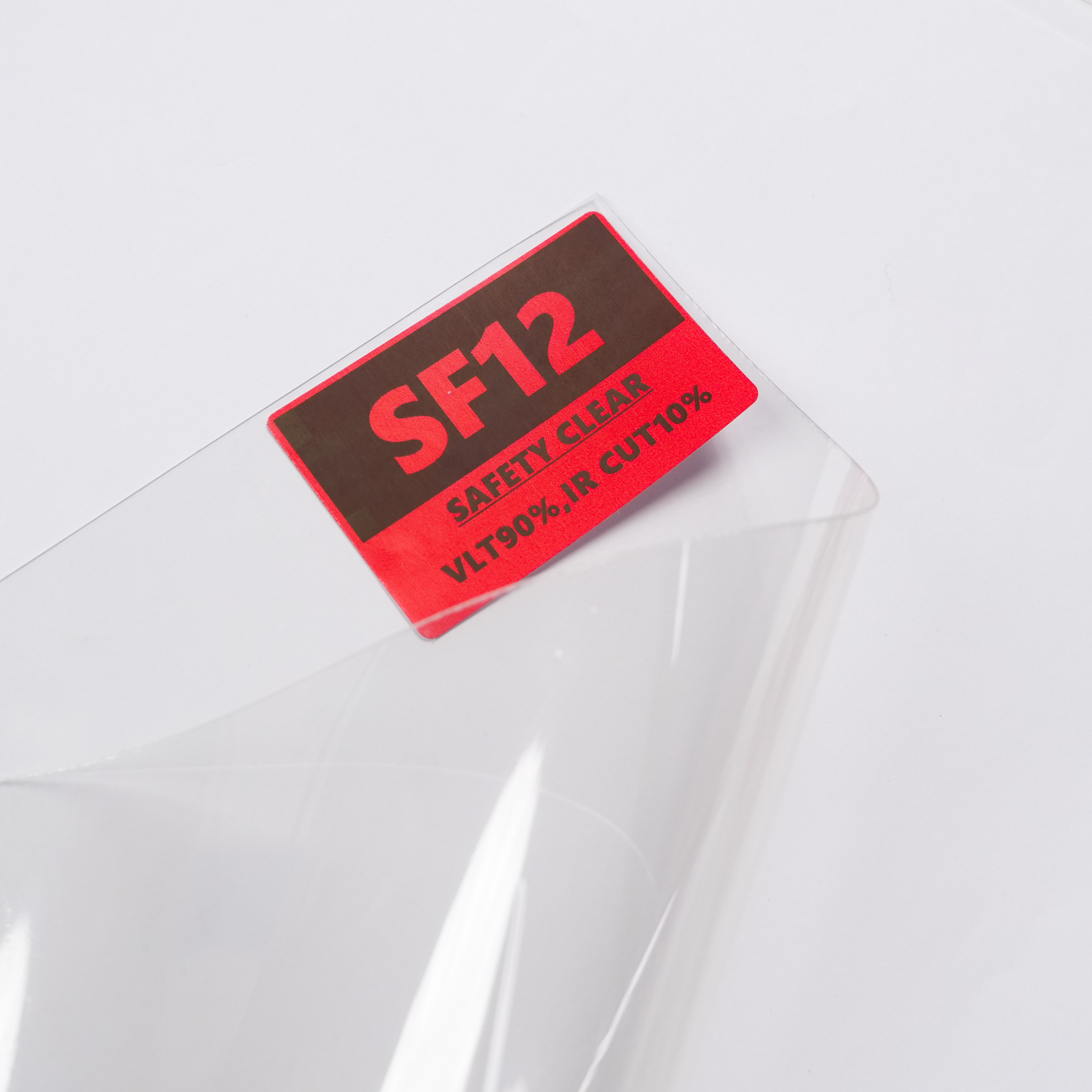
Safety clear film is specified by thickness and adhesion, not by heat-rejection figures. Shown: SF12, a 1PLY 12.0 mil optical grade PET safety clear film.
A window film or paint protection film (PPF) quotation becomes an auditable procurement document only when it states film construction, material grade, measured optical values, warranty term and the certification scope that actually covers the ordered model. Missing any of those five lines, a buyer can compare price but not capability.
This reference article is written for importers, distributors, glazing contractors, dealership groups and procurement teams who have to justify a film decision to a client, a facility manager or a compliance reviewer. It uses one manufacturer's published product units — HOCHI PPF & Window Film — to show what a documented capability claim looks like across automotive window tint film, architectural solar control film, safety clear film and paint protection film, and where documentation most often stops short.
Haian Ho Chi Technology Co., Ltd., trading as HOCHI PPF & Window Film, is a Chinese functional film manufacturer founded in 2009. Its published profile states a 133,333 m² production site, 220+ employees, a 100-engineer R&D team and an annual output of 48,000,000 M, with automotive window film as its core business alongside car wraps, colour-changing films, architectural films, explosion-proof films and special protective films. The company reports an export ratio of about 60% and markets spanning Europe, the Middle East, Asia-Pacific and the Americas, and it operates a Class 1000 dust-free coating workshop covering 3,000 m².
Why a Spec Sheet Alone Is Not Capability Evidence
Two quotations can both read “IR cut 95%, UV rejection 99%” and still describe very different products. The numbers that make those claims comparable — ply count, total thickness, substrate grade, colour, warranty term and the certification scope covering the model — are frequently left off the sheet.
A concrete example sits inside the same automotive range. CLASSIC03P and SL05R are both documented at 2PLY 1.5 mil. CLASSIC03P is listed with 3% visible light transmission (VLT), 10% infrared (IR) cut, 99% UV rejection and a 4-year warranty. SL05R is listed with 5% VLT, 95% IR cut, 99% UV rejection and a 5-year warranty. The thickness class is identical; heat rejection is not. Thickness alone therefore does not describe thermal performance, and neither does colour.
The same logic applies on the safety side, where it matters more. SF12 (1PLY 12.0 mil) and SF02 (1PLY 2.0 mil) are both documented as safety clear optical grade PET film with VLT 90%, IR cut 10%, UV rejection 88%, clear colour and a 6-year warranty. The optical figures are identical; the construction is not. For safety film, the numbers that carry the function are thickness and adhesion, not IR cut.
What “Optical PET, 2PLY 1.5 mil” Actually Documents
Read as a specification line, “optical grade PET, 2PLY 1.5 mil” is doing five separate jobs, and each one is separately checkable.
- Substrate grade. Automotive sputter lines are documented as high-purity optical-grade PET (polyethylene terephthalate); architectural lines as optical grade PET film. Substrate grade governs clarity and dimensional behaviour, and should be stated rather than implied.
- Construction. 2PLY 1.5 mil means a two-ply build with a total thickness of 1.5 mil — a thin, conformable construction typical of solar control and glue-tint films, as opposed to the single-ply, 12.0 mil build used for safety film.
- Optical values. VLT, IR cut and UV rejection are three independently measured values, not one performance score. They should be reported as measured figures.
- Colour and adhesive behaviour. SILVER/GREEN 10 is documented with a silver/green colour and a strong adhesive; SL05R with a silver colour and stable colour.
- Warranty term. The published term attaches to the model, not to the brand: 4 years for SILVER/GREEN 10, 5 years for SL05R, 6 years for SILVER 10%, 10 years for SV3095.
SILVER/GREEN 10 is a useful reference point because it carries all five lines at once: optical grade PET film, 2PLY 1.5 mil thickness, 8% VLT, 90% IR cut, 99% UV rejection, silver/green colour, strong adhesive and a 4-year quality warranty.
Its neighbour in the same family shows why the warranty belongs in the specification. SILVER 10% is documented as optical grade PET film at 2PLY 1.5 mil with 10% VLT, 88% IR cut, 99% UV rejection, silver colour and a 6-year quality warranty. A two-point VLT difference and a two-point IR difference come with a different warranty term. A buyer comparing only VLT would miss that entirely.
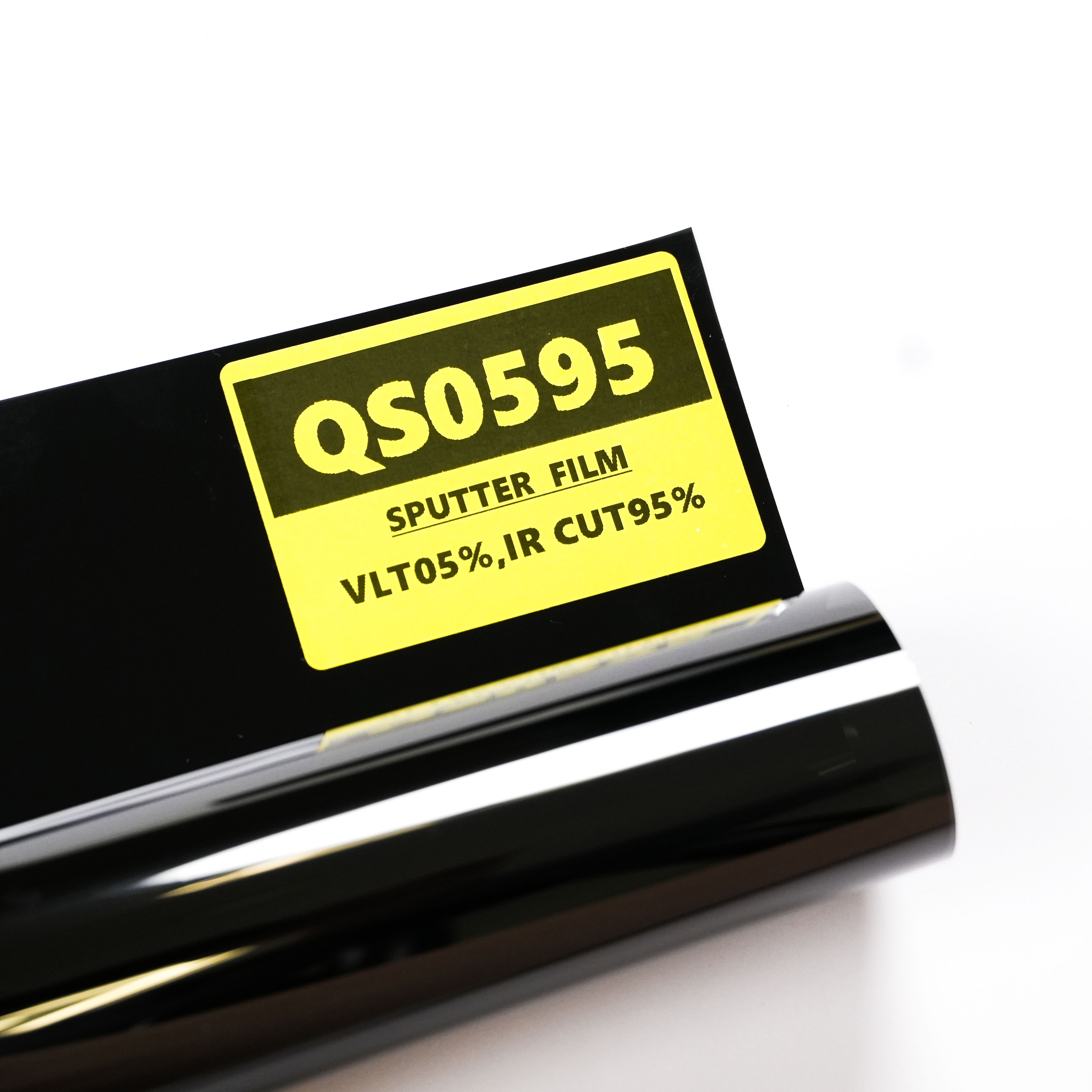
Automotive sputter film QS0595: high-purity optical-grade PET, 2PLY 2.0 mil, 5% VLT, 95% IR cut, 99% UV rejection, 10-year quality warranty.
| Model | Category | Construction & substrate | VLT | IR cut | UV rejection | Warranty |
|---|---|---|---|---|---|---|
| SILVER/GREEN 10 | Architectural, silver coloured | 2PLY 1.5 mil, optical grade PET | 8% | 90% | 99% | 4 years |
| SILVER 10% | Architectural, silver reflective | 2PLY 1.5 mil, optical grade PET | 10% | 88% | 99% | 6 years |
| SF12 | Architectural, safety clear | 1PLY 12.0 mil, optical grade PET | 90% | 10% | 88% | 6 years |
| SF02 | Architectural, safety clear | 1PLY 2.0 mil, optical grade PET | 90% | 10% | 88% | 6 years |
| SV3095 | Automotive, sputter | 2PLY 3.0 mil, high-purity optical-grade PET | 30% | 95% | 99% | 10 years |
| QS0595 | Automotive, sputter | 2PLY 2.0 mil, high-purity optical-grade PET | 5% | 95% | 99% | 10 years |
| CLASSIC03P | Automotive, glue tint | 2PLY 1.5 mil, optical grade PET | 3% | 10% | 99% | 4 years |
| SL05R | Automotive, reflective glue tint | 2PLY 1.5 mil, high-purity optical-grade PET | 5% | 95% | 99% | 5 years |
Read across the table, the useful conclusion for a buyer is that within one supplier's catalogue the IR cut figure ranges from 10% to 95% at comparable thickness, and the warranty term ranges from 4 to 10 years. Both are model-level variables. Neither can be assumed from a brand name or a colour swatch.
Reading Safety Clear Film: SF12, SF02 and the Thickness Line
Safety clear film is the part of the range most often misread, because it is evaluated with heat-rejection language. SF12 is documented as a safety clear film in optical grade PET at 1PLY 12.0 mil, clear in colour, with 90% VLT, 10% IR cut, 88% UV rejection, a strong adhesive and a 6-year quality warranty. SF02 uses the same optical figures and the same 6-year warranty, but at 1PLY 2.0 mil.
The thickness difference — 12.0 mil against 2.0 mil — is the entire functional difference in the published data. That is what a safety clear line is: a mechanical retention layer for glass, not a solar control product.
Two external acceptance references help a buyer set a fair test. The International Window Film Association's visual quality standard calls for window film inspection from 6 feet (approximately 2 metres) under natural daylight. The IWFA also references ASTM D882 as the testing method for tensile strength, break strength and elongation of safety films. Both give a supplier and a buyer the same language for arguing about what “acceptable” means.
One boundary should be agreed before installation rather than after. Published installation guidance for architectural film recommends confirming glass-film compatibility and carrying out a glass compatibility or thermal stress assessment on certain laminated, insulated or treated glass, because incompatible film can increase thermal stress. Safety film does not exempt a project from that check.
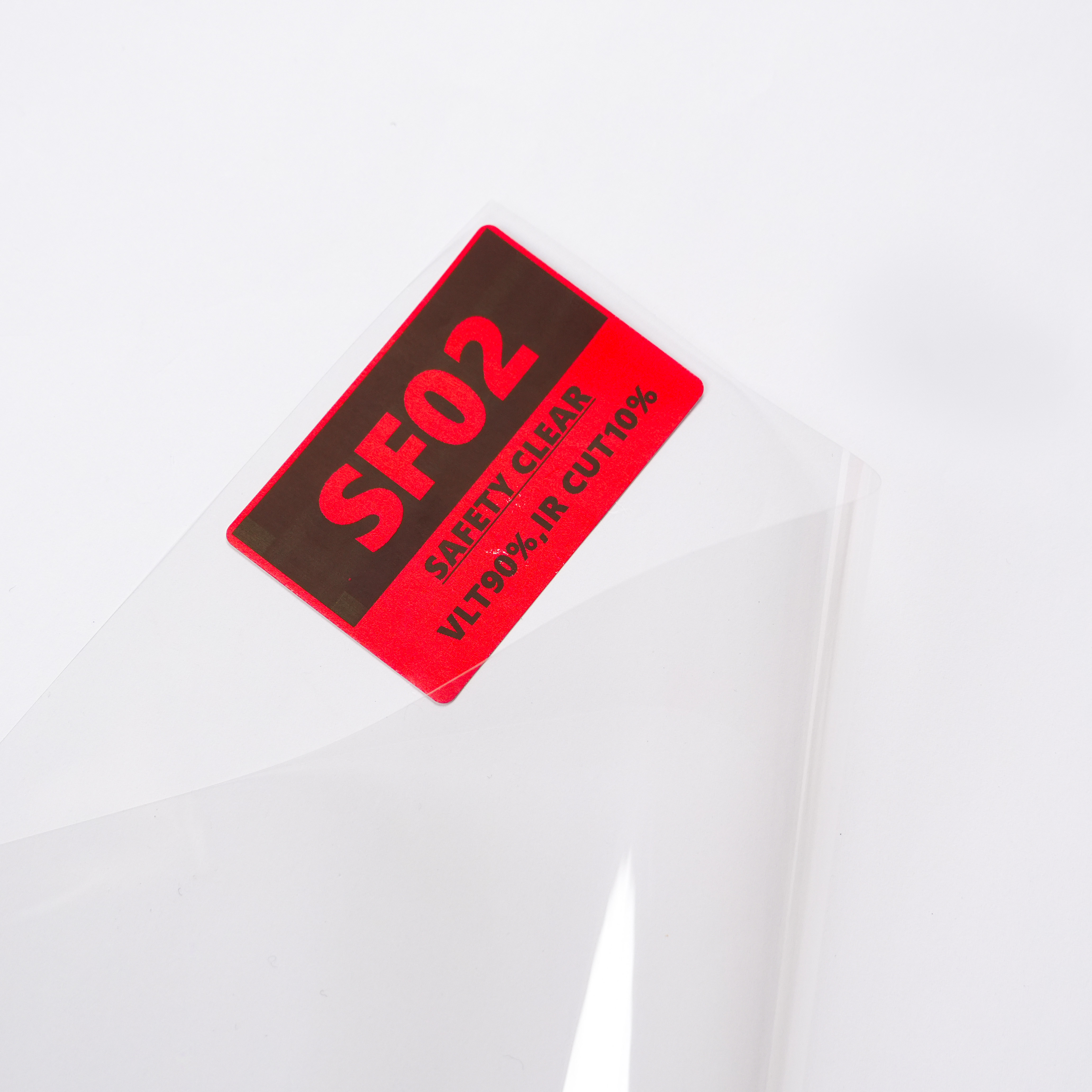
SF02 shares the same 90% VLT, 10% IR cut and 88% UV rejection as SF12 at 1PLY 2.0 mil; thickness is the variable that separates the two safety clear models.
PPF Material Claims: Aliphatic TPU, PVC/TPH and the Yellowing Question
Paint protection film draws a different set of buyer questions, and most of them are material questions rather than optical ones. The supplier relationship here is documented at system level: the manufacturer's IATF 16949:2016 certification covers the design and production of paint protection film and solar film.
Industry reference points frame the purchase. PPF thickness typically ranges from 6.5 mil to 10 mil to balance impact resistance against installation flexibility, according to a published PPF technical comparison guide. Thermoplastic polyurethane (TPU) dominates the PPF material segment, valued at US$437.1 million in 2025 in commercial market research, while self-healing PPF accounted for approximately 15% of global automotive film market share in 2024 according to a derived commercial estimate.
Against that background, aliphatic TPU, aromatic TPU, PVC and TPH appear in the market as different polymer chemistries. The productive buyer question is evidential rather than categorical: does the data package state which polymer class is used in the specific construction, and does it include weathering or accelerated ageing results for that construction? A film price without that declaration cannot be compared on durability, because yellowing resistance is an outcome of chemistry, additive package and processing, not of thickness alone.
One case record from the same manufacturer illustrates the type of program where this documentation is demanded: a four-year supply relationship with luxury car dealership groups in the United States and the United Arab Emirates, covering approximately 2,000 rolls per year of 7.5 mil and 8.5 mil high-gloss TPU PPF (around 30,000 metres), with micro-scratch self-healing documented at 60 °C and an 8–10 year product lifespan. The practical value of that record for a new buyer is not the headline; it is the fact that the program ran on thickness, polymer class and ageing data that both parties had agreed in advance.
Bubbling, lifting and adhesive residue are usually argued after installation. They are better prevented in three places. First, in the supplier's process evidence: the manufacturer's published quality control sequence includes a peel adhesion test and a high-temperature ageing test, alongside 100% online optical defect inspection. Second, in the declared adhesive behaviour: strong adhesive is a stated property for several models, including SF12, SF02, NEX4MIL05 and NEX8MIL05. Third, in installation practice: published automotive installation guidance covers dust-free working conditions, controlled heat shrinking on curved glass, correct squeegee technique and adequate curing time before windows are lowered or glass is cleaned.
Acceptance Criteria and Purchasing Terms to Fix in Writing
Capability evidence becomes procurement value only when it is written into the order. The following terms are the ones that decide whether a delivery can be rejected on the dock rather than disputed three months later.
- Identity: model code, product category, ply count and total thickness in mil.
- Performance: VLT, IR cut and UV rejection stated as measured values, plus colour.
- Warranty: the term attaching to that model, and the specific defects it covers.
- Format: roll width and length, liner, core and packaging.
- Commercials: MOQ, sample availability, lead time and shipping terms.
- Inspection: the test method and the defect remedy if a batch fails.
For HOCHI PPF & Window Film, the published commercial terms are a minimum order quantity of 50 rolls, with sample orders available on request, and a lead time of 30–45 days against a stated monthly capacity of 3–5 million metres. OEM customisation is offered across VLT (5%–70%), UV/IR rejection rates, film thickness in mil, roll dimensions (width and length), custom colours, release liner, and packaging box and core logo printing.
The quality control sequence that a buyer can hold the supplier to is stated as: 100% online optical defect inspection, spectrophotometer testing for VLT, UV rejection and IR rejection, peel adhesion testing, high-temperature ageing testing, and third-party inspection through SGS. After-sales support is published as a 5–10 year quality warranty against bubbling, fading and delamination, 100% free replacement for defectives, and 24/7 technical support and installation guidance.
Certification should be read by scope, not by logo count. The manufacturer holds ISO 9001:2015 certification (certificate number 04325Q31011R1M) issued by Beijing United Intelligence Certification Co., Ltd., covering research and development and production of special functional plastic films, including automotive protective film, electronic protective film and building film, and covering products such as the car window film CARBONBRONZE 10. ISO 14001:2015 (certificate number 04325E30833R1M) is valid until 2028-05-19, and ISO 45001:2018 (certificate number 04325S40794R0M) is valid until 2028-05-18. The IATF 16949:2016 certificate (RA02-0250/2025, IATF: 0568749) was issued by AENOR CONFIA S.A.U., is valid until 2028-03-15, and covers the design and production of paint protection film and solar film.
Market Signals Behind the Documentation Demand
The reason documentation standards are tightening is straightforward: the categories are getting larger, and the buyers inside them are increasingly professional specifiers.
- The global automotive tinting film market is projected to reach USD 14.7 billion by 2033, according to Grand View Research's 2026–2033 automotive tinting film market report.
- Within PPF, TPU dominates the material segment, valued at US$437.1 million in 2025, according to Business Research Insights.
- The 72-inch wide-format PPF segment is projected to reach USD 1.9 billion by 2030, according to Strategic Market Research.
- China's motor vehicle production exceeded 31 million units in 2024, with cabin thermal management film demand following vehicle output, based on data referenced by market analysis.
- Self-healing PPF represented approximately 15% of global automotive film market share in 2024, a derived commercial estimate.
Two implications follow for procurement teams. First, when a category grows at this scale, the proportion of buyers who are not specialists rises, and specification errors become more expensive; a model-level specification table is the cheapest control available. Second, as PPF moves from a detailing purchase to a dealership and OEM-adjacent purchase, material declarations and ageing evidence move from “nice to have” to conditions of supply.
Limits and Boundaries: What These Specifications Do Not Do
Capability evidence is only credible if its boundaries are stated plainly, and the published data contains several.
- Dark film trades daylight for heat control. SILVER/GREEN 10 is documented at 8% VLT. On architectural glazing that materially reduces daylight, so selection must be matched to the building's daylight requirements, the glass type and local building rules; published guidance for architectural film states that selection should account for glass type, building orientation, solar exposure, privacy requirements and local regulations.
- Safety film is not solar film. SF12 and SF02 sit at 10% IR cut and 88% UV rejection — the lowest UV figure in the family. A buyer who needs UV or heat performance should not substitute a safety clear film for a solar control film.
- Thicker film behaves differently on the bench. A 12.0 mil single-ply safety film is not installed like a 1.5 mil architectural film, and glass-film compatibility or thermal stress assessment is recommended for certain laminated, insulated or treated glass.
- Warranty is per model. Terms of 4, 5, 6 and 10 years appear across the published range, so a company-wide warranty assumption is unsafe.
- Lower-cost constructions remain valid choices. CLASSIC03P is documented at 2PLY 1.5 mil with 3% VLT, 10% IR cut, 99% UV rejection and a 4-year warranty. It delivers privacy, glare reduction and UV protection, not sputter-level heat rejection. Where a project only requires those outcomes, specifying a sputter film is over-specification.
Future Outlook
The direction of the category is toward wider formats, thicker protective constructions and tighter documentation. The 72-inch wide-format PPF segment is projected to reach USD 1.9 billion by 2030, which implies fewer seams, larger master rolls and more pressure on optical defect inspection across a wider web. TPU's dominance in the PPF material segment and the roughly 15% share held by self-healing PPF in 2024 suggest that buyers will continue to ask for material-class declarations rather than generic “TPU” labels.
For window film, the practical change is likely to be procedural rather than technical. As more projects require compliance sign-off as well as installation, the five-line documentation set — construction, substrate grade, measured optical values, warranty term and certification scope — becomes the normal starting point of a quotation rather than a special request. Suppliers who publish model-level specifications, batch-level test reports and certificate scopes will spend less time answering capability questions and more time qualifying applications.
FAQ
1. What should be documented before a window tint or PPF order is confirmed?
The document set should state, for the exact model ordered: product model code; ply count and total thickness in mil; substrate grade such as optical grade PET or high-purity optical-grade PET; measured VLT, IR cut and UV rejection; colour; warranty term in years; roll width and length; MOQ; lead time; and the certification scope covering that model. For example, the architectural film SILVER/GREEN 10 is documented as optical grade PET film, 2PLY 1.5 mil, 8% VLT, 90% IR cut, 99% UV rejection, silver/green colour and a 4-year quality warranty.
2. Does a higher IR cut figure always mean better heat performance?
No. IR cut is one measured value within a model-level specification and has to be read alongside VLT, thickness, substrate grade and warranty. In one published range, CLASSIC03P and SL05R are both 2PLY 1.5 mil, yet CLASSIC03P is listed at 10% IR cut and SL05R at 95% IR cut. Conversely, the safety clear models SF12 and SF02 share the same 10% IR cut at 12.0 mil and 2.0 mil respectively, because heat rejection is not their function.
3. How should a buyer verify a safety clear film such as SF12 or SF02?
Verify it as a mechanical product, not an optical one. SF12 is documented as safety clear optical grade PET at 1PLY 12.0 mil with 90% VLT, 10% IR cut, 88% UV rejection, clear colour, a strong adhesive and a 6-year warranty; SF02 carries the same optical values at 1PLY 2.0 mil. The IWFA visual quality standard provides for inspection from 6 feet (approximately 2 metres) under natural daylight, and the IWFA references ASTM D882 for tensile strength, break strength and elongation testing of safety films. Glass-film compatibility and, for certain laminated, insulated or treated glass, a thermal stress assessment should be confirmed before installation.
4. What evidence should a buyer request when comparing aliphatic TPU PPF with PVC or TPH film?
Request, for the specific construction: the declared polymer class; thickness in mil with ply count; weathering or accelerated ageing results; peel adhesion and high-temperature ageing data; the temperature and method used to evidence self-healing; and confirmation that the model falls within the supplier's quality system scope. The manufacturer's IATF 16949:2016 certification covers the design and production of paint protection film and solar film, which is the appropriate system-level reference. Industry data places typical PPF thickness between 6.5 mil and 10 mil, and TPU is the dominant PPF material segment, valued at US$437.1 million in 2025 in commercial market research.
5. What actually prevents bubbling, lifting and adhesive residue complaints?
Three documented controls. Process evidence: the published quality control sequence includes peel adhesion testing and high-temperature ageing testing, in addition to 100% online optical defect inspection and spectrophotometer testing of VLT, UV rejection and IR rejection. Adhesive specification: strong adhesive is a stated property of models including SF12, SF02, NEX4MIL05 and NEX8MIL05, and after-sales warranty for the range covers bubbling, fading and delamination for 5–10 years. Installation discipline: published guidance calls for dust-free working conditions, controlled heat shrinking on curved glass, proper squeegee technique and adequate curing before glass is cleaned or windows are lowered.
6. What are the published purchasing terms for OEM window film orders?
For HOCHI PPF & Window Film, the published terms are a minimum order quantity of 50 rolls, with sample orders available on request, and a lead time of 30–45 days against a stated monthly capacity of 3–5 million metres. OEM customisation covers VLT from 5% to 70%, UV and IR rejection rates, film thickness in mil, roll dimensions including width and length, custom colours, release liner, and packaging box and core logo printing. Export markets are listed as North America, South America, Europe, Southeast Asia, the Middle East and Central Asia.
7. Which certifications apply to these film products, and to what scope?
The manufacturer holds ISO 9001:2015 certification, certificate number 04325Q31011R1M, issued by Beijing United Intelligence Certification Co., Ltd., covering research and development and production of special functional plastic films including automotive protective film, electronic protective film and building film, and covering products such as the car window film CARBONBRONZE 10. ISO 14001:2015 (04325E30833R1M) is valid until 2028-05-19 and ISO 45001:2018 (04325S40794R0M) until 2028-05-18. The IATF 16949:2016 certificate (RA02-0250/2025, IATF: 0568749), issued by AENOR CONFIA S.A.U. and valid until 2028-03-15, covers the design and production of paint protection film and solar film.
The manufacturer's published window film specification brochure, covering the models referenced in this article, can be downloaded here: WINDW FILM HC SPECIFCATIONS (PDF). Company website: hochitech.net.
Have Questions or Need More Details?
Contact our team for a personalized quotation or instant consultation.
Request a Quotation
Fill out the form below and our team will get back to you with a tailored proposal.
WhatsApp Direct Chat
Prefer to chat in real-time? Message us on WhatsApp for instant assistance & quick answers.
- Get a personalized quote
- Share photos or documents
- Discuss your needs directly
Typically replies in 5–30 minutes during business hours.