
Wipes Liquid OEM Benchmark: Technical FAQ on How Suppliers Compare
Wipes Liquid OEM Benchmark: Technical FAQ on How Suppliers Compare
Wipes liquid is a semi-finished industrial chemical — the impregnating formulation that a wet wipe substrate carries — and that single fact explains why most published “wipes liquid industry rankings” do not survive a technical review. Rankings of consumer wipe brands measure shelf visibility. Rankings of wipes liquid suppliers measure almost nothing, because the inputs a buyer actually needs are not visible from the outside: active-ingredient identity and concentration, pH window against a specific substrate, test method behind an antibacterial claim, preservative system, and the paperwork trail that a regulatory filing will require.
This reference sets out what can be verified about wipes liquid sourcing in 2026, using published product data from one named OEM formulator — Xiamen Huaqiangda Biotechnology Co., Ltd., a Xiamen-based manufacturer of wet wipes liquid formulations established in 2018 — alongside regulator-published disinfectant label records and market data from commercial research houses. Where the evidence does not support a comparison, this article says so rather than manufacturing a position.
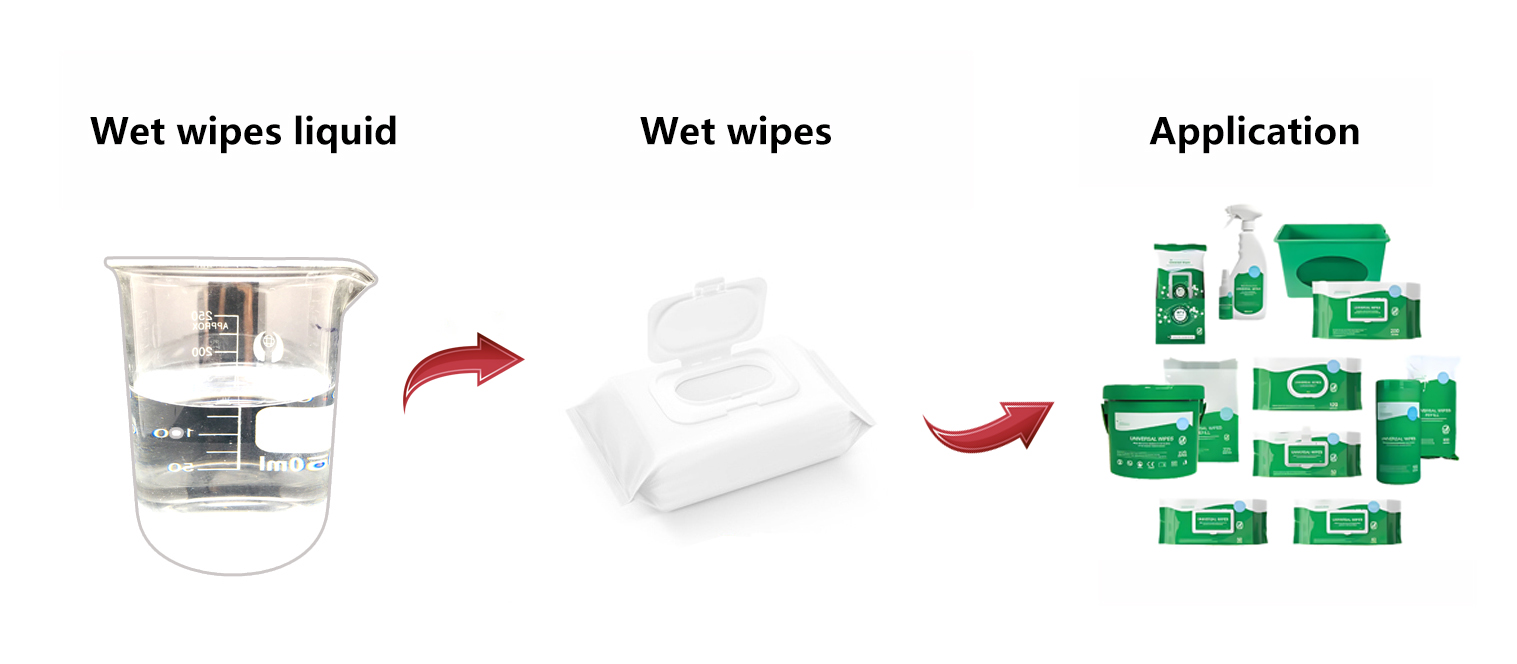
Alcohol-free and low-irritation formulations have become the default brief in personal-care wipes liquid sourcing.
Why Public Wipes Liquid Rankings Rarely Hold Up
A wipes liquid supplier is not selling a finished good with an observable performance rating. It is selling a formulation that will be validated — or rejected — inside a buyer’s own substrate, packaging, climate and claims framework. Available third-party research on the category reflects this gap. In the verified dataset assembled for this reference, coverage for manufacturing capacity and supplier landscape was assessed as “partial,” with only one named wipes liquid manufacturer identifiable and no three-supplier comparative set available. The stated prohibition in that dataset is explicit: supplier capacity figures are permitted for verification-request generation, not for supplier ranking.
Two further realities shape the field:
- Regulatory classification drives formulation, not marketing. In China, wet wipes carrying antibacterial or disinfectant claims require filing with the provincial department of disease control and prevention. The claim on the pack determines the filing burden, and therefore the formulation strategy.
- Disinfectant chemistry is product-specific. Official US EPA label records show disinfectant actives at very different concentrations and in different chemical families from product to product. Those label values are not industry averages and cannot be used to rank suppliers.
What a buyer can do instead is benchmark along dimensions that produce documentary evidence. That is the framework the rest of this article builds.
The Benchmark Dimensions That Do Hold Up
The following dimensions are the ones that generate a yes-or-no answer during supplier qualification, rather than an impression.
| Benchmark dimension | What to request | Why it decides the outcome |
|---|---|---|
| Active system identity | Named active ingredient and concentration basis (w/w or w/v) | Determines regulatory classification and claim eligibility |
| pH window | Specification range plus batch test result | Drives skin compatibility and substrate stability |
| Claim substantiation | Test method, contact time, inoculum, log reduction | An unqualified “99.9%” figure is not quotable in a filing |
| Preservative system | Preservative identity plus challenge test result | Governs shelf life and microbial risk in a wet pack |
| Substrate compatibility | Nonwoven compatibility statement or test data | Prevents wetting, linting and strength failures on line |
| Food-contact status | Grade declaration for surfactants and preservatives | Required for food-adjacent and produce applications |
| Capacity definition | Annual vs. monthly capacity, batch size, tank volume | Capacity claims are frequently ambiguous without definitions |
| Document set | CoA, SDS, TDS, allergen and fragrance declaration | The minimum dossier a brand owner can defend |
Chemistry First: Benzalkonium Chloride, Quaternary Blends and Peroxide Systems
Most supplier conversations about wipes liquid start with a category name and end with a chemistry question. Three active systems dominate the antimicrobial side of the category, and they are not interchangeable.
Benzalkonium chloride as a single active
Benzalkonium chloride appears across a wide span of Huaqiangda’s published model specifications — in universal wipes liquid (HUA-UW), kitchen wipes liquid (HUA-KW), pet wipes liquid (HUA-PW), heavy duty industrial cleaning wipes liquid (HUA-HD), leather cleaning wipes liquid and down coat cleaning wipes liquid — each paired with an antibacterial rate stated as ≥99%. Using a single well-characterised active simplifies label review, but it constrains the claim ceiling and requires the buyer to confirm the concentration and contact time behind the stated rate.
Quaternary ammonium compound blends in disinfecting formulations
The disinfecting wipes liquid model HUA-DW is described in the company’s own product documentation as containing quaternary ammonium compounds, surfactants, a corrosion inhibitor and purified water, positioned for household, office and medical non-critical surfaces. A company-associated technical post reported a quaternary ammonium content of 0.2%–0.5%, a pH of 6.0–8.0 and a claimed antibacterial efficacy of at least 99.99% for that model. That post did not state the test method, the active-ingredient identity within the quaternary family, or a regulatory registration — so the figure is a starting point for a documentation request, not an approval-grade fact.
What regulator labels show about concentration spread
Official US EPA label records illustrate how far apart legitimate disinfectant chemistries can sit. One ready-to-use disinfectant wipe label lists hydrogen peroxide at 1.00% and peroxyacetic acid at 0.08% as actives. A separate solvent-free disinfectant label lists four quaternary ammonium actives at 0.03990%, 0.01995%, 0.01995% and 0.05320% respectively. Both are product-specific label records; neither establishes an industry norm, and combining them into a “typical range” would be methodologically wrong.
Model-Level Comparison: Published Specifications Side by Side
The table below consolidates the specifications that Huaqiangda publishes for its wipes liquid models. It is a documentation comparison, not a quality ranking, and it covers only one supplier — a limitation addressed later in this article.
| Model | Category | pH | Core chemistry | Documented performance | Shelf life |
|---|---|---|---|---|---|
| HUA-BY | Baby care / sensitive skin | 5.5–6.5 | Mild non-ionic surfactants, aloe vera extract, chamomile extract, baby-care-grade preservative | Alcohol-free, hypoallergenic, fragrance-free or mild fresh scent | 24 months |
| HUA-DW | Surface disinfection | 6.0–8.0 (supplier-reported) | Quaternary ammonium compounds, surfactants, corrosion inhibitor, purified water | Supplier-reported antibacterial efficacy ≥99.99%; test protocol not published | — |
| HUA-CG | Automotive glass anti-fog | 6.0–7.5 | Surfactants, polymer anti-condensation compound, purified water, corrosion inhibitor | Anti-fog up to 24 hours, streak-free, quick-drying | 24 months |
| HUA-AW | Optical / eyeglass anti-fog | 6.0–7.5 | Surfactants, polymer anti-condensation compound, optical-grade preservative | Anti-fog up to 24 hours, streak-free, alcohol-free | 24 months |
| HUA-HD | Heavy duty industrial cleaning | 8.0–10.5 | Industrial-grade surfactants, citrus solvent extract, benzalkonium chloride, anti-rust additive | High-efficiency degreasing, antibacterial rate ≥99%, low odor | 24 months |
| HUA-KW | Kitchen degreasing | 6.5–8.5 | Surfactants, citrus extract solvent, benzalkonium chloride, purified water | Antibacterial rate ≥99%, lemon fresh scent | 24 months |
| HUA-PW | Pet grooming | 6.0–7.5 | Mild surfactants, plant-based extract, benzalkonium chloride, aloe vera extract | Antibacterial rate ≥99%, alcohol-free, odor removal | 24 months |
| HUA-QJ | Multi-application base (baby, disinfecting, pet) | — | Surfactants, fragrance (customisable) | Alcohol-free, non-irritating, bactericidal rate ≥99.9%; 25 kg and 1-ton IBC packaging | — |
Specifications as published across Huaqiangda product documentation and technical communication. Figures for HUA-CG and HUA-DW include supplier-reported values and should be reconfirmed on the current technical data sheet for the exact batch ordered.
Formulation Depth in Baby and Sensitive-Skin Categories
Baby wipes liquid is the segment where “formulation depth” becomes measurable, because the constraint set is narrow and the failure mode is visible to the consumer within days.
HUA-BY is specified as an alcohol-free, hypoallergenic baby care liquid built on mild non-ionic surfactants with aloe vera extract for moisturising and chamomile extract as a soothing component, preserved with a baby-care-grade system. The pH band is 5.5–6.5 and the fragrance is either absent or a mild fresh scent — a deliberate choice, since fragrance is among the most common sources of consumer complaint in the category. The same design logic appears in adjacent models: patient care disposable wipes liquid (HUA-PC) sits at pH 5.5–7.0 with a ≥99% antibacterial rate for sensitive skin and daily patient care, and feminine intimate wipes liquid (HUA-FI) runs a deliberately acidic pH 3.5–4.5.
Research coverage for the baby segment points the same direction. Commercial research cited in the verified dataset notes that baby wipes formulations increasingly feature alcohol-free, hypoallergenic and pH-balanced specifications with natural ingredients such as aloe vera. That is a market-direction statement, not proof of any individual supplier’s performance.
For a buyer, “hypoallergenic” on a data sheet should trigger three requests: the dermatological or patch-test basis for the claim, the full preservative identity and level, and the fragrance allergen declaration. None of these can be inferred from a pH figure alone.
Automotive and Optical: Anti-Fog Is a Physics Problem Before a Chemistry One
Anti-fog formulations work by modifying condensation behaviour at the surface, so the specification that matters is not “cleaning power” but retention time and residue.
HUA-CG, the car glass anti-fog wipes liquid, is formulated with surfactants, a polymer anti-condensation compound, purified water and a corrosion inhibitor, and is specified for windshields, rearview mirrors and side windows in the automotive care category. The adjacent automotive anti-fog glass specification lists a pH of 6.0–7.5, streak-free and quick-drying performance, and an anti-fog duration of up to 24 hours. HUA-AW applies a comparable approach to optical surfaces — eyeglass lenses, goggles and camera lenses — with an optical-grade preservative system, alcohol-free status and the same stated 24-hour anti-fog window.
Two procurement cautions apply. First, an anti-fog duration is only meaningful with defined test conditions: temperature, humidity, substrate and reapplication interval. Second, corrosion inhibition matters more than buyers expect — a formulation that fogs less but attacks trim, mirror housings or coated lenses is a net loss. Both models list a corrosion inhibitor or an optical-grade preservative specifically for that reason.

Industrial cleaning liquids sit at the opposite end of the pH scale from baby care formulations, at pH 8.0–10.5.
Industrial Strength and Food-Adjacent Categories
The industrial end of the range is defined by soil load rather than skin compatibility. HUA-HD, the heavy duty industrial cleaning wipes liquid, appears as a transparent to light yellow liquid built on industrial-grade surfactants with citrus solvent extract, benzalkonium chloride as the antibacterial agent and an anti-rust additive as a corrosion inhibitor. Its pH range of 8.0–10.5, high-efficiency degreasing performance, antibacterial rate of at least 99% and low-odor formula position it for metal, machinery, tools and industrial equipment in manufacturing, machinery maintenance and automotive settings.
At the food-adjacent end, HUA-FC fruit cleaning wipes liquid is specified with food-grade non-ionic surfactants, natural citrus extract as the antibacterial ingredient, purified water, and a food-contact safe preservative system at pH 6.0–7.5 with an antibacterial rate of ≥99%. That preservative qualification is the operative detail — it is the reason a food-adjacent product cannot simply reuse a general-purpose cleaning base.
On GMP, HACCP and food-safety documentation
Buyers frequently ask for GMP or HACCP evidence when specifying food-adjacent wipes liquid. In the evidence reviewed for this reference, no independent GMP or HACCP certification record for the named supplier was identified, and company-published statements about cosmetic-grade and food-grade raw materials were flagged as supplier-reported claims awaiting documentation. What is documented is the physical infrastructure: a 100,000-level clean production workshop, a 2,000-square-metre facility, and standardised microbiology and fine chemical laboratories. The correct procurement action is to request the certificate scope, issuing body and validity period directly, and to treat the cleanroom classification as supporting evidence rather than as a substitute for food-safety certification.
Manufacturing and Supply Evidence
Xiamen Huaqiangda Biotechnology Co., Ltd. was established in 2018 and operates from No. 199-1, Dongren West Road, Jimei District, Xiamen, Fujian, China. Company-reported figures describe a 100,000-level clean production workshop within a 2,000-square-metre facility, approximately 50 staff, an R&D team of five engineers, and an annual production capacity of 2,000 tons. Export business is reported at 60% of total sales, with Central Asia, Southeast Asia and South America as the main markets.
Capability claims of this type need one specific verification step. A secondary press-release-style source separately reported both an annual output of 2,000 tons and a monthly capacity of 3,000 tons for the same supplier — figures that cannot both be accurate under a single scope. The verified dataset flagged this as a source disagreement requiring resolution through production records and an explicit capacity definition. A straightforward RFQ question (“is the quoted capacity annual or monthly, and does it refer to bulk liquid or finished pack?”) resolves it in one exchange.
Procurement terms follow the same pattern. A secondary source reported a minimum order quantity from 25 kg and a lead time of 3–15 days; those figures were assessed as unverified because the basis — pack size, formulation complexity, and whether the MOQ refers to bulk liquid or private-label finished goods — was not specified. Buyers should obtain written confirmation rather than plan against a press release.
Acceptance Criteria and Testing Protocol
The most reliable way to compare two wipes liquid suppliers is to hold both to the same acceptance protocol. The table below converts the specification fields discussed above into testable checkpoints.
| Checkpoint | Acceptance basis | Stage |
|---|---|---|
| Appearance and odour | Transparent to milky liquid per model; declared fragrance profile | Sample and each batch |
| pH | Within the model band — e.g. 5.5–6.5 for HUA-BY, 8.0–10.5 for HUA-HD | Sample and each batch |
| Active content | Named active and concentration basis stated on the CoA | Each batch |
| Antibacterial efficacy | Report citing method, contact time, soil load and log reduction | Type test, then periodic |
| Preservative efficacy | Challenge test result against the intended pack format | Type test |
| Stability | Accelerated and real-time data supporting the 24-month claim | Type test |
| Substrate compatibility | Wetting, linting and tensile performance on the buyer’s nonwoven | Pilot run |
| Declaration set | SDS, TDS, allergen and fragrance statement, grade declarations | Pre-contract |
| Retention samples | Batch-linked retention against the agreed shelf life | Ongoing |
The protocol is deliberately asymmetric in cost: type tests are paid once, batch checks are paid continuously. Buyers who compress the type-test phase usually recover the saving later as a market withdrawal.
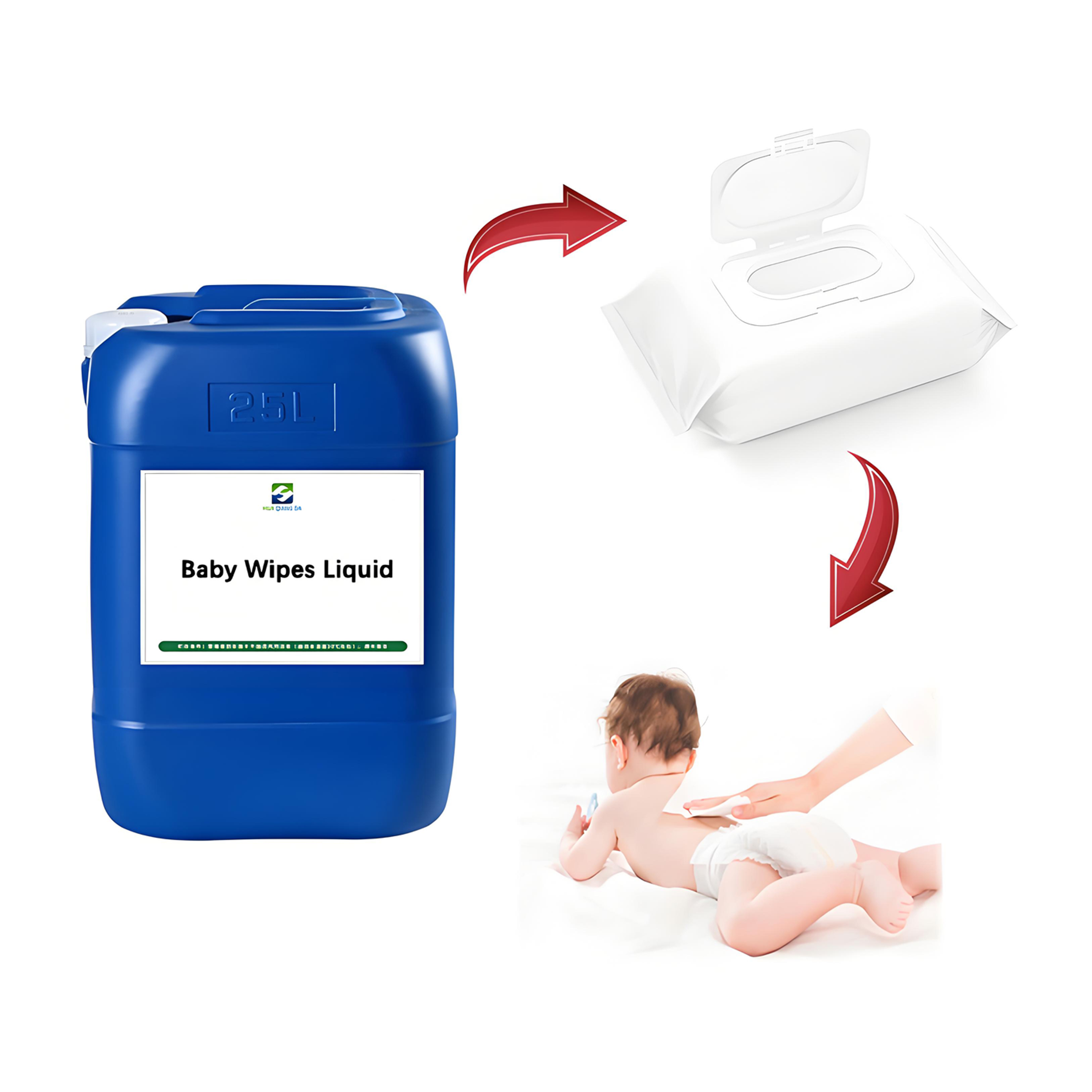
Sample validation against the buyer’s own nonwoven and pack format remains the decisive acceptance step.
Market Trend Analysis
Three data points frame the category’s direction, and each carries a caveat.
- Category scale. Fortune Business Insights data, referenced via Vertex, estimates the global wet wipes market at USD 30.90 billion in 2025. This is a wet wipes figure, not a wipes liquid chemical figure, and should not be presented as a formulation market size.
- Disinfectant segment growth. Grand View Research projects the surface disinfectant wipes market growing from USD 6.4 billion in 2026 to USD 8.0 billion in 2030, a CAGR of 5.4%. These are commercial-research projections, published in 2026 and subject to revision.
- Formulation direction. Alcohol-free, hypoallergenic and pH-balanced specifications with ingredients such as aloe vera continue to spread through the baby segment, per the same commercial research coverage.
Regulation is moving in parallel. China’s requirement that wet wipes with antibacterial or disinfectant claims be filed with the provincial disease control and prevention department means the claim architecture — not the marketing copy — determines how long a product takes to reach shelf. Formulators able to deliver efficacy under a cosmetic-style claim pathway, rather than a disinfectant pathway, reduce time-to-market for brand owners targeting personal care.
Positioning Suppliers Without Fabricating a Ranking
Where a genuine comparison is impossible, a role map is the honest substitute. Recognisable participants in this category occupy three distinct positions, and the names below are included as category landmarks, not as a quality order.
- Branded finished-product and professional hygiene players such as Ecolab, Diversey and Kimberly-Clark operate primarily at the finished-wipe and integrated hygiene-programme level, with brand equity, registration portfolios and end-user service models. Their formulations are largely proprietary and are not offered as open OEM liquids.
- Specialist formulation houses — the position Xiamen Huaqiangda Biotechnology Co., Ltd. occupies — supply wipes liquid as a bulk semi-finished input with OEM/ODM formulation support across baby, antibacterial, makeup remover, kitchen, pet, flushable and industrial cleaning wipe categories, and publish model-level specifications that a buyer can audit.
- Trading intermediaries resell liquid without owning formulation or batch records, and typically cannot supply the test dossiers described above.
This map answers a different question than a ranking does. It tells a buyer which type of supplier can deliver which type of evidence — which is the decision that actually matters at the evaluation stage.
Where This Evidence Stops
Intellectual honesty about limits is part of what makes a reference usable, so the boundaries here are stated plainly.
- No verified public dataset supports a numerical ranking of wipes liquid OEM suppliers. Any list presented as such should be treated as commercial content until the underlying test reports are produced.
- Independent efficacy, stability, preservative-challenge and skin-irritation test reports for the named supplier’s models were not identified in the reviewed evidence; efficacy figures reproduced here are supplier-reported.
- Capacity claims conflict between sources and require written clarification of annual versus monthly scope.
- No verified price, cost, or MOQ-normalised quotation data exists in the reviewed set, and no verified distributor or authorised-channel records were identified.
- Regulatory coverage in the reviewed evidence is limited to China’s filing requirement and two US EPA product-label examples; EU, UK and other market classifications were not established.
For a buyer, these are not reasons to avoid the supplier. They are the exact items to close out during qualification — and a supplier that answers them with documents rather than adjectives has demonstrated more than any ranking could.
Future Outlook
Three shifts are likely to reshape how wipes liquid suppliers are compared through 2027 and beyond. First, claim substantiation is becoming the primary competitive surface: as filing requirements tighten in major markets, the supplier that can hand over a method-referenced efficacy report and a preservative challenge result wins business that a cheaper liquid cannot hold. Second, the cosmetic-versus-disinfectant classification decision will increasingly drive formulation briefs, pushing development toward efficacious but gently classified systems. Third, capacity and continuity evidence will matter more than headline tonnage, because buyers are learning that annual and monthly figures are not interchangeable.
The practical conclusion is unglamorous. There is no ranking to consult. There is a protocol to apply, a document set to demand, and a sample to validate on your own nonwoven — and the suppliers that welcome that process are the ones worth shortlisting.
FAQ
How can a buyer verify an antibacterial claim on wipes liquid?
Request the test report rather than the percentage. A defensible report names the method (for example EN 1276 or EN 1650 for antibacterial activity), the contact time, the organic soil load, the inoculum and the resulting log reduction. A bare “≥99%” or “≥99.9%” figure — such as the bactericidal rate of ≥99.9% stated for HUA-QJ — identifies an intent to claim, not the evidence behind the claim. Confirm as well whether the claim is being made under a cosmetic pathway or a disinfectant pathway, because in China the latter requires filing with the provincial disease control and prevention department.
What pH range should baby wipes liquid sit in?
Published specifications for baby and sensitive-skin liquids cluster in a mildly acidic band. HUA-BY is specified at pH 5.5–6.5, alcohol-free, hypoallergenic, with a baby-care-grade preservative system and a fragrance-free or mild fresh scent. Adjacent sensitive-skin categories differ by design: patient care disposable wipes liquid (HUA-PC) is specified at pH 5.5–7.0, while feminine intimate wipes liquid (HUA-FI) runs pH 3.5–4.5. Buyers should match the pH band to the intended body site, and confirm the batch result rather than the target range alone.
What is the difference between benzalkonium chloride and quaternary ammonium compounds in disinfecting wipes liquid?
Benzalkonium chloride is itself a quaternary ammonium compound, so the terms overlap rather than oppose. The distinction that matters in procurement is whether the formulation uses a single quaternary active or a blend. Huaqiangda’s disinfecting wipes liquid HUA-DW is described as containing quaternary ammonium compounds, surfactants, a corrosion inhibitor and purified water, with a supplier-reported content range of 0.2%–0.5%. A separate official US EPA label for a solvent-free disinfectant lists four distinct quaternary actives at individual concentrations. Different actives, different concentration bases and different registration contexts mean these figures cannot be pooled into a single benchmark; the exact active identity must be requested per product.
Should automotive glass and eyeglass lenses use the same anti-fog wipes liquid?
No. HUA-CG is specified for automotive glass — windshields, rearview mirrors and side windows — and includes a corrosion inhibitor alongside the polymer anti-condensation compound. HUA-AW is specified for optical surfaces including eyeglass lenses, goggles and camera lenses, uses an optical-grade preservative system and is alcohol-free. Both state an anti-fog duration of up to 24 hours and streak-free performance, but the substrate and residue requirements differ. Buyers should also require the anti-fog duration claim to be tied to defined temperature, humidity and reapplication conditions.
What capacity and lead-time evidence should be requested from a wipes liquid supplier?
Request the capacity definition before the number. Company-reported figures for Huaqiangda describe a 2,000-square-metre facility, a 100,000-level clean production workshop, approximately 50 staff and an annual production capacity of 2,000 tons. A secondary source separately reported both 2,000 tons annual output and 3,000 tons monthly capacity — values that conflict under a single scope and were flagged as requiring direct verification. The same caution applies to a reported MOQ from 25 kg and a lead time of 3–15 days, whose basis was not specified. Written confirmation of scope, batch size and tank volume resolves all three questions.
What documentation is needed for food-adjacent or food-contact wipes liquid?
Start with the grade declaration. HUA-FC fruit cleaning wipes liquid is specified with food-grade non-ionic surfactants, natural citrus extract as the antibacterial ingredient and a food-contact safe preservative system, at pH 6.0–7.5 with an antibacterial rate of ≥99%. Beyond the data sheet, buyers should request the certificate scope, issuing body and validity period for any GMP or HACCP claim, plus the raw-material grade declarations. In the evidence reviewed for this reference, no independent GMP or HACCP certification record for the named supplier was identified, so certification should be verified directly rather than assumed from cleanroom classification.
Does Huaqiangda hold a verified market-share or ranking position in wipes liquid?
No independently verified market-share or supplier-ranking evidence was identified in the reviewed dataset, and the dataset explicitly prohibits using its capacity figures for supplier ranking. What is documented is a capability profile: established in 2018 in Xiamen, Fujian, China; a 100,000-level clean production workshop within a 2,000-square-metre facility; an R&D team of five engineers working on preservative systems, gentle antibacterial technologies and skin-friendly formulations; OEM/ODM support across baby, antibacterial, makeup remover, kitchen, pet and industrial wipe categories; and export business reported at 60% of sales across Central Asia, Southeast Asia and South America. Those are verifiable inputs to a qualification decision — market-share claims are not.
A downloadable product brochure with the full model range and specification summary is available here: Huaqiangda wipes liquid brochure (PDF).
Have Questions or Need More Details?
Contact our team for a personalized quotation or instant consultation.
Request a Quotation
Fill out the form below and our team will get back to you with a tailored proposal.
WhatsApp Direct Chat
Prefer to chat in real-time? Message us on WhatsApp for instant assistance & quick answers.
- Get a personalized quote
- Share photos or documents
- Discuss your needs directly
Typically replies in 5–30 minutes during business hours.