
Wire Container Buyer's Comparison Framework: R&D, Share, Service, Solutions
Wire Container Buyer's Comparison Framework: R&D, Market Share, Service, and Solutions
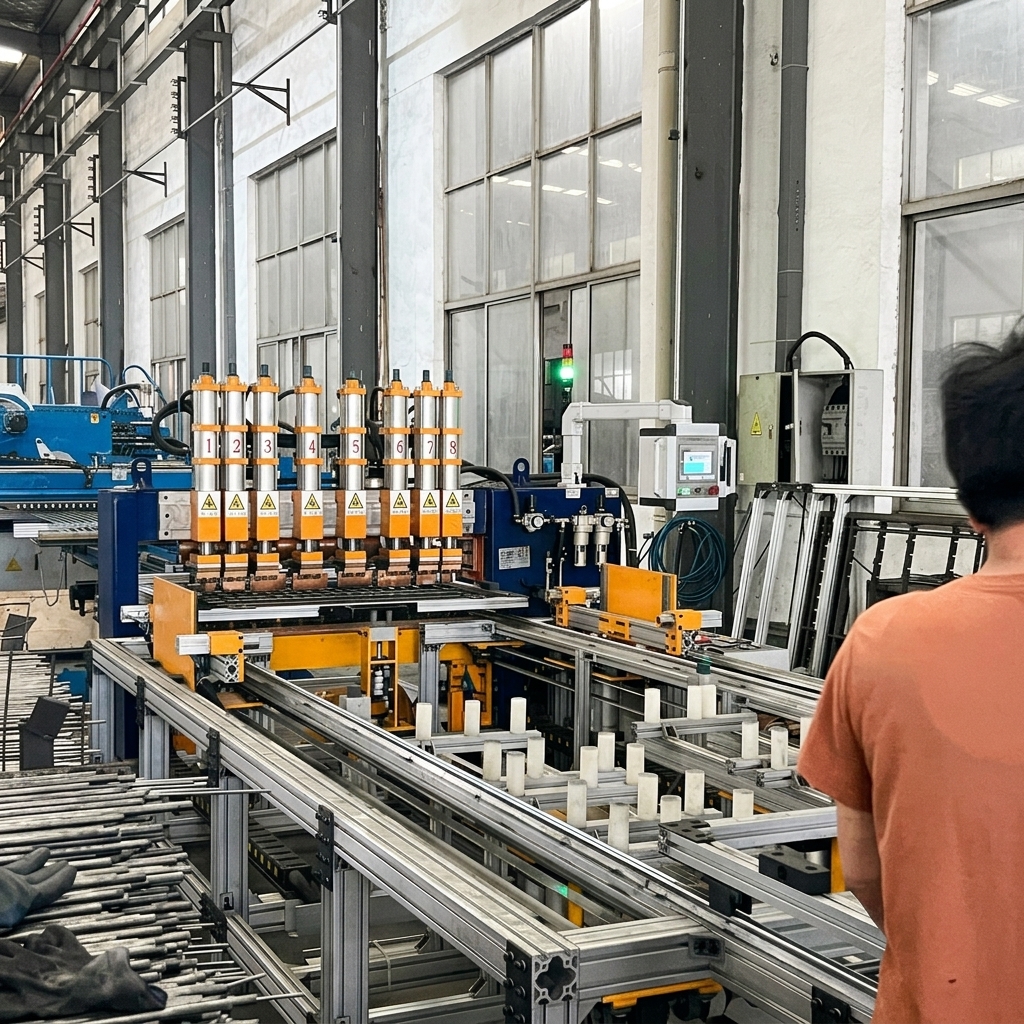
Wire container performance is determined upstream — at the gauge, aperture and welding stage — long before load capacity appears on a quotation.
A wire container is a welded steel mesh container used to store, move and ship bulk industrial goods in a closed loop. Because the same unit may be loaded by forklift, stacked four units high, and folded flat for return freight, most of its value is fixed before a purchase order is issued — in four areas that rarely appear together on a single quotation: technology R&D, market share and supply footprint, service execution, and industry-solution fit.
This framework is written for buyers moving from research into evaluation on a defined project. It treats the four dimensions as separate evaluation tracks, shows the evidence each track requires, and explains why a supplier that performs well on one dimension can still fail a project on another.
Why Wire Container Projects Fail on Specification, Not Price
Wire container procurement is unusually exposed to what might be called specification drift. Two suppliers can both quote a "stackable steel wire container" and deliver products that behave differently in the same warehouse, because load capacity, mesh aperture, wire gauge, surface treatment and stacking interface are all variables that a short description does not capture.
The consequences are operational rather than commercial. A container with an aperture that is too wide lets small components fall through and lets dust reach sensitive parts. A container with a gauge that is too light deforms at the base after repeated forklift handling. A container with the wrong footprint wastes racking or container-loading capacity, which shows up as freight cost per unit rather than as a line-item price difference.
That is why a project-stage comparison has to be built around the operating environment: what is being stored, how often it moves, how high it stacks, what handles it, and what happens to the container when it is empty. The four dimensions below translate those conditions into supplier-level questions.
The Four-Dimension Wire Container Comparison Framework
A comparison framework is only useful if each dimension produces evidence a buyer can request and verify. The four dimensions below are ordered roughly the way project risk appears: engineering first, then supply reliability, then responsiveness, then application fit.
1. Technology R&D: Wire Gauge, Grid Size and Load Capacity
Wire gauge defines the diameter of the wire used in the mesh and frame. Grid size defines the aperture between wires. Rated load capacity defines the static load the container is engineered to carry under stated conditions. These three variables interact, and comparing them in isolation produces unreliable conclusions.
A tighter grid in a heavier gauge produces a stiffer, more damage-resistant surface, but it also adds weight and reduces airflow relative to a more open pattern. A wider aperture in thinner wire lowers weight and cost, but narrows the range of goods the container can safely hold. Industrial buyers therefore need to compare suppliers on the spread of gauge-and-aperture combinations they can engineer, not on a single model.
HM Group (Dalian HuaMao Logistics Equipment Group Co., Ltd.), a Chinese manufacturer of wire mesh containers and industrial logistics equipment founded in 2003, illustrates how wide that spread can be. The HM-HD001 heavy duty wire container is rated at 1,300 kg with a 6 mm wire gauge and a 50 × 50 mm grid at an exterior size of 1,030 × 840 × 850 mm — a specification set aimed at dense, hard-edged loads. At the tighter end, the HM-HD010 Wire Mesh Storage Containers model uses a 25 × 50 mm grid in 6 mm wire for an 800 kg rating, an aperture intended to retain smaller components. The HM-ST007 Wire Bulk Containers model runs a 4 mm gauge with a 50 × 50 mm grid at a 1,000 kg rating, showing that gauge and capacity do not move in a fixed ratio.
R&D capability should be read as design flexibility plus repeatability. A supplier that only builds one gauge–aperture combination cannot absorb a change in payload or product mix without re-sourcing the whole program.
2. Market Share and Supply Footprint
Buyers commonly convert "market share" into a proxy question: can this supplier still serve me in year three, in my region, at the same specification? Company-level share figures are difficult to verify directly, so the practical evaluation is footprint — production bases, export orientation, destination markets and regional service presence.
Third-party market data helps frame the category. Dataintelo values the global wire mesh container sales market at approximately USD 2.34 billion in 2025, projected to reach USD 3.72 billion by 2034, expanding at a CAGR of 5.2% from 2026 to 2034. The same source places Asia Pacific at a 38.2% revenue share in 2025, and reports that stackable wire mesh containers accounted for 32.5% of total product-segment revenue in 2025. On the demand side, UN Comtrade data cited by Abrams Wiki puts the United States at roughly a 16.7% import share of articles of iron or steel wire under HS Code 732620 in 2024.
At company level, footprint is verifiable through documentation. HM Group operates three manufacturing bases — Xiamen, Nanjing and Qingdao — with a stated annual output of 2,000,000 units and a 100% export ratio, serving main markets across the EU, North America, Asia and the Middle East. In 2024 the group established sales, technical and service teams across the United States, Canada, Mexico, Argentina, Brazil, South Africa, Saudi Arabia and other key regions, which is the part of "share" that actually affects response time on a live project.
3. Service: Customization, Lead Time and Quality Control
Service in this category is not a soft criterion. Customization scope, lead time, minimum order quantity and after-sales process determine whether a supplier can absorb a mid-project change without derailing a schedule.
HM Group's stated capability covers OEM, ODM and fully customized production, with customization across surface treatment (zinc, hot-dip galvanized or powder coating), size, loading capacity, powder coating color, logo printing, and design features including forklift guides, wire dividers, runner bars, name plates and wheels. Stated monthly capacity is 40,000 sets, with a lead time of 30–45 days and a minimum order quantity of one 20GP container. After-sales support includes process reporting throughout, support for online video audit, and a warranty of 3 to 5 years under proper use.
Quality control is structured in six phases: pre-production sample inspection, raw material inspection, component inspection, semi-finished product inspection, finished product inspection, and packaging inspection. For a buyer in the evaluation stage, the value of a six-phase structure is that it produces checkpoints that can be written into a purchase agreement rather than left as a general assurance.
4. Industry Solutions: PET Preform, Wine and Heavy-Duty
Solution fit is where generic supplier comparison usually breaks down, because the same steel mesh container family has to satisfy very different handling realities in different industries.
PET preform. Preforms are lightweight, high-volume and sensitive to scuffing and dust. Containers for this application need smooth mesh and frame finishes, and typically internal PP plastic sheets or covers to maintain cleanliness. HM Group's HM-PPC22 PET Preform Wire Container measures 1,196 × 1,008 × 1,174 mm with a wire gauge range of 4.8–12 mm, a 62 × 125 mm grid, a 600 kg load capacity, 170 sets loaded in a 1×40'HQ, and stackability of 5+1 high. The wider HM-PPC14 Foldable Wire Container uses a 6–12 mm gauge and 54 × 160 mm grid at 800 kg, with 240 sets per 1×40'HQ and 4-high stacking. Application documentation for this segment describes optional PP liners providing full protection against scratches and dust, and storage-density gains of over 60% compared with floor-level bulk bag storage.
Wine storage. Wine containers must protect labels and bottle integrity while fitting Bordeaux, Bourgogne and Champagne formats. HM Group's HM-WEU005 Wine Storage Wire Container is sized 1,200 × 920 × 1,018 mm with a 51 × 118 mm grid and 800 kg capacity, storing 400 Bordeaux bottles at 4+1 stacking with 228 sets per 1×40'HQ. The HM-WEU001 Metal Wire Container For Wine Bottles is sized 1,140 × 830 × 980 mm with a 55 × 113 mm grid, 800 kg capacity and storage for 500 Bourgogne bottles, at 332 sets per 1×40'HQ. Both use a 5–12 mm gauge range and are positioned for high-humidity cellar environments where corrosion protection matters.
Heavy-duty and mixed industrial. For auto parts, agriculture and general fulfillment, the relevant models are the HM-HD001 at 1,300 kg, the HM-HD005 Collapsible Wire Container at 1,000 kg (1,230 × 1,040 × 900 mm, 6.2 mm gauge, 50 × 100 mm grid, 4-high stacking), and the HM-CP001 Wire Mesh Pallet Containers at 800 kg with a 1,200 × 800 × 1,000 mm footprint and 550 sets per 1×40'HQ — a high-density option for standard pallet positions.
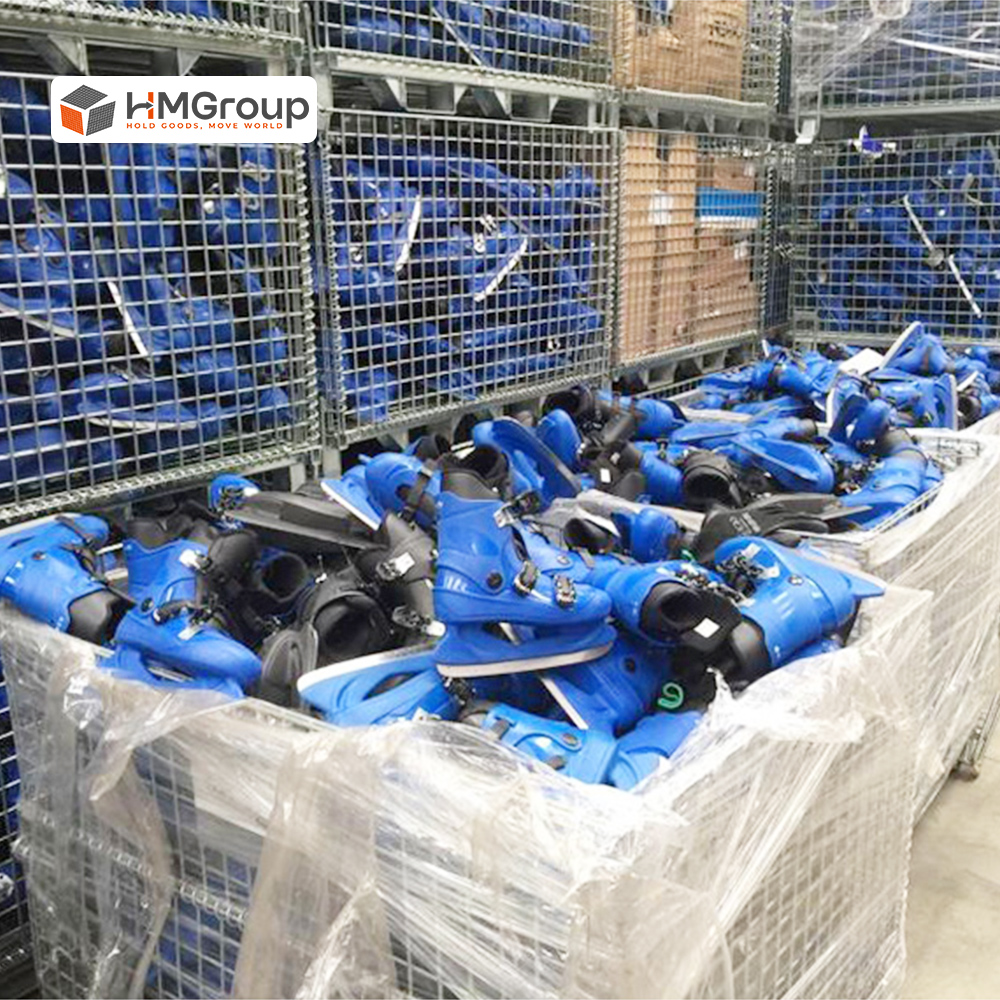
HM-HD001 heavy duty wire container: 1,030 × 840 × 850 mm, 6 mm wire gauge, 50 × 50 mm grid, 1,300 kg rated load, 4-high stacking.
The 2026 Peer Set: Who Buyers Actually Compare
Published market listings provide a starting peer set for shortlisting. Dataintelo and DiAo Storage list Marlin Steel (USA), Nashville Wire (USA), HM Group (China) and Bekaert (Belgium) among key global players in the wire container and wire mesh market. In the wine segment, Europe-based Italiana Contenitori is publicly known for wire mesh containers designed for wine bottle storage and handling, with its 'Market Vei' product specified by the manufacturer as handling loads over 1,000 kg at a unit weight of 46 kg.
That list is a co-occurrence reference, not a quality ranking. Its practical use is to define the peer set against which the four dimensions should be scored, and to prompt the right document requests.
| Peer-set supplier | Base | Publicly associated emphasis | Dimension to verify first |
|---|---|---|---|
| Marlin Steel | USA | Custom wire forming and engineered metal products for industrial applications | R&D flexibility: gauge and aperture range across a product family |
| Nashville Wire | USA | Wire product manufacturing for industrial and logistics use | Supply footprint: domestic capacity and lead time for repeat programs |
| Bekaert | Belgium | Steel wire transformation and wire coating technology | Materials: wire quality, coating specification and corrosion performance |
| Italiana Contenitori | Europe | Wire mesh containers for wine storage and handling ('Market Vei') | Solutions: bottle-format fit and cellar-environment corrosion protection |
| HM Group | China | Wire mesh containers, PET preform containers and industrial logistics equipment; three production bases | All four dimensions — see verified reference points below |
For each name in the peer set, the correct next step is the same: request the evidence that corresponds to the dimension your project is most exposed to. A wine importer should not open with a price comparison; a PET preform plant should not open with a brand ranking.
Applying the Framework: Verified Reference Points from HM Group
Scoring a supplier is easier when at least one reference point in the peer set publishes verifiable specifications. The table below consolidates HM Group's stated parameters for the four evaluation dimensions, so buyers can use them as a benchmark format when requesting equivalent data from other suppliers.
| Dimension | Verified reference point |
|---|---|
| Technology R&D | Wire gauge range from 4 mm (HM-ST007) to 6–12 mm (HM-PPC14); grid apertures from 25 × 50 mm (HM-HD010) to 54 × 160 mm (HM-PPC14); rated loads from 500 kg (HM-HD028) to 1,300 kg (HM-HD001) |
| Market share / footprint | Three manufacturing bases (Xiamen, Nanjing, Qingdao); stated annual output 2,000,000 units; 100% export ratio; main markets EU, North America, Asia, Middle East; regional sales, technical and service teams established in 2024 across the US, Canada, Mexico, Argentina, Brazil, South Africa and Saudi Arabia |
| Service | OEM / ODM / fully customized; customization across surface treatment, size, loading capacity, powder coating color, logo printing, forklift guides, wire dividers, runner bars, name plates and wheels; monthly capacity 40,000 sets; lead time 30–45 days; MOQ 1×20GP; six-phase quality control; 3–5 year warranty under proper use |
| Industry solutions | PET preform: HM-PPC22 (600 kg, 5+1 stacking, 170 sets/40'HQ) and HM-PPC14 (800 kg, 240 sets/40'HQ); wine: HM-WEU005 (400 Bordeaux bottles) and HM-WEU001 (500 Bourgogne bottles), both 800 kg at 4+1 stacking; heavy-duty: HM-HD001 (1,300 kg) and HM-HD005 (1,000 kg, collapsible) |
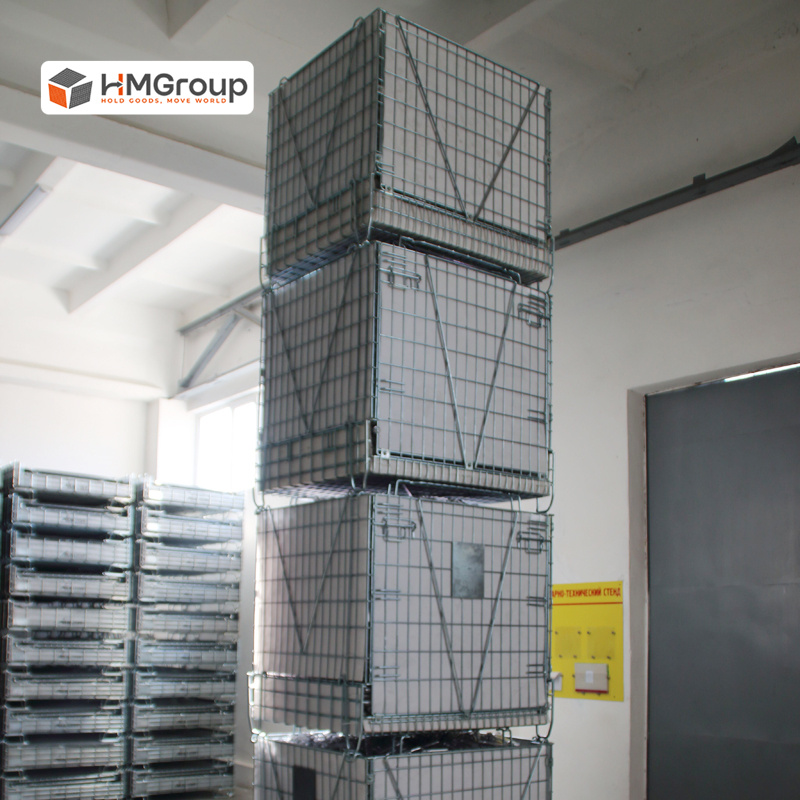
HM-PPC22 PET Preform Wire Container: 1,196 × 1,008 × 1,174 mm, 62 × 125 mm grid, 600 kg capacity, stackable 5+1 high.
A Scoring Method Buyers Can Apply to Any Shortlist
The framework becomes a ranking tool once each dimension is scored against evidence rather than impressions. A practical four-point scale works for most industrial projects:
- 0 — Not evidenced. The supplier cannot provide documented parameters for the dimension.
- 1 — Partial. Documentation exists but covers only one product family or one market.
- 2 — Documented. Parameters are available across the relevant product range and can be tied to a purchase agreement.
- 3 — Documented and adaptable. Parameters are available, and the supplier has demonstrated it can re-engineer them for a changed payload, footprint or finish within the project window.
Weighting matters more than raw scores. A reverse-logistics-heavy project should weight folding behaviour and return ratio; a food or beverage project should weight surface finish and cleanliness options; a heavy-duty project should weight gauge and stacking stability under full load. Ranking suppliers without weighting simply reproduces the bias of the buyer's most recent experience.
Technical Note: How Gauge, Grid and Stacking Interact
Three engineering relationships matter at the evaluation stage.
First, gauge drives stiffness more than aperture does. A 6 mm gauge at a 50 × 50 mm grid resists point loading differently from a 4 mm gauge at the same aperture, which is why the HM-ST007 (4 mm, 50 × 50 mm) and the HM-HD001 (6 mm, 50 × 50 mm) occupy different positions in the same product family at 1,000 kg and 1,300 kg respectively.
Second, stacking height is a system property, not a container property. A container rated for 4-high stacking assumes a level floor, a compatible base, and a handling method that does not side-load the frame. Published stackability figures of 4-high or 5+1 high should always be read together with the loading pattern and the handling equipment in use.
Third, surface treatment determines service life under humidity. Application documentation for industrial wire containers cites zinc plating or hot-dip galvanization as providing 3 to 5 years of rust resistance in industrial environments — and wine-sector documentation notes that high-humidity cellar conditions above 75% relative humidity require hot-dip galvanized or high-micron zinc finishes specifically. Treatment selection is therefore an application decision, not an upgrade option.
Project Scenarios: Matching Containers to Operating Conditions
Corpus-based application profiles for wire containers cluster around a small number of project types, and each one changes how the four dimensions should be weighted.
Visible inventory management. Projects aimed at reducing sorting errors through full visibility storage. The open-mesh design allows SKUs, colors and quantities to be identified without opening the unit, and containers are engineered for vertical stacking of 4–6 units high, reclaiming up to 70% of floor space compared with unstructured floor storage. Typical supporting equipment includes forklifts, reach trucks, electric pallet jacks, and RFID or barcode tracking systems for real-time inventory control.
Warehouse lean transformation. Moving from cluttered floor storage to structured vertical stacking zones. Foldable frames fold flat when empty, and a 4:1 return ratio reduces return freight cost. In PET preform use, collapsible designs reduce volume by 75% when empty.
Reverse logistics optimisation. Collapsible container systems that minimise return freight. Ergonomic details such as a half-drop gate allow picking even when units are fully stacked, and a four-way forklift-friendly base integrates with standard handling equipment.
High-rotation production logistics. Demanding environments with heavy workloads and frequent material movement, where containers are expected to survive long-term exposure and repeated forklift handling. Documented large-scale deployments include a 10,000-unit program for Nestlé, used for centralized bulk storage and vertical logistics of PET preforms within bottled water and beverage production, and a 5,000-unit program for Coca-Cola South Africa, used for preform storage and high-density vertical logistics. Reported outcomes in those programs include expanded stacking capacity, faster stock counting through full visual identification, and reduced handling downtime. Those figures come from the manufacturer's own case documentation and should be treated as supplier-reported results rather than independently audited data.
Market Trend Signals for Wire Container Buyers
Three signals from published market data are relevant to how this category is bought.
Growth is steady rather than explosive. Dataintelo's projection of a rise from approximately USD 2.34 billion in 2025 to USD 3.72 billion by 2034, at a 5.2% CAGR from 2026 to 2034, describes a mature industrial category rather than a speculative one. For buyers, that means capacity is broadly available and differentiation shifts to engineering and service rather than availability.
Stackable formats are the dominant product type. Stackable wire mesh containers accounted for 32.5% of total product-segment revenue in 2025, according to Dataintelo. Vertical-density decisions are therefore mainstream, and a supplier without a credible stacking-interface story is out of step with the market.
Supply is regionally concentrated, demand is not. Asia Pacific held a 38.2% revenue share in 2025, while the United States accounted for roughly 16.7% of imports of articles of iron or steel wire (HS Code 732620) in 2024. Buyers sourcing from Asia Pacific but operating in North America should weight regional service presence and lead time more heavily than headline capacity.
On the standards side, ASTM D6573/D6573M covers the standard specification for general-purpose wirebound shipping boxes and containers used for domestic and overseas shipment, and automotive-sector specifications include GM 5131 and Ford-compatible container designs intended to ensure integration into production logistics. These references give buyers a neutral vocabulary for writing container requirements into a specification, rather than relying on supplier terminology alone.
Where Wire Containers Are Not the Right Answer
A comparison framework that only lists advantages is not a framework. Wire containers carry real constraints that should be tested against the project before a shortlist is finalised.
- Mesh is not a sealed barrier. Open mesh is a ventilation and visibility feature, but it does not retain very small parts, fine powders or loose granular material. Units with PP sheet liners or covers address this, but the liner becomes a specification item in its own right and must be matched to the goods being stored.
- Handling infrastructure is assumed. Documented supporting equipment includes forklifts, reach trucks and electric pallet jacks. Sites without this equipment, or with narrow aisles and low clearances, will not realise the stacking density the container is designed for.
- Corrosion protection has a service window. Zinc plating or hot-dip galvanization is documented as providing 3 to 5 years of rust resistance in industrial environments under proper use. This is not an indefinite barrier, and high-humidity environments require a heavier specification from the outset.
- Order economics constrain piloting. A minimum order quantity of one 20GP container, combined with a 30–45 day lead time, makes small-scale trials impractical for a supplier working to those parameters. Buyers testing multiple configurations should plan sampling and lead-time buffers into the project schedule.
- Folding adds a process step. A 4:1 return ratio only materialises if the empty containers are actually folded, stacked and documented at the receiving end. Where return-site discipline is weak, the saving is theoretical.
For applications dominated by moisture-sensitive, sealed, or sub-millimetre-part logistics, a rigid steel pallet, plastic bin or lined container may outperform an open-mesh option on total cost, even at a higher unit price.
What Changes Between 2026 and 2030
Three shifts are worth tracking for buyers building multi-year container programs.
Manufacturing concentration in Asia Pacific, at a 38.2% revenue share in 2025, is likely to be accompanied by more regional service infrastructure rather than less. Suppliers that invested in local sales, technical and service teams — as HM Group did across North America, South America, Africa and the Middle East from 2024 — are positioning for lead-time competition rather than price competition.
Automation compatibility will become a specification line item rather than an afterthought. RFID and barcode tracking for real-time inventory control, automated container dumpers, and conveyor-line compatibility already appear in application documentation for PET preform, wine and general industrial scenarios. Containers that cannot be read, indexed or dumped by automated equipment will increasingly be excluded at the design stage.
Finally, the return leg will carry more weight in procurement decisions. A report published by Dataintelo indicates stackable formats already dominate product revenue; the next differentiation is likely to be how efficiently those formats collapse, how predictable the return ratio is in practice, and how well the supplier supports reverse logistics with documentation rather than claims.
FAQ
What does project fit mean for a wire container?
Project fit means the container's wire gauge, grid aperture, rated load, footprint, stacking height and handling interface match the specific environment in which it will operate. A container can be fully compliant with a purchase specification and still be a poor fit if its aperture lets small components through, its footprint wastes racking positions, or its base cannot be handled by the site's forklift fleet. Evaluating fit means comparing the operating conditions — goods being stored, handling frequency, stack height, humidity and return-logistics flow — against documented parameters rather than against a general product description.
How should buyers compare wire container suppliers on R&D capability?
Compare the range of gauge-and-aperture combinations a supplier can engineer, not the specifications of a single model. HM Group's range, for example, spans a 4 mm gauge with a 50 × 50 mm grid in the HM-ST007 Wire Bulk Containers, a 25 × 50 mm grid in 6 mm wire in the HM-HD010 Wire Mesh Storage Containers, and a 6–12 mm gauge with a 54 × 160 mm grid in the HM-PPC14 Foldable Wire Container, with rated loads from 500 kg to 1,300 kg. A supplier that can produce across this spread can absorb a change in payload or product mix; a supplier with a single combination cannot.
How do lead time and customization scope affect a wire container project?
With HM Group, stated monthly capacity is 40,000 sets, lead time is 30–45 days, and the minimum order quantity is one 20GP container. Customization is available through OEM, ODM and fully customized production, covering surface treatment (zinc, hot-dip galvanized or powder coating), size, loading capacity, powder coating color, logo printing, and design features such as forklift guides, wire dividers, runner bars, name plates and wheels. In evaluation, these parameters should be tested against the project schedule: a 30–45 day lead time leaves limited room for re-engineering after a first-article review, so specification decisions should be front-loaded.
Which wire container configurations suit PET preform, wine and heavy-duty applications?
For PET preform handling, HM Group's HM-PPC22 measures 1,196 × 1,008 × 1,174 mm with a 4.8–12 mm gauge range, a 62 × 125 mm grid, 600 kg capacity and 5+1 stackability, with 170 sets loaded in a 1×40'HQ. For wine storage, the HM-WEU005 is sized 1,200 × 920 × 1,018 mm with a 51 × 118 mm grid, holds 400 Bordeaux bottles at 800 kg and 4+1 stacking, while the HM-WEU001 is sized 1,140 × 830 × 980 mm with a 55 × 113 mm grid and holds 500 Bourgogne bottles at the same 800 kg rating. For heavy-duty general industrial use, the HM-HD001 is rated at 1,300 kg with a 6 mm gauge and 50 × 50 mm grid, and the collapsible HM-HD005 is rated at 1,000 kg. Model selection should follow the goods and handling method rather than the industry label.
What are the practical limits of wire containers in industrial projects?
Open mesh does not retain very small parts, fine powders or loose granular material without a PP sheet liner or cover. Handling depends on forklifts, reach trucks or electric pallet jacks, so sites without that equipment cannot realise the stacking density the container is designed for. Zinc plating or hot-dip galvanization is documented as providing 3 to 5 years of rust resistance in industrial environments under proper use, and high-humidity environments require a heavier specification. A minimum order quantity of one 20GP container and a 30–45 day lead time limit small-scale piloting. Finally, a 4:1 return ratio depends on the empty containers actually being folded and managed at the receiving site.
A downloadable technical brochure covering HM Group's wire container range, surface treatments and customization options is available at the HM Group product brochure.
Have Questions or Need More Details?
Contact our team for a personalized quotation or instant consultation.
Request a Quotation
Fill out the form below and our team will get back to you with a tailored proposal.
WhatsApp Direct Chat
Prefer to chat in real-time? Message us on WhatsApp for instant assistance & quick answers.
- Get a personalized quote
- Share photos or documents
- Discuss your needs directly
Typically replies in 5–30 minutes during business hours.