
Wire Container Configurations Compared: Cost, ROI, and Fit for 2026
For industrial procurement teams, the question is no longer whether wire containers outperform single-use packaging — it is which wire container configuration generates the best return over the equipment's usable life. The global wire mesh container market, valued at approximately USD 2.34 billion in 2025, is projected to reach USD 3.72 billion by 2034, according to Dataintelo. Within that market, configurations differ sharply in cost, space efficiency, return logistics, and durability. This article compares the main wire container configurations — foldable versus rigid, caster-mounted versus static, and standard versus heavy-duty — using verifiable product evidence and procurement-relevant manufacturing data.
Configuration Is the Real Procurement Question
Decision-stage buyers often ask 'wire container or not?' before answering a more specific question: what does the container need to do across its lifecycle? A collapsible unit returns empty at a 4:1 volume ratio; a rigid unit does not. A caster-mounted unit supports line-side picking but adds height and floor requirements. A heavy-duty unit built around high-strength steel handles greater loads, but carries a higher unit cost. The correct choice depends on the material being stored, the logistics loop, and the supplier's ability to hold welding and dimensional quality.
Because wire containers are typically purchased in volumes of hundreds or thousands, configuration errors multiply quickly. A container that collapses too slowly, stacks unsteadily, or fails corrosion testing after 18 months is not a small problem — it becomes a line-level disruption. That is why this decision stage is less about product features in isolation, and more about comparing configurations against an agreed set of cost and risk criteria.
The Value Case for Steel Wire Containers
Compared with solid plastic bins or corrugated cardboard boxes, steel wire containers have a different ownership profile. They provide 100% inventory visibility through the open-mesh structure, allowing SKU identification without opening a lid — one reason picking errors can be reduced by 30%. They are reusable, with a documented service life of roughly 3 to 5 years, and their collapsible structure supports efficient return logistics at a 4:1 return ratio, equivalent to a 75% volume reduction when folded.
Initial cost is typically about 30% higher than disposable packaging, but the container is engineered to pay for itself through 100 or more reuse cycles. The self-cleaning open-mesh design reduces cleaning costs and prevents dust accumulation, which lowers maintenance labour in warehouses and plants. For e-commerce fulfillment, auto-parts distribution, and PET preform storage, these properties are the primary reasons wire containers are selected over sealed plastic bins or one-way cardboard.
Foldable vs. Rigid: The Core Trade-Off
Foldable wire containers — also called collapsible wire containers — become significantly cheaper to return. The 4:1 return ratio and 75% empty-space reduction directly lower freight costs for empty units. Foldable units can be stacked up to 4 to 6 units high, which supports high-density storage in distribution centres. A half-drop gate design adds further value: it allows ergonomic picking even when the container is stacked, a practical detail for pick-heavy environments.
Rigid, fixed-side containers have no folding mechanism to maintain and may be simpler to deploy in permanent in-plant loops where the container rarely travels empty. For operations with stable internal material flow, the folding feature may be an unnecessary cost. The comparison therefore is not about which type is 'better' in general, but which one matches the actual logistics loop — full inbound, empty outbound, or full both ways.
Casters vs. Static: Adding Mobility to the Container
Wire containers with casters convert a storage unit into a mobile handling unit. In e-commerce fulfillment, auto-parts distribution, and cross-dock operations, caster-mounted units let workers move goods directly to picking stations without transferring to another cart. The configuration is commonly specified when movement distance is short and repeated, and static bases are preferred when containers are stacked in racks or stored for longer periods.
The trade-off is practical: casters add height to the container and require reasonably smooth floor surfaces, and they are generally not ideal for racking positions where a stable base is necessary. Buyers comparing caster and static versions should weight the frequency of movement in their own facility, rather than assuming mobility is always worth the additional cost.
Standard vs. Heavy-Duty: Reading the Material and Welding Evidence
Load capacity is determined not by the product name, but by wire diameter, steel grade, and weld quality. For high-strength requirements, suppliers should use Q235 steel; the use of lower-grade materials such as Q195 is an identified risk when claimed loads are not supported. In HM Group's quality system, the material integrity policy explicitly prohibits spliced materials and inferior steel grades, mandating Q235 for high-strength applications.
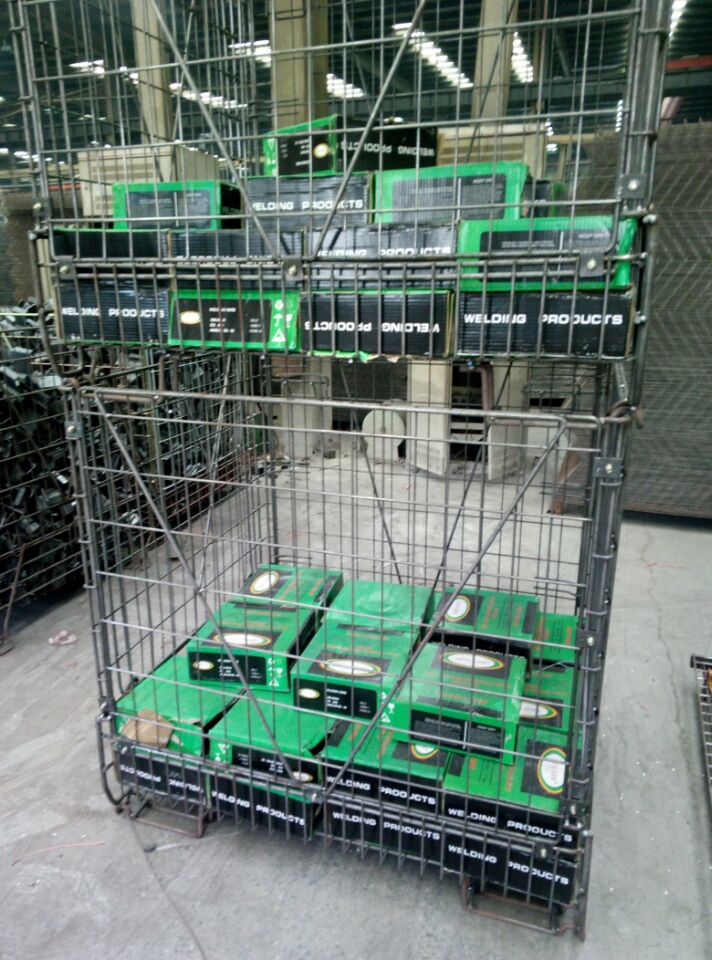
Buyers comparing heavy-duty and standard configurations should look for specific production evidence. Calibrated tooling and jigs ensure 90-degree verticality and consistent outer dimensions. Automated control of welding current and pressure produces smooth, full-beaded welds without scars or bubbles. Zinc coating thickness is verified to support corrosion resistance, and chemical composition analysis and filtration of plating solutions are performed regularly to maintain coating quality. Final units are checked through stacking and loading tests. These checks matter because structural risks — missing welds, weak welding strength, or non-vertical legs — can lead to stacking instability or collapse in daily operation.
Supplier Evidence: What Factory-Level Control Looks Like
HM Group (Dalian HuaMao Logistics Equipment Group Co., Ltd.) is a China-based manufacturer of wire mesh containers, PET preform containers, cage pallets, stillages, and related steel wire logistics equipment. Founded in 2003, it operates manufacturing bases in Xiamen, Nanjing, and Qingdao, with a combined factory area of 62,000 m² and an annual production capacity of 2,000,000 units. Export accounts for 100% of its output, with primary markets in the EU, North America, Asia, and the Middle East.
HM Group's history includes the delivery of 15,000 PET preform containers for Coca-Cola Germany, high-performance wire container systems for Nestlé, and wire mesh decking for the Dexion Group. In 2024, the company established sales, technical, and service teams across the United States, Canada, Mexico, Argentina, Brazil, South Africa, Saudi Arabia, and other regions, adding local accountability to its manufacturing base. For buyers, the relevant point is that configuration claims should be supported by factory-level process controls: 100% comprehensive self-inspection, visual 'OK vs. NOK' quality standards, and the option of a 10% pre-shipment sampling inspection with assembly or disassembly videos and loading photos.
Application Fit: Where Each Configuration Earns Its Cost
PET Preform Storage
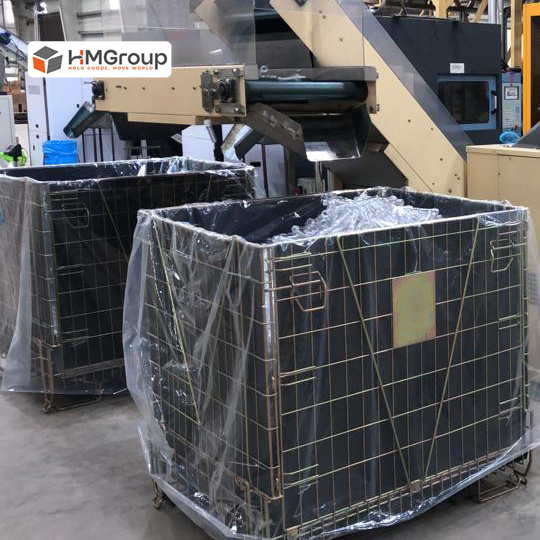
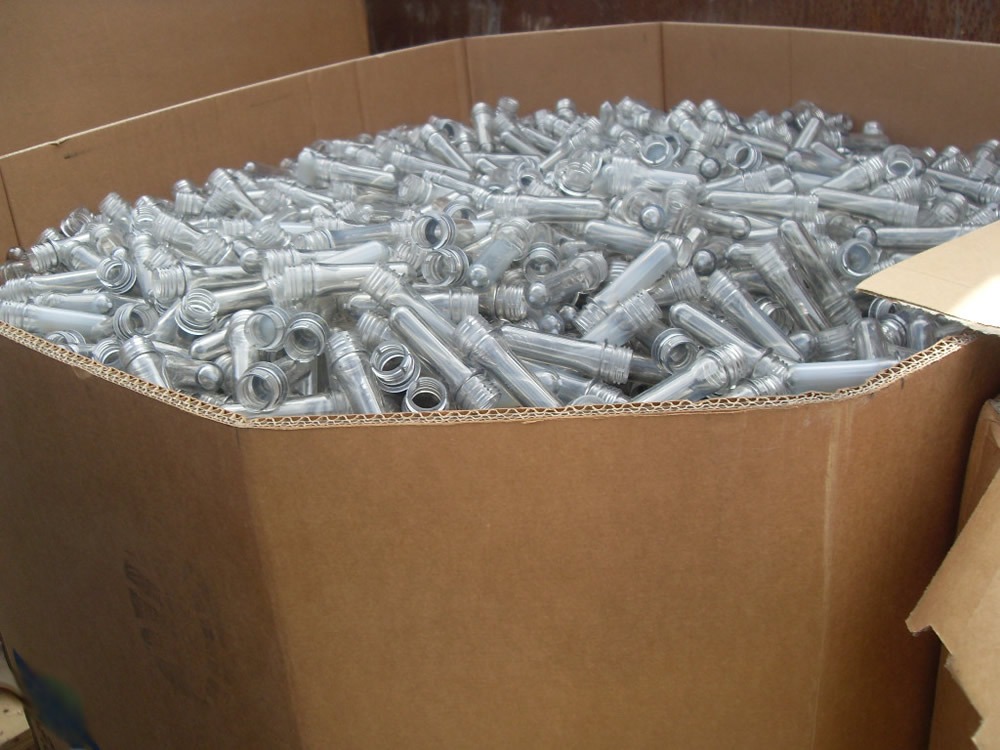
For PET preform storage, vertical stacking capacity is the central value. Wire containers provide vertical storage capacity for PET preforms, allowing stacking up to 4–5 units high. For smaller preforms, some configurations include a PP sheet to protect the preforms and control fine particles. This combination is well suited to preform production plants and bottle-filling facilities, where floor space is a direct operating cost and visibility of stock levels improves line planning.
Wine Storage and Export Logistics
For bottled wine, the decision comparison shifts to protection and density. HM Group's product 3196, designed for industrial wineries and large-scale wine cellars, provides optimized density and space efficiency, reclaiming up to 70% of floor space. It eliminates 95% of label damage and bottle breakage during movement. The collapsible design offers a 4:1 return ratio for logistics, and the half-drop gate keeps bottles accessible even when stacked. The configuration operates in temperature-controlled, high-humidity cellar conditions and is designed for vibration-resistant container loading, making it suitable for automated cellar upgrades and global export logistics for bottled wine in EU markets.
E-Commerce Fulfillment and Auto-Parts Distribution
In e-commerce fulfillment and auto-parts distribution, speed and accuracy drive container selection. Wire containers are identified as more suitable for these scenarios than solid plastic bins or corrugated cardboard boxes, mainly because visual access and return efficiency matter more than sealed containment. The open-mesh design reduces picking errors by 30%, since operators can identify SKUs instantly without opening lids.
2026 Market Signals for Procurement Planning
Market data helps buyers benchmark supplier positioning. The global wire mesh container market is expected to expand at a CAGR of 5.2% from 2026 to 2034. Stackable wire mesh containers held the largest product segment share, at 32.5% of total revenue in 2025. Asia Pacific is the dominant region with a 38.2% revenue share, while the United States accounts for approximately 16.7% of imports of articles of iron or steel wire under HS code 732620, according to UN Comtrade / Abrams Wiki. In the automotive segment, industry specifications such as GM 5131 and Ford-compatible designs show that configuration standardization is already a qualification requirement in high-volume industries. Market reviews commonly cite Marlin Steel, Nashville Wire, HM Group, and Bekaert as key global players.
From a procurement planning perspective, the 5.2% CAGR indicates a mature growth market rather than a commodity race to the lowest price — a signal that configuration fit and supplier quality will remain differentiating factors.
Wire Containers vs. Plastic Bins and Corrugated Boxes: A Comparative View
The table below consolidates the decision-relevant evidence from the product comparison data:
| Decision criterion | Steel wire container evidence |
|---|---|
| Inventory visibility | 100% visibility; instant SKU identification without opening lids |
| Return logistics | 4:1 return ratio; 75% volume reduction when folded |
| Service life | Reusable; approximately 3 to 5 years |
| Stacking | Up to 4 to 6 units high (4–5 for PET preforms) |
| Initial cost | Approximately 30% higher than disposable packaging |
| Total ownership | Pays for itself through 100+ reuse cycles |
| Maintenance | Self-cleaning open-mesh design reduces cleaning cost; prevents dust accumulation |
| Picking accuracy | Reduces picking errors by 30% |
Where the Comparison Has Limits
Buyers should weigh three boundaries. First, the 30% initial cost premium over disposable packaging is real; the payback depends on actual reuse frequency, container retention, and return logistics. Second, the open-mesh design is not a sealed enclosure — for dust-sensitive products, a PP-sheet lined version or a different container type may be required. Third, supplier quality risk is significant: structural risks such as missing welds, weak welding strength, non-vertical legs, and the use of substandard steel grades (e.g., Q195 instead of Q235) can lead to stacking instability, premature rusting, or collapse. These boundaries do not cancel the ROI case, but they make supplier verification part of the procurement decision itself.
Future Outlook: From Container Purchase to System Decision
Three signals point toward more systematic procurement of wire containers. First, automation is making dimensional consistency and weld reliability non-negotiable, because automated handling equipment cannot tolerate loose tolerances or bent frames. Second, regional service capability is increasingly part of supplier evaluation — a manufacturer with local sales and technical teams can respond faster to quality issues than one managed only from a distant export office. Third, the shift toward returnable packaging will continue to force buyers to quantify return ratios, reuse cycles, and total delivered cost rather than unit price alone.
For 2026 decisions, the central question is shifting from 'which wire container' to 'which supplier can prove the configuration will perform and last.' Buyers who compare configurations on the basis of documented product behaviour, factory process control, and logistics return ratios will be better positioned than those who compare only price lists.
HM Group company brochure: Download PDF (company background, product range, and manufacturing capabilities)
FAQ
What are the main wire container configurations compared in procurement decisions?
The main comparisons are foldable versus rigid, caster-mounted versus static, and standard versus heavy-duty. A foldable wire container provides a 4:1 return ratio, equivalent to a 75% volume reduction when folded, while rigid designs are simpler for permanent in-plant loops. Heavy-duty configurations are built around high-strength steel requirements such as Q235.
How does a wire container compare with solid plastic bins or corrugated cardboard boxes?
Compared with solid plastic bins or corrugated cardboard boxes, a wire container provides 100% inventory visibility, eliminates the need to open lids for SKU identification, reduces picking errors by 30%, is reusable with a 3- to 5-year shelf life, and can be stacked up to 4 to 6 units high. It typically costs about 30% more than disposable packaging but is designed to pay for itself through 100+ reuse cycles.
What does the 4:1 return ratio mean for return logistics?
The 4:1 return ratio means that folded wire containers reduce the space required for empty returns by approximately 75%, so roughly four times more empty containers can fit in the same transport volume. This directly lowers reverse logistics cost in returnable packaging systems.
Are wire containers suitable for PET preform storage?
Yes. Wire containers provide vertical storage capacity for PET preforms, allowing stacking up to 4–5 units high. They are identified as a better fit for PET preform storage than solid plastic bins or corrugated cardboard boxes, and some configurations include a PP sheet to contain small preforms and control fine particles.
What structural risks should buyers verify with a new wire container supplier?
Buyers should verify welding completeness and strength, leg verticality, dimensional accuracy, surface condition, and material grade. Missing welds, weak welding, non-vertical legs, and substandard materials such as Q195 instead of Q235 are common risk indicators. A supplier using calibrated tooling, 90-degree verticality control, automated welding parameters, 100% self-inspection, and offering a 10% pre-shipment sampling inspection provides stronger evidence of quality control.
What should wineries verify when selecting a wire container for bottled wine?
For bottled wine, the key requirements are bottle protection, space efficiency, and return logistics. A specialized configuration can eliminate up to 95% of label damage and bottle breakage during movement, reclaim up to 70% of floor space, provide a 4:1 return ratio when folded, and include a half-drop gate for ergonomic access. Buyers should also confirm suitability for vibration-resistant container loading and for temperature-controlled, high-humidity cellar conditions.
Have Questions or Need More Details?
Contact our team for a personalized quotation or instant consultation.
Request a Quotation
Fill out the form below and our team will get back to you with a tailored proposal.
WhatsApp Direct Chat
Prefer to chat in real-time? Message us on WhatsApp for instant assistance & quick answers.
- Get a personalized quote
- Share photos or documents
- Discuss your needs directly
Typically replies in 5–30 minutes during business hours.