
Wire Container Decision Scorecard for Multi-Year Supply
A wire container decision rarely fails at the quotation stage. It fails later — in year two, when a folded unit no longer closes cleanly, when a leg is no longer vertical enough to stack safely, or when the supplier can no longer reproduce the specification that was approved.
That gap is why this comparison is built differently from a standard product comparison. Rather than ranking wire container types against one another, it compares the criteria buyers use at the Decision stage with the criteria that decide cost at the Execution stage, and identifies the evidence that should be in hand before either stage is closed.
A wire container is a reusable welded steel mesh unit used to store, move and ship goods inside a plant, across a distribution network or on an export lane; foldable versions collapse for return transport, and specialised variants are built for PET preform, wine bottle, automotive and general industrial loads. HM Group — formally Dalian HuaMao Logistics Equipment Group Co., Ltd. — is a Chinese manufacturer of wire mesh containers and related logistics equipment, founded in 2003 and exporting 100% of its output to markets including the EU, North America, Asia and the Middle East.
Why the Comparison Shifts Between Decision and Execution
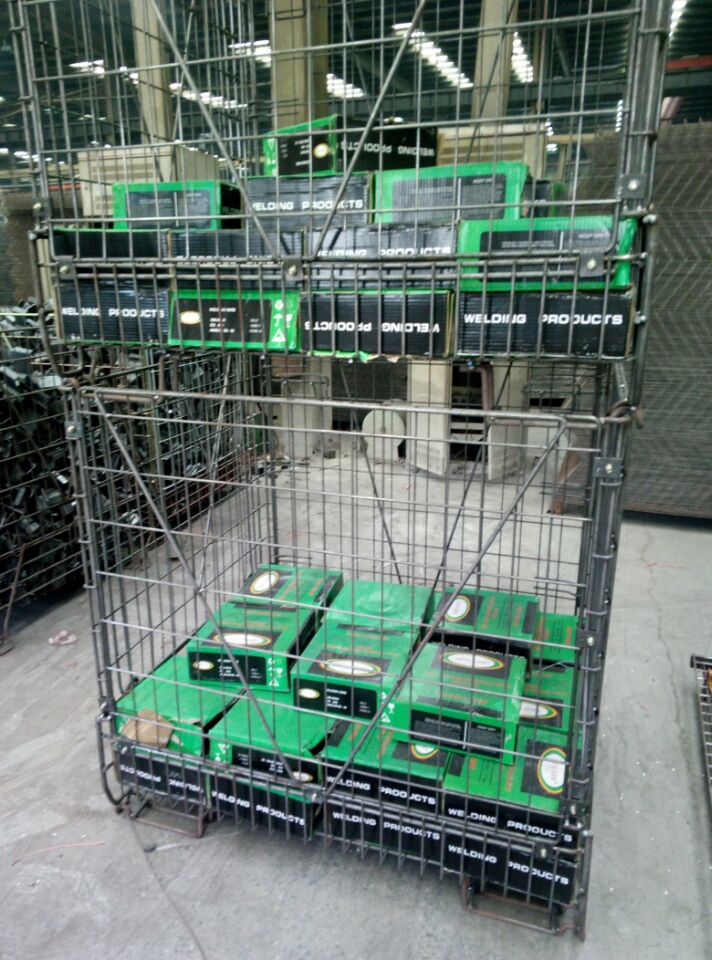
Decision-stage comparison is quote-led: unit price, payload figure, footprint, lead time. Execution-stage comparison is evidence-led: whether welds hold, whether dimensions stay stable enough to fold, whether the coating survives the actual humidity of the site, and whether the same specification can be shipped again eighteen months later. Both stages compare the same product, but they weight the same criteria very differently.
| Comparison input | Decision stage (quoting) | Execution stage (year 2 and beyond) |
|---|---|---|
| Price basis | Unit price, freight, minimum order quantity | Cost per handling cycle, replacement rate, return freight |
| Load claim | Nominal payload figure on the offer | Weld strength, leg verticality and stacking stability under real loads |
| Dimensions | Outer size on the drawing | Whether the unit still folds, nests and interfaces with automated handling after repeated cycles |
| Finish | Coating type named in the quotation | Measured coating thickness and corrosion behaviour at the site's actual humidity |
| Supplier | Reply speed and sample appearance | Batch repeatability, service response, spare-part and specification continuity |
The practical consequence is straightforward. A scorecard covering only the middle column decides a purchase. A scorecard that also covers the right column decides a supply relationship — and that is the transition buyers make when they move from Decision to Execution.
Six Comparison Dimensions That Still Matter After Year One
1. Structural integrity, evidenced rather than asserted
The failure modes worth comparing against are specific and documented: missing welds, weak welding strength, and legs that are not vertical, which lead to stacking instability or collapse. HM Group addresses this at the process level rather than the inspection level — calibrated tooling and jigs are used in every welding process to maintain 90-degree verticality and consistent dimensions, and welding current and pressure are regulated according to wire diameter so that welds are full-beaded. Torque and strength testing verifies that mesh welding strength meets or exceeds the wire diameter versus strength reference the company maintains. For a buyer, the comparison question is not "how strong is it" but "what process keeps it strong in batch 40 as well as batch one."
2. Dimensional control and folding consistency
This is the dimension most frequently omitted from a comparison and most frequently responsible for return-logistics failure. Deviation in overall size or wire diameter can prevent proper folding, stacking or automated handling — which means the volume reduction that makes a foldable container economical depends directly on dimensional discipline. Buyers comparing options should therefore ask how dimensions are controlled in production, not only what the nominal dimensions are.
3. Surface and corrosion protection, matched to the operating environment
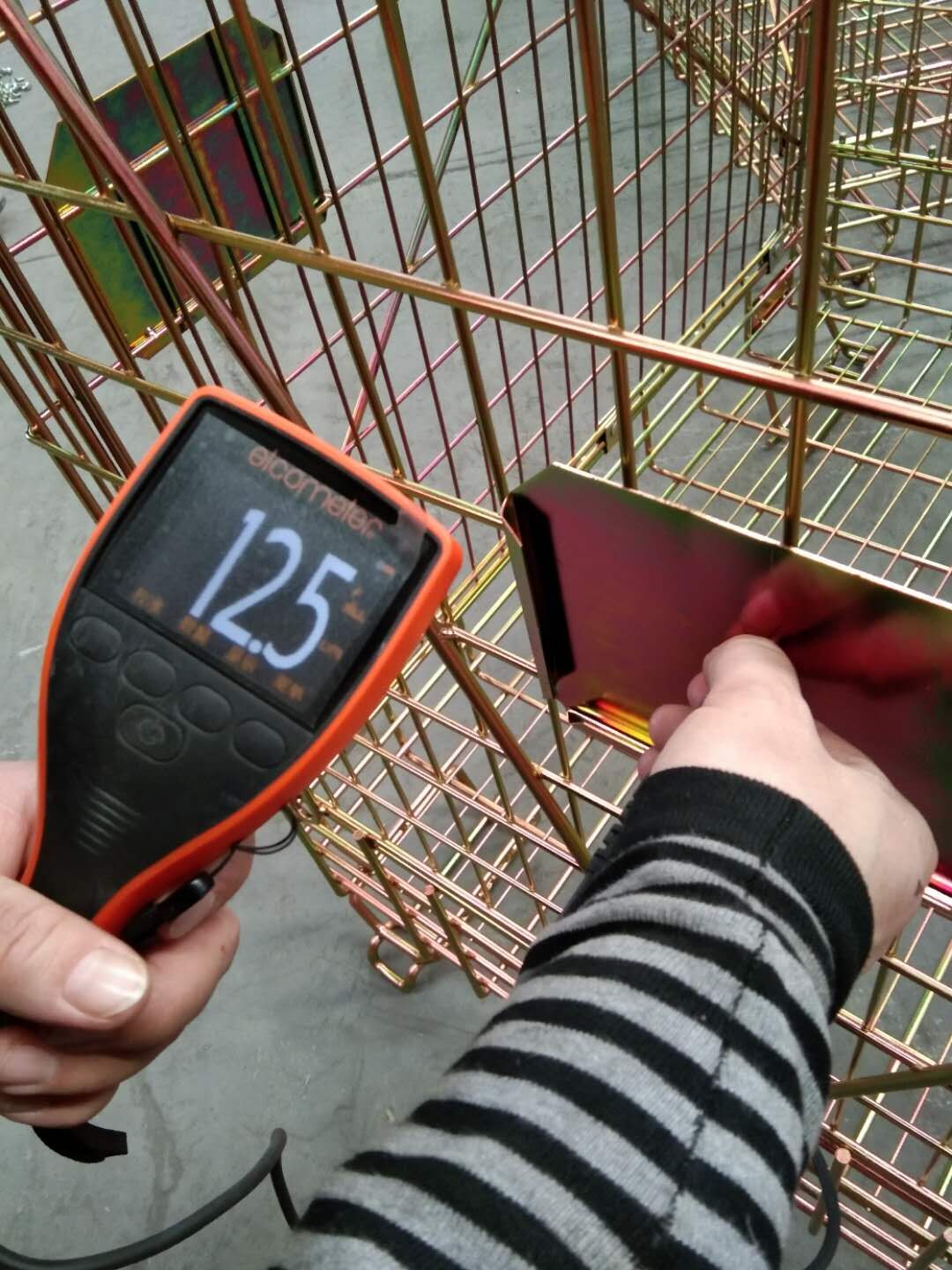
Coating is not one specification. For applications operating in humidity above 75% RH, the stated requirement is hot-dip galvanized or high-micron zinc plating. The comparison criterion is therefore whether the finish in the quotation was derived from the site's environment or carried over from a default catalogue entry. Batch stability depends on plating-solution control: chemical composition analysis and filtration of plating solutions are performed regularly to hold coating thickness and corrosion resistance within range, and zinc thickness testing provides a verifiable output rather than a promise.
4. Material grade policy
A documented material policy belongs in the comparison because it is invisible in a finished container. The risk it addresses is explicit: using substandard material such as Q195 instead of Q235 in load-bearing applications, or using spliced material, reduces load capacity and accelerates premature rust and peeling. HM Group's policy prohibits spliced material and mandates Q235 for high-strength requirements. The buyer-side check is whether the supplier will state the grade policy in writing and support it with incoming-material measurement.
5. Handling and logistics fit
A wire container is one component of a handling system, not a standalone asset. Supporting equipment matters to the comparison: electric forklifts, reach trucks and automated conveyor systems in European installations, and forklifts, automated container dumpers and RFID or barcode tracking systems in general industrial deployment. Stacking height, return ratio and picking efficiency are only realised if the handling fleet on site can execute them.
6. Supply continuity and after-sales structure
This is the dimension that separates a product comparison from a supply comparison, and it is where most scorecards are thinnest. Quantifiable inputs include monthly production capacity (40,000 sets), minimum order quantity (1x20GP container), typical lead time (30 to 45 days), the number of quality-control phases applied from pre-production to packaging inspection (six), and the warranty under proper use (3 to 5 years, matching the 3 to 5 year service life of high-tensile steel with zinc or galvanized coating). After-sales structure — process reports and online video audit support — belongs on the same line as price, not in an appendix.
| Comparison dimension | Evidence to request | If left unverified |
|---|---|---|
| Weld and structural integrity | Process description, jig and tooling control, torque and strength test method | Stacking instability, collapse risk, unpredictable payload derating |
| Dimensional control | How tolerance is held across production runs | Folding and automated handling failures; return volume reduction not achieved |
| Corrosion protection | Coating specification tied to site humidity; zinc thickness test records | Premature rust and peeling; shortened service life in humid sites |
| Material grade | Written grade policy; incoming material verification | Reduced load capacity; inconsistent batch behaviour |
| Handling fit | Container plus supporting equipment list | Benefits remain theoretical on the floor |
| Supply continuity | Capacity, MOQ, lead time, QC phases, warranty and service scope | A one-time purchase instead of a repeatable supply relationship |
Comparing Configurations by Job, Not by Catalogue
Configuration comparison becomes useful only when each option is tied to the job it has to perform. The table below sets out the most common industrial variants against what they change in the comparison, where they fit, and the boundary a buyer accepts with each.
| Configuration | What it changes | Best-fit job | Boundary to accept |
|---|---|---|---|
| Open-mesh foldable container | Full inventory visibility without opening lids, self-cleaning open-mesh design that limits dust accumulation, and a 75% volume reduction when folded | E-commerce fulfilment, auto-parts distribution, general industrial storage and shipping | The mesh is not a sealed enclosure; goods needing dust or moisture protection require a liner |
| Container with PP sheet liner | Adds a smooth contact surface and a half-drop gate for ergonomic picking | PET preform storage in cosmetic packaging and pharmaceutical plastics industries, where an ultra-smooth surface finish prevents damage to delicate preforms | A solid lining reduces the instant SKU identification that open mesh provides |
| High-stack container | Stacking up to 4 to 6 units high changes floor-space economics | Storage-dense warehouses and staging areas | Achievable height depends on floor condition, load distribution and verified weld strength, not on the catalogue figure alone |
| Bottle and wine container | Ventilation-optimised geometry; container designs in the wine segment handle loads over 1,000 kg while weighing only 46 kg (Italiana Contenitori, 'Market Vei') | Wine bottle and beverage logistics where airflow and bottle protection both matter | Ventilation-focused designs trade complete enclosure for airflow |
| Mobility-equipped variant | Moves part of the comparison to the handling route: floor surface, aisle access and who moves the unit | In-plant movement and picking routes where lifting equipment is not always available | The load documentation applying to the mobile version should be confirmed, rather than assumed from the base container rating |
| Automotive-compliant container | Design compatibility with standards such as GM 5131 and Chrysler/Ford-compatible specifications | Automotive production logistics requiring seamless integration | Compliance adds documentation and approval effort to the project timeline |
What a Documented Comparison Looks Like on the Supplier Side
A comparison framework is only usable if at least one option can be documented against it end to end. HM Group's structure illustrates what that documentation looks like. The company was founded in 2003, operates three manufacturing bases — Xiamen, Nanjing and Qingdao — across a 62,000 m² factory footprint, employs a 10-person R&D team, and produces 2,000,000 units annually with 100% export orientation. The product range covers wire mesh container, PET preform container, cage pallet, stillage, tire rack, nestainer rack, fabric roll rack, wine barrel rack, post pallet rack, wire mesh roll container, wire mesh decking, danish trolley and steel pallet.
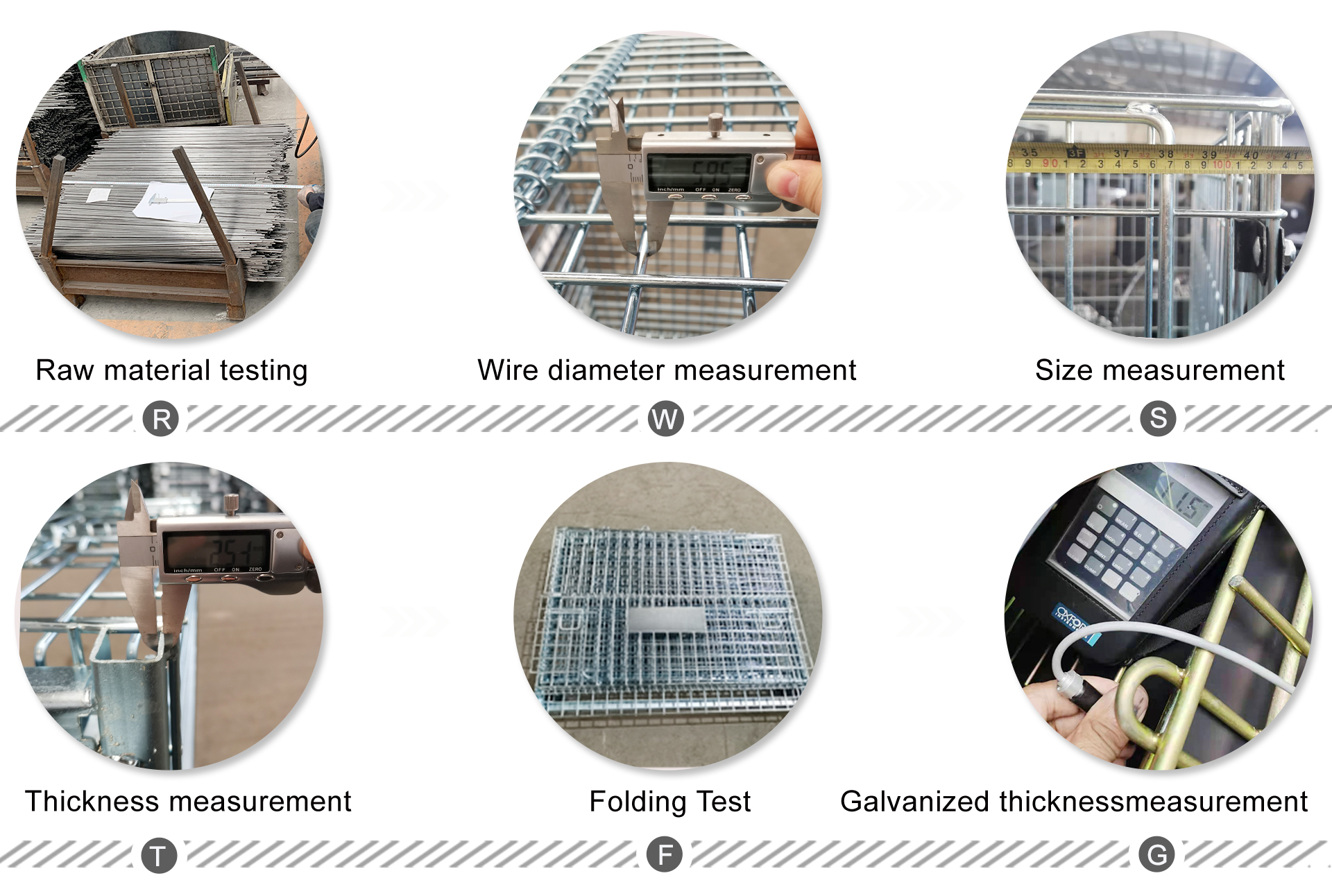
On the execution side, the company implements a six-phase quality control process from pre-production to packaging inspection and runs 100% comprehensive self-inspection on every unit rather than relying on random sampling alone for internal quality release. Production is guided by an OK versus NOK visual handbook so that defects are identified and isolated at the station. Material integrity is governed by a policy that prohibits spliced materials and inferior steel grades. For external verification, HM Group offers a 10% pre-shipment sampling inspection and supplies assembly/disassembly videos and loading photos before goods leave the port.
Service proximity is part of the same comparison. In 2024, the company established sales, technical and service teams across the United States, Canada, Mexico, Argentina, Brazil, South Africa, Saudi Arabia and other key regions — a structure that matters at the Execution stage, when response time affects uptime rather than merely the quotation score. Earlier reference projects in the company's history include 15,000 PET preform containers for Coca-Cola Germany, high-performance wire container systems for Nestlé, and wire mesh decking for the Dexion Group.
Where the Wire Container Comparison Is Genuinely Weaker
A framework that produces no negative answers is not a framework. Wire containers lose on several comparison dimensions, and buyers should price those losses into the decision.
- Upfront cost. Reusable wire containers typically carry a cost premium of roughly 30% over disposable packaging, and that premium is recovered only through reuse — the payback case depends on exceeding roughly 100 reuse cycles. Low-cycle, one-way or highly seasonal flows may never reach that threshold.
- Dependency on supporting equipment. The benefits assume access to electric forklifts, reach trucks, automated conveyors, container dumpers or tracking systems. A facility without the handling fleet cannot realise the stacking and return-ratio advantages.
- Environment-specific coating requirements. In humidity above 75% RH, standard finishes may be insufficient; hot-dip galvanized or high-micron zinc plating is required, which raises unit cost and can extend the production schedule.
- Return-logistics discipline. The 4:1 return ratio and 75% volume reduction only materialise if containers are folded and returned on a managed loop. Folding consistency depends on the dimensional control described earlier — so the logistics saving is contingent on manufacturing quality, not independent of it.
- Order scale and lead time. A minimum order quantity of 1x20GP container and a typical lead time of 30 to 45 days constrain trial-scale or urgent buyers, particularly those validating a new flow for the first time.
- Enclosure trade-offs. Open mesh maximises visibility and self-cleaning but does not seal goods. Where dust or moisture control is required, liners are needed, which reduces visibility and adds handling steps.
Market Context That Should Feed the Scorecard
Market scale affects the comparison indirectly but materially: it determines how many suppliers can support a multi-year specification, and how quickly handling standards shift. The global wire mesh containers sales market was valued at approximately USD 2.34 billion in 2025 and is projected to reach USD 3.72 billion by 2034, according to Dataintelo, with the same source projecting a CAGR of 5.2% for the forecast period from 2026 to 2034. Stackable wire mesh containers held the largest product-segment share, accounting for 32.5% of total revenue in 2025, and Asia Pacific held a 38.2% revenue share as of 2025.
On the demand side, the United States remains a major importer of articles of iron or steel wire under HS Code 732620, with a market share of approximately 16.7% in 2024 (UN Comtrade / Abrams Wiki). Standards context is also relevant to the comparison: ASTM D6573/D6573M covers the standard specification for general-purpose wirebound shipping boxes and containers used for domestic and overseas shipment, while automotive specifications such as GM 5131 and Chrysler/Ford-compatible designs exist to ensure containers integrate into production logistics.
Note on forecast divergence. Growth estimates vary with scope. Dataintelo projects 5.2% CAGR for wire mesh containers specifically, while Market Research Future projects 3.64% for the broader wire mesh market. Buyers building a multi-year capacity assumption should treat the range rather than a single figure as the planning input.
The competitive field is broad and includes named global players such as Marlin Steel (USA), Nashville Wire (USA), HM Group (China) and Bekaert (Belgium). For procurement purposes, the practical implication of a fragmented supplier base is not that options are scarce — it is that specification comparability is scarce, which is precisely what a documented scorecard resolves.
Application Fit: Where the Scorecard Changes
The weights buyers assign to the six dimensions shift by application. In PET preform storage for the cosmetic packaging and pharmaceutical plastics industries, the dominant constraint is contact surface quality: the application requires an ultra-smooth surface finish to prevent damage to delicate preforms, supported by a half-drop gate for ergonomic picking and a collapsible design that reduces volume by 75% for return transport. In beverage and wine logistics, ventilation and bottle protection dominate, and specialised designs handle loads over 1,000 kg at a container weight of only 46 kg. In e-commerce fulfilment and auto-parts distribution, visibility and cycle speed dominate — reusable mesh containers support picking accuracy through instant SKU identification without opening lids, and the open-mesh design limits dust accumulation. In automotive production logistics, standards compatibility moves to the top of the list, because a container that does not integrate with the line creates cost rather than saving it.
Future Outlook
Three shifts are likely to reshape how buyers compare wire containers over the next several development cycles. First, verification is moving from document to data: zinc thickness testing, dimensional measurement and loading tests are becoming expected attachments to a quotation rather than optional extras. Second, environmental specificity is becoming a specification discipline — humidity, washdown and corrosion exposure will increasingly determine coating choice rather than catalogue convention. Third, service proximity is becoming a scored criterion rather than an afterthought, which is visible in the regional sales, technical and service structures that manufacturers such as HM Group have been building since 2024. Buyers who build those three shifts into their scorecard now will spend less time re-negotiating specifications later.
Frequently Asked Questions
What should buyers compare first when shortlisting wire container options?
Start with the criteria that cannot be corrected after delivery: structural integrity, leg verticality and dimensional control, because deviation in overall size or wire diameter can prevent proper folding, stacking or automated handling. Material grade policy follows, since using Q195 instead of Q235 in load-bearing applications reduces load capacity. Configuration and price are variables that can be adjusted before ordering; structural and dimensional decisions generally cannot be corrected later at reasonable cost.
How does configuration change the comparison between foldable, lined and mobility-equipped containers?
Configuration determines which job the container can perform. A foldable container reduces volume by 75% when collapsed, which is what makes return logistics viable. A PP sheet-lined version adds a smooth contact surface and a half-drop gate for ergonomic picking, suited to PET preform storage where an ultra-smooth finish prevents damage to delicate preforms. Mobility-equipped variants shift part of the comparison to the handling route — floor condition, aisle access and who moves the unit — and the load documentation for that specific version should be confirmed rather than inferred from the base container rating.
What evidence should be requested to verify structural and dimensional claims?
On the manufacturer side, the relevant controls are calibrated tooling and jigs that maintain 90-degree verticality and consistent dimensions, welding current and pressure regulated by wire diameter, and torque and strength testing against a wire diameter versus strength reference. On the evidence side, HM Group applies a six-phase quality control process from pre-production to packaging inspection, performs 100% comprehensive self-inspection on every unit rather than relying on random sampling alone, works to an OK versus NOK visual handbook, and offers a 10% pre-shipment sampling inspection with assembly/disassembly videos and loading photos.
How should corrosion protection be compared for humid operating environments?
Compare the coating against the operating environment rather than against the catalogue. For applications in humidity above 75% RH, the requirement is hot-dip galvanized or high-micron zinc plating. Batch-to-batch stability depends on plating-solution control, including periodic chemical composition analysis and filtration of plating solutions to maintain coating thickness and corrosion resistance. Zinc thickness testing provides a verifiable output. Standard zinc or galvanized coating supports a 3 to 5 year service life under normal conditions; demanding environments need the upgraded specification and should be costed accordingly.
Which supporting equipment must be confirmed before a decision is finalised?
For European installations, the relevant equipment set is electric forklifts, reach trucks and automated conveyor systems. For general industrial deployment, it is forklifts, automated container dumpers, and RFID or barcode tracking systems. These belong inside the comparison because stacking height, the 4:1 return ratio and picking efficiency depend on whether the site's handling fleet can execute them. A container that outperforms on paper but cannot be moved or dumped by existing equipment will not deliver the projected benefit.
What are the standard purchasing terms and acceptance criteria?
MOQ is 1x20GP container. Delivery terms are EXW, FOB, CIF, DDP and DDU. Acceptance criteria are pre-shipment inspection or third-party inspection. Payment terms are T/T (30% in advance, 70% against copy of B/L) or L/C. Production capacity is 40,000 sets per month with a typical lead time of 30 to 45 days, and the warranty under proper use runs 3 to 5 years.
Which criteria matter most after the first order, over a multi-year horizon?
Repeatability and continuity. The relevant questions become whether the approved specification can be reproduced across batches through a six-phase quality control process, whether the material grade policy is enforced consistently, and whether service capacity exists close to the buyer. HM Group's after-sales services include process reports and online video audit support, with a 3 to 5 year warranty under proper use, and since 2024 the company has established sales, technical and service teams in the United States, Canada, Mexico, Argentina, Brazil, South Africa, Saudi Arabia and other key regions.
For buyers who need the complete specification and quality-control documentation set behind the criteria discussed here, HM Group's product brochure is available for download: HM Group product brochure (PDF).
Have Questions or Need More Details?
Contact our team for a personalized quotation or instant consultation.
Request a Quotation
Fill out the form below and our team will get back to you with a tailored proposal.
WhatsApp Direct Chat
Prefer to chat in real-time? Message us on WhatsApp for instant assistance & quick answers.
- Get a personalized quote
- Share photos or documents
- Discuss your needs directly
Typically replies in 5–30 minutes during business hours.