
Wire Container Procurement FAQ: Load, Gauge, Stacking Benchmarks
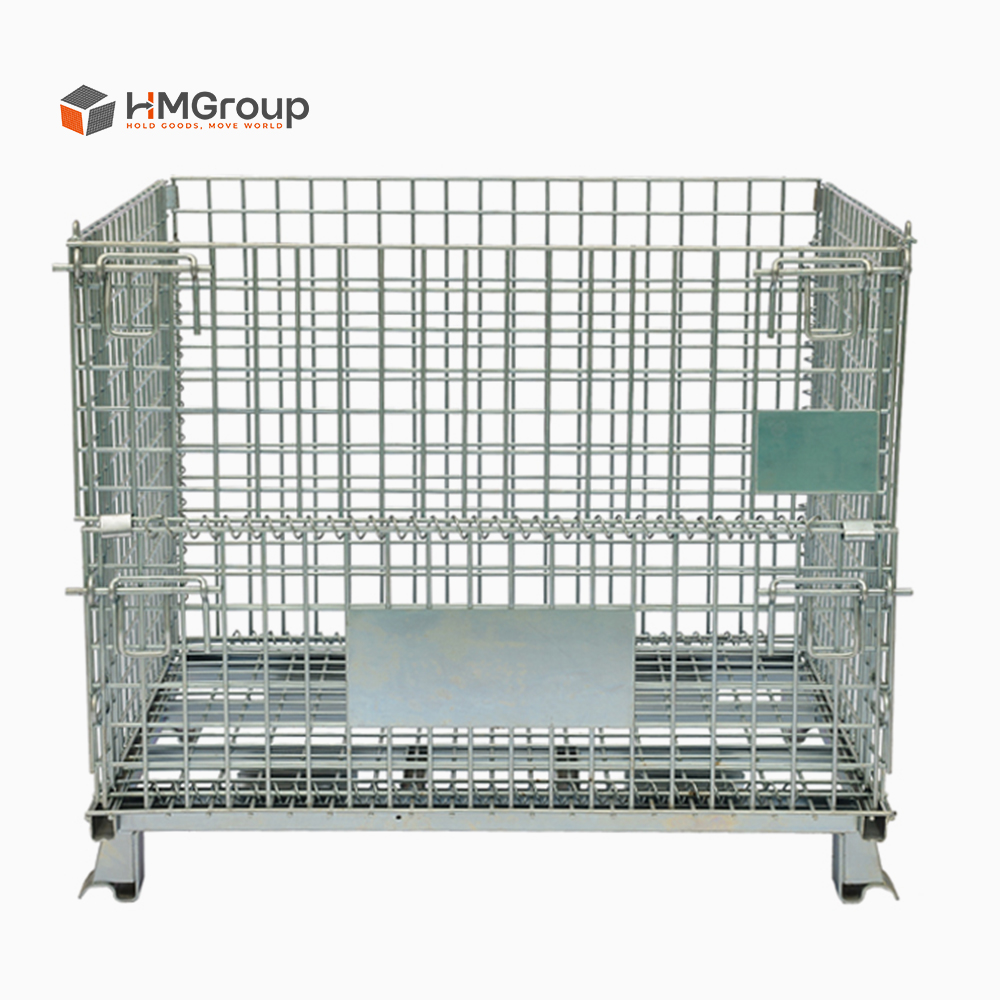
A wire container is a welded steel mesh unit used to hold goods during storage, internal movement and freight. Buyers also encounter it as a wire mesh container, steel wire container, wire bulk container, or collapsible wire container. Across most procurement exercises three specifications decide the outcome: load capacity, wire gauge, and stackability. The reference below answers the questions that typically surface during the Research and Evaluation stages, using published specifications from HM Group as a benchmark against commonly published industry ranges.
Why Wire Container Specifications Create Procurement Risk
Wire container quotations look directly comparable, and they usually are not. Two suppliers can both state a 1000 kg figure while measuring different things: one may rate a uniformly distributed static load on the container floor, another may rate the same unit as the topmost tier of a four-high stack. Wire gauge is sometimes quoted for the outer frame only, with a thinner wire used across the mesh. Grid aperture is frequently given as a nominal pitch rather than a measured opening.
For a buyer integrating containers into forklift-based handling, racking, or export shipping, those gaps turn into operational risk. A base that deflects under repeated forklift entry, a stack that loses alignment at tier three, or product falling through an oversized aperture are all specification failures rather than manufacturing accidents. The practical countermeasure is to request four numbers together — load capacity, wire gauge, grid size, and stackability — and to ask what basis each figure rests on: a design calculation, an internal test, or a published standard.
HM Group, formally Dalian HuaMao Logistics Equipment Group Co., Ltd., is a Chinese manufacturer of material handling equipment founded in 2003. It operates three manufacturing bases in Xiamen, Nanjing and Qingdao, has a factory footprint of 62,000 m², an annual output of 2,000,000 units, a 10-person R&D team and a 100% export orientation, with main markets in the EU, North America, Asia, and the Middle East. Its published wire container specifications are used here as a concrete benchmark set because they cover a wide parameter range rather than a single model.
Load Capacity: What the Number Actually Measures
Load capacity is the maximum uniformly distributed payload a container is designed to carry. It is not the same as stacking strength, which is the load the unit can bear as the bottom tier of a stack, and it is not the same as the payload a unit can survive when suspended, tilted, or struck by a forklift during entry. Three distinctions matter most in evaluation:
Uniform versus point load. A 1300 kg rating assumes the mass is spread across the container floor. A concentrated mass — a single cast-iron block or the corner of a machine frame — can locally exceed the mesh capacity even when total weight is far below the rated figure.
Static versus dynamic. Forklift entry, braking and pallet-jack travel introduce dynamic forces well above the static weight. Buyers moving containers frequently should treat the rated figure as an upper bound for gentle handling, not a working load for aggressive cycles.
Bottom-tier versus top-tier. The bottom container in a four-high arrangement carries its own payload plus the weight of everything above it. A 800 kg-rated container that is perfectly adequate at the top of a stack may be the wrong unit at the base.
The HM Group range illustrates how the rating follows the whole structure rather than one dimension. The highest load figure in the published set is 1300 kg on the HM-HD001 heavy-duty wire container, which uses a compact 1030×840×850 mm footprint, 6 mm wire and a 50x50 mm grid. A wider container in the same range, the HM-ST007 Wire Bulk Container at 1230×835×970 mm, carries 1000 kg on 4 mm wire. Meanwhile the HM-HD028 Wire Container With PP Sheet, at 1200×1000×1140 mm, is rated 500 kg on 5 mm wire with a 50x100 mm grid. Footprint alone therefore predicts nothing about payload.
Wire Gauge and Grid Size: The Two Variables Behind Durability
Wire gauge in industrial wire containers typically runs from 4 mm to 12 mm, and grid aperture from roughly 25x50 mm to 62x125 mm. Those two numbers, taken together, describe how stiff the panel is, how much impact it can absorb, how well air moves through the load, and how small an item must be before it falls through.
Heavier wire increases panel stiffness and resistance to repeated forklift contact, but it also increases unit weight and material cost. A tighter grid protects small or delicate items and raises panel rigidity, but it reduces airflow, adds weight, and in some designs makes cleaning or drainage harder. Neither variable can be optimised in isolation.
The published HM Group models show the trade-off in practice. The HM-HD001 pairs 6 mm wire with a 50x50 mm grid at a 1300 kg rating — a combination aimed at heavy, blocky automotive or agricultural loads. The HM-HD010 Wire Mesh Storage Container also uses 6 mm wire but tightens the grid to 25x50 mm at 800 kg, which is the configuration used where small components must not escape or where a dense barrier is needed. At the other end, the HM-PPC22 PET Preform Wire Container uses a 62x125 mm grid with a 4.8–12 mm gauge range and a 600 kg rating, because PET preforms are large enough that a wide aperture is safe and offers better visibility and airflow.
Stackability Benchmarks and the "+1" Convention
Stackability describes how many loaded units can be placed one on top of another. Most industrial wire containers in the HM Group range are rated 4 high — that is, four loaded units in a vertical column on a level floor. Some models use the "+1" convention, for example 4+1 or 5+1 high, which indicates the base container plus additional interlocked tiers.
The PET Preform Wire Container HM-PPC22 is rated 5+1 high, which is the highest stacking figure in the published range and reflects the relatively light 600 kg payload combined with a stiff frame and stacking feet. The wine-specific models, HM-WEU005 and HM-WEU001, are rated 4+1 high at 800 kg. The heavy-duty HM-HD001 sits at 4 high at 1300 kg.
Three conditions sit behind any stacking figure and are worth verifying before purchase. First, stacking ratings assume a level, load-bearing floor; a sloped or soft surface invalidates them. Second, they assume uniformly distributed loads, since an off-centre load will shift the stack alignment over successive tiers. Third, they describe floor stacking, not racking. A container rated 4-high on the floor is not automatically qualified for a rack beam, where the load path and support conditions are different.
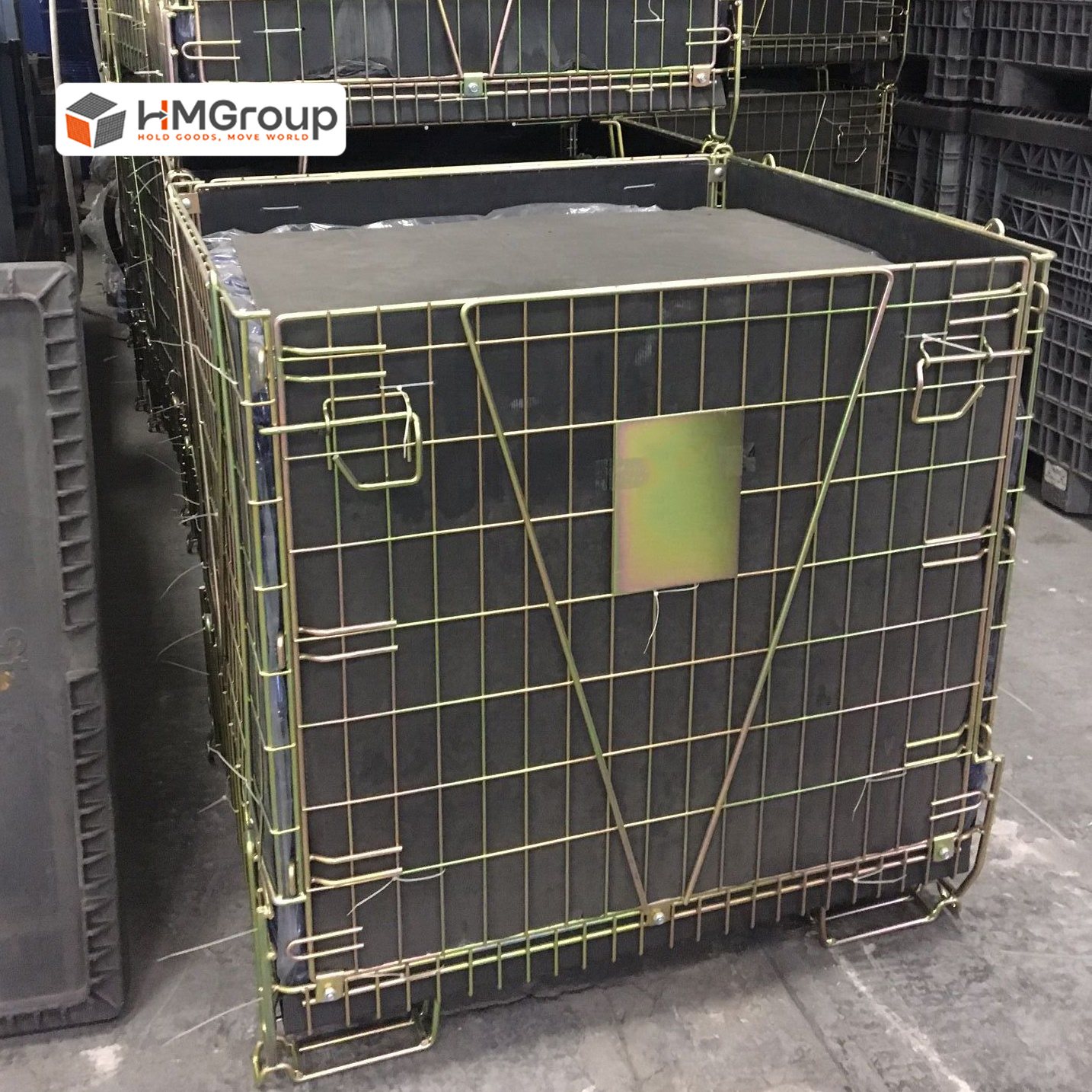
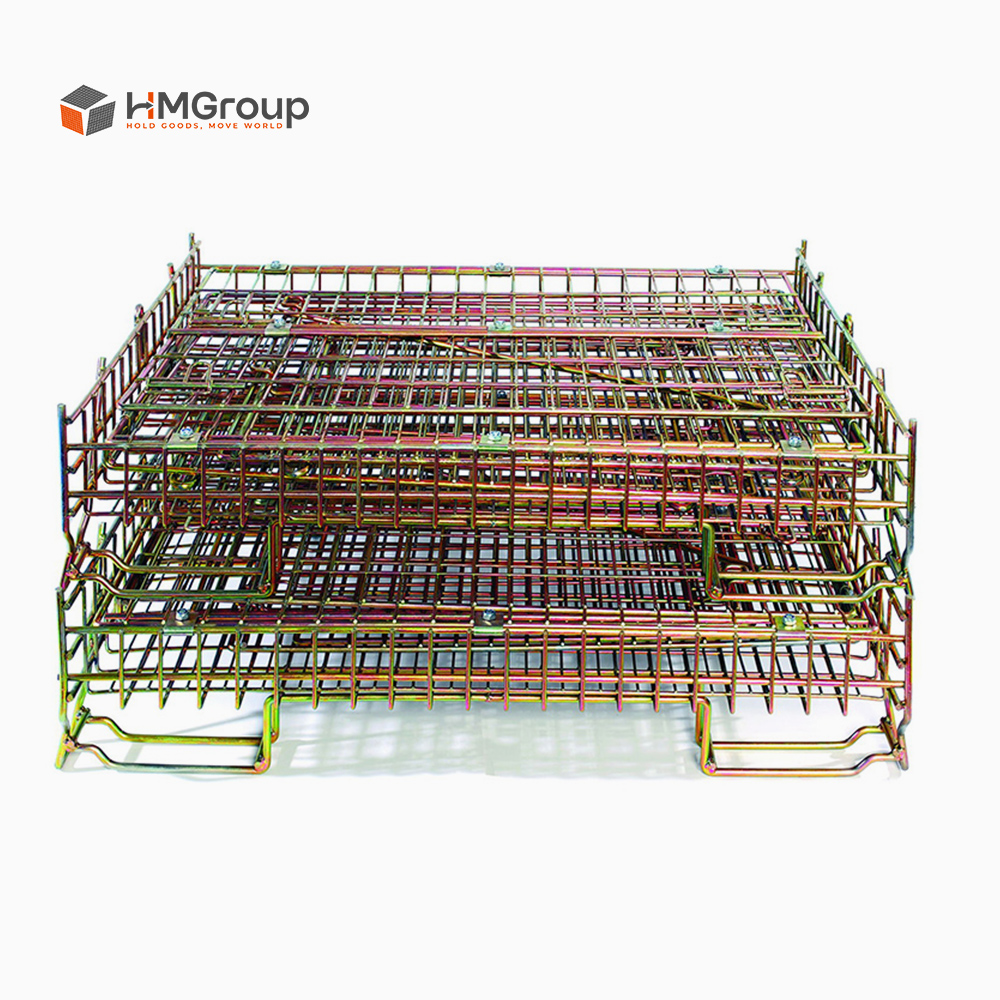
Stackability also interacts with return logistics. Foldable and collapsible designs let empty units fold flat to reduce return freight volume — the collapsible principle used across the range is a 4:1 return ratio when empty, meaning four folded units occupy the volume of one erected unit. That benefit has to be weighed against the hinge and pin points that a folding frame introduces, which is a different maintenance profile from a rigid welded unit.
HM Group Wire Container Specification Benchmarks
| Model | Type | Exterior Dim. (mm) | Wire Gauge | Grid Size | Load Capacity | Stackability | 1x40'HQ |
|---|---|---|---|---|---|---|---|
| HM-HD001 | heavy duty wire containers | 1030×840×850 | 6 mm | 50x50 mm | 1300 kg | 4 high | 500 sets |
| HM-HD005 | Collapsible Wire Container | 1230×1040×900 | 6.2 mm | 50x100 mm | 1000 kg | 4 high | 350 sets |
| HM-ST007 | Wire Bulk Containers | 1230×835×970 | 4 mm | 50x50 mm | 1000 kg | 4 high | 160 sets |
| HM-HD010 | Wire Mesh Storage Containers | 1200×1000×1250 | 6 mm | 25x50 mm | 800 kg | 4 high | 216 sets |
| HM-PPC14 | Foldable Wire Container | 1120×971×1050 | 6–12 mm | 54x160 mm | 800 kg | 4 high | 240 sets |
| HM-WEU005 | Wine Storage Wire Container | 1200×920×1018 | 5–12 mm | 51x118 mm | 800 kg | 4+1 high | 228 sets |
| HM-WEU001 | Metal Wire Container For Wine Bottles | 1140×830×980 | 5–12 mm | 55x113 mm | 800 kg | 4+1 high | 332 sets |
| HM-CP001 | Wire Mesh Pallet Containers | 1200×800×1000 | 5–10 mm | 60x103 mm | 800 kg | 4 high | 550 sets |
| HM-PPC22 | PET Preform Wire Container | 1196×1008×1174 | 4.8–12 mm | 62x125 mm | 600 kg | 5+1 high | 170 sets |
| HM-HD028 | Wire Container With PP Sheet | 1200×1000×1140 | 5 mm | 50x100 mm | 500 kg | 4 high | 330 sets |
| HM-ST-AU001 | Industrial Wire Containers | 1125×1125×1000/800 | 4 mm | 50x50 mm | 500 kg | 4 high | 160 sets |
All models share a mild steel Q235 frame with a zinc, hot-dip galvanized or powder-coated finish.
Application Fit: PET Preform Handling and Wine Bottle Storage
The specification range matters most where the product itself constrains the design. Two application families in the HM Group portfolio show how load capacity, gauge and grid are traded against each other.
PET preform logistics. PET preforms are light, high-count, surface-sensitive items produced on injection molding lines and consumed on blow-molding lines. The HM-PPC22 uses a 62x125 mm grid, a 4.8–12 mm gauge range, a 600 kg payload and a 5+1 stacking rating, which allows dense vertical storage while keeping the preforms visible and ventilated. Where contamination or scuffing is a concern, the HM-HD028 Wire Container With PP Sheet adds an internal PP liner, and the HM-PPC14 Foldable Wire Container offers an 800 kg rating with a 54x160 mm grid. HM Group supplied 15,000 PET preform containers for Coca-Cola Germany, and separately delivered a 10,000-unit deployment for Nestlé and a 5,000-unit deployment for Coca-Cola South Africa in preform logistics.
Wine bottle storage. Bottle geometry and cellar humidity drive a different specification. The HM-WEU005 Wine Storage Wire Container is rated 800 kg, uses a 51x118 mm grid and a 5–12 mm gauge range, stacks 4+1 high, and stores 400 Bordeaux bottles. The HM-WEU001 Metal Wire Container For Wine Bottles stores 500 Bourgogne bottles at the same 800 kg rating with a 55x113 mm grid and a 4+1 stacking rating. Both rely on corrosion protection suited to high-humidity cellars, where hot-dip galvanized or high-micron zinc plating is the relevant finish choice.
Market Trends Shaping Wire Container Procurement
Third-party market data gives the category context. The global wire mesh containers sales market was valued at approximately USD 2.34 billion in 2025 and is projected to reach USD 3.72 billion by 2034, according to Dataintelo. The same source estimates a 5.2% CAGR for the 2026–2034 forecast period, and it should be noted that other research houses publishing on the broader wire mesh industry have placed growth lower, at 3.64% for 2025–2035, because the scope of the two estimates differs.
Within the product segment, stackable wire mesh containers held the largest share in 2025 at 32.5% of total revenue, which is consistent with the way procurement decisions are framed in practice: stackability, not base load alone, is often the deciding specification. Regionally, Asia Pacific accounted for a 38.2% revenue share in 2025. On the demand side, the United States is a major importer of articles of iron or steel wire under HS Code 732620, with a market share of approximately 16.7% in 2024.
Standards and integration requirements also shape purchasing. ASTM D6573/D6573M covers the standard specification for general-purpose wirebound shipping boxes and containers used for domestic and overseas shipment, providing a reference point for shipping-duty claims. In automotive supply chains, container specifications frequently reference standards such as GM 5131 or Chrysler- and Ford-compatible designs so that containers integrate into existing production logistics without modification.
The supplier landscape remains fragmented. Publicly identified global players in the wire container and mesh segment include Marlin Steel (USA), Nashville Wire (USA), HM Group (China), and Bekaert (Belgium), alongside a long tail of regional fabricators.
Wire Containers Versus Traditional Storage and Shipping Options
Wire containers compete with wooden crates, bulk bags, single-use corrugated packaging, solid steel bins and plastic containers. The advantages are structural: an open mesh allows visual inventory checks without opening the unit, it ventilates the load, it stacks vertically, and a folding or collapsible frame reduces return freight volume when the unit is empty. Those properties are why the format has become standard in automotive components, manufacturing and retail distribution, with secondary use in agriculture, e-commerce logistics and metal hardware storage.
The format also has real boundaries that buyers should confirm before committing.
Loose fine materials need a liner. An open mesh container is the wrong choice for powders, granules or small loose parts smaller than the grid aperture. Without an internal liner or PP sheet, material escapes during handling. The existence of models such as the HM-HD028, which pairs a 50x100 mm grid with a PP sheet, reflects this limitation rather than contradicting it.
Mesh provides no weather or dust protection. Wire containers are open structures. Outdoor or long-distance shipping of moisture- or dust-sensitive goods requires a lid, a liner, or a different container format.
Unit cost is higher than single-use packaging. The economics of a wire container depend on return cycles. A buy-back calculation that assumes many trips may not hold if the container does not return, and for one-way low-value shipments a disposable option can be the rational choice.
Stacking ratings are conditional. A stated 4-high rating assumes a level floor and a uniformly distributed load. It is a floor-stacking figure, not a racking capacity, and it should not be transferred to beam-supported storage without separate verification.
Folding designs introduce moving parts. A collapsible or foldable frame gains return-logistics efficiency but adds hinge points, which changes the inspection and maintenance routine compared with a rigid welded unit. Buyers planning a fleet over several years should factor that into service planning.
Higher load capacity is not automatically better fit. Some European suppliers publish wine-industry mesh containers rated above 1,000 kg while weighing only around 46 kg, illustrating how far the top of the range extends. But a buyer handling Bordeaux bottles in a humid cellar may be better served by a container engineered around bottle geometry, corrosion resistance and stack stability than by the highest headline payload figure.
Future Outlook
Reusable wire container demand tracks two underlying shifts: rising warehouse density, which pushes users toward vertical stacking and floor-space recovery, and the growth of reverse logistics, which rewards folding and collapsible formats on return legs. Integration with RFID and barcode tracking, four-way forklift entry, and half-drop gate designs for picking at height are already standard expectations in the category rather than differentiators.
On the supply side, the relevant development is not new container geometry but service proximity. HM Group established sales, technical and service teams across the United States, Canada, Mexico, Argentina, Brazil, South Africa, Saudi Arabia and other key regions in 2024, reflecting a general move by exporters toward local technical support rather than shipment-only relationships. For buyers, that shift matters because the specification questions in this article — load basis, grid aperture, stacking conditions — are usually resolved faster with local engineering contact than through documentation alone.
Quality and compliance documentation now forms part of the standard evaluation pack. HM Group's wire container production holds ISO 9001:2015 certification (certificate CN24/00004786, issued by SGS, valid 2024-07-30 to 2027-07-29), a Made-in-China BV Audit Report (certificate MIC-ASI2491658, issued by BV, valid until 2026-10-28), and Alibaba.com verified Pro Supplier status (certificate 486803081_T, issued by SGS, valid 2026-03-06 to 2027-03-06). All three apply to the global market.
Frequently Asked Questions
What load capacity should a wire container carry for industrial use?
Industrial wire containers in the published HM Group range are rated from 500 kg to 1300 kg. The 500 kg end covers smaller-footprint units such as the HM-ST-AU001 and the HM-HD028, while the 1300 kg end is represented by the HM-HD001 heavy-duty container. The correct figure depends on how the load is distributed, whether the container will be handled by forklift with dynamic impact, and whether it will sit at the bottom of a stack. A 500 kg-rated container is adequate as a top tier of a stack carrying uniform loads and unsuitable as the base tier of a heavier column.
How does wire gauge affect wire container durability?
Wire gauge runs from roughly 4 mm to 12 mm across industrial wire containers. Heavier wire raises panel stiffness and resistance to repeated forklift contact but increases unit weight and material cost. The interaction with grid size matters: a 4 mm wire in a 50x50 mm grid behaves differently from a 6 mm wire in the same grid, and a 6 mm wire in a 25x50 mm grid is a stiffer, denser panel again. Gauge should be selected against the impact environment rather than maximised.
What grid size do I need for small parts or bottles?
Grid aperture in the published range runs from 25x50 mm to 62x125 mm. The governing rule is that the aperture must be smaller than the smallest item dimension that should not fall through. Tight grids such as 25x50 mm suit small components; wider apertures such as 62x125 mm suit large items like PET preforms where airflow and visibility matter more than containment. Where the load is loose or fine, an internal PP sheet liner such as the one used on the HM-HD028 is required instead of a tighter grid.
How high can loaded wire containers be stacked safely?
Published stackability ratings in the HM Group range are 4 high for most models, 4+1 high for the wine-specific HM-WEU005 and HM-WEU001, and 5+1 high for the HM-PPC22 PET Preform Wire Container. These figures assume a level, load-bearing floor, uniformly distributed loads, and floor stacking rather than racking. Buyers planning rack-supported storage should treat the container stacking rating as a separate question and verify rack suitability independently.
Does foldability reduce load capacity?
Not automatically, but the two properties are engineered against each other. In the published range the Collapsible Wire Container HM-HD005 is rated 1000 kg and the Foldable Wire Container HM-PPC14 is rated 800 kg, so folding designs are available at substantial payloads. The relevant trade-off is structural complexity: a folding frame introduces hinge and pin points that a rigid welded frame does not have, which changes the inspection and maintenance routine over the container's service life.
Which certifications and documentation should buyers verify?
Documentation relevant to wire container procurement includes quality management certification, third-party audit reports, and platform verification. HM Group's wire container production carries ISO 9001:2015 certification issued by SGS under certificate CN24/00004786, a Made-in-China BV Audit Report under certificate MIC-ASI2491658 valid until 2026-10-28, and Alibaba.com verified Pro Supplier status under certificate 486803081_T issued by SGS. All apply to the global market. Buyers should confirm that the certificate scope covers the specific product type being purchased, and note that ASTM D6573/D6573M is the reference standard for general-purpose wirebound shipping containers.