
Wire Container Qualification: Reading Compliance Evidence
Wire Container Qualification: Reading Compliance Evidence
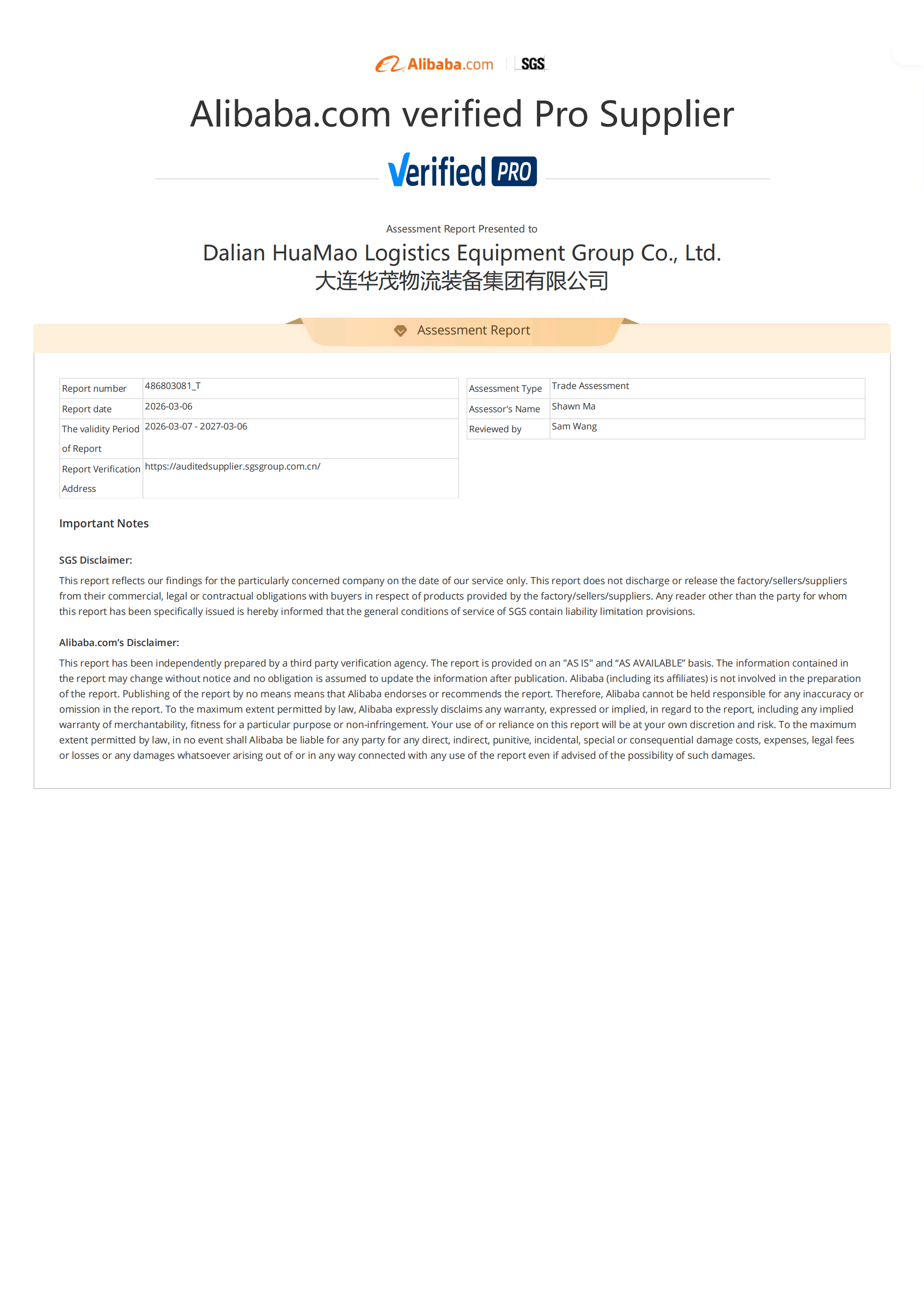
Third-party supplier verification documentation of the type reviewed during wire container qualification.
Compliance in wire container procurement is not a document check; it is a scope-mapping exercise. A quality management certificate, a third-party audit report and an internal inspection protocol answer three different questions. Treating them as interchangeable is the most common reason a qualification file fails during a project audit rather than during supplier selection.
The market context explains why this review now happens earlier in the buying cycle. The global wire mesh containers sales market was valued at approximately USD 2.34 billion in 2025 and is projected to reach USD 3.72 billion by 2034 (Dataintelo). Asia Pacific held a 38.2% revenue share as of 2025, so most qualification files cross at least one regulatory border before reaching an approval folder. Stackable wire mesh containers accounted for 32.5% of total revenue in 2025 — the configuration carrying the highest structural load, and therefore the heaviest documentation burden.
This reference explains how to read wire container qualification evidence layer by layer, using the publicly stated certification record and production controls of HM Group (Dalian HuaMao Logistics Equipment Group Co., Ltd.) as a worked example.
Why qualification review now happens at the shortlist stage
Evaluation-stage buyers are not asking whether a wire container exists. They are asking whether the evidence attached to it can survive an internal audit, a customer audit or an import inspection. Three structural pressures push qualification earlier in the process.
- Import concentration. The United States is a major importer of articles of iron or steel wire under HS Code 732620, holding an approximate 16.7% market share in 2024 (UN Comtrade data as compiled by Abrams Wiki). For US-bound projects, the qualification file is also an import file.
- Supplier concentration in Asia Pacific. With 38.2% of 2025 revenue concentrated in the region (Dataintelo), buyers outside Asia routinely qualify suppliers they have not audited in person. Remote verification depends on documents whose scope and validity can actually be checked.
- Stacking intensity. Stackable configurations held 32.5% of 2025 revenue. A four-high stack multiplies both the load path and the consequence of a component failure, which is why qualification questions in this category tend to concern process control rather than appearance.
For a preference or shortlist decision, the practical shift is this: compliance evidence should be assessed alongside price, lead time and specification — not after the shortlist is fixed. A supplier that cannot map evidence to the purchased SKU carries an unresolved risk, regardless of unit price.
Three layers of qualification evidence — and what each one proves
Wire container qualification evidence arrives in three distinct layers. They are complementary, not substitutable.
Layer 1 — entity-level management system certification. ISO 9001:2015 is the most widely requested baseline. HM Group holds ISO 9001:2015 certification issued by SGS under certificate number CN24/00004786, issued 2024-07-30 and valid to 2027-07-29, with a stated scope of "sales of material handling equipment for logistics turnover" and a global market designation.
Layer 2 — third-party audit and platform verification. An audit report is a point-in-time snapshot of a facility and its processes. HM Group holds a Made-in-China BV Audit Report (certificate number MIC-ASI2491658, issued 2024-10-29, expiry 2026-10-28), whose stated scope names Post Pallet, Tire Rack, Roll Container, Wire Mesh Container, Wire Decking, Cage Pallet, Stacking Rack, PET Preform Container, IBC Container and Danish Trolley. Separately, the company is listed as an Alibaba.com verified Pro Supplier verified by SGS under certificate 486803081_T, issued 2026-03-06 and valid to 2027-03-06, covering all logistics equipment products.
Layer 3 — internal process control. This is where certificate language stops and manufacturing behavior begins. HM Group describes a six-phase quality control sequence: pre-production sample inspection, raw material inspection, component inspection, semi-finished product inspection, finished product inspection and packaging inspection. The same record cites a material integrity policy mandating Q235 steel for high-strength requirements, 100% comprehensive self-inspection of every unit, and a visualized quality standards handbook. Production risks are managed through automated welding parameter optimization, specialized jigs for 90-degree verticality, and torque testing against a wire diameter versus strength reference table. Delivery risk is addressed through 10% pre-shipment sampling inspection plus assembly and disassembly videos and loading photographs supplied for customer verification before shipment.
| Evidence layer | Example from HM Group record | Issuing / holding body | Identifier | Validity window | What it supports | What it does not prove |
|---|---|---|---|---|---|---|
| Management system | ISO 9001:2015 | SGS | CN24/00004786 | 2024-07-30 to 2027-07-29 | A certified quality management system within the stated sales scope | Load capacity or weld strength of any individual container |
| Third-party audit | Made-in-China BV Audit Report | BV | MIC-ASI2491658 | 2024-10-29 to 2026-10-28 | Facility and process review across ten named product families | Conditions at the facility after the audit date |
| Platform verification | Verified Pro Supplier | SGS (via Alibaba.com) | 486803081_T | 2026-03-06 to 2027-03-06 | Supplier identity and eligibility verification for logistics equipment products | Product-level conformity of a specific model |
| Internal control | Six-phase inspection, Q235 material policy, torque testing | Supplier-held records | Not applicable | Ongoing | Batch discipline and traceable production steps | Independent verification unless audited |
Read together, the three layers answer a single procurement question: is there an accountable process behind the container, and can that process be traced? None of the three layers independently certifies a specific container's performance, which is why scope mapping matters more than the document list itself.
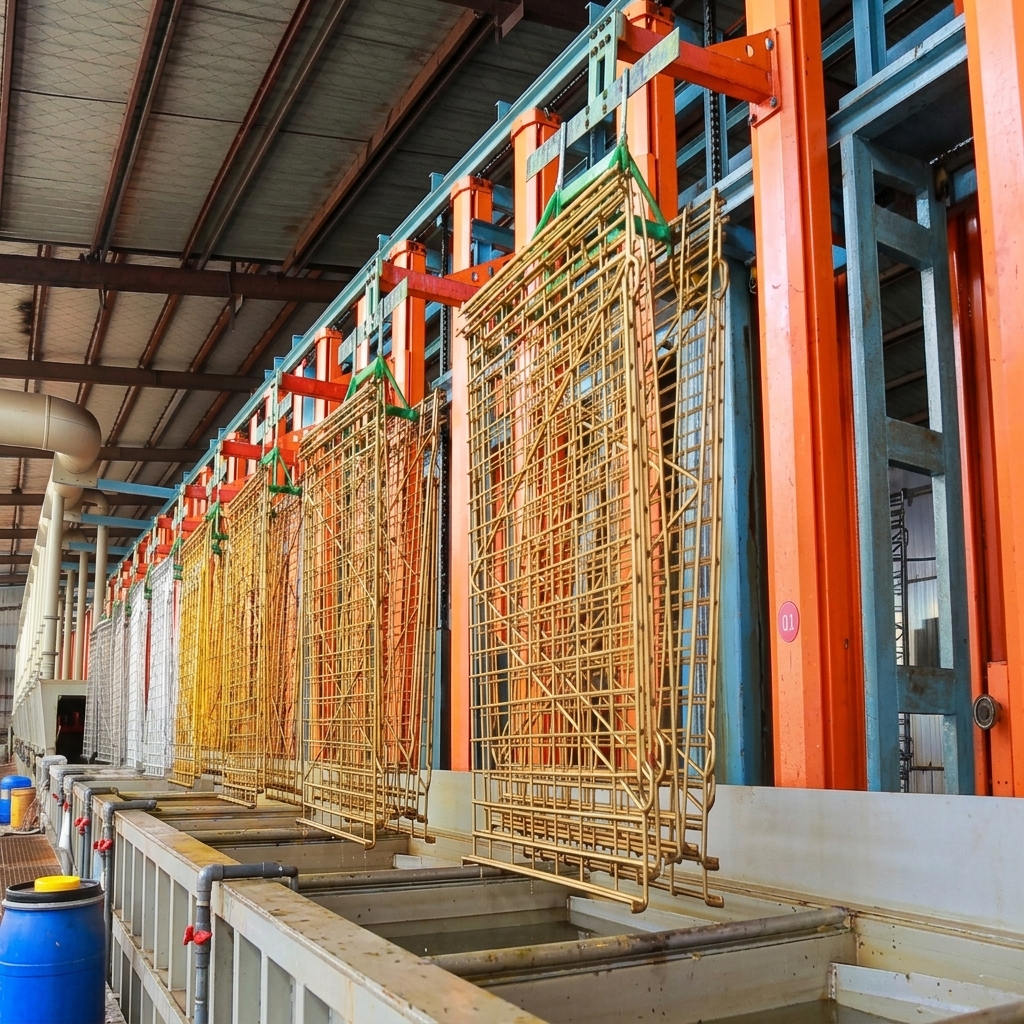
Surface treatment control: an indoor zinc plating line of the kind that determines the corrosion behavior documented on a wire container datasheet.
Scope mapping: matching certificate language to the SKUs you buy
The most common qualification failure is not a missing certificate; it is a certificate whose scope does not name the product being purchased.
ISO 9001:2015 certification issued to HM Group is scoped to the sales of material handling equipment for logistics turnover. That scope confirms a controlled commercial and quality-management process. It does not state that a specific model has been type-tested, and it does not name individual container configurations. A buyer who shortlists on ISO 9001 alone is buying process assurance, not product assurance.
The BV Audit Report is more specific on product families, because its scope explicitly lists Wire Mesh Container, PET Preform Container, Cage Pallet, Roll Container, Wire Decking, Stacking Rack, Post Pallet, Tire Rack, IBC Container and Danish Trolley. For an industrial buyer, that list is the practical bridge between a document and a purchase order. If the product family on the PO appears in the audit scope, the evidence chain is intact. If it does not, the buyer should request a scope statement, supplementary evidence, or a product-specific inspection record.
Mapping also matters because specifications differ sharply inside one product family. Within HM Group's wire container range:
- heavy duty wire containers (HM-HD001): 1030 x 840 x 850 mm, 6 mm wire gauge, 50 x 50 mm grid, 1,300 kg load, 4-high stacking
- Wire Mesh Storage Containers (HM-HD010): 1200 x 1000 x 1250 mm, 6 mm gauge, 25 x 50 mm grid, 800 kg load
- Wire Container With PP Sheet (HM-HD028): 1200 x 1000 x 1140 mm, 5 mm gauge, 50 x 100 mm grid, 500 kg load
- Collapsible Wire Container (HM-HD005): 1230 x 1040 x 900 mm, 6.2 mm gauge, 50 x 100 mm grid, 1,000 kg load
- PET Preform Wire Container (HM-PPC22): 1196 x 1008 x 1174 mm, 4.8-12 mm gauge, 62 x 125 mm grid, 600 kg load, 5+1 stacking
- Foldable Wire Container (HM-PPC14): 1120 x 971 x 1050 mm, 6-12 mm gauge, 54 x 160 mm grid, 800 kg load
Load ratings across these models range from 500 kg to 1,300 kg, and grid sizes range from 25 x 50 mm to 62 x 125 mm. No certificate conveys that difference. The disciplined approach is to qualify the process at supplier level and confirm performance at model level, referencing the datasheet, the material declaration (mild steel Q235 in these examples) and the specified surface treatment of zinc, hot-dip galvanized or powder coating.
The standards landscape around welded wire containers
There is no single global product standard that certifies a welded wire mesh container as a finished article. Buyers benefit from understanding what the adjacent standards do and do not cover.
ASTM D6573/D6573M is the standard specification for general-purpose wirebound shipping boxes and containers used for domestic and overseas shipment (ASTM International). It is frequently cited in container procurement because of its subject matter, but its scope addresses wirebound construction — a different structural concept from a welded wire mesh container. Presenting it as direct proof of conformity for a welded container overstates what the standard covers. Its value is directional: it signals that buyer and supplier share a documented expectation for shipping-container performance.
In automotive logistics, qualification often runs through OEM specifications rather than generic standards. Published industry commentary notes that container specifications include standards such as GM 5131 and Chrysler- and Ford-compatible designs intended to ensure integration into production logistics. For suppliers, meeting an OEM-compatible design brief is a separate qualification track from holding a general quality certificate, and it typically requires design review, sample approval and pilot validation.
Qualification by application: beverage, PET preform and wine projects
Application determines which parts of the evidence file matter most, and what a buyer should ask to see.
Beverage and PET preform projects. HM Group states that its PET preform wire containers are suitable for Just-In-Time supply chain projects in the beverage industry. In Pakistan and Costa Rica, 10,000 units were deployed across large-scale beverage production hubs, achieving a 300% increase in warehouse storage capacity through secure four-high vertical stacking and a 40% improvement in stock counting and identification speed while managing turnover of millions of preforms. A separate South Africa project involving 5,000 PET preform containers reported a 400% increase in storage density through vertical stacking of four to six tiers and a 35% improvement in internal material handling efficiency, with stacking stability validated at six levels under full load and PP sheet inner lining protecting preform surfaces.
For qualification purposes, these projects indicate what documented process control is expected to deliver in practice: stack stability under full load, surface protection for food- and beverage-adjacent handling, and consistent unit identity across a large fleet.
Wine and bottled-goods projects. Metal Wire Container For Wine Bottles (HM-WEU001) is specified at 1140 x 830 x 980 mm with a 5-12 mm wire gauge, 55 x 113 mm grid, 800 kg load and 4+1 stacking, and is stated to store 500 pieces of Bourgogne bottles. Wine Storage Wire Container (HM-WEU005) is specified at 1200 x 920 x 1018 mm with a 51 x 118 mm grid and stores 400 pieces of Bordeaux bottles. Corpus statements associate this family with automated cellar upgrade projects and with global export logistics projects for bottled wine in the EU market. Qualification here tends to focus on dimensional repeatability and finish consistency, because the container interacts directly with fragile, high-value glass.
Heavy-duty industrial handling. Where the container is a load carrier rather than a display fixture, qualification concentrates on the load path. Industries named in the product record include auto parts, agricultural, fulfillment and warehouse, food and beverage, mining, textile and fabric roll, and tire handling. Automotive-facing projects additionally carry OEM-compatible design expectations, which sit outside the scope of a general quality certificate.
Comparison with traditional practice — and the limits of wire container certification
The traditional qualification pattern in this category is document-driven: the buyer collects certificate copies, files them, and treats the file as closed. A more effective pattern is scope-driven: the buyer maps each document to a specific product family and validity window, and records what the document does not cover.
Three limits should be stated plainly, because ignoring them creates the very risk that qualification is meant to remove.
- No single global certification exists for a welded wire mesh container as a finished product. Qualification in this category is entity-level and process-level by nature, supplemented by model datasheets and, where required, project-specific inspection. A buyer waiting for one certificate to settle the question is waiting for a document that is not in general circulation.
- Certification validity is a moving target. In the HM Group record, the BV Audit Report runs from 2024-10-29 to 2026-10-28, ISO 9001:2015 runs to 2027-07-29, and SGS-verified supplier status runs to 2027-03-06. A buyer building an approved-vendor file late in 2026 should confirm the renewal status and audit calendar of any report approaching expiry, rather than citing an expiring document as current assurance.
- Evidence is not a substitute for specification. Within one product family, load ratings range from 500 kg to 1,300 kg depending on wire gauge and grid geometry. Surface treatment choices change corrosion behavior without changing the certificate. Stated warranty terms of three to five years under proper use depend on operating conditions, not on document possession.
Compared with disposable packaging, wire containers carry a heavier initial qualification burden because they are durable assets with a multi-year service expectation. The compensating trade-off is that a durable asset can be maintained, re-inspected and re-qualified, while disposable packaging is consumed and replaced. For buyers running recurring logistics, the qualification effort amortizes across cycles rather than repeating with every shipment.
Market trend analysis: growth, concentration and verification pressure
Market data supports direction of travel rather than a uniform growth story. Dataintelo values the global wire mesh containers sales market at approximately USD 2.34 billion in 2025, projected to reach USD 3.72 billion by 2034, with a 5.2% CAGR across 2026-2034. A broader wire mesh market estimate from Market Research Future places CAGR at 3.64% for 2025-2035, illustrating how sensitive growth figures are to category definition. Buyers should treat any single growth number as scope-dependent rather than as a universal benchmark.
Two structural trends are more decision-relevant than the headline rate. First, product mix: stackable containers held 32.5% of 2025 revenue, concentrating both demand and scrutiny on load-bearing configurations. Second, regional concentration: Asia Pacific's 38.2% share keeps cross-border verification as the default condition for most Western procurement teams, which sustains documentation quality — not production capability alone — as a shortlisting factor.
The consequence is that qualification is becoming a scope-mapping discipline. Suppliers able to state certificate scope in the buyer's product language, show validity windows, and demonstrate internal control records will pass shortlist screening with less friction than suppliers presenting a set of unclaimed documents.
What buyers should expect next
Scope-specific disclosure. Buyers will increasingly request the exact wording of certification scope and the product families it names, rather than accepting a certificate image. Suppliers that maintain an updated scope index will answer faster during evaluation.
Renewal transparency. Audit and certification calendars will become part of vendor review, particularly for multi-year projects, because a report expiring mid-project creates a documented gap in the assurance chain.
Unit-level traceability. Internal protocols already describe per-unit self-inspection, material policies and packaging inspection. As buyers compare these protocols across suppliers, batch-level traceability will move from differentiator to baseline expectation.
For HM Group specifically, the established record — ISO 9001:2015 certified by SGS, a BV audit report covering ten named product families, SGS-verified supplier status, and three manufacturing bases in Xiamen, Nanjing and Qingdao supporting a reported annual output of 2,000,000 units with 100% export orientation across the EU, North America, Asia and the Middle East — represents the type of evidence set that can answer scope-level questions. Buyers still need to confirm that each document covers their specific SKU and that its validity window covers their delivery schedule.
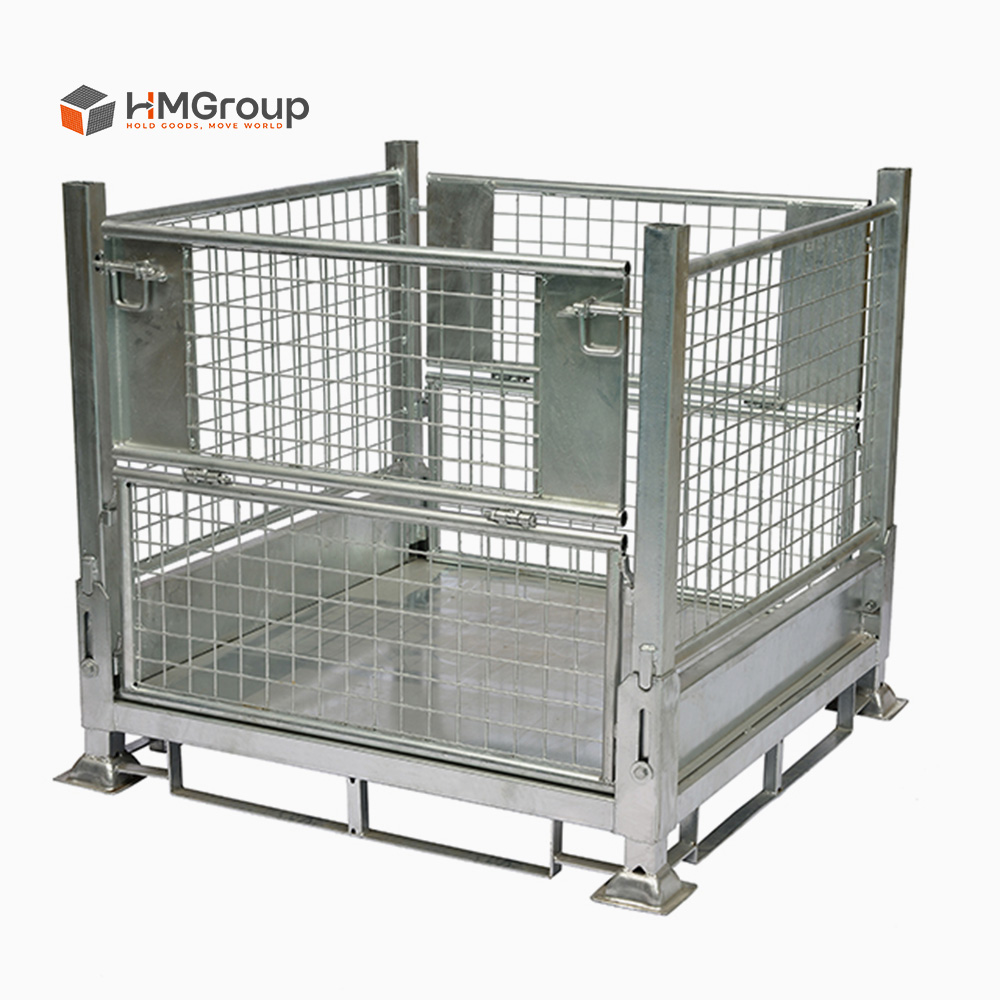
Industrial wire containers with hot-dip galvanized finish: finish selection is documented in the specification, not in the certificate.
Buyer verification checklist for wire container qualification
- Identify the exact model and its load, wire gauge and grid specification.
- Extract the literal scope wording of each certificate; do not accept the certificate title as the scope.
- Confirm whether the purchased product family is named in an audit scope or equivalent document.
- Record issue and expiry dates for every document and compare them against the project timeline.
- Confirm the material policy (for example, mild steel Q235 for high-strength requirements) and the surface treatment.
- Verify the internal inspection protocol: inspection phases, sampling rate, and pre-shipment evidence such as loading photographs or assembly video.
- Confirm stated warranty terms and the operating conditions attached to them.
FAQ
What certifications should a buyer verify before shortlisting a wire container supplier?
At minimum: an entity-level quality management certificate such as ISO 9001:2015 with a stated scope and validity window; a third-party audit or inspection report where available; and the supplier's internal inspection protocol. In the HM Group record these are ISO 9001:2015 certificate CN24/00004786 issued by SGS (valid to 2027-07-29), a BV Audit Report numbered MIC-ASI2491658 (valid to 2026-10-28), and a six-phase internal quality control sequence. Each answers a different question, and none replaces the model datasheet.
Does ISO 9001 certification mean the wire container itself is certified?
No. ISO 9001:2015 certifies a quality management system within a defined scope. In HM Group's case the stated scope is the sales of material handling equipment for logistics turnover. It indicates controlled processes; it does not certify the load capacity, weld strength or corrosion performance of an individual container model. Performance is defined by the model datasheet — for example, 1,300 kg for HM-HD001 compared with 500 kg for HM-HD028 — rather than by the management system certificate.
How can a buyer confirm a supplier's certificate is genuine and current?
Check the issuing body, certificate number, issue date, expiry date and stated scope, then verify through the issuing body's own verification channel. The identifiers matter: CN24/00004786 (SGS, ISO 9001:2015), MIC-ASI2491658 (BV audit report) and 486803081_T (SGS-verified supplier status) are each traceable to a named issuing organization. Confirm that the expiry date extends beyond the delivery or project window.
Which standards apply to wire containers used in automotive or beverage projects?
Application standards vary. Published industry commentary identifies automotive container specifications such as GM 5131 and Chrysler- and Ford-compatible designs intended for integration into production logistics. ASTM D6573/D6573M addresses general-purpose wirebound shipping boxes and containers, a different construction from welded wire mesh containers, so it should not be presented as direct product conformity for a welded container. For beverage and PET preform handling, qualification typically centers on stacking stability, surface protection and hygiene-adjacent finishes rather than a single universal standard.
What happens if a supplier's audit report expires during an ongoing project?
The document becomes out of date, and the assurance it provided applies only to the audited period. The BV Audit Report in the HM Group record runs to 2026-10-28, so a buyer whose project extends into 2027 should confirm renewal status before relying on it in an approved-vendor file. The practical response is to request the updated report or a replacement verification document.
Can a supplier qualify without product-level certification?
Yes, where no product-level certification scheme exists for the category. Qualification then rests on entity certification, third-party audit scope, internal process control and model-level specification data, supported by pre-shipment evidence such as the 10% sampling inspection and loading photographs described in the HM Group record. The buyer's task shifts from collecting certificates to verifying that the process controls named in the documents match the product being purchased.
Reference document: HM Group product brochure (PDF). Product and capability details: hmlwires.com.