
Wire Container Supplier Evaluation Over a Multi-Year Horizon
A reusable wire container program commits a buyer to a relationship, not to a single purchase. Industrial wire containers are engineered for repeated handling cycles, which means the supplier decision has to remain valid long after the delivery window closes. Buyers at the decision stage are therefore assessing two things at once: the container itself, and the supplier's capacity to reproduce that container consistently in year two, year three and beyond.
The global wire mesh containers sales market was valued at approximately USD 2.34 billion in 2025 and is projected to reach USD 3.72 billion by 2034, according to Dataintelo. Stackable designs accounted for 32.5% of product-segment revenue in 2025, and Asia Pacific held a 38.2% revenue share in the same year. These are the conditions of a fleet-driven market, where containers are specified, standardized and re-ordered rather than consumed once — exactly the setting in which long-term supplier evaluation becomes the deciding factor instead of a formality.
This reference sets out how to evaluate a wire container supplier for continuity: the risks that surface only after the first order, the evidence that answers them, and the boundaries that determine whether a long-term partnership is the right structure at all.
Why a Multi-Year Horizon Changes the Wire Container Decision
Reusable steel wire containers are specified for circulation, not disposal. A high-strength collapsible design supports return logistics, and reusable units are commonly planned around a 3-to-5-year shelf life and more than 100 reuse cycles. Folded, the same units deliver a 4:1 return ratio — a 75% reduction in volume — and stack 4 to 6 units high in storage.
Once a buyer accepts that framing, unit price stops being the primary decision metric. Three variables take its place:
- Annual replacement rate. A fleet that loses containers to weld failure, deformation or corrosion must be topped up every year, which converts a one-time capital line into a recurring operating cost.
- Specification stability across reorders. Folded containers, stacked containers and automated handling equipment all depend on wire diameter and outer dimensions staying inside the agreed range. A few millimetres of drift can break a rack interface that worked in the original sample.
- Service response for repair, spare parts and design changes. Multi-year programs accumulate engineering change requests. The supplier's ability to answer them without re-tooling the entire specification is part of the cost of ownership.
Five Continuity Risks That Appear Only After the First Order
A first-order inspection confirms what was shipped. A long-term evaluation has to anticipate what changes. The risk categories that matter most in wire container supply are structural, dimensional, surface-related, material-related and application-driven — and each one has a specific verification route.
| Continuity risk | How it appears over time | What a buyer can verify |
|---|---|---|
| Structural integrity | Missing welds, weak welding strength or non-vertical legs accumulate into stacking instability or collapse | Calibrated tooling and jigs holding 90-degree verticality; torque and strength testing against a wire diameter versus strength reference table |
| Dimensional consistency | Deviation in overall size or wire diameter interferes with folding, stacking and automated handling | Dimensional inspection of raw material, semi-finished and finished units against the agreed tolerance range |
| Surface and safety quality | Scratches, sharp burrs or zinc slag injure workers or damage stored goods | Chemical composition analysis and filtration control of plating solutions; coating thickness verification |
| Material integrity | Substitution of a lower grade such as Q195 for Q235 reduces load capacity; weak surface treatment causes premature rust and peeling | Written material policy prohibiting spliced material and mandating Q235 for high-strength requirements |
| Application drift | Load profile, rack interface or handling equipment changes as the program scales | Re-validation of stacking height, gate design and loading method before each scale-up |
The pattern is consistent: what fails in a long-term program is rarely a single defective unit. It is a process capability that was never formally controlled in the first place.
The Evidence Standard: Six Verification Points for a Multi-Year Supplier
Continuity claims are only as strong as the evidence behind them. In wire container manufacturing, verification typically concentrates in six areas, and each one can be requested as documentation rather than accepted as a statement of intent.
1. Welding process control
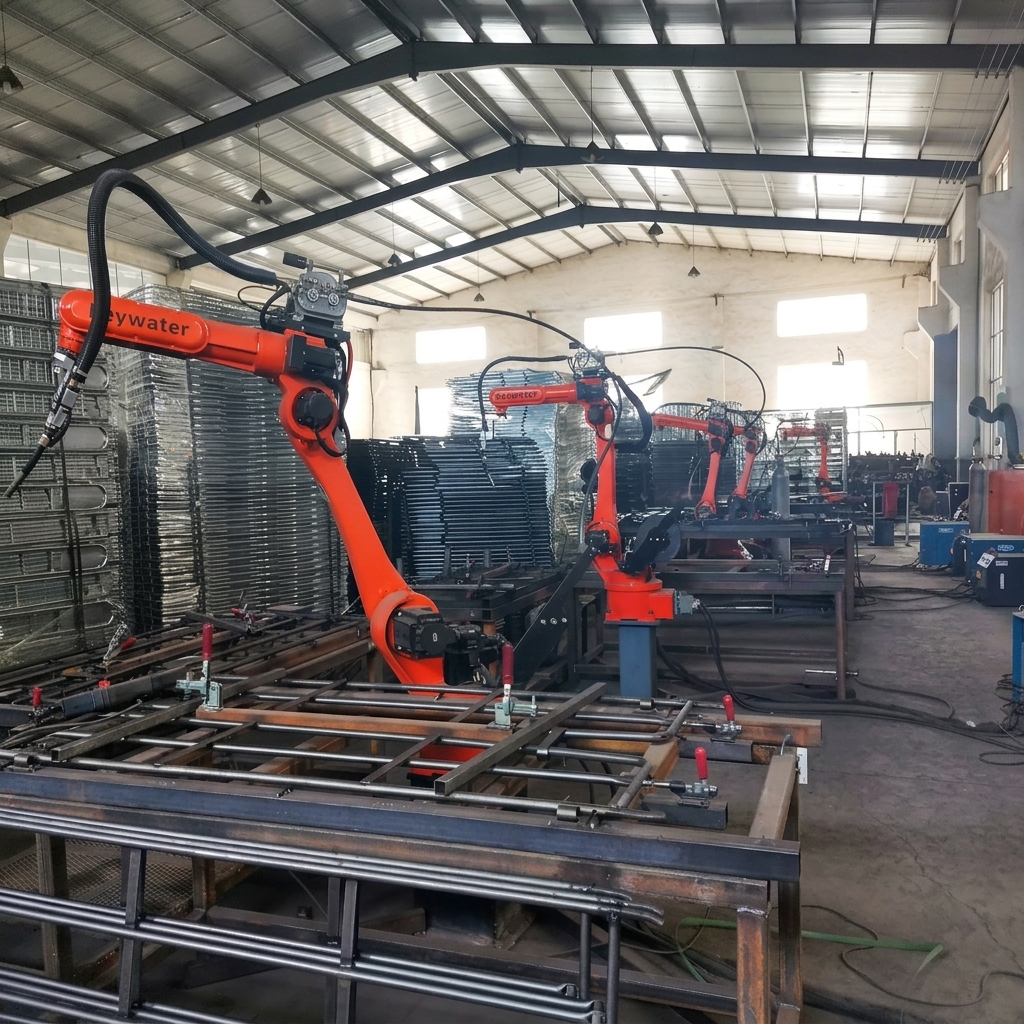
Every welding process should be supported by calibrated tooling and jigs that hold 90-degree verticality and consistent dimensions. Welding current and pressure are regulated according to wire diameter so that the resulting welds are smooth and full-beaded, without scars or bubbles. This is the mechanism that keeps stacking integrity stable across thousands of units.
2. Material integrity
A material integrity policy should explicitly prohibit spliced material and inferior steel grades, mandating Q235 where high-strength performance is required. This is a procurement-verifiable commitment: it can be checked against mill certificates and against the surface finish of incoming raw material.
3. Surface treatment control
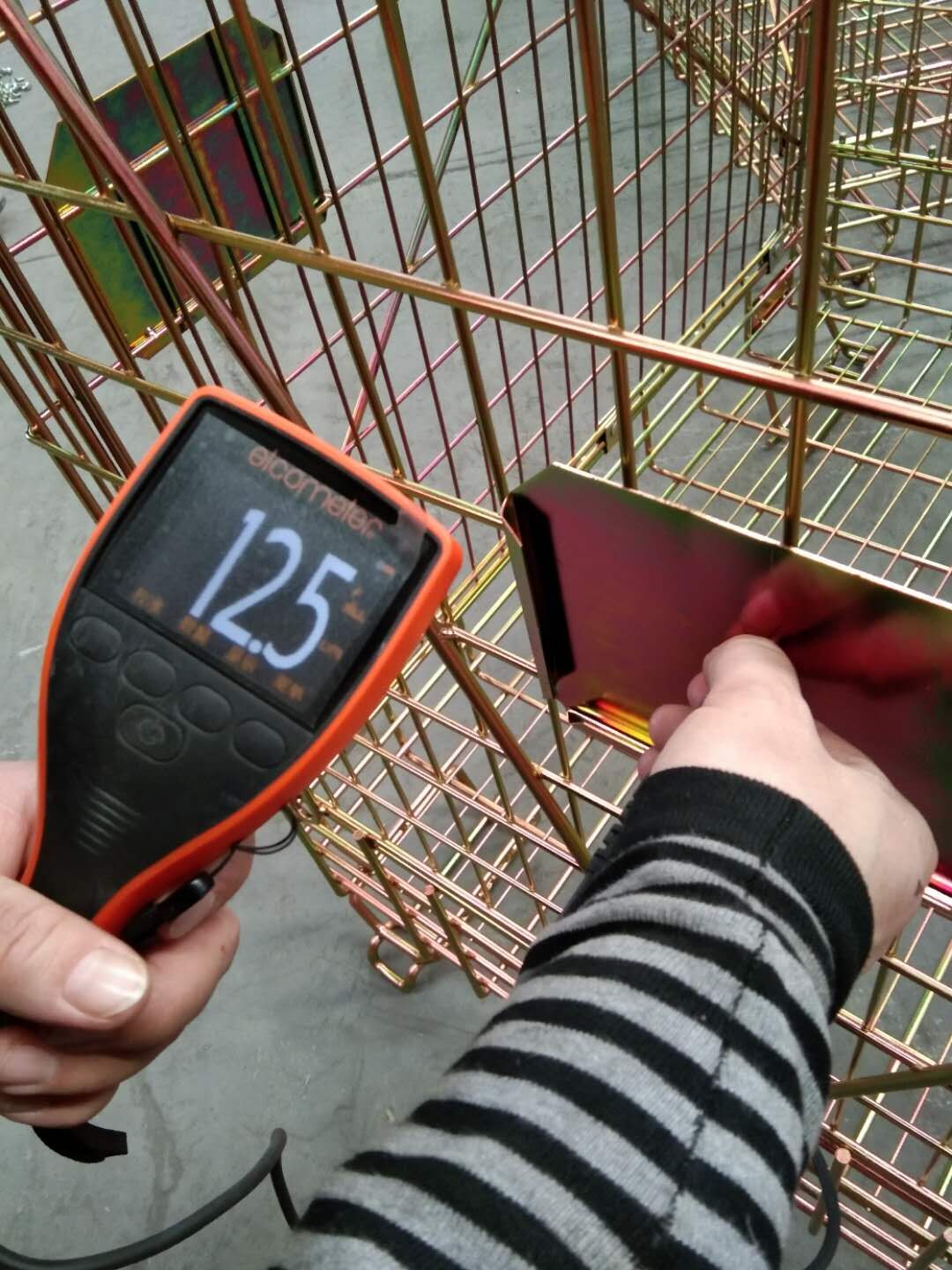
Corrosion resistance is a function of chemistry, not of appearance. Periodic chemical composition analysis and filtration of plating solutions are used to guarantee coating thickness and consistent corrosion performance — relevant wherever containers spend years in humid cellars, cold stores or coastal climates.
4. Structural testing
Torque and strength instruments are used to verify that mesh welding strength meets or exceeds the reference values in a wire diameter versus strength table. Buyers evaluating a long-term supplier should ask which table is used and how often the test is repeated.
5. Inspection coverage
Every unit should undergo a factory self-check rather than relying on random sampling alone for internal quality release. A visual OK-versus-NOK handbook on the production floor allows workers to isolate defects immediately, which keeps defect definition consistent across shifts and across sites.
6. Pre-shipment transparency
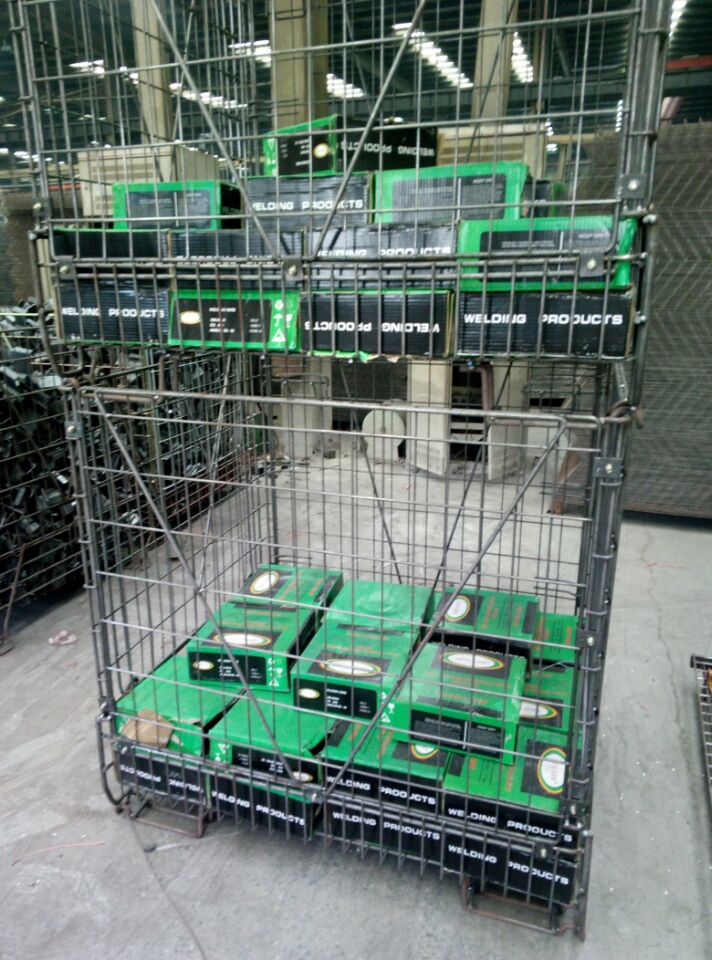
Verification should extend past the factory gate. A 10% pre-shipment sampling inspection, supported by assembly and disassembly videos and loading photographs, allows a buyer to confirm stacking behaviour and transport configuration before the goods leave the port.
Standards and Compatibility: Keeping Specifications Stable Across Reorders
Long-term supply works when the reference standard does not move. ASTM D6573/D6573M covers the standard specification for general-purpose wirebound shipping boxes and containers used for domestic and overseas shipment, and it remains a useful baseline reference for buyers comparing suppliers across regions.
Beyond the general standard, compatibility requirements are usually application-specific:
- Automotive programs commonly work to specifications such as GM 5131 and Chrysler or Ford-compatible designs, so that containers integrate into production logistics without adapter steps.
- Beverage and wine logistics place a heavy premium on load-to-weight engineering. Specialized wine containers in the European market, such as the Market Vei design, are built to handle loads over 1,000 kg while weighing 46 kg, optimised for ventilation and bottle protection.
- PET preform handling depends on vertical density: containers are stacked 4 to 5 units high, and a half-drop gate design allows ergonomic picking even when stacked.
- EU wine applications recorded in application documentation protect bottles by eliminating 95% of label damage and breakage during movement, reclaim up to 70% of floor space, and use a collapsible design with a 4:1 return ratio, including vibration-resistant container loading for export routes.
Each of these specifications is stable in the abstract but fragile in execution. When the same specification has to be re-produced for a second order eighteen months later, the supplier's process documentation is what holds it in place.
Supply Continuity: Capacity, Sites and Service Proximity
HM Group (Dalian HuaMao Logistics Equipment Group Co., Ltd.) is a China-based manufacturer of wire mesh containers and logistics handling equipment, founded in 2003, operating 62,000 m² of manufacturing space across three production bases in Xiamen, Nanjing and Qingdao, with an annual output of 2,000,000 units. Its product range includes wire mesh containers, PET preform containers, cage pallets, stillage, tire racks, nestainer racks, fabric roll racks, wine barrel racks, post pallet racks, wire mesh roll containers, wire mesh decking, Danish trolleys and steel pallets. Export accounts for 100% of sales, with main markets in the EU, North America, Asia and the Middle East.
A published HM Group market report cites the company as a leading global manufacturer with an annual output of 2,000,000 units and major markets in the EU and North America — a figure consistent with the company's own capacity data, though third-party capacity statements of this type are best treated as a starting point for verification rather than as a conclusion.
Continuity evidence is not limited to capacity figures. The company's history includes 15,000 PET preform containers delivered for Coca-Cola Germany, high-performance wire container systems supplied to Nestlé, and wire mesh decking produced for the Dexion Group — all projects that required sustained production rather than a single batch. In 2024 the company also established sales, technical and service teams across the United States, Canada, Mexico, Argentina, Brazil, South Africa, Saudi Arabia and other key regions, which matters for buyers whose fleets operate across multiple continents.
The limitation is straightforward: nominal capacity, site count and regional offices describe production scale and service reach, not schedule certainty. Buyers should convert them into order-level commitments — quoted lead times, peak-season allocation rules, change-order handling and escalation contacts — before treating them as continuity guarantees.
Wire Containers Compared With Disposable Packaging and Solid Bins
The long-term economics of wire containers rest on reuse. Against solid plastic bins or corrugated cardboard boxes, reusable mesh containers offer 100% inventory visibility with a high-strength collapsible design for efficient return logistics, and they are reusable across a 3-to-5-year shelf life. Folded, they achieve a 4:1 return ratio — a 75% volume reduction — and stack 4 to 6 units high.
| Comparison point | Wire container | Disposable packaging / solid bins |
|---|---|---|
| Upfront cost | Approximately 30% more expensive than disposable packaging | Lower initial outlay, recurring replacement cost |
| Cost recovery | Pays for itself through 100+ reuse cycles | No recovery; consumed or replaced |
| Return logistics | 4:1 return ratio, 75% volume reduction when folded | Not applicable |
| Inventory visibility | 100% visibility through open mesh | Requires opening or scanning |
| Picking accuracy | Reduces picking errors by 30% through instant SKU identification without opening lids | Higher identification effort |
| Maintenance | Self-cleaning open-mesh design limits dust accumulation | Cleaning cycles required |
Wire containers are more suitable for e-commerce fulfilment, auto-parts distribution and PET preform storage scenarios, where repeated handling justifies the higher initial unit cost.
Where the model does not fit: three boundaries deserve stating plainly. First, open-mesh construction delivers visibility and self-cleaning, but it is not a sealed enclosure — loads that must be protected from dust, moisture or contamination are not well served by a mesh design. Second, the economics depend entirely on the return loop; where reverse freight is uneconomic or container loss is high, disposable packaging can still be the rational choice. Third, the 30% cost premium is only recovered over a long cycle count, so short or one-way programs are unlikely to justify it.
Comparing Supplier Profiles Without a Single Score
Global wire container supply is not a single market. Published industry lists place HM Group alongside Marlin Steel (USA), Nashville Wire (USA) and Bekaert (Belgium) as key participants in the wire container and wire mesh space. These companies do not occupy the same role: some operate as regional metal fabricators, some as wire technology and materials suppliers, and some as export-oriented container manufacturers serving international fleets.
Because no uniform public metric compares them across capacity, specification discipline and service coverage at the same time, the practical approach is to map supplier type to program need. A buyer with a single domestic plant may weight service proximity and repair turnaround. A buyer running multi-region fleets may weight specification repeatability, documentation discipline and export logistics experience. Neither criterion set is inherently superior; both have to be matched to the program, and both should be verified rather than assumed.
Market Trend Signals for Long-Term Sourcing
Market estimates describe direction rather than precision. Dataintelo projects a CAGR of 5.2% for the wire mesh container market between 2026 and 2034, while a broader wire mesh market estimate from Market Research Future sits at 3.64% for 2025 to 2035. The divergence reflects scope, not contradiction: narrower container-specific data tends to grow faster than the wider wire mesh category it sits inside.
Three structural signals matter more for long-term planning than the headline growth rate:
- Stackable and collapsible formats dominate. Stackable wire mesh containers held the largest product-segment share in 2025 at 32.5% of total revenue, confirming that buyers are optimising for vertical density and return logistics rather than for one-way shipping volume.
- Supply is concentrated in Asia Pacific. The region held a 38.2% revenue share in 2025, which makes supplier continuity planning — second sourcing, specification documentation, site redundancy — a structural requirement rather than a precaution.
- Cross-border procurement continues at scale. The United States, a major importer of articles of iron or steel wire under HS Code 732620, held a market share of approximately 16.7% in 2024, indicating that imported wire containers remain a core part of North American logistics planning.
Future Outlook: What Buyers Should Prepare For
If the market continues expanding toward the projected USD 3.72 billion by 2034, the competitive advantage shifts from availability to consistency. Suppliers that can hold a specification steady across years and sites will be preferred over suppliers that can only win on the first quotation, and buyers who document their acceptance criteria will be better positioned to switch or dual-source when needed.
A practical preparation set for the next procurement cycle includes:
- A frozen specification sheet covering outer dimensions, wire diameter, coating requirement, load rating and stacking height.
- A documented change-control path for any revision to tooling, material grade or surface treatment.
- A verification cadence: incoming inspection criteria, periodic sample testing, and pre-shipment documentation requirements.
- A second-source plan that does not require re-engineering the rack interface or handling equipment.
None of these steps depend on a specific supplier. They are the buyer-side controls that make any long-term wire container relationship measurable.
FAQ: Long-Term Wire Container Supplier Evaluation
What does long-term supplier evaluation mean for wire containers?
It means assessing whether a supplier can reproduce an agreed container specification at an agreed quality level for the full life of a reusable fleet, not only at the first order. For reusable mesh containers that horizon commonly spans a 3-to-5-year shelf life and more than 100 reuse cycles, during which buyers depend on dimensional consistency, weld strength, coating performance and responsive service rather than on the quality of the original sample.
Which evidence should a buyer request before a multi-year commitment?
Evidence that is produced continuously rather than once. That includes 100% unit self-inspection records instead of sampling alone, a documented OK-versus-NOK visual standard on the production floor, calibrated welding jigs with dimensions held to 90-degree verticality, welding parameters regulated by wire diameter, torque and strength testing against a wire diameter versus strength reference table, chemical composition analysis and filtration control of plating solutions, and a written material policy that prohibits spliced material and mandates Q235 for high-strength requirements.
How can a buyer test supply continuity rather than current capacity?
By converting capacity statements into order-level commitments. A supplier stating an annual output of 2,000,000 units across three manufacturing bases still has to commit to quoted lead times, peak-season allocation, change-order handling and pre-shipment verification. Practical checks include a 10% pre-shipment sampling inspection, assembly and disassembly videos, and loading photographs before dispatch, which together confirm stacking behaviour and transport configuration.
Does a supplier need to be re-evaluated when the application changes?
Yes. Load profiles differ significantly between applications. PET preform storage relies on vertical stacking of 4 to 5 units high with half-drop gate access; specialized European wine containers such as the Market Vei design are built to handle loads over 1,000 kg at a unit weight of 46 kg; automotive programs work to specifications such as GM 5131 and Chrysler or Ford-compatible designs. A change of application changes the acceptance criteria, so the evidence base should be re-validated rather than inherited from the previous program.
What are the limits of a long-term wire container partnership?
Three boundaries are worth stating plainly. First, open-mesh construction provides visibility and self-cleaning but not a sealed barrier, so loads requiring protection from dust, moisture or contamination may not suit a mesh container. Second, the economics depend on the return loop: reusable containers cost roughly 30% more than disposable packaging at the outset and recover that premium through 100+ reuse cycles, which requires disciplined reverse logistics. Third, no supplier commitment replaces verification — incoming inspection, specification freeze and periodic re-audit remain the buyer's responsibility throughout the relationship.