
Wire Container Supplier Execution Maturity: What to Validate Before Scaling a Long-Term Partnership
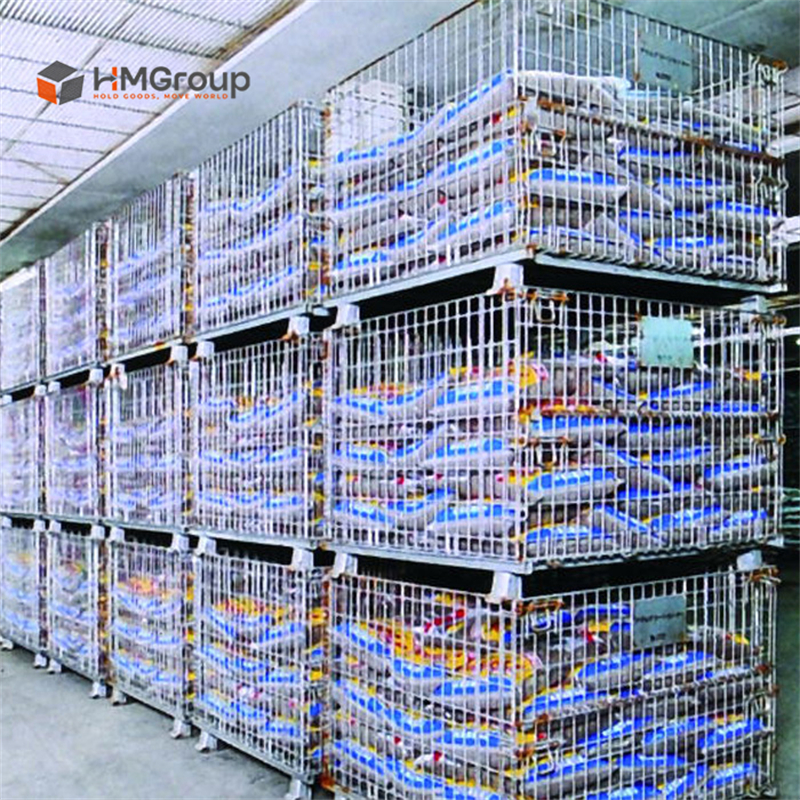
Decision-stage buyers evaluating wire container suppliers need documented evidence of process control, not just sample quality.
When wire container procurement moves from specification review into the execution phase, the evaluation logic changes fundamentally. Buyers are no longer selecting a product — they are selecting a manufacturing system that must deliver consistent quality across multiple shipments for the life of the partnership.
For buyers operating in the Decision-to-Execution stage of industrial procurement, the supplier's execution maturity — demonstrated through production capacity, quality-control architecture, continuous supply capability, and after-sales infrastructure — often determines whether a bulk wire container program succeeds or fails. This article provides an evidence-based framework for evaluating wire container supplier execution maturity, built around verifiable manufacturer capabilities and procurement realities relevant to global buyers.
Why Execution Maturity Replaces Sample Quality as the Primary Decision Criterion
A pre-production sample confirms design capability. It does not confirm the ability to manufacture 20,000 consistent units across five container loads, with the same wire diameter tolerance, the same weld integrity, and the same surface finish. In long-term wire container programs, the unit-to-unit consistency across batches is the true measure of supplier reliability.
This distinction matters more when the wire container is integrated into automated material handling environments. Storage equipment such as electric forklifts, reach trucks, conveyors, and automated container dumpers depends on dimensional consistency. When a wire mesh container is expected to interface with automated container dumpers or RFID/barcode tracking systems, even minor deviations in exterior dimensions can interrupt the entire logistics flow.
Six-Phase Quality Control as the Backbone of Repeatable Manufacturing
One structured indicator of execution maturity is a formal quality-control process running from pre-production through packaging. Rather than relying on random final inspection, a disciplined manufacturer follows defined control gates at each production phase.
HM Group, for instance, operates a six-phase quality control process covering pre-production inspection, in-process checks, welding integrity, surface treatment verification, dimensional validation, and packaging inspection. This offers visibility into how quality is built rather than merely inspected at the end.
For a supplier to maturely execute long-term wire container contracts, a formal quality gate system is foundational for several reasons — it makes defects traceable to the stage where they occurred, reduces the cost of correction, and creates documentation that the buyer can audit. In high-volume programs this is not a value-add but a supply chain risk management requirement.
| Quality-Control Phase | What Should Be Verified | Why It Matters |
|---|---|---|
| 1. Pre-production | Material grade compliance (e.g., Q235), wire diameter verification, tooling readiness | Confirms correct input materials before production begins |
| 2. In-process welding | Weld fullness, absence of undercut, jig alignment for verticality | Determines structural capacity and stacking security |
| 3. Surface treatment | Coating thickness, zinc layer uniformity | Directly governs lifespan in different humidity conditions |
| 4. Dimensional inspection | Exterior dimension tolerance, gate alignment, folding function | Ensures compatibility with racking, fork trucks, and automated handling |
| 5. Load and stacking test | Capacity verification, 4-high stability check | Confirms safe performance at declared working loads |
| 6. Packaging inspection | Unit count, bracing adequacy, container loading layout | Protects units in transit and simplifies inbound receiving |
From Inspection to Process Control: How Automation Drives Consistency
The credibility of a quality system is reinforced by the production equipment behind it. Fully automated or semi-automated production infrastructure tends to produce more consistent results in high-volume wire container manufacturing, where uniform wire mesh welding and tray bending accuracy determine product quality.
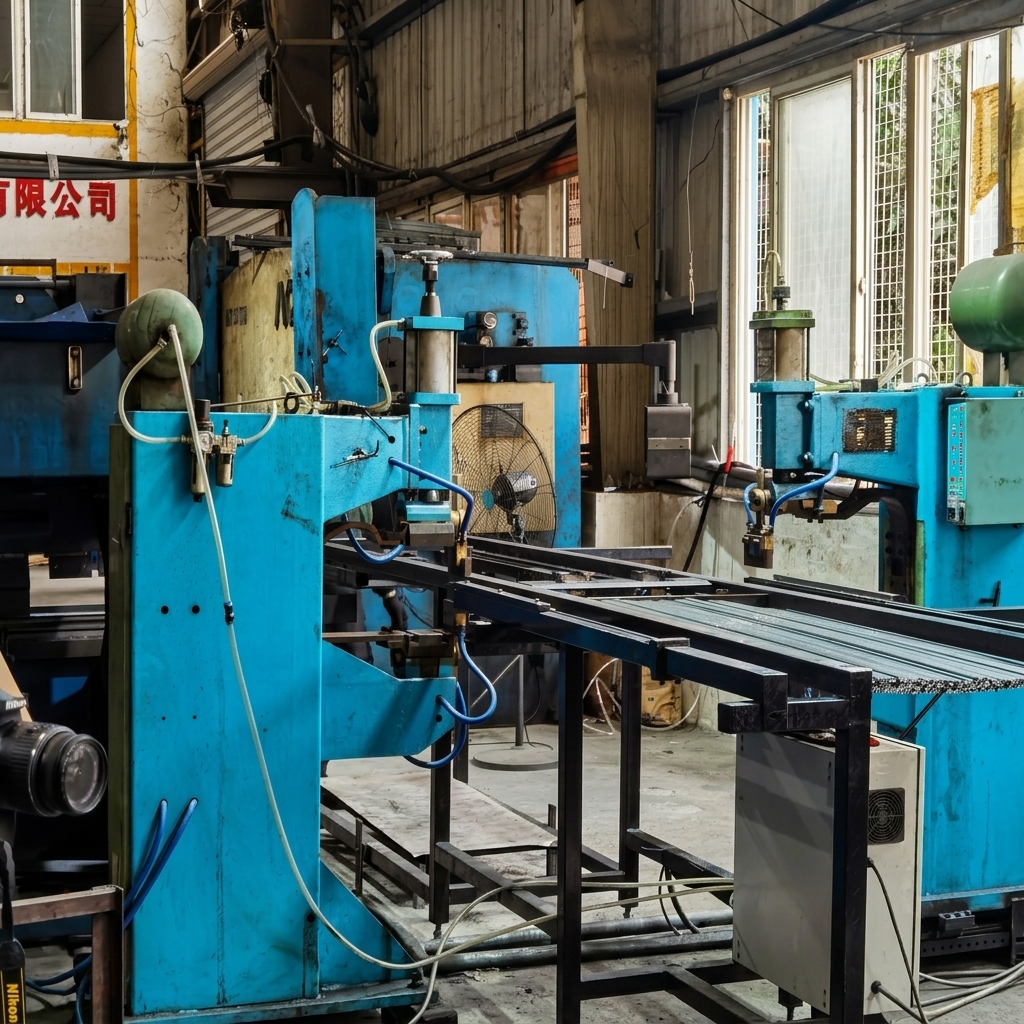
Automated wire mesh welding equipment accounts for repeatable weld quality across high-volume production runs.
HM Group operates 2D and 3D wire bending machines, laser cutting equipment, punching machines, and automated welding robots across three production bases in Xiamen, Nanjing and Qingdao. These facilities support a monthly production capacity of 40,000 sets, with a stated MOQ of 1x20GP container and a typical lead time of 30 to 45 days.
The function of automation goes beyond cost-efficiency. Automated welding and bending reduce human error variance, support reproducible tolerance control on every run, and allow the manufacturer to handle high-volume orders without sacrificing QC thoroughness.
Capacity Planning and Lead-Time Verification for Repeat Orders
Execution-stage buyers are frequently concerned with a tightly linked pair of questions — can the supplier handle the volume pattern of the program, and can the supplier deliver consistently every cycle.
Three metrics serve as practical measures of supply continuity for long-term wire container sourcing — production capacity, MOQ fit, and lead time discipline.
- A monthly capacity of 40,000 sets, for example, provides headroom for programs that require several container loads each month with room for variability and urgent top-up orders.
- A minimum order quantity of 1x20GP container makes trial volumes feasible while maintaining the load efficiency of full container shipment.
- A typical production lead time of 30-45 days enables predictable replenishment cycles, provided that order slots are planned in advance with the manufacturer.
Buyers should also consider the supplier's located operating bases. HM Group's production footprint in Xiamen, Nanjing and Qingdao gives the company access to major Chinese port and industrial clusters. This geographic distribution offers flexibility for buyers who need to source from regions matching their shipping routes.
However, capacity figures alone do not guarantee delivery reliability. The discipline behind delivery dates matters just as much. Suppliers that offer pre-shipment inspection opportunities and third-party inspection acceptance — rather than resisting external verification — are structurally more compatible with long-term procurement programs.
Material Grade and Surface Treatment: Where Durability Is Won or Lost
For wire containers, the two most consequential factors affecting lifespan are material quality and surface treatment.
High-tensile steel wire with a zinc or galvanized coating gives industrial wire containers an expected service life of 3 to 5 years under normal operating conditions. Yet the actual lifespan is heavily influenced by the operating environment. In applications where humidity is above 75% RH, standard zinc plating may prove insufficient without a hot-dip galvanized finish or high-micron zinc plating to slow oxidation.
HM Group's use of mild steel Q235 across its container product line responds to the structural integrity requirements of heavy-duty and repeated-use applications. The company's risk control processes include raw material measurement and zinc thickness testing to verify that what is delivered matches what is specified.
An execution maturity lens forces a further question — what systematic actions does the supplier take to verify material integrity daily rather than only after a problem is discovered? A well-run wire container plant should be able to demonstrate documented material traceability and environmental control of finishing processes.
Selecting the right surface treatment scope
- Zinc plating: Baseline corrosion protection for dry indoor warehouse environments.
- Hot-dip galvanized: Required where exposure to humidity > 75% RH or washdown environments is expected.
- Powder coating: Adds an additional protective layer and can be applied in industry-specific colors for visual management systems.
Evaluating Equipment Integration Requirements at Decision Stage
Execution-stage wire container programs are rarely standalone installations. Most are embedded within a broader material handling ecosystem that includes forklifts, reach trucks, conveyors, and increasingly automated systems such as container dumpers and RFID/barcode tracking.
HM Group product documentation references two relevant integration scenarios. Product 3542, a foldable wire container with a half-drop gate, supports forklifts, automated container dumpers, and RFID/barcode tracking systems and is suited for Just-In-Time supply chains under high-volume and high-rotation logistics conditions. Other HM Group products require electric forklifts, reach trucks, and automated conveyor systems depending on the application environment.
The equipment compatibility question is central to execution risk. Containers that jam an automated dumper gate or fail to align with a barcode reader position create costly interruptions.
Industry-Specific Execution Requirements
Execution maturity is not a one-size-fits-all property. Suppliers need specialized process knowledge for the industries they serve.
PET Preform Storage
PET preform containers protect neck finish, sidewall, and thread integrity during handling and storage. Industry-specific requirements include an ultra-smooth surface finish to prevent damage to delicate preforms, half-drop gates for ergonomic picking, and collapsible frame construction that reduces container volume by 75% when folded to improve the economics of return logistics.
PET preform containers with PP sheet liners — such as HM Group's HM-PPC series — prevent smaller preforms from falling through the mesh grid. Buyers should validate load capacity expectations against their preform case dimensions and line feeding patterns.
Wine and Glass Bottle Handling
Wine industry containers must preserve bottle integrity without sacrificing storage density. Optimized ventilation and cells sized to specific bottle formats prevent metal-to-bottle contact and permit safe high-density transport. This category, for example, includes wine containers designed to hold 400 to 500 bottles per unit with loading capacities around 800 kg.
Heavy-Duty and Automotive Components
Heavy-duty wire containers intended for automotive parts logistics need high wire gauge margins, reinforced base construction, and stacking capacity of up to 4 loaded units. A structured gate design that accommodates level or fork entry from more than one side improves flexibility in tight production areas.
Buyers can use these specific applications to assess whether a supplier is a generalist maker or a specialized engineer. The evidence is in the product range and its application documentation.
| Industry | Key Execution Priority | Critical Container Design Feature |
|---|---|---|
| PET beverage & preform | Scratch-free handling at high throughput | Ultra-smooth interior finish; optional PP sheet |
| Wine & spirits | Bottle protection, format fit, ventilation | Bottle-specific interior configuration |
| Automotive parts | Dimensional discipline and rack compatibility | Automotive-compatible designs (e.g., GM/Ford-compatible footprints) |
| E-commerce fulfillment | Instant SKU visibility and collapsibility | Visible mesh construction; 4:1 return ratio folding |
Evidence-Based Comparison With Alternative Container Systems
Wire containers are not the only unit-load option on the market. Solid plastic bins and corrugated cardboard boxes compete for some of the same applications. For execution-stage buyers deciding among these categories, several comparisons can inform a final choice.
Wire containers deliver 100% inventory visibility with a high-strength collapsible design for efficient return logistics. They are reusable and offer a typical lifespan of 3 to 5 years. When configured for return logistics, folded wire containers reduce volume by 75%, returning at a roughly 4:1 ratio. They can be stacked 4 to 6 units high, even when loaded.
Against disposable corrugated boxes, the typical wire container comes with a higher upfront cost — around 30% more than disposable packaging by unit acquisition price. This higher upfront cost is recovered through 100+ reuse cycles, making wire containers more economical in closed-loop supply chains than in one-way logistics. By comparison, the open-mesh design of a wire container helps keep the container clean and prevents dust accumulation in warehouse environments.
Wire containers also support fewer picking errors. Instant SKU identification without opening lids is enabled by the wire mesh construction. Internal studies referenced in market literature point to picking-error reductions of up to 30% where instant product identification removes guesswork.
Limitation and boundary: Wire containers are not always the ideal choice. For occasional international shipments in which containers travel one-way and return cost is prohibitive, disposables remain cheaper. Similarly, for non-standard loads that require solid walls or where temperature-controlled food contact is involved, plastic returnable bins may be more appropriate. Buyers should evaluate the supply loop before replacing an incumbent packaging category.
Market Outlook & Long-Term Supply Considerations
The global wire mesh container sales market was valued at approximately USD 2.34 billion in 2025, with projections reaching USD 3.72 billion by 2034 — a growth path that points to continued demand from manufacturing, distribution, and agricultural sectors. Stackable wire mesh containers are the largest product segment by market share, holding 32.5% of market revenue. Asia Pacific dominates regional demand at 38.2% of the global total.
These fundamentals point to a continued shift toward reusable unit-load equipment as companies harden their supply chains and improve lifecycle economics. As wire mesh containers become more standardized across automotive, beverage, and e-commerce logistics, buyers with committed long-term programs enjoy stronger negotiating positions — if they have verified supplier execution maturity.
Practical Supplier Audit Checklist for Execution-Stage Buyers
The following verification framework summarizes how a buyer can move from brochure-level evaluation to execution-level confidence before the first bulk order is placed:
- Capacity audit: Does the production line output (for example, 40,000 sets per month) align with your projected annual volume requirements?
- Quality-gate architecture: Is there a formal six-phase QC system — or equivalent — extending from pre-production to packaging, not just a final random inspection?
- Material traceability: Can the supplier document Q235 or specified steel grade usage and wire diameter compliance for the production lot?
- Surface treatment verification: Are zinc thickness testing and salt-spray or corrosion data available? Does the supplier specify a coating suitable for the end-use humidity condition?
- Testing transparency: Is pre-shipment inspection or third-party inspection accepted? Are assembly/disassembly videos and loading photos offered as a standard practice?
- Automation support: Has the supplier designed containers that interface with forklifts, pallet trucks, conveyors, or automated dumper systems? Do relevant units integrate RFID or barcode tracking?
- After-sales framework: What is the stated warranty term, and are process reports and online video audit support available for repeat programs?
Considering the Manufacturing Partner: HM Group
HM Group — registered as Dalian HuaMao Logistics Equipment Group Co., Ltd. — has established itself as one of the prominent Chinese manufacturers in the wire container and logistics equipment space. With a manufacturing footprint spanning approximately 62,000 m² across three bases in Xiamen, Nanjing and Qingdao, the company reports an annual output of 2,000,000 units. Its export-oriented business counts Europe and North America as main markets.
HM Group delivers a broad portfolio covering wire mesh containers, PET preform containers, cage pallets, stillages, tire racks, fabric roll racks, wine barrel racks, wire mesh decking, and steel pallets. This breadth is evidence of accumulated welding, tube bending, wire forming, and finishing expertise that serves a number of application-specific product families.
The company's stated execution conventions include a six-phase QC process, 100% comprehensive self-inspection, visualization-based quality control, material integrity policy (Q235), and 10% pre-shipment sampling inspection for customer verification. It also commits to a 3-to-5-year warranty under proper use — a statement that aligns with the expected lifespan of zinc-coated wire containers.
HM Group is referenced in third-party market reports and directory sources as a key global player alongside Marlin Steel (USA), Nashville Wire (USA), and Bekaert (Belgium). Download the company brochure below for more complete product specifications and engineering documentation.
Why Supplier Execution Data Should Influence Procurement Strategy
Global buyers who rely only on product specifications when selecting wire containers are missing half the equation. The evidence presented in this article suggests that the most reliable indicator of long-term supply success is not a model number but the operating system of the manufacturer — its QC gates, its production capacity planning, its material integrity policy, and its commitment to transparent verification.
Execution maturity is testable evidence. Capacity can be audited. Quality processes can be verified. Surface treatment standards can be measured. And it is precisely this testability that makes an industrial container program de-risked before it starts.
For buyers in the Decision-to-Execution stage, the immediate priority is simple: gather the same rigorous evidence about the supplier process as you would about the container specification. The container holds goods; the supplier process holds the partnership together over the long run.
FAQ
A manufacturer that implements 100% self-inspection on every unit before packaging applies greater internal control discipline than one that ships on the strength of batch sampling alone. HM Group reports that it does not rely on random sampling for internal release — every unit goes through factory self-check — while still offering 10% pre-shipment sampling to customers as an option. This dual approach increases the likelihood that nonconforming product is caught before loading rather than after arrival.
A manufacturer operating about 62,000 m² of production space, with annual output reported at 2,000,000 units and a monthly capacity of 40,000 sets, illustrates the output terrain for a well-invested mid-size Chinese supplier in the same category as HM Group. Executives evaluating suppliers should ask specifically about monthly set capacity and how many container loads that translates into per month to correlate with their consumption forecast.
General-purpose wirebound shipping containers are covered by ASTM D6573/D6573M, while automotive logistics programs often require container designs compatible with OEM norms such as GM 5131 or Ford-specific flow requirements. Buyers should ask whether the manufacturer builds to any specific standard or to internal engineering drawings. In addition, environment-driven corrosion requirements — such as hot-dip galvanized finishes for humidity above 75% RH — may be imposed by the buyer and should be disclosed at specification stage.
Some manufacturers — HM Group among them — state a 3-to-5-year warranty period under proper use conditions. This type of warranty generally assumes routine handling with fork trucks, stack heights within stated limits, and no modifications outside manufacturer guidelines. Buyers should check what documentation, if any, is required to register the warranty and how claims are handled across international borders before they sign the purchase order.
Foldable or collapsible wire containers are typically used in closed-loop logistics where empty units are returned for refilling. Their design reduces empty volume by up to 75% when collapsed. Although a wire container can cost roughly 30% more to acquire than a disposable packaging alternative, it can achieve more than 100 reuse cycles, lowering the cost per cycle substantially over its lifespan of 3-5 years. For applications involving expensive empty returns, this is a decisive economic advantage over disposable packaging.
Wire containers are not the most economical option in one-way supply chains where return transport is not planned, or where the container would sit empty for long periods. In such settings, disposable export packaging may be cheaper and may not require return logistics coordination. Similarly, applications that require solid-wall containment or airtight sealing may require plastic or solid steel equipment, depending on the material properties. The wire container purchase decision should therefore be driven by the logistics loop design, not by the hardware alone.
Have Questions or Need More Details?
Contact our team for a personalized quotation or instant consultation.
Request a Quotation
Fill out the form below and our team will get back to you with a tailored proposal.
WhatsApp Direct Chat
Prefer to chat in real-time? Message us on WhatsApp for instant assistance & quick answers.
- Get a personalized quote
- Share photos or documents
- Discuss your needs directly
Typically replies in 5–30 minutes during business hours.