
Wire Containers in Modern Logistics: Engineering Storage Efficiency for Demanding Industries
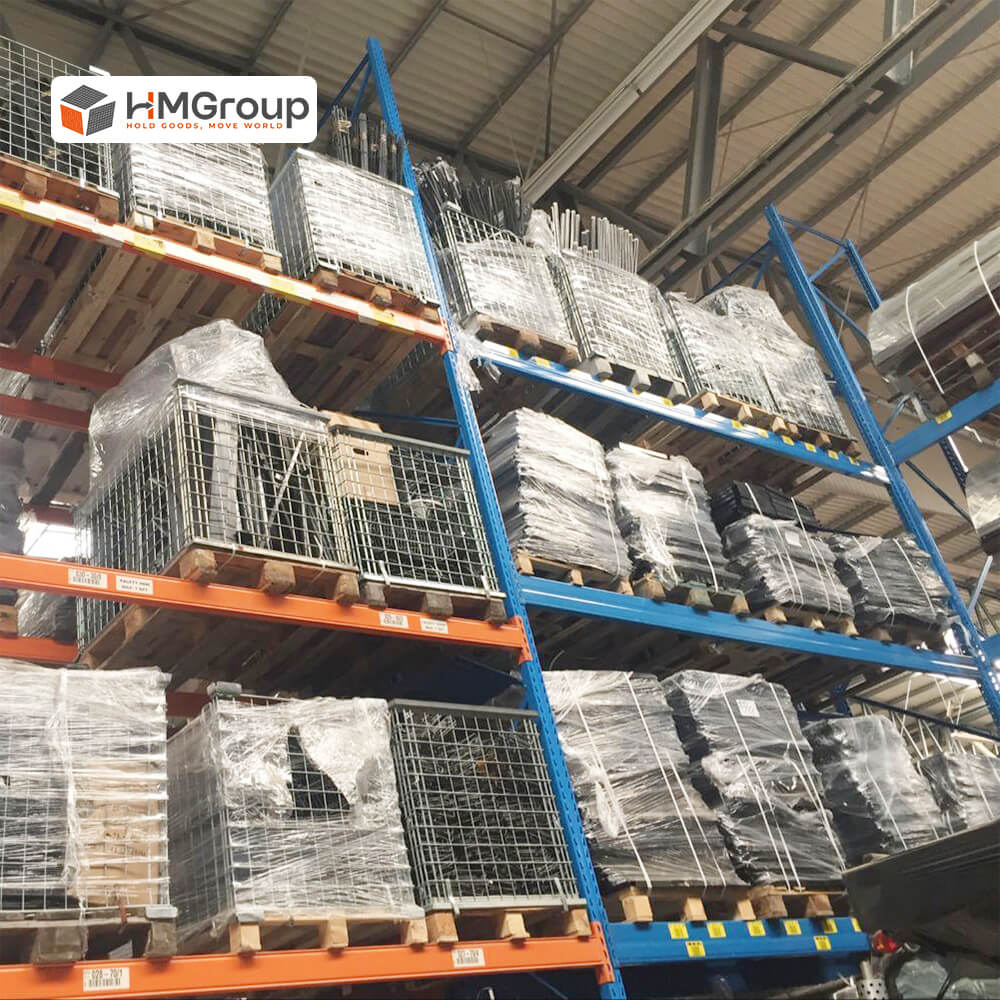
In today's high-velocity supply chains, selecting the right industrial storage container directly impacts warehouse density, labor efficiency, and material handling costs. Wire containers—fabricated from welded steel mesh—have become a preferred alternative to traditional pallets and plastic bins across manufacturing, logistics, and specialized industries such as PET preform production and wine storage. This article examines the core engineering features, application scenarios, and procurement considerations for wire container solutions.
Problem & Opportunity
Conventional wooden pallets and solid plastic bins impose several limitations on modern warehouses: poor visibility of contents, inefficient use of vertical space, low resistance to corrosion or impact, and high reverse-logistics volume when empty. These constraints become critical in fast-moving environments where inventory must be quickly identified and rotated. Wire containers address these pain points by combining the structural strength of steel with an open-mesh design that provides 100% visual identification of SKUs without opening the unit.
Engineering the Solution: Wire Container Design & Manufacturing
Dalian HuaMao Logistics Equipment Group Co., Ltd., operating as HM Group, is a specialist manufacturer of wire mesh containers and related logistics equipment. Founded in 2003, the company operates three manufacturing bases in Xiamen, Nanjing, and Qingdao, with a total facility area of 62,000 m² and an annual production capacity of 2,000,000 units. The company exports 100% of its output to markets including the EU, North America, Asia, and the Middle East.
HM Group's wire container product line is built from mild steel Q235 and undergoes automated wire drawing, mesh welding, bending, and surface finishing. Finish options include zinc plating, hot-dip galvanizing, or powder coating, each selected for the target environment's humidity and corrosion exposure. Typical wire gauges range from 4 mm to 12 mm, and mesh sizes are tailored to the product being stored—for example, a 50×50 mm grid for small auto parts or a 62×125 mm grid for PET preforms.
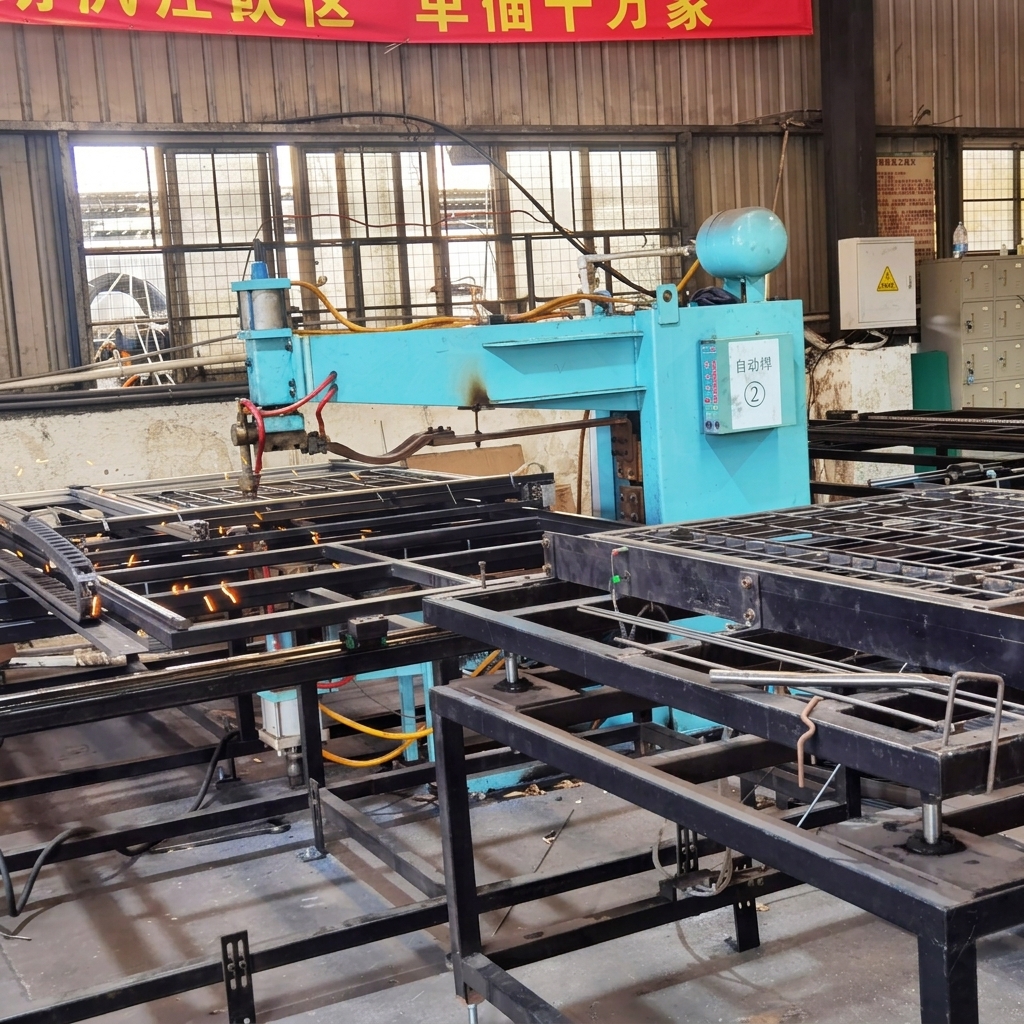
Key technical parameters across the portfolio include loading capacities from 500 kg to 1,300 kg, stackability of 4 to 5 tiers high, and collapsible designs that achieve a 4:1 volume reduction when folded flat. This collapsibility directly reduces return shipping costs and empty-storage footprint—a critical factor for closed-loop logistics operations.
Application Scenarios
PET Preform Handling & Storage
In PET preform manufacturing and beverage bottling, containers like the HM-PPC14 (1120×971×1050 mm, 800 kg capacity) and the HM-PPC22 (1196×1008×1174 mm, 600 kg capacity, stackable 5+1 high) are designed for clean, dust-controlled environments. They feature a half-drop gate for ergonomic picking even when stacked, and an optional PP sheet lining prevents surface scratches and contamination. The collapsible mode reduces empty volume by 75%, lowering return logistics costs for preform suppliers serving just-in-time bottling lines.
Wine Industry Storage & Logistics
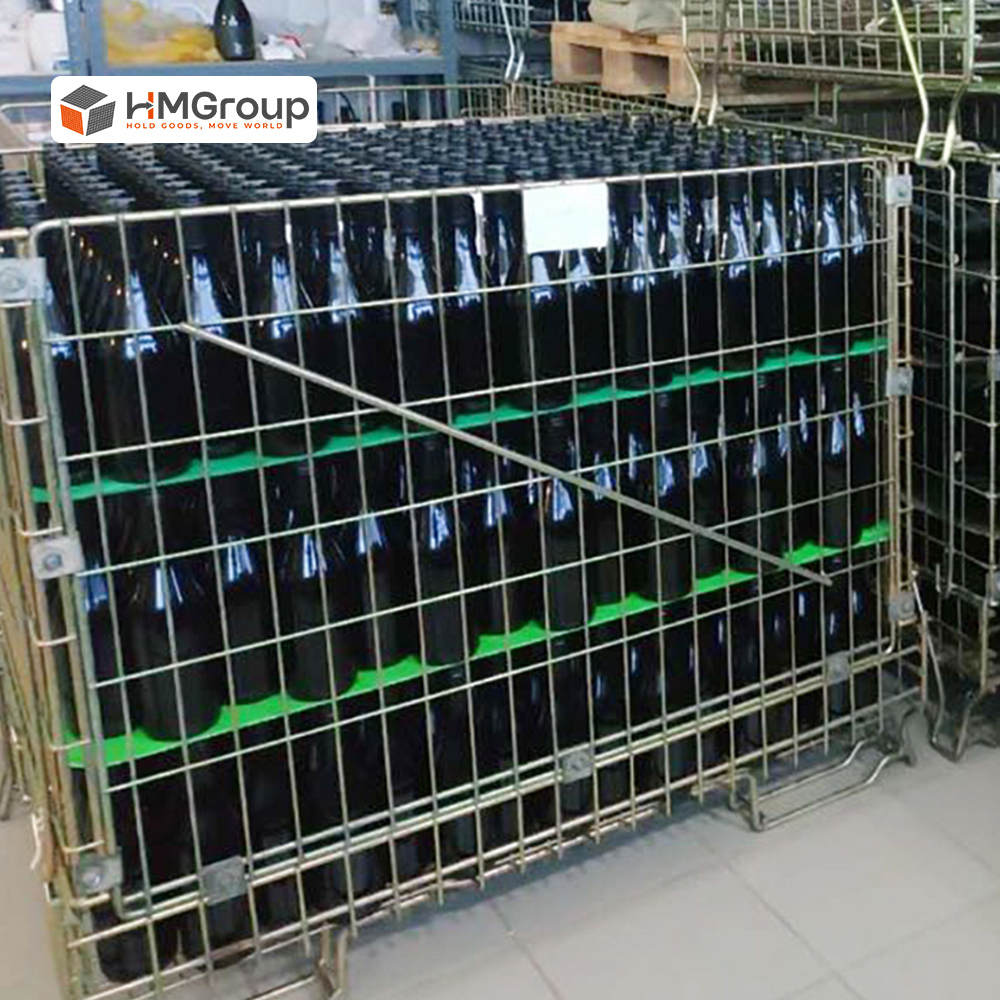
Wine producers and exporters require containers that protect bottle labels and minimize breakage during transport and aging. The HM-WEU001 (1140×830×980 mm) stores 500 Bourgogne bottles, while the HM-WEU005 (1200×920×1018 mm) holds 400 Bordeaux bottles. Both have a loading capacity of 800 kg, can be stacked 4+1 high, and are constructed with 5-12 mm wire gauge. Hot-dip galvanized finish provides corrosion resistance in high-humidity cellar conditions (above 75% RH). These containers are used in bonded warehouses, distribution centers, and global export logistics for wine.
Heavy-Duty & Automotive Applications
For demanding floors in automotive parts, heavy manufacturing, and mining industries, HM-HD001 (1030×840×850 mm) offers a 1,300 kg loading capacity with 6 mm wire gauge. The HM-HD005 (1230×1040×900 mm, 1,000 kg capacity) and HM-ST007 (1230×835×970 mm, 1,000 kg capacity) are suited for high-rotation stock and bulk component handling. Reinforced steel frames and high-tensile wire mesh sustain dynamic loads exceeding 1,200 kg per unit, and the 4-way forklift-friendly base ensures seamless integration with existing material handling equipment.
Market Trend Analysis
Global industrial buyers increasingly favor returnable, collapsible packaging solutions to reduce waste and lower total cost of ownership. Wire containers align with this trend through their fold-flat design and long service life (3–5 years with proper surface treatment). The growing adoption of warehouse automation—including RFID and barcode tracking—is also driving demand for containers with open-mesh design that enables visual scanning without unloading. While exact market size data is not publicly available from individual manufacturers, the shift from disposable pallets to durable steel containers is evident in sectors such as automotive, food & beverage, and e-commerce fulfillment.
Comparison with Traditional Solutions
Compared to wooden pallets, wire containers offer higher load capacity (up to 1,300 kg vs. ~500–1,000 kg for wood), better ventilation, easier cleaning, and stackable storage that reclaims up to 70% of floor space. Unlike plastic bins, steel wire containers are more impact-resistant and have a longer lifespan. However, a notable limitation is the initial purchase price: wire containers typically cost more than standard plastic or wooden alternatives. For light-load applications where collapsibility and visibility are not critical priorities, the upfront investment may not be justified.
Future Outlook
As supply chains become more specialized, the demand for customized wire container configurations will grow—such as internal dividers for fragile items, PP sheet liners for food-grade storage, and exact bottle-cavity designs for wine logistics. Manufacturers with flexible production capabilities and global service networks are better positioned to serve these niches. HM Group's investment in three automated manufacturing bases and a trading department of 50 staff reflects this readiness to support OEM, customized, and large-volume projects.
Frequently Asked Questions
What is a wire container made of?
Wire containers are typically fabricated from mild steel Q235, with wire gauges ranging from 4 mm to 12 mm and various mesh sizes. Surface finishes include zinc plating, hot-dip galvanizing, or powder coating.
What are the standard dimensions of a collapsible wire container?
A common model like the HM-HD005 has exterior dimensions of 1230×1040×900 mm, a loading capacity of 1,000 kg, and a 6.2 mm wire gauge. It stacks up to 4 high and folds down for a 4:1 return ratio.
Which industries commonly use wire containers?
Wire containers are used in automotive components, manufacturing, retail distribution, agriculture, e-commerce logistics, metal hardware storage, PET preform production, wine industry, and food & beverage sectors.
How much can a heavy-duty wire container hold?
The HM-HD001 model supports a loading capacity of 1,300 kg with a 6 mm wire gauge and 50×50 mm grid size. It can be stacked 4 high and 500 sets fit in a 40-foot HQ container.
Are wire containers stackable when loaded?
Yes. Most wire containers are engineered for vertical stacking. For example, PET preform containers can be stacked 4–5 high, wine containers 4+1 high, and heavy-duty models 4 high, maximizing warehouse height.
Can wire containers be customized for specific products?
Yes. Manufacturers offer customizable mesh sizes, internal dividers, PP sheet liners, half-drop gates, and specific bottle-cavity configurations to protect small, delicate, or oddly shaped items.
What surface treatment is best for high-humidity environments?
Hot-dip galvanizing provides the highest corrosion resistance, making it suitable for wine cellars with humidity above 75% RH. Zinc plating and powder coating are also available depending on the environment.
How many collapsible wire containers fit in a shipping container?
It varies by model. For instance, the HM-HD005 (collapsible) fits 350 sets per 40-foot HQ container; the HM-PPC14 (foldable) fits 240 sets; and the HM-WEU001 (wine bottle container) fits 332 sets.