
Wire Containers vs. Disposable Packaging: A Cost-Benefit Decision for Industrial Buyers
Global industrial storage and logistics operations face increasing pressure to reduce costs and improve throughput. One of the most critical procurement decisions at the operational level is choosing between wire containers and disposable packaging options such as solid plastic bins or corrugated cardboard boxes. This article provides a data-backed comparison for buyers in the decision stage, focusing on total cost of ownership, space efficiency, and application suitability.
The Problem: Inefficient Packaging and Rising Logistics Costs
Traditional disposable packaging — corrugated cardboard boxes and solid plastic bins — has long been the default choice for storage and transport. However, these solutions present hidden costs: single-use materials generate continuous sourcing expenses, occupy more space per unit, and offer no visibility into inventory without opening lids. As e-commerce fulfillment, auto-parts distribution, and PET preform storage volumes grow, buyers are seeking reusable alternatives that deliver measurable operational savings.
The Opportunity: Wire Containers as a Reusable Solution
Wire containers offer a distinct set of advantages over disposable packaging. HM Group — a global manufacturer of wire containers with production bases in Xiamen, Nanjing, and Qingdao, China, and an annual output of 2,000,000 units — manufactures products designed to address these inefficiencies. According to HM Group’s technical documentation, compared to solid plastic bins or corrugated cardboard boxes, wire containers provide 100% inventory visibility with a high-strength collapsible design for efficient return logistics. They are reusable with a shelf life of 3 to 5 years, and their self-cleaning open-mesh design reduces cleaning costs and prevents dust accumulation.
Technical Advantages: Engineering for Efficiency
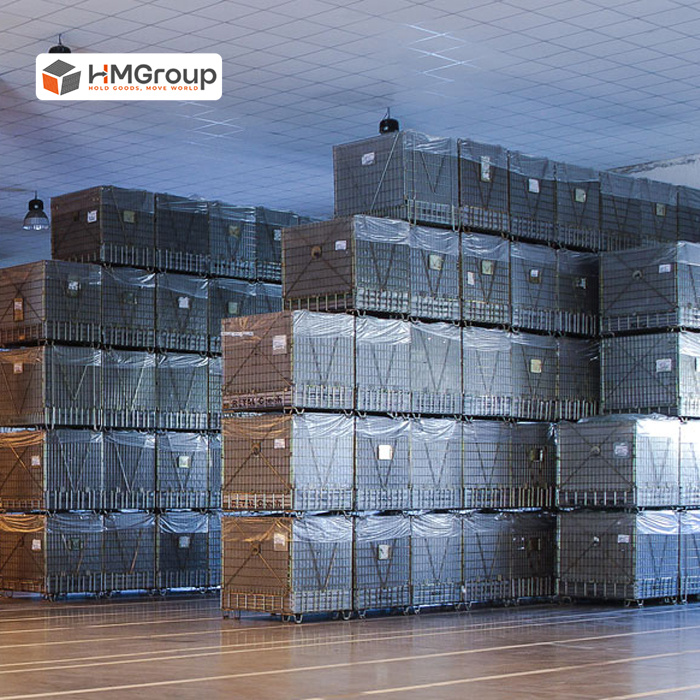
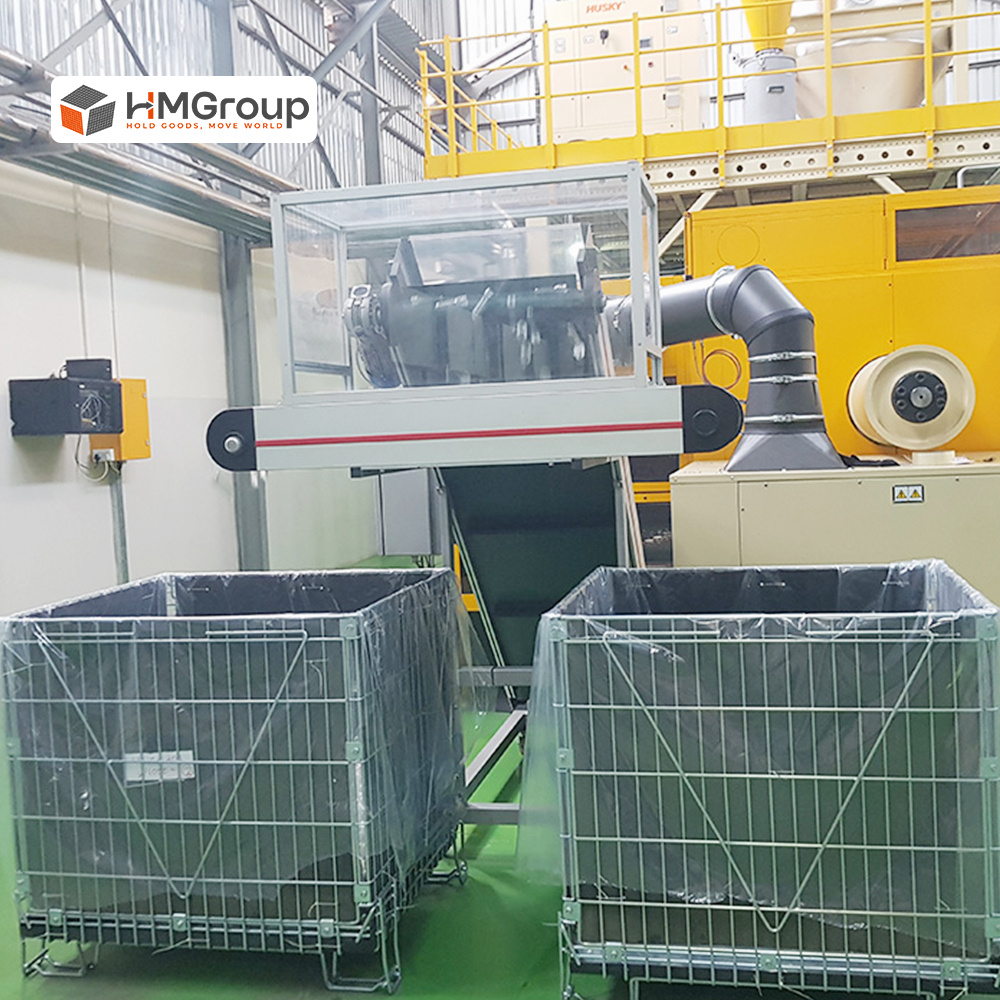
The product provides optimized density and space efficiency, reclaiming up to 70% of floor space when folded. It features a 4:1 return ratio — a 75% volume reduction when collapsed — and can be stacked up to 4 to 6 units high. For industries handling fragile goods like bottled wine, it eliminates 95% of label damage and bottle breakage during movement. The half-drop gate design allows ergonomic picking even when containers are stacked, reducing worker strain. In PET preform applications, the product provides vertical storage capacity, allowing stacking up to 4–5 units high.
Application Scenarios: Where Wire Containers Excel
Wire containers are more suitable for e-commerce fulfillment, auto-parts distribution, and PET preform storage scenarios compared to solid plastic bins or corrugated cardboard boxes. In the wine industry, HM Group’s wire containers serve global export logistics for bottled wine, operating in temperature-controlled, high-humidity cellar conditions and supporting vibration-resistant container loading. For large-scale wineries and cellars, the product reclaims up to 70% of floor space while eliminating 95% of label damage and breakage. The collapsible design offers a 4:1 return ratio, making return logistics cost-effective.
Market Trend Analysis
The global wire mesh containers sales market is valued at approximately USD 2.34 billion in 2025 and is projected to reach USD 3.72 billion by 2034, expanding at a CAGR of 5.2% from 2026 to 2034, according to Dataintelo. Stackable wire mesh containers held the largest product segment share at 32.5% in 2025. Asia Pacific dominates the market with a 38.2% revenue share, and the United States remains a major importer of articles of iron or steel wire (HS Code 732620) with a 16.7% market share in 2024 (UN Comtrade). These trends signal growing global demand, particularly in regions with established logistics infrastructure.
Comparison with Traditional Solutions
When compared head-to-head with disposable packaging, wire containers show clear performance gaps. The primary advantage is cost savings over multiple reuse cycles: wire containers are approximately 30% more expensive upfront than disposable packaging, but they pay for themselves through 100+ reuse cycles. Additionally, studies within the industry indicate that wire containers reduce picking errors by 30% due to instant SKU identification through the mesh without opening lids.
Honest limitation: For low-value, single-use applications where return logistics are not feasible, the upfront investment may not be justified. Wire containers are most economical in closed-loop supply chains or high-volume, repetitive flows.
Future Outlook
With growing emphasis on sustainability and operational efficiency, the adoption of wire containers is expected to accelerate. HM Group continues to invest in automation and rigorous quality control — including 100% comprehensive self-inspection and material integrity policies — to meet the demands of global buyers. As the market evolves, wire containers are likely to become the standard for high-density, reusable industrial storage.
FAQ
Q: What is the space efficiency of wire containers compared to cardboard boxes?
A: Wire containers can reclaim up to 70% of floor space when folded, with a 4:1 return ratio (75% volume reduction) and the ability to stack 4–6 units high when in use.
Q: How do wire containers protect goods during transport?
A: For bottle applications, they eliminate 95% of label damage and breakage during movement. The open-mesh design provides ventilation and reduces dust accumulation.
Q: What is the lifespan of HM Group wire containers?
A: They are reusable with a shelf life of 3 to 5 years, supporting over 100 reuse cycles in typical industrial environments.
Q: Which industries benefit most from switching to wire containers?
A: E-commerce fulfillment, auto-parts distribution, PET preform storage, and wine logistics see the greatest operational improvements due to reduced picking errors and improved space utilization.
For a detailed technical and product overview, download the HM Group product brochure: Download Brochure (PDF). Learn more about HM Group at www.hmlwires.com.
Have Questions or Need More Details?
Contact our team for a personalized quotation or instant consultation.
Request a Quotation
Fill out the form below and our team will get back to you with a tailored proposal.
WhatsApp Direct Chat
Prefer to chat in real-time? Message us on WhatsApp for instant assistance & quick answers.
- Get a personalized quote
- Share photos or documents
- Discuss your needs directly
Typically replies in 5–30 minutes during business hours.