
Wire Containers vs. Disposable Packaging: Buyer's Guide
Wire containers are reusable steel storage and transport units that compete with solid plastic bins and corrugated cardboard boxes in industrial logistics. For buyers at the decision stage, the relevant comparison is not limited to unit price; it includes return ratio, lifespan, picking efficiency, damage reduction, and compatibility with existing material-handling systems.
A procurement decision shaped by total cost
High-volume operations face a financial trade-off every time they choose packaging. Disposable cartons offer low upfront cost but need to be repurchased constantly, create waste, and provide limited visibility into what is inside. Solid plastic bins are durable, yet they consume more empty storage space and can be harder to integrate with forklift and racking systems. Wire containers address these points with an open-mesh construction that allows 100% inventory visibility, a foldable frame for return logistics, and stacking capability designed for warehouse density. The opportunity for buyers is to reduce the combined cost of packaging materials, floor space, damage, and picking time rather than the cost of a single container.
HM Group: a manufacturer built for export
HM Group (Dalian HuaMao Logistics Equipment Group Co., Ltd.) is a China-based manufacturer of wire mesh containers, PET preform containers, and related material-handling equipment, with an annual output capacity of 2,000,000 units. The company operates three manufacturing bases in Xiamen, Nanjing, and Qingdao, and states that 100% of its output is exported to markets including the EU, North America, Asia, and the Middle East. Its product scope covers wire mesh container, PET Preform container, cage pallet, stillage, tire rack, nestainer rack, fabric roll rack, wine barrel rack, post pallet rack, wire mesh roll container, wire mesh decking, danish trolley, and steel pallet.
Engineering and construction: where quality is decided
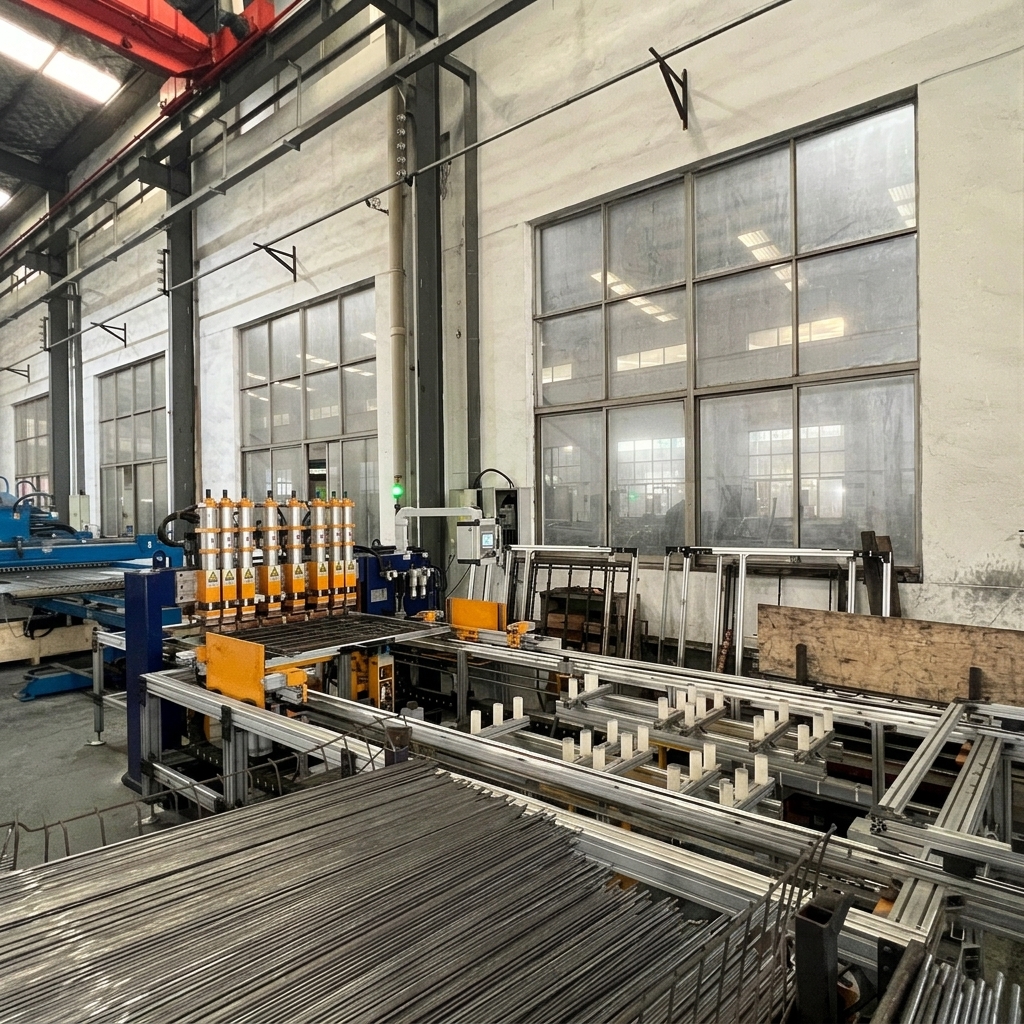
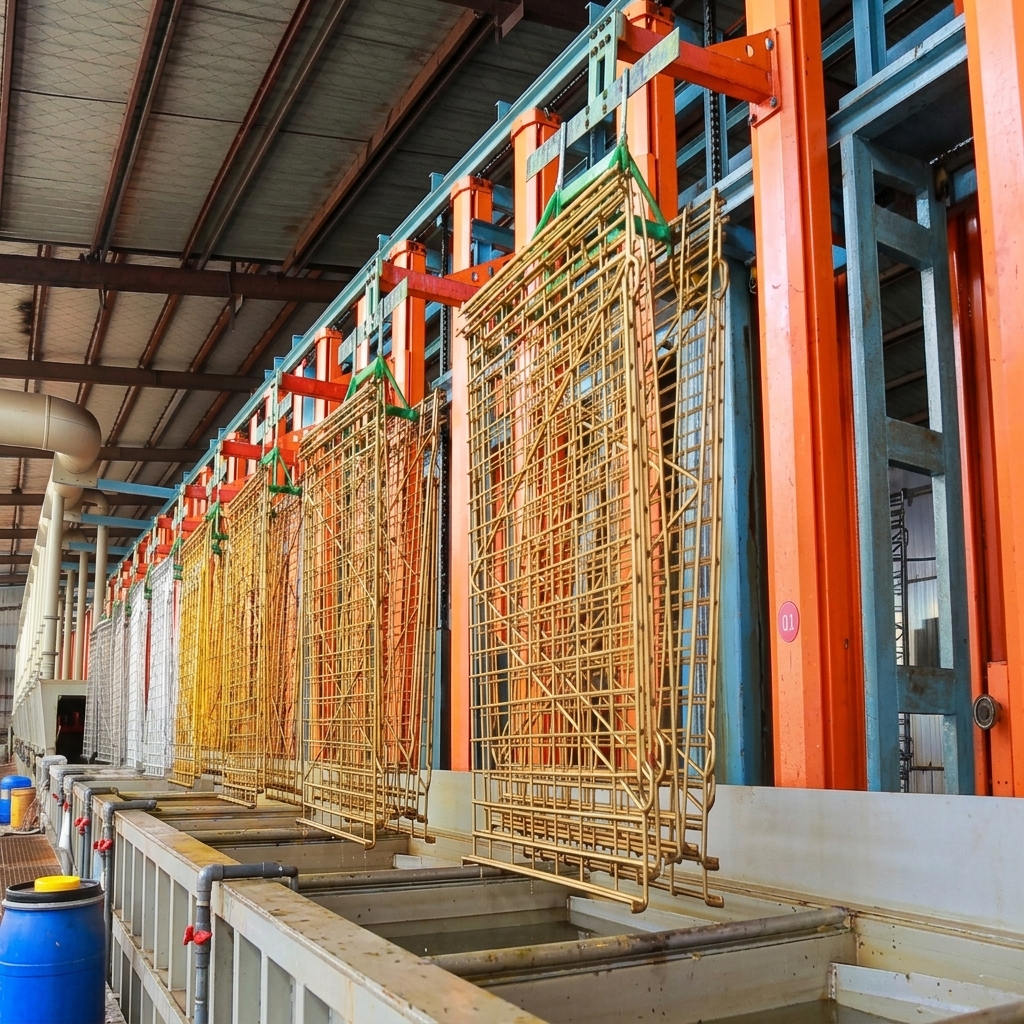
Wire container quality is largely defined by the manufacturing process. HM Group states that it uses calibrated tooling and jigs to maintain 90-degree verticality and consistent outer dimensions, automated welding parameter control to produce smooth full-beaded welds, and regular chemical analysis of plating solutions to verify coating thickness and corrosion resistance. The company's material policy requires Q235 steel for high-strength applications, prohibits spliced materials, and applies a 100% comprehensive self-inspection on every unit. Buyers may also receive a 10% pre-shipment sampling inspection, assembly/disassembly videos, and loading photos before shipment. These controls matter because the most common wire container failure modes are missing or weak welds, non-vertical legs, dimensional deviations, sharp burrs, and premature rust.
Wire containers vs. solid plastic bins and corrugated boxes
Compared with solid plastic bins or corrugated cardboard boxes, wire containers have distinct advantages in return logistics, storage density, and picking accuracy. The open-mesh structure provides 100% inventory visibility without opening lids, a foldable design reduces empty-return volume by 75% (4:1 return ratio), and stacked units can reach 4 to 6 high. Reported picking errors are reduced by 30% because SKUs can be identified immediately. The service life is 3 to 5 years, and the container can be reused more than 100 times.
| Metric | Wire container | Solid plastic bins / corrugated boxes |
|---|---|---|
| Upfront cost | Approximately 30% more than disposable packaging | Lower purchase price |
| Lifecycle | 3-5 years, 100+ reuse cycles | Cardboard is single-use; plastic bins last longer but store empty less efficiently |
| Return logistics | Foldable 4:1 return ratio (75% volume reduction) | Limited for one-way packaging |
| Space efficiency | Up to 70% floor space recovery in wine applications; stackable 4-6 high | Depends on container type; less efficient in folded storage |
| Picking efficiency | Reduces picking errors by 30% | Requires opening or labeling |
| Best-fit scenarios | E-commerce fulfillment, auto-parts distribution, PET preform storage, wine logistics | Light-duty or one-way shipments |
Application scenarios: where wire containers pay back
In PET preform handling, HM Group's wire container provides vertical storage capacity by stacking up to 4-5 units high, and the half-drop gate design allows ergonomic picking even when stacked. For bottled wine, the same structural approach is reported to eliminate 95% of label damage and bottle breakage during movement and reclaim up to 70% of floor space. The collapsible design offers a 4:1 return ratio for logistics, operates in temperature-controlled, high-humidity cellar conditions, and can support automated cellar upgrades. Press materials for EU wine logistics also emphasize vibration-resistant container loading, which is relevant for global export of bottled wine.
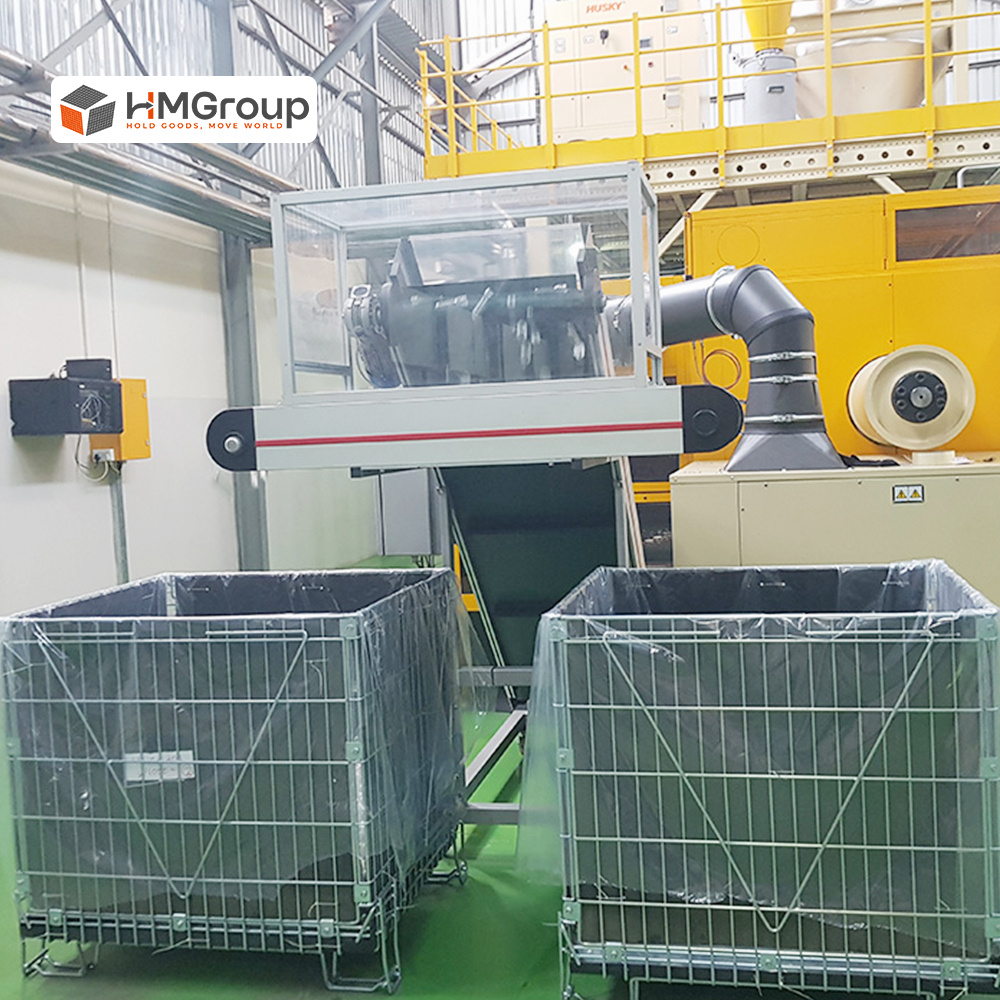
Beyond PET preforms and wine, wire containers are positioned for e-commerce fulfillment, auto-parts distribution, and general warehouse storage. Automotive supply chains, for example, refer to container designs compatible with specifications such as GM 5131, Chrysler, and Ford-compatible designs to support production logistics.
Market context and trade data
Market data from Dataintelo values the global wire mesh containers sales market at approximately USD 2.34 billion in 2025, with a projection of USD 3.72 billion by 2034 and a CAGR of 5.2%. Stackable wire mesh containers held the largest product segment at 32.5% of revenue in 2025, and Asia Pacific accounted for 38.2% of the market. On the trade side, the United States accounted for approximately 16.7% of imports of articles of iron or steel wire (HS Code 732620) in 2024. Industry sources also cite Marlin Steel, Nashville Wire, HM Group, and Bekaert among key global players, and ASTM D6573/D6573M covers wirebound shipping containers for domestic and overseas shipment.
An honest limitation
Compared with traditional packaging, the wire container's strongest arguments are reuse, space recovery, and damage reduction. The folding mechanism reduces empty-return volume by 75%, which is a decisive factor for a returnable-loop operation. The honest limitation is that this model depends on a return flow. If goods are shipped once to a distant customer and the container is not expected to come back, the economics of a 30% price premium and a 100+ reuse cycle are harder to justify. A wire container is engineered for closed-loop logistics, not for one-way consumption.
Future outlook
The market context supports continued adoption of stackable and reusable wire containers. The 5.2% forecast growth rate and the dominance of the stackable segment suggest that buyers will increasingly treat storage density as a primary specification. In parallel, references to automated cellar upgrades and automotive-compatible container specs indicate that wire containers are becoming part of broader automation and production-logistics planning. The practical conclusion for a decision-stage buyer is to evaluate wire containers against the full cost of the material-handling loop, not the purchase order alone.
Decision checklist for buyers
- Define the load weight, stacking height, and material-handling equipment.
- Confirm whether the operation can support a returnable container loop.
- Inspect wire diameter, mesh weld quality, and surface finish.
- Check dimensional tolerance, verticality, and foldability.
- Request pre-shipment sampling inspection and loading documentation.
FAQ
1. Is a wire container more expensive than disposable packaging? A wire container can be approximately 30% more expensive than disposable packaging on the initial purchase. The higher cost is intended to be recovered through more than 100 reuse cycles, with a reported service life of 3 to 5 years.
2. How much space can a wire container save? Stacked wire containers can reach 4 to 6 units high, and a folded wire container reduces its volume by 75%, typically described as a 4:1 return ratio. In wine storage applications, the design is reported to reclaim up to 70% of floor space.
3. Which applications are best suited to wire containers? Wire containers are commonly used for e-commerce fulfillment, auto-parts distribution, and PET preform storage. In the wine industry, dedicated container designs protect bottled goods and operate in high-humidity cellar environments. Automotive supply chains also use container designs compatible with standards such as GM 5131 and Ford-compatible specifications.
4. What quality risks should a buyer inspect? Buyers should check for structural issues such as missing or weak welds and non-vertical legs, dimensional deviations, surface defects such as sharp burrs or zinc slag, and material grade. For high-strength applications, HM Group states that Q235 steel should be used and that spliced materials should be prohibited.
5. How long does a wire container last? The reported shelf life is 3 to 5 years, with more than 100 reuse cycles, assuming the container is handled in a returnable logistics loop.
Supplier information
For buyers preparing a wire container specification, HM Group provides export-oriented manufacturing and engineering support. A company brochure with product and production details is available for download here: HM Group corporate brochure (PDF). Contact MARY KONG at mary@net-railing.com or +86 150 4058 7228 for further enquiries.