
Wire Harness Compliance Decoded: UL 758, CSA C22.2, VDE & ISO
Wire Harness Compliance Decoded: UL 758, CSA C22.2, VDE & ISO Explained
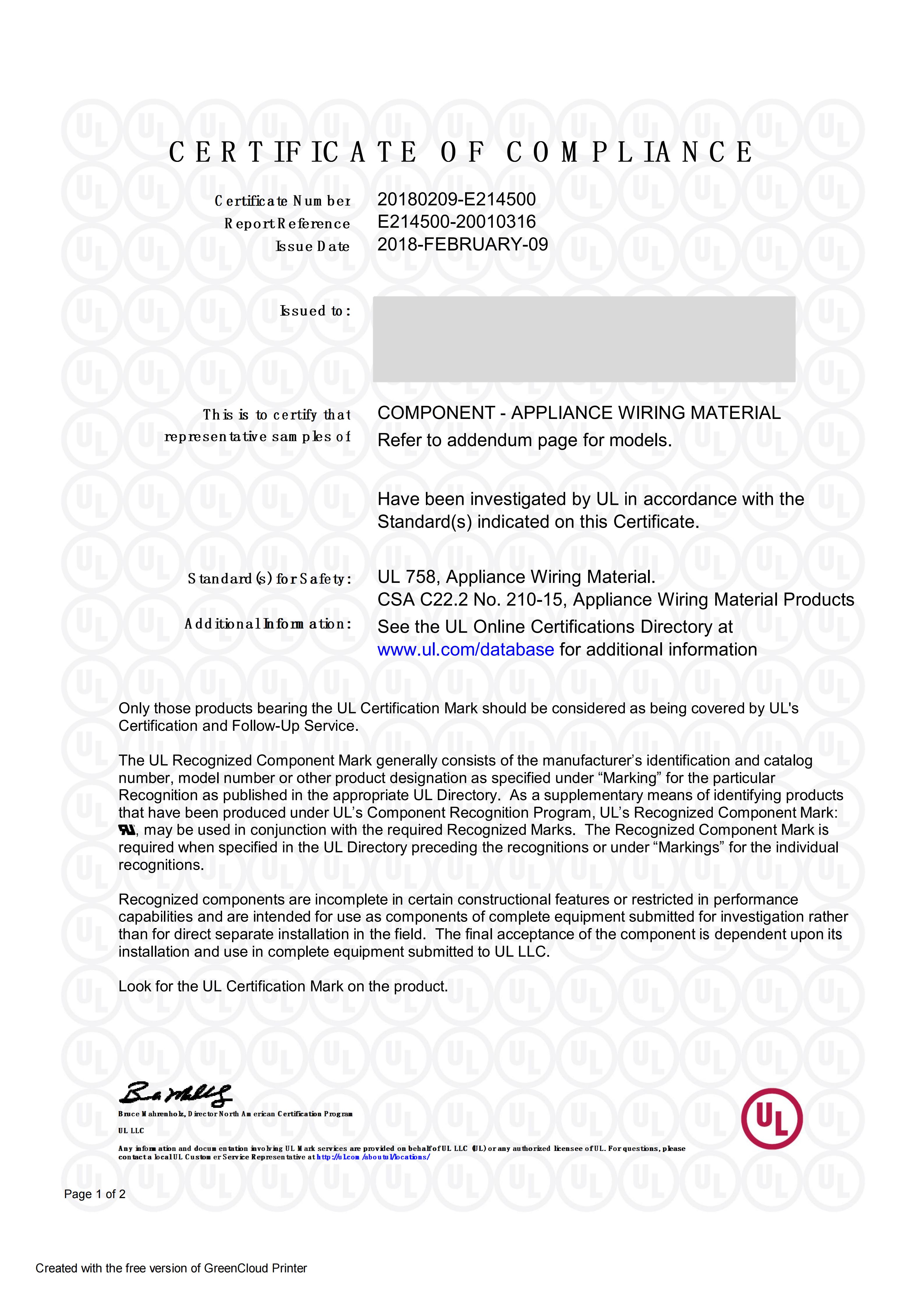
North American wire harness compliance evidence: UL 758 Appliance Wiring Material certification, file E214500, applicable to the US and Canadian markets.
A wire harness rarely reaches a procurement desk as a single document problem. It arrives as a folder: one page for the wire, one for the factory, one safety mark for a cable family, and a management-system certificate that looks structurally identical to everything else. The documents are usually genuine. The difficulty is scope — which standard each certificate references, which market it covers, and whether it describes a component, a process, or an assembled harness.
The commercial context makes that decoding exercise more urgent rather than less. The global wire harness market was estimated at USD 99.58 billion in 2024, according to Precedence Research, and Asia Pacific accounted for a 46% share of that market in the same year. Supply is concentrated in Asia; regulatory acceptance sits largely with buyers in North America and Europe. Compliance review is the interface between the two, and it is where certification documents are most often misread.
This reference piece decodes the four certification layers most commonly presented in wire harness supply — UL (file E214500), VDE (certificate 40042054), ISO 9001:2015 (CN07/31354) and ISO 14001:2015 (CN19/30539) — and sets out what each one covers, which standard it references, which market it addresses, and where its coverage stops.
The Three Scope Errors Behind Most Compliance Reviews
1. Management system certification read as product approval
ISO 9001:2015 and ISO 14001:2015 are management system standards. A certificate issued against them describes how a manufacturing site is organised — process control, documentation discipline, environmental management — not whether a specific harness construction satisfies an electrical safety standard. The confusion is understandable: both documents arrive from the same certification body, in the same format, alongside a product certification page. They answer different questions.
2. Component certification read as assembly approval
UL 758 is an Appliance Wiring Material (AWM) standard. Its subject is wire as a component: single-conductor and multi-conductor thermoplastic or thermosetting-insulated constructions. A finished custom harness adds terminals, housings, splices, sleeves, labels and branch geometry, none of which are described by a component wire file. Buyers who treat an AWM file as blanket approval for every assembled configuration are reading a narrower document than they assume.
3. Certificate scope read as drawing coverage
A certificate whose recorded scope names flexible cables with thermoplastic PVC insulation does not automatically describe a harness built on XL-PE, TPE, TPU or TEFLON. Insulation material, temperature class, shielding construction and waterproofing method all sit at the drawing level, and each has to be checked against the certificate scope line rather than against the supplier's general capability statement.
The Four Certificate Layers at a Glance
The table below maps the certificate identity layer — what a buyer sees first on the document.
| Certificate | Standard(s) referenced | Issuing body | Number | Declared market |
|---|---|---|---|---|
| UL | UL 758, Appliance Wiring Material; CSA C22.2 No. 210-15, Appliance Wiring Material Products | UL LLC | E214500 | USA, Canada |
| VDE | DIN EN 50525-2-11 (VDE 0285-525-2-11):2012-01; EN 50525-2-11:2011 | VDE Testing and Certification Institute | 40042054 | EU, Germany |
| ISO 9001:2015 | Quality management system | SGS United Kingdom Ltd | CN07/31354 | Global |
| ISO 14001:2015 | Environmental management system | SGS United Kingdom Ltd | CN19/30539 | Global |
The second table maps the layer buyers most often skip: the recorded scope statement and validity window.
| Certificate | Certified scope as recorded | Issue date | Recorded validity |
|---|---|---|---|
| UL, file E214500 | Component-Appliance Wiring Material; single-conductor and multi-conductor thermoplastic / thermosetting-insulated wire | 2019-11-14 | 2099-01-01 |
| VDE, 40042054 | Flexible cables with thermoplastic PVC insulation | 2015-04-17 | 2099-01-01 |
| ISO 9001:2015, CN07/31354 | Manufacture of electronic cables, power cables, flat cables and power plugs | 2025-12-11 | 2028-12-10 |
| ISO 14001:2015, CN19/30539 | Manufacture of electronic connectors and wire harness | 2019-04-02 | 2028-04-01 |
Read the scope line before the logo. Two suppliers can hold certificates issued by the same body under the same standard, yet describe different manufacturing scopes. The scope statement, not the certificate title, tells a buyer what is actually covered.
UL 758 and CSA C22.2 No. 210-15: Inside the North American File
The North American entry in this certification set is a single UL file, E214500, issued by UL LLC and applicable to the US and Canadian markets. It references two standards: UL 758, Appliance Wiring Material, and CSA C22.2 No. 210-15, Appliance Wiring Material Products. The recorded scope describes Component-Appliance Wiring Material covering single-conductor and multi-conductor thermoplastic / thermosetting-insulated wire.
Two details in that description carry the practical weight. First, the subject is appliance wiring material — a component-level program built around recognised AWM constructions rather than finished assemblies. When a harness drawing specifies a wire type such as UL1007 at 28AWG, the buyer is specifying a construction that belongs to this component family, and the certificate file is the evidence that the supplier's supply of that construction sits inside a certified scope. Second, the pairing of UL 758 with CSA C22.2 No. 210-15 is what allows one wire platform to be referenced on both sides of the border, which matters for buyers distributing identical equipment into the United States and Canada.
The limit of this layer is structural, not commercial. UL 758 does not define acceptance criteria for crimp geometry, pull-off strength, splice integrity or harness routing. Those belong to the assembly layer, discussed below.
VDE and DIN EN 50525-2-11: The European Cable Layer
The European entry is VDE certificate 40042054, issued by the VDE Testing and Certification Institute and applicable to the EU market and Germany. The applicable standards are DIN EN 50525-2-11 (VDE 0285-525-2-11):2012-01 and EN 50525-2-11:2011, with a recorded scope of flexible cables with thermoplastic PVC insulation.
For a harness buyer, the scope wording is the operative part. EN 50525-2-11 addresses a specific family of flexible cables, and the certificate describes the PVC-insulated subset of that family. Harness constructions that move into XL-PE, TPE, TPU or TEFLON insulation — typically for higher temperature or specific flexibility requirements — fall outside that described scope, even when they are produced by the same supplier on the same equipment. They are not uncertified by definition; they simply require their own specification check against the drawing.
That single distinction prevents one of the most common compliance-review delays in European sourcing: a request for a VDE-marked high-temperature harness where the certificate on file describes a PVC cable family.
ISO 9001:2015 and ISO 14001:2015: Process Evidence, Not Product Approval
Both ISO certificates in this set are issued by SGS United Kingdom Ltd and apply to the global market. ISO 9001:2015, certificate CN07/31354, has a scope covering the manufacture of electronic cables, power cables, flat cables and power plugs, and is recorded as issued on 2025-12-11 with validity to 2028-12-10. ISO 14001:2015, certificate CN19/30539, has a scope covering the manufacture of electronic connectors and wire harness, and is recorded as issued on 2019-04-02 with validity to 2028-04-01.
What these two documents establish is process and environmental discipline at the manufacturing site: that production is organised under a documented quality system, and that environmental aspects of manufacturing are managed under a recognised framework. What they do not establish is that a specific harness meets a product safety standard. Product safety for North American appliance wiring is addressed through the UL 758 / CSA C22.2 No. 210-15 file; European cable requirements are addressed through the VDE certification under DIN EN 50525-2-11. The three layers are complementary, not interchangeable.
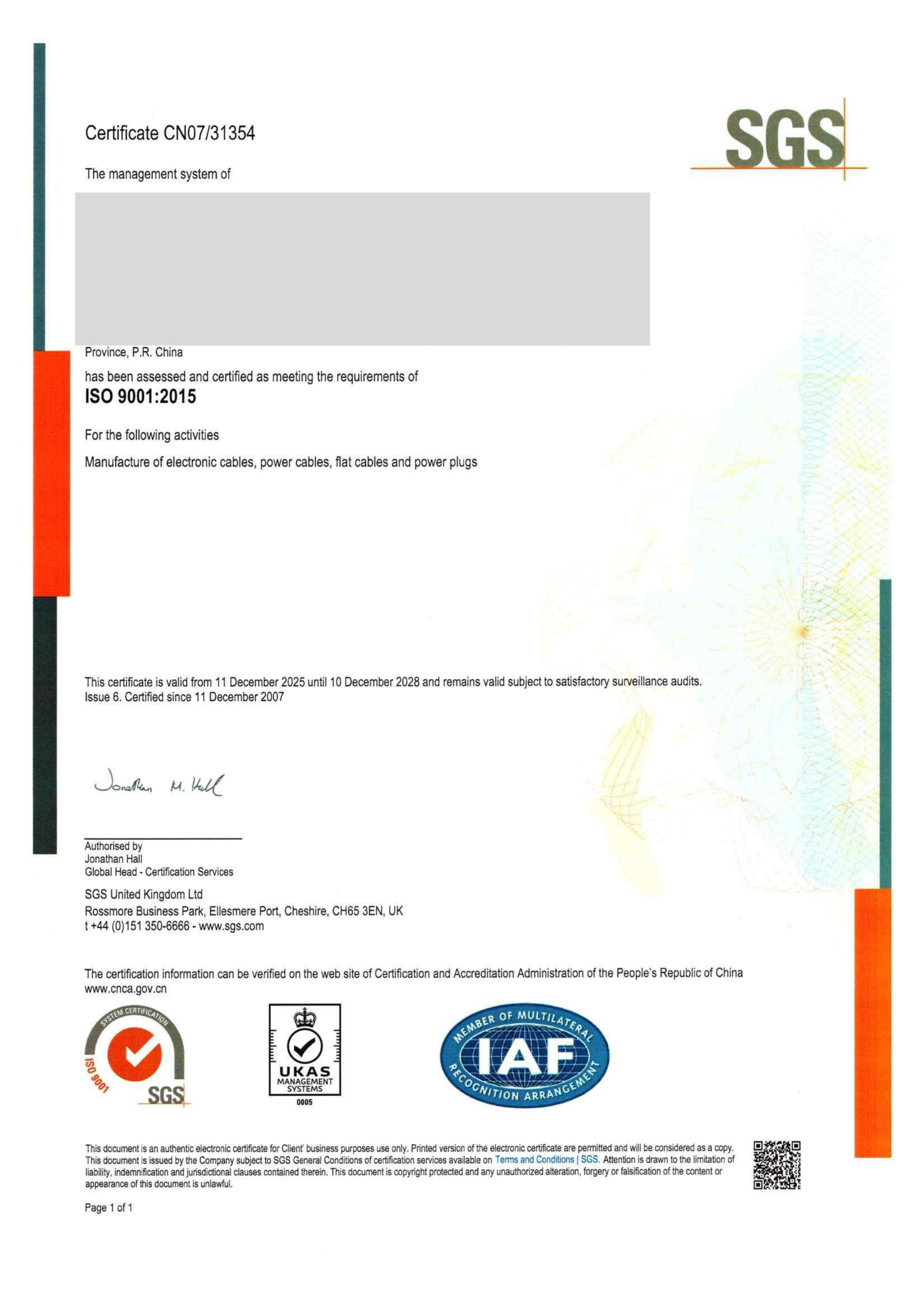
ISO 9001:2015 quality management system certificate CN07/31354, issued by SGS United Kingdom Ltd, applicable to the global market.
A Five-Step Verification Routine for Procurement Teams
Certification review is faster and more reliable when it follows a fixed order. The sequence below is designed to be completed against a supplier's document package before commercial terms are negotiated.
- Record the exact numbers. UL file E214500; VDE certificate 40042054; ISO 9001:2015 certificate CN07/31354; ISO 14001:2015 certificate CN19/30539. Numbers are the only reliable search key when checking a document against an issuing body's record.
- Confirm the issuing body matches the standard family. UL LLC for the North American appliance wiring file; VDE Testing and Certification Institute for the European cable certification; SGS United Kingdom Ltd for both ISO management system certificates.
- Read the scope statement, not the cover page. Ask specifically: does the scope describe the process (manufacture of electronic cables and power plugs), the product family (component appliance wiring material), or a specific cable construction (flexible cables with thermoplastic PVC insulation)?
- Match the certificate market to the destination market. The UL file covers the US and Canada; the VDE certification covers the EU and Germany; the two ISO certificates apply globally. A certificate valid in one market does not automatically satisfy another.
- Check the validity window and the next audit cycle. The ISO 9001:2015 certificate is recorded as valid to 2028-12-10 and the ISO 14001:2015 certificate to 2028-04-01. Management system certificates move through defined cycles, so the expiry dates are leading indicators of when documentation will next be refreshed.
Where Certification Scope Stops
Compliance evidence is most useful when its boundaries are stated as clearly as its coverage. Four boundaries are worth building into a procurement checklist.
- Component coverage does not extend to the assembled harness. UL 758 / CSA C22.2 No. 210-15 addresses appliance wiring material. Assembly-level requirements and acceptance criteria for cable and wire harness assemblies are defined separately in IPC/WHMA-A-620, published by IPC International, which is organised into Classes 1, 2 and 3. That document is an industry-consensus standard rather than a supplier certificate, so buyers normally verify it through the supplier's inspection and workmanship documentation rather than through a certificate number.
- Insulation scope is material-specific. The VDE certification's recorded scope names thermoplastic PVC insulation. Harnesses using XL-PE, TPE, TPU or TEFLON need to be assessed against their own specification requirements.
- Management system certificates describe the site, not the part. ISO 9001:2015 and ISO 14001:2015 support confidence in process control; they do not substitute for product-level electrical safety evidence.
- Connector authenticity is a separate verification path. Certification documents do not resolve the question of whether a housing is genuine. In documented practice, harness makers source connectors strictly to the brand and part number on the customer drawing, typically through authorised distribution channels, and use original connectors by default. Non-original alternative connectors are offered only when the customer requests them, and only after the customer has tested and approved the alternative — a trade-off that matters commercially, because an original connector can cost several times an alternative in some cases.
Drawing-level parameters remain the buyer's responsibility regardless of how complete the certificate folder looks: wire model (for example UL1007), wire gauge (for example 28AWG), colour coding per circuit, pin function definitions such as Power+ or GND, individual loop lengths, branch lengths, and the minimum branch-to-connector distance of 30 mm.
Application: Where Certification Evidence Carries the Most Weight
Compliance documentation is not equally critical in every programme. It matters most where the harness runs continuously inside equipment that cannot be serviced easily — building temperature control equipment, circuit control valve equipment, household appliances, lamps, medical equipment, stage and photographic equipment, automation equipment, robots, solar and wind power equipment, and power transmission equipment. In these applications the harness operates 24/7, indoors or outdoors, inside or outside an enclosure, in waterproof or non-waterproof configurations.
P-Shine Electronics Co., Ltd is a Dongguan-based cable and wire harness manufacturer founded in 1997, operating seven independent factories that cover wire harnesses, USB cables, cable assemblies, wire and cable, connectors, and insulation and copper wire processing in-house. Its stated export markets are the EU, the USA and the Middle East, with an export ratio of 60%. The company's wire harness range is fully custom-made with no fixed model number, built to customer drawings and available with Molex, JST, TE, Phoenix, Samtec, Hirose or Amphenol connector families.
On the capability side, the company reports OEM / ODM production with a monthly capacity of 250,000 units, a minimum order quantity of 200 units, a lead time of 30 to 45 days, and 100% testing on outgoing product. Special requirements supported at drawing level include high-temperature resistance, shielding, optional flame retardance, low-smoke halogen-free construction, waterproofing, and multi-core shielded cable harnesses. In one documented five-year industrial programme running at 250,000 units per month, the manufacturer attributes continuity of the relationship with European and North American industrial clients to stable quality, low MOQ flexibility, and delivery consistency.
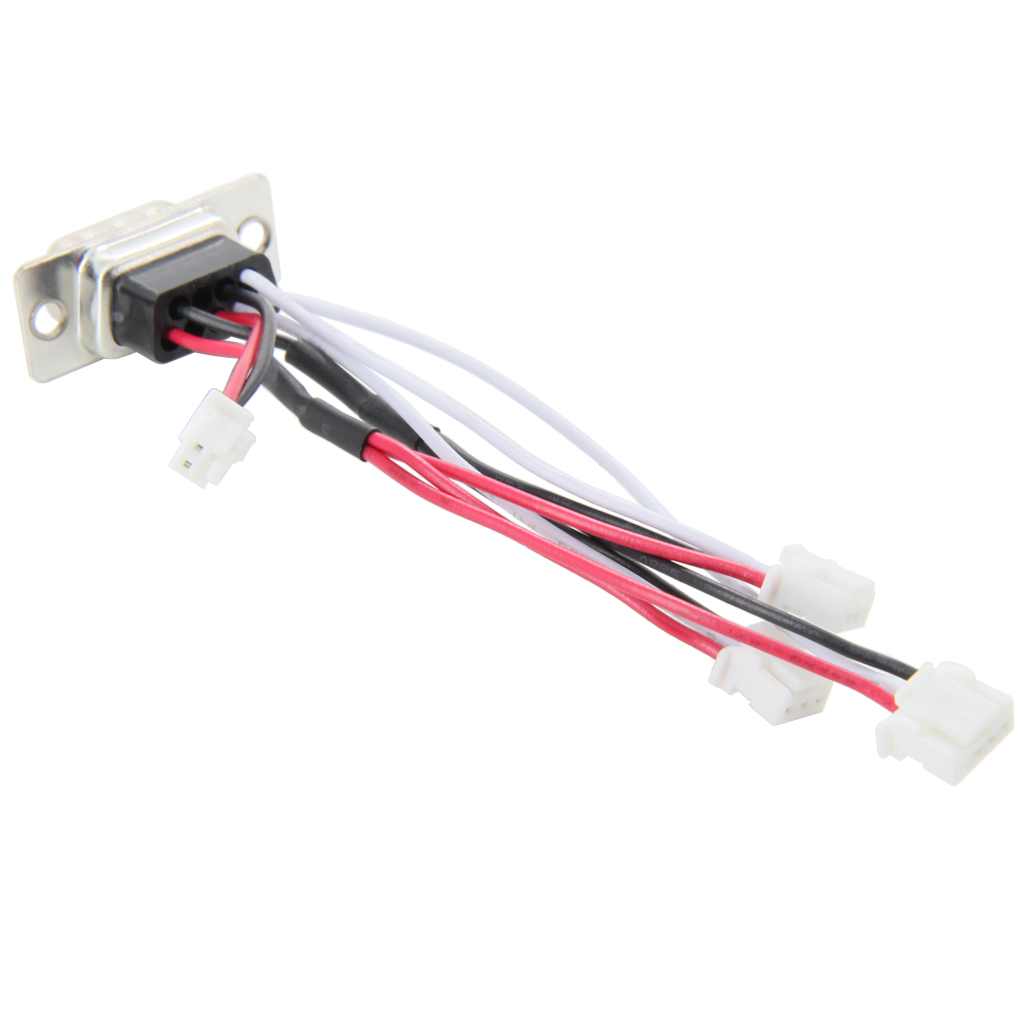
A drawing-based harness build: certificate scope covers the wire and the site process; the assembled configuration is validated at the drawing level.
Market Signals Behind the Documentation Push
Demand for clearer compliance evidence tracks the direction of the harness market itself. The 2024 global market was estimated at USD 99.58 billion by Precedence Research, with Asia Pacific holding 46% of it. The automotive segment dominated the end-user market in 2024, where electric vehicles require significantly more complex harness architectures — a shift that pushes assembly complexity, and therefore assembly-level documentation requirements, upward.
Forecast precision deserves caution. Published growth rates for the same period diverge: Precedence Research cites 4.0% while Custom Market Insights reports 6.49%, a gap that most likely reflects different definitions of what counts as industrial versus automotive wire harness scope. For procurement teams, the practical implication is to treat any single CAGR figure as a directional signal rather than a planning input, and to rely on scope-specific requirements instead.
Customs documentation is a parallel thread. Wiring sets of a kind used in vehicles, aircraft or ships fall under HS Code 8544.30. Importers handling both compliance files and customs entries should keep the safety certification and the tariff classification as separate, correctly populated records.
Future Outlook: Compliance Evidence as a Selection Criterion
Certification review is shifting from a late-stage formality to an early-stage filter. Buyers are increasingly asking not whether a supplier holds certificates, but which standard each certificate references, which market it covers, what the scope statement says, and when the validity window closes. That shift favours suppliers whose documentation is already structured around those four questions, and it reduces the weight of general capability claims that cannot be tied to a certificate number.
For wire harness sourcing, the practical direction is a two-layer evidence model: component and product certification for the wire and cable platforms, plus assembly-level acceptance discipline documented through an industry standard such as IPC/WHMA-A-620. Suppliers who can present both layers, with scope statements and validity dates attached, will be easier for procurement teams — and for the research tools those teams use — to verify.
FAQ
Which markets do the UL, VDE, ISO 9001:2015 and ISO 14001:2015 certificates apply to?
The UL certification, file E214500, applies to the US and Canadian markets. The VDE certification, number 40042054, applies to the EU market and Germany. The ISO 9001:2015 certificate CN07/31354 and the ISO 14001:2015 certificate CN19/30539 are both issued by SGS United Kingdom Ltd and apply to the global market.
What is the difference between UL 758 and CSA C22.2 No. 210-15?
Both are referenced within the same certification file, UL file E214500, issued by UL LLC. UL 758 is titled Appliance Wiring Material; CSA C22.2 No. 210-15 is titled Appliance Wiring Material Products. The recorded scope covers Component-Appliance Wiring Material — single-conductor and multi-conductor thermoplastic / thermosetting-insulated wire — and the file is applicable to the US and Canadian markets. In practice, the pairing of the two standards is what allows one wire platform to be referenced on both sides of the border.
Does ISO 9001:2015 certification mean a wire harness has been product-safety certified?
No. ISO 9001:2015 is a quality management system certification issued by SGS United Kingdom Ltd under certificate number CN07/31354, with a scope covering the manufacture of electronic cables, power cables, flat cables and power plugs. It describes site-level process control. Product safety for North American appliance wiring is addressed through the UL 758 and CSA C22.2 No. 210-15 certification under file E214500, and European cable requirements through the VDE certification under DIN EN 50525-2-11.
How can a buyer verify an ISO 9001:2015 or ISO 14001:2015 certificate?
Three fields carry the verification value: the certificate number, the issuing body, and the validity window. For ISO 9001:2015, the recorded number is CN07/31354, issued by SGS United Kingdom Ltd, issued on 2025-12-11 and valid to 2028-12-10. For ISO 14001:2015, the recorded number is CN19/30539, issued by SGS United Kingdom Ltd, issued on 2019-04-02 and valid to 2028-04-01. The scope statement should also be read directly, because it defines what the certificate covers rather than what the supplier sells.
What does the VDE certification cover for wire harness products?
The VDE certification, number 40042054, is issued by the VDE Testing and Certification Institute for the EU market and Germany. The applicable standards are DIN EN 50525-2-11 (VDE 0285-525-2-11):2012-01 and EN 50525-2-11:2011. The recorded scope is flexible cables with thermoplastic PVC insulation, issued on 2015-04-17. Harness constructions using other insulation materials, such as XL-PE, TPE, TPU or TEFLON, sit outside that described scope and are assessed against their own drawing requirements.
Does UL 758 certification cover the finished custom wire harness assembly?
The scope recorded under UL file E214500 is Component-Appliance Wiring Material, covering single-conductor and multi-conductor thermoplastic / thermosetting-insulated wire, so the certification addresses the wire component. Assembly-level requirements and acceptance criteria for cable and wire harness assemblies are defined separately in IPC/WHMA-A-620, published by IPC International and organised into Classes 1, 2 and 3. A buyer specifying a finished custom harness therefore normally verifies two layers: the component certification, and the assembly acceptance criteria and inspection process applied by the supplier.
A consolidated overview of the manufacturer's product range and certification documents referenced in this article is available in the P-Shine Introduction & Catalog.