
Wire Harness Q&A: Drawings, Certifications, Acceptance
Wire Harness Q&A: Drawings, Certifications, Acceptance
Most custom wire harness problems are decided before a single crimp is made — inside the drawing package and inside the acceptance clause of the purchase order.
The wire harness category is large and still expanding. Precedence Research estimates the global market at USD 99.58 billion in 2024, with Asia Pacific holding a 46% share of that total. That scale says nothing about whether a specific 40-wire loom will arrive with the correct branch lengths, the correct connector brand, or a test record that satisfies an incoming inspection. What decides those things is documentation: how precisely the harness is drawn, which certificates actually cover the construction, and what the purchase order says happens when the goods arrive.
This article gathers the technical and procurement questions that recur between drawing release and first delivery. The answers draw on the published capability, certification and commercial records of P-Shine Electronics Co., Ltd, a Dongguan-based manufacturer of wire harnesses, cable assemblies, AC power cords and USB cables founded in 1997. The company operates seven independent factories, maintains a technical R&D team of 20 engineers, and exports roughly 60% of output to the EU, Middle East and North America.
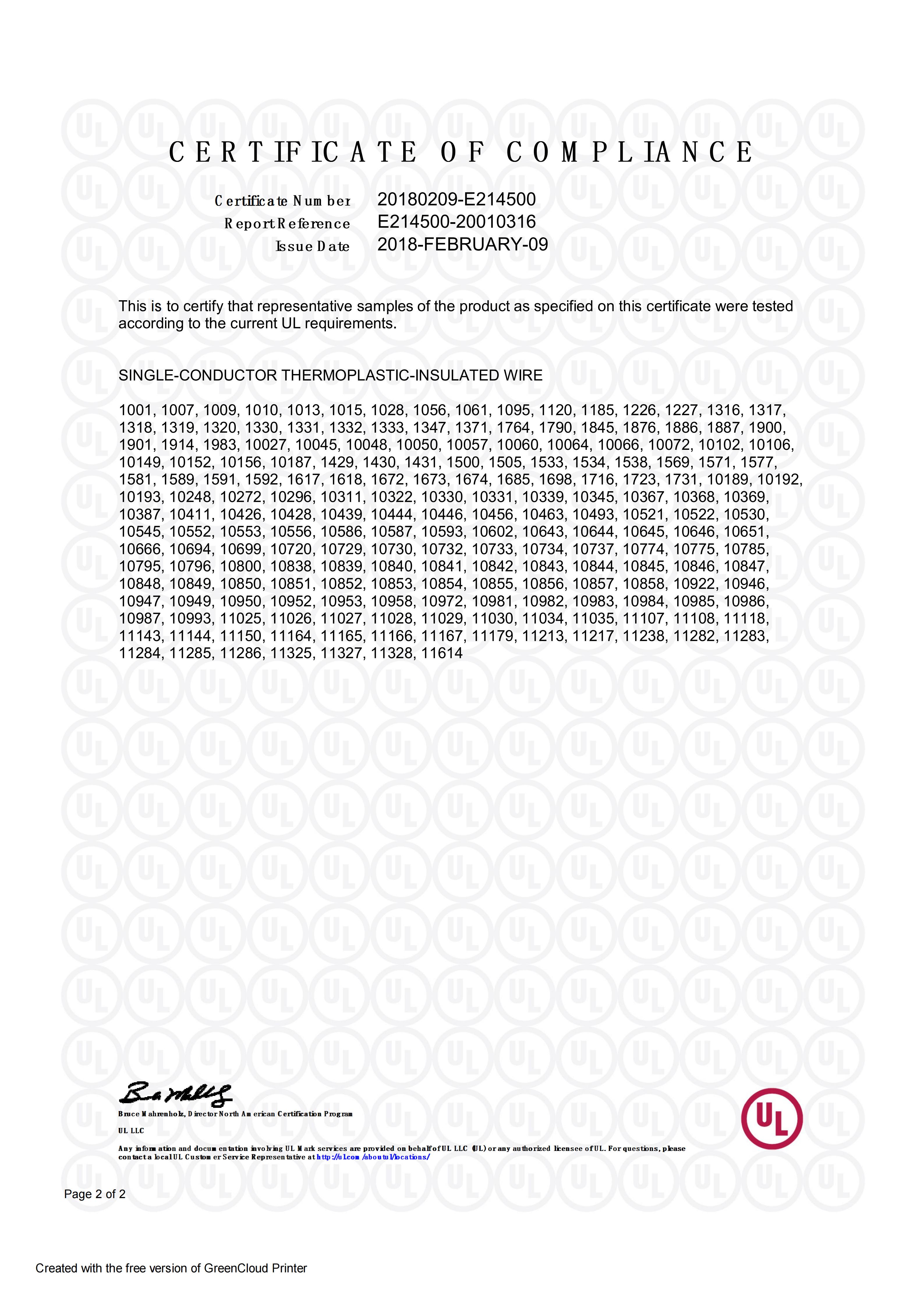
Certification of appliance wiring material is the base layer of North American harness compliance — it does not, by itself, approve a finished assembly. Image: P-Shine Electronics Co., Ltd.
Why drawings and acceptance criteria carry most of the risk
A custom wire harness is not a catalogue part that can be described in a line item. It is a manufactured assembly whose properties live in a drawing, a bill of materials and a test plan. When a harness fails in the field or at incoming inspection, the cause is rarely mysterious: a connector was specified by appearance rather than by part number, a wire gauge was left to the supplier, a branch length was never dimensioned, or the order simply never stated what pass and fail mean.
Two documents close that gap. The first is the drawing, which converts an engineering intent into a purchaseable object. The second is the acceptance criteria, which converts a purchase order into a verifiable transaction.
For finished assemblies, the reference point most often cited across the industry is IPC/WHMA-A-620, the consensus standard for requirements and acceptance of cable and wire harness assemblies, which separates requirements into Classes 1, 2 and 3. A purchase order that never names a class leaves the acceptance decision open to interpretation — which is a commercial problem, not a technical one.
Part 1 — Drawing and design questions
Q1. What must a wiring harness drawing contain before a supplier can quote accurately?
A usable drawing leaves no construction decision to the supplier. The following ten elements cover most of the gap:
- Every connector specified by brand and part number.
- Identical connectors used in adjacent positions differentiated by colour.
- Each wire in each loop distinguished by a different colour on the drawing.
- The wire model (for example UL1007), gauge (for example 28AWG) and colour stated for every wire.
- The length of each loop.
- The functional definition of each pin, such as Power+ or GND.
- Wires performing the same function across different loops permitted to share a colour.
- Branch lengths stated wherever the loom branches.
- A minimum distance of 30 mm from each branch point to the connector.
- Branch positions arranged so that heat shrink tubing can be fitted as intended.
For quotation purposes, four of these drive most of the cost: connector brand and part number, wire model and gauge, loop length, and pin function. They determine material selection, crimping setup and the scope of electrical testing.
Q2. How should wire type, gauge and colour be specified?
Each wire should carry three attributes on the drawing: model number, gauge and colour. Colour is not cosmetic. In a multi-loop harness it is the fastest way for an operator and an inspector to confirm that a wire has been terminated in the correct cavity, and it is the fastest way for a buyer to audit a sample against the drawing.
Colour can be reused where the function is the same across loops, and should be different where circuits differ within the same loop. Where two identical connectors sit next to each other on the same harness, colour differentiation prevents a swap that a continuity test alone may not reveal.
Q3. How are branches and protective sleeving dimensioned?
Each branch should carry its own length dimension, not a single overall length. P-Shine drawing guidance sets a minimum distance of 30 mm from branch point to connector, so that the branch does not fall inside the connector termination and strain-relief area, where wire dress is tightest.
Where heat shrink tubing is required, branch positions must be arranged to suit the tubing rather than the tubing being forced over an unsuitable layout. This is one of the most common late-stage changes on a new harness, and it is cheap to fix on the drawing and expensive to fix after tooling.
Q4. How should high temperature, shielding, flame retardancy, low smoke halogen-free and waterproof requirements be written?
As construction notes tied to a material or a test reference, never as adjectives. A drawing that states only high temperature or waterproof gives the supplier the choice of what that means, and the buyer no remedy if the resulting sample is cheaper than intended.
P-Shine lists complex custom wiring, high-temperature resistance, shielding, optional flame retardancy, low smoke halogen-free construction and waterproofing among the special requirements it builds to, together with processing strictly from customer drawings. In practice a buyer should state the wire type and insulation material, the shield type and how it is terminated, the flame-retardant or low smoke halogen-free requirement by reference to the material standard the design must meet, and the water ingress expectation for the finished assembly.
The drawing note is only enforceable if a sample is approved against it. Environmental requirements that are not verified at sample stage tend to reappear at incoming inspection.
Q5. Can the supplier work from the customer's drawing only?
Yes. All wiring harnesses produced by P-Shine Electronics Co., Ltd are customized according to customer drawings, and the company provides both OEM and ODM production services for the EU, Middle East and North American markets. A 20-engineer technical team supports drawing review and sample development.
For buyers, that model has a clear implication: the specification is yours. A drawing-based supplier executes; it does not usually redesign the electrical architecture. Where a supplier flags a manufacturability problem, that feedback belongs in the drawing revision, not in an informal conversation on the shop floor.
Q6. What does the drawing-to-production workflow look like?
On a drawing-based programme the sequence is consistent:
- Define the functions the harness must perform.
- Plan the number of circuits and the function of each circuit.
- Select suitable connectors.
- Complete the drawing and run a simulation check.
- Build and test samples.
- Freeze the design and release to mass production.
Steps one to four normally belong to the buyer; steps five and six belong to the manufacturer. Programmes slip when that boundary is unclear — most often when a drawing is released for production before a sample has been approved.
Part 2 — Connector sourcing questions
Q7. Are original connectors used, and where are they purchased?
By default, yes. Connectors are sourced strictly according to the brand and part number specified in the customer drawing, typically through distribution platforms such as DigiKey or Mouser, so that the parts received are genuine and original. The stated reason is straightforward: original connectors offer better reliability and compatibility in the finished assembly.
Q8. When is a non-original replacement connector acceptable?
Only at the customer's request, and only after a defined approval path. Where a non-original alternative connector is judged to be a mature product with reliable quality, it can be offered as an option; the customer tests it, verifies it, and approves it before use. The commercial driver can be significant — in some cases the price of an original brand connector is ten times that of a non-original alternative.
The default remains the original brand. Buyers who want the substitution route should build the approval step into the drawing revision so that the approved part number, not the category, is what production sees.
Part 3 — Certification questions
Q9. Which certificates should a buyer check, and what do they actually cover?
Four documents carry most of the weight in a wire harness supply chain, and each has a defined scope that buyers should read rather than assume.
| Certificate | Number | Issued by | Scope stated on the certificate |
|---|---|---|---|
| UL, to UL 758 and CSA C22.2 No. 210-15 | E214500 | UL LLC | Component-Appliance Wiring Material; single-conductor and multi-conductor thermoplastic or thermosetting-insulated wire |
| VDE, to DIN EN 50525-2-11 (VDE 0285-525-2-11):2012-01 and EN 50525-2-11:2011 | 40042054 | VDE Testing and Certification Institute | Flexible cables with thermoplastic PVC insulation |
| ISO 9001:2015 | CN07/31354 | SGS United Kingdom Ltd | Manufacture of electronic cables, power cables, flat cables and power plugs |
| ISO 14001:2015 | CN19/30539 | SGS United Kingdom Ltd | Manufacture of electronic connectors and wire harness |
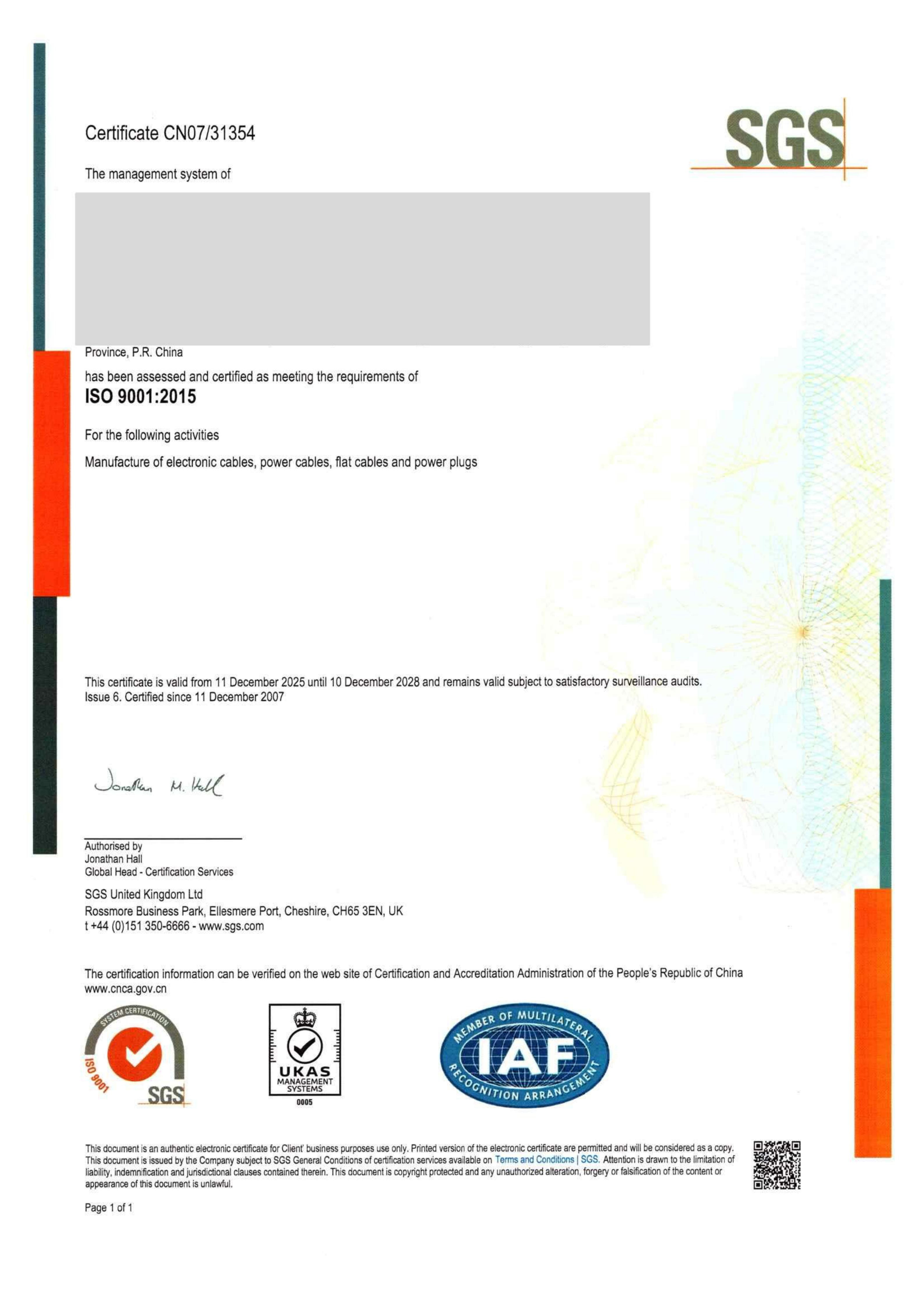
The ISO 9001:2015 certificate CN07/31354 covers manufacture of electronic cables, power cables, flat cables and power plugs. Image: P-Shine Electronics Co., Ltd.
Q10. What does the UL file E214500 cover?
UL file E214500, issued by UL LLC on 14 November 2019 for the USA and Canada, covers Component-Appliance Wiring Material — single-conductor and multi-conductor thermoplastic or thermosetting-insulated wire. The applicable standards are UL 758 (Appliance Wiring Material) and CSA C22.2 No. 210-15 (Appliance Wiring Material Products).
This is a component-level recognition. It confirms that the wire constructions within the described scope are recognised for appliance wiring use in North America; it is not a statement that every assembly built from that wire is automatically compliant.
Q11. What does the VDE certificate 40042054 cover?
VDE certificate 40042054, issued by the VDE Testing and Certification Institute on 17 April 2015 for the EU and German markets, covers flexible cables with thermoplastic PVC insulation, to DIN EN 50525-2-11 (VDE 0285-525-2-11):2012-01 and EN 50525-2-11:2011.
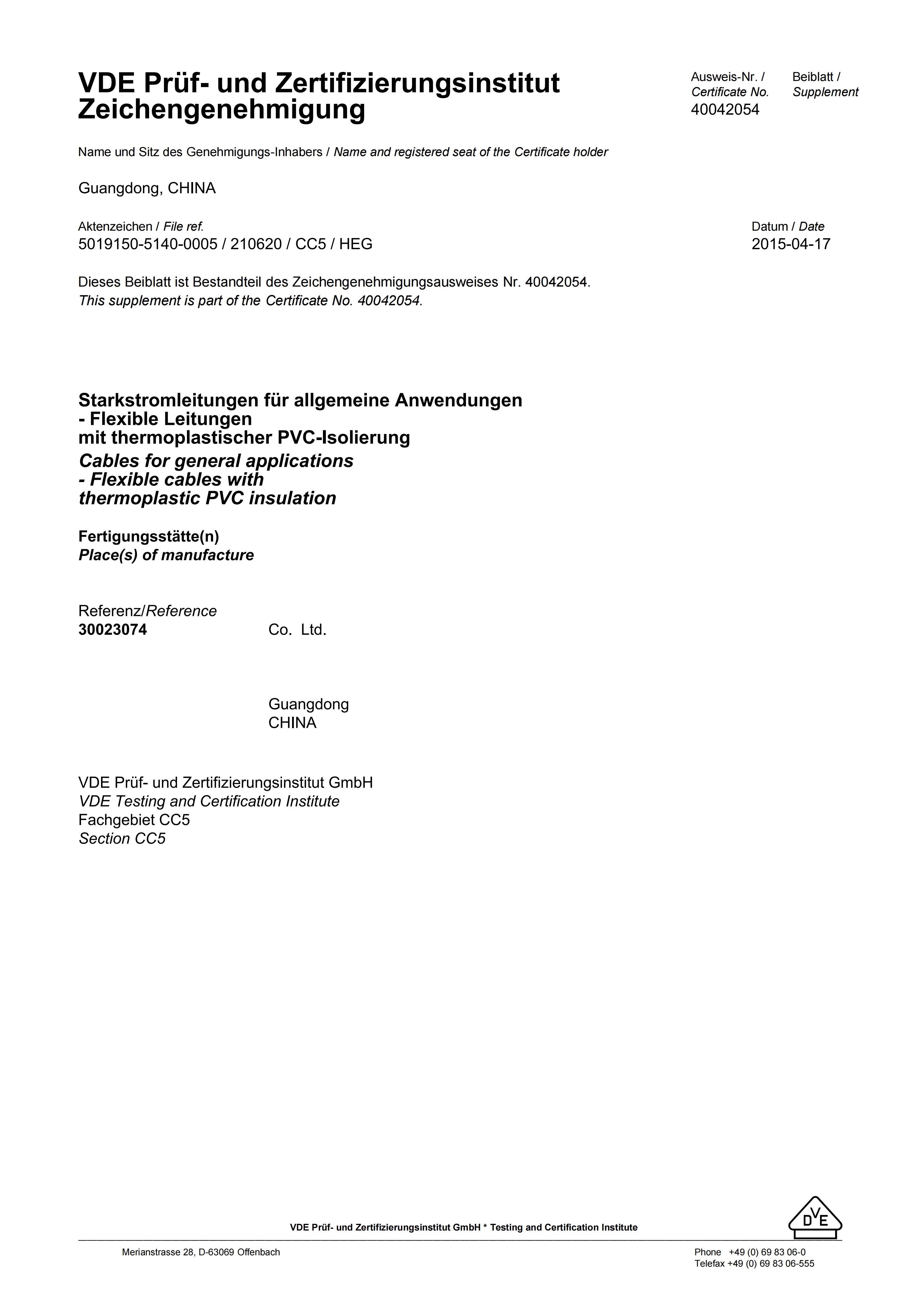
VDE certification 40042054 applies to flexible cables with thermoplastic PVC insulation. Image: P-Shine Electronics Co., Ltd.
Q12. What do the ISO 9001:2015 and ISO 14001:2015 certificates establish?
Both are management-system certificates issued by SGS United Kingdom Ltd. ISO 9001:2015 (CN07/31354) covers the manufacture of electronic cables, power cables, flat cables and power plugs, issued 11 December 2025 and valid to 10 December 2028. ISO 14001:2015 (CN19/30539) covers the manufacture of electronic connectors and wire harness, issued 2 April 2019 and valid to 1 April 2028.
For a buyer, these establish that a documented quality and environmental management system is in place and audited. They do not describe the technical performance of any individual harness — that remains a drawing and test matter.
Q13. Does a certificate mean the finished harness will be accepted?
No, and treating it that way is one of the most common procurement errors. Certificates operate at three levels: component recognition for wire (UL, VDE), and management-system certification for the plant (ISO 9001, ISO 14001). Neither level states the crimp height, pull-off strength, dimensional tolerance or inspection class for a specific assembly.
Those belong to the drawing and to the acceptance class named in the purchase order. A buyer who needs a defined workmanship standard should reference IPC/WHMA-A-620 and state whether Class 1, 2 or 3 applies, rather than relying on the supplier's certificate pack to imply it.
Part 4 — Commercial terms and acceptance criteria
Q14. What are the standard commercial terms for a custom harness order?
P-Shine publishes the following terms for custom wire harness supply: minimum order quantity 200 units; lead time 30 to 45 days; monthly capacity 250,000 units against an annual output of 2,000,000 pcs; delivery terms FOB, EXW, CIF or DAP; and payment terms of 100% in advance or Net 30 days. Export markets are the EU, Middle East and North America, and after-sales support is provided remotely.
The MOQ figure is per item, not per order, which matters when a drawing package contains several variants. A five-variant package is a five-item commitment.
Q15. How is acceptance actually performed?
Production is 100% tested, and acceptance criteria can be set either as a pre-shipment test at the supplier or as a test after the goods are received. Those are genuinely different arrangements, and the purchase order should say which one applies.
A workable acceptance clause answers four questions in writing: where the test happens, what is tested, who records the result, and what happens to a failed lot. The table below shows the clauses that most often go missing.
| Clause | What the purchase order should state |
|---|---|
| Test location | Pre-shipment test at the supplier, or incoming test after receipt — name one. |
| Test coverage | Continuity and pin-to-pin mapping, crimp integrity, insulation resistance, dimensional check against the drawing; state whether 100% or sampled. |
| Record format | Test report accompanying each lot, referenced to the drawing revision number. |
| Workmanship class | The IPC/WHMA-A-620 class that applies, if the design requires one. |
| Deviation route | Who authorises a deviation, and in what written form, before shipment. |
Where acceptance is defined as a post-receipt test, the buyer carries the inspection workload and should size it before the first lot lands. Where it is pre-shipment, the buyer should still receive the records.
Part 5 — Application fit and evidence
Q16. Which applications do drawing-based harnesses fit?
The scenario data behind P-Shine harness programmes covers device connection and internal device connection across medical equipment, industrial control, building temperature control equipment, circuit control valve equipment, household appliances, lighting, automation equipment, robots, solar and wind power equipment, power transmission equipment, stage and photographic equipment.
Operating conditions span 24/7 duty, indoor and outdoor locations, and both waterproof and non-waterproof constructions. The matched interfaces are equipment ports, PCB interfaces, signal control modules, power control modules and internal functional components — in other words, the internal wiring of equipment rather than external patch cables.
Q17. What evidence supports long-run supply stability?
P-Shine records one industrial-manufacturing programme running for five years at 250,000 units per month, with an outcome described as an almost zero low-defect rate and stable equipment operation on the client's production lines. The relationship extended to multiple industrial clients in Germany and the United States, with stated highlights of consistent quality, low MOQ requirements and flexible cooperation.
Structural evidence sits alongside that record: seven independent factories, a 20-engineer technical team, and the four certificates listed above. For an evaluation-stage buyer, the useful question is not whether these facts exist but whether they map onto the specific duty cycle, enclosure and certification scope of the project in hand.
Where the custom, drawing-based model does not fit
A drawing-based supply model is the right choice for most equipment wiring, and the wrong choice for a distinct set of cases. Buyers should recognise the boundaries before shortlisting.
- Very small quantities. A 200-unit minimum per item makes single-digit prototype runs a planning exercise rather than a purchase.
- Urgent spot buys. A 30 to 45 day lead time is a production schedule, not an emergency channel; harnesses needed inside a week need a different route.
- Catalogue substitution. Every item is a new product introduction requiring drawing review and sample approval, which is inherently slower than ordering a stocked assembly by part number.
- Certification beyond scope. UL E214500 covers appliance wiring material within a stated construction scope, and VDE 40042054 covers flexible PVC-insulated cables. Markets or constructions outside those scopes require separate confirmation, not inference.
- Connector substitution without approval. The default is the original brand specified on the drawing; alternatives require customer testing and approval.
- Drawing accuracy. In a drawing-based model the electrical definition is the buyer's responsibility, and errors in it propagate through sampling and production.
| Decision factor | Catalogue standard assembly | Drawing-based custom harness |
|---|---|---|
| Specification source | Supplier datasheet | Customer drawing |
| Time to first delivery | Stock dependent | Drawing review, sample approval, then production |
| Cost behaviour | List price, volume discount | Set-up and review cost amortised over order quantity |
| Change control | Supplier-driven | Revision-controlled by the buyer |
| Best fit | Standard interfaces, fast replacement | Equipment-internal wiring with defined duty and routing |
What the market data suggests for 2026 sourcing
The category's headline numbers confirm that harness supply is not a constrained market. Precedence Research puts 2024 global market value at USD 99.58 billion, with Asia Pacific at a 46% share, and Future Market Insights identifies automotive as the dominant end-user segment in the same year, driven in part by electric vehicles requiring more complex harness architectures.
That has a practical consequence for industrial and medical buyers: the supply base is deep, so differentiation between suppliers shows up in documentation discipline rather than in availability. It is also worth treating published growth rates carefully. Forecasts for this category diverge — one commercial source cites a 4.0% CAGR while another reports 6.49% for a comparable period — most likely because the scopes define industrial and automotive harnesses differently. Granular growth rates specific to medical-grade or industrial-control harnesses are frequently paywalled or bundled into broader electronics categories, so segment-level claims deserve scrutiny.
Future outlook
Two shifts are visible in how buyers are writing harness orders rather than in the harnesses themselves. The first is the move from brand-level trust to scope-level verification: buyers now check what a certificate covers, not merely that one exists. The second is the explicit naming of workmanship classes and test records in purchase orders, which turns acceptance from an argument into a procedure.
Alongside that, environmental requirements are being written into drawings earlier — low smoke halogen-free construction and shielding notes that once appeared after the first sample are increasingly part of the initial release. For suppliers, the implication is that drawing review capacity matters as much as crimping capacity. P-Shine's 20-engineer technical team and its stated support for high-temperature, shielded, flame-retardant and waterproof constructions sit in that direction, though the practical test remains the individual drawing package.
FAQ
What is the smallest order that can be placed for a custom harness?
The published minimum order quantity is 200 units, applied per item. A drawing package containing several variants is therefore a multi-item commitment rather than a single 200-unit order.
How long does the first delivery take?
Published lead time is 30 to 45 days. On a first order this sits after drawing review and sample approval, so the calendar time from drawing release to delivered goods is longer than the production lead time alone.
Who is responsible if the drawing contains an error?
Under a drawing-based model, all harnesses are produced according to the customer drawing, so the electrical and dimensional definition belongs to the buyer. Suppliers typically review for manufacturability — branch spacing, tubing fit, connector availability — but the revision that production builds to is the customer's.
Are low smoke halogen-free and waterproof constructions available?
Yes. P-Shine lists flame-retardant optional, low smoke and halogen-free, waterproof, shielding, high-temperature resistance and complex custom wiring among supported special requirements. Each should be written as a material or test reference on the drawing and confirmed at sample approval.
What happens after delivery if parts fail the agreed tests?
Acceptance can be defined either as a pre-shipment test or as a test after receipt, and after-sales support is provided remotely. The remedy for a failed lot should be fixed in the purchase order rather than negotiated after the event, since the acceptance route chosen determines which party holds the inspection evidence.
Contact for drawing review and quotation
P-Shine Electronics Co., Ltd — No.8, Beiheng Road, Shangsha Community, Chang'an Town, Dongguan City, Guangdong, China 523867
Contact: Kaya Pi | Email: pshine@pshinecable.com | Tel: +86 769 85391338 | WhatsApp: +86 135-8085-0092
Company introduction and product catalogue: P-Shine Introduction & Catalog (PDF)
Have Questions or Need More Details?
Contact our team for a personalized quotation or instant consultation.
Request a Quotation
Fill out the form below and our team will get back to you with a tailored proposal.
WhatsApp Direct Chat
Prefer to chat in real-time? Message us on WhatsApp for instant assistance & quick answers.
- Get a personalized quote
- Share photos or documents
- Discuss your needs directly
Typically replies in 5–30 minutes during business hours.