
Wireless Presentation Supplier Proof: Market Registrations
Wireless Presentation Supplier Proof: Market Registrations
A wireless presentation product list can show what a supplier sells. It does not show whether a specific model has been entered into a target market's equipment registration system, what standard was applied, or how long the record remains valid. For buyers moving from evaluation to execution, that distinction matters.
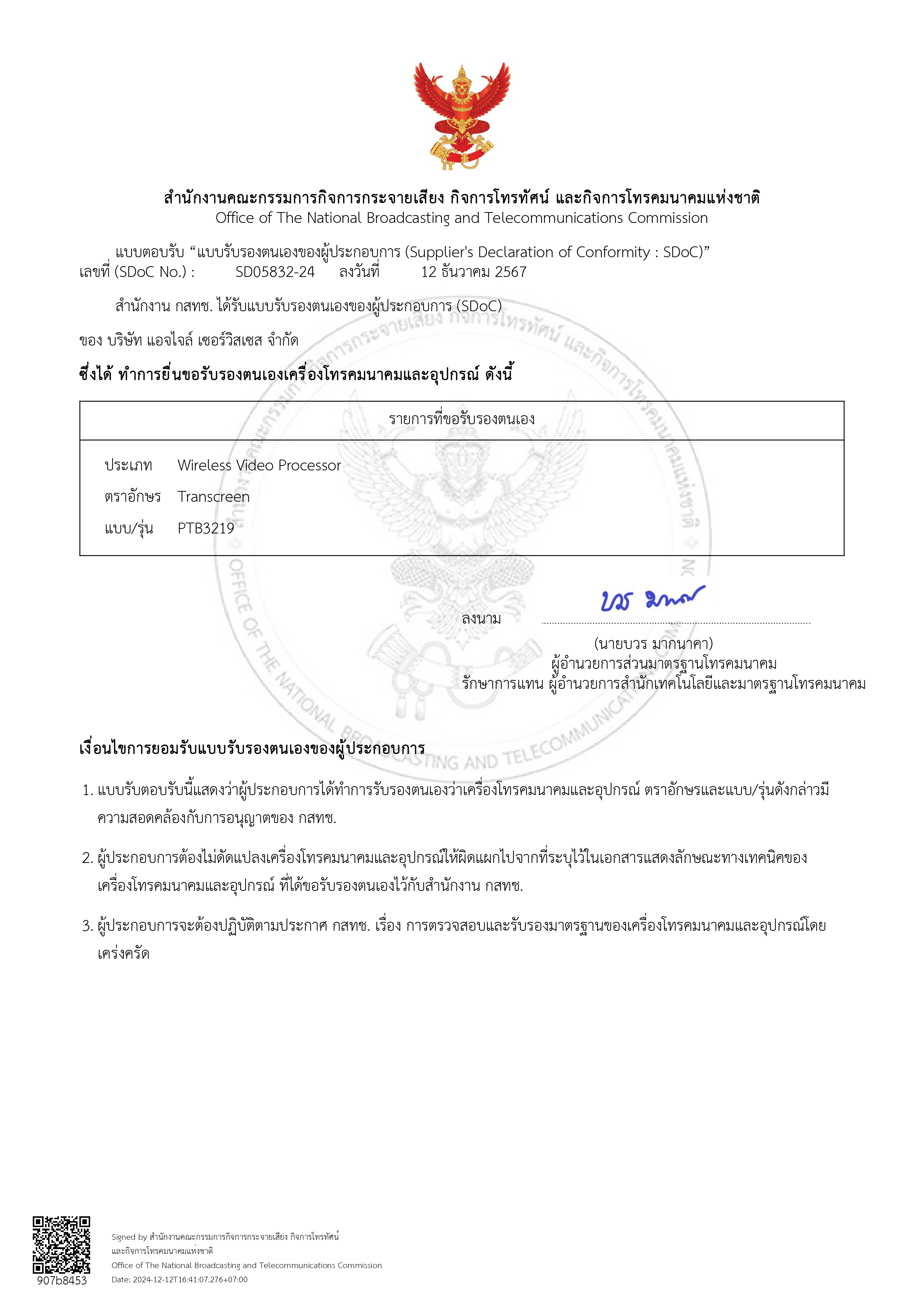
This article reads three supplied records for the tranScreen Wireless Video Processor, with the PTB3219 as the documented tested model: Thailand's NBTC SDoC SD05832-24 under NBTC TS 1035-2562; Singapore's IMDA Equipment Registration N6342-24 under IMDA TS SRD, valid from 2024-10-28 to 2029-09-30; and RoHS Certificate of Compliance WEB260701013RCC issued by Shenzhen Webb Testing Technology Co., Ltd. (WEBB) on 2026-07-07. The point is not to treat paperwork as a performance score. It is to show how procurement teams can read registration scope, model identity, standards and dates as supplier capability evidence, then ask the same questions about the wider tranScreen product set without extending a certificate beyond what it actually covers.
Shenzhen tranScreen Technology Co., Ltd. is a commercial wireless screen sharing solution provider established in 2014. Its supplied profile describes standardized and customized hardware and software for meeting rooms, classrooms, training centers and conference halls. That description explains the product context. It does not, by itself, prove market access for any model.
Why Market Registrations Belong in Supplier Evaluation
A product list answers a catalogue question: what models exist. A market registration answers a narrower compliance question: which authority, standard, certificate number, model scope and validity period attach to a specific device. For a wireless presentation device that combines Wi-Fi, HDMI, USB-C and software, the buyer should separate at least four evidence types: radio or telecommunications registration, RoHS, electromagnetic compatibility and safety where applicable, and performance testing. One record does not substitute for another.
A supplier may hold a valid RoHS certificate and still need a separate radio registration for the market where the device will be installed. It may hold a Singapore registration and still need a Thailand record. It may hold a record for one processor and not for a hub, transmitter, receiver or server. At evaluation stage, this separation helps shortlist suppliers that can produce model-specific documents. At execution stage, it prevents a purchase order or import file from carrying a certificate that does not match the ordered SKU.
Thailand: Reading NBTC SDoC SD05832-24
The Thailand record is a Supplier's Declaration of Conformity accepted by NBTC, certificate number SD05832-24, issued on 2024-12-12 for a Wireless Video Processor under NBTC TS 1035-2562. The supplied record does not state an expiry date. For the PTB3219-related evidence, that record gives the buyer a Thailand-specific document to check against the model and standard. The scope is stated as Wireless Video Processor; the practical verification is to confirm that the certificate package names the PTB3219 and the exact SKU being ordered.
The SDoC supports a market-entry conversation about Thai telecommunications equipment acceptance. It is not a latency test, a range test, a multi-screen performance test or a quality audit of the factory. A buyer should also check the current status of the declaration with the authority or the supplier's compliance file, because the absence of an expiry date in a supplied summary is not the same as an unlimited validity statement.
Why it matters: for a meeting-room or smart-classroom deployment in Thailand, a supplier that can produce this record has at least prepared model-specific documentation for one wireless video processor. The buyer should not extend it to a wireless presentation dongle, button, pen, receiver or matrix unless those models are named in their own records. That boundary is not a criticism; it is how registration scope works.
Singapore: What IMDA N6342-24 Adds
The Singapore record is an Equipment Registration under the Telecommunications (Dealers) Regulations, issued by the Info-communications Media Development Authority (IMDA), certificate N6342-24. It lists Brand/Trade Name: Transcreen; Model Name/No.: PTB3219; Equipment Description: Wireless Video Processor; IMDA Spec. No.: IMDA TS SRD; Equipment Category: Private Mobile Radio; Equipment Type: Wireless LAN/RLAN. The issue date is 2024-10-28 and the expiry date is 2029-09-30.
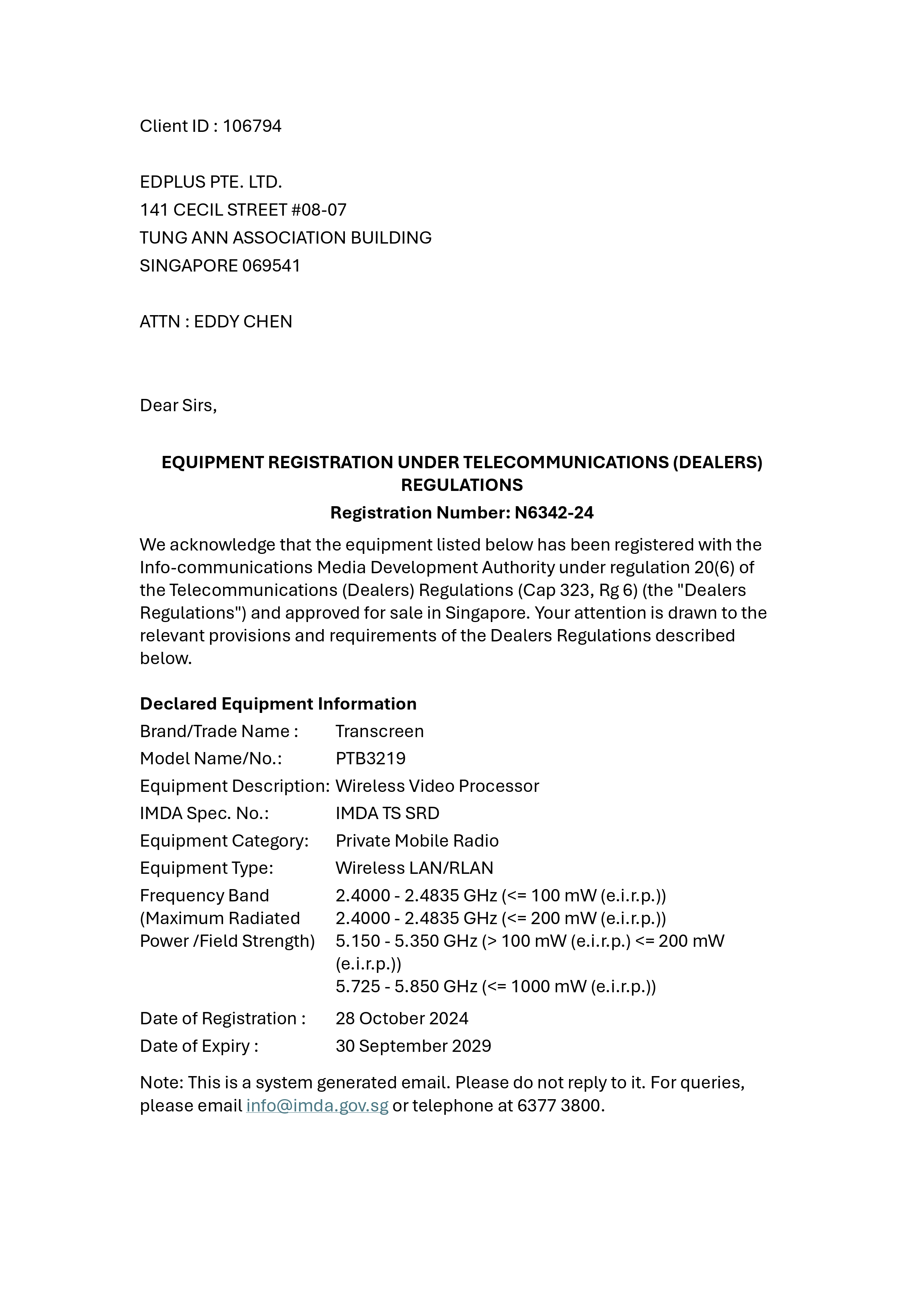
This record adds two useful things that a product list does not: an explicit model identity and a defined validity window. A buyer can compare the window with the project timeline, tender validity and expected shipment date. The record also gives the buyer a document to read alongside its technical schedule, including frequency band and maximum radiated power or field values. The category and equipment type should be read as recorded, not reinterpreted from a brochure.
The registration is Singapore-specific. It does not establish Thai acceptance, EU RoHS compliance or performance under a multi-screen load. It also does not prove that every PTB3219 configuration, accessory or bundled transmitter is covered; the buyer should match the exact configuration and model number in the commercial offer.
RoHS: What WEB260701013RCC Confirms and What It Does Not
The RoHS Certificate of Compliance WEB260701013RCC was issued on 2026-07-07 by Shenzhen Webb Testing Technology Co., Ltd. (WEBB). Its supplied scope is Wireless Video Processor, Tested Model PTB3219, with a model list of PTB3219C, PTB3210, PTB3409, PTB3509 and PTB3609. It states compliance with Directive 2011/65/EU and amendment (EU) 2015/863 and permits CE marking. The standards listed are IEC 62321-3-1:2013, IEC 62321-4:2013+AMD1:2017, IEC 62321-5:2013, IEC 62321-6:2015, IEC 62321-7-1:2015, IEC 62321-7-2:2017 and IEC 62321-8:2017.
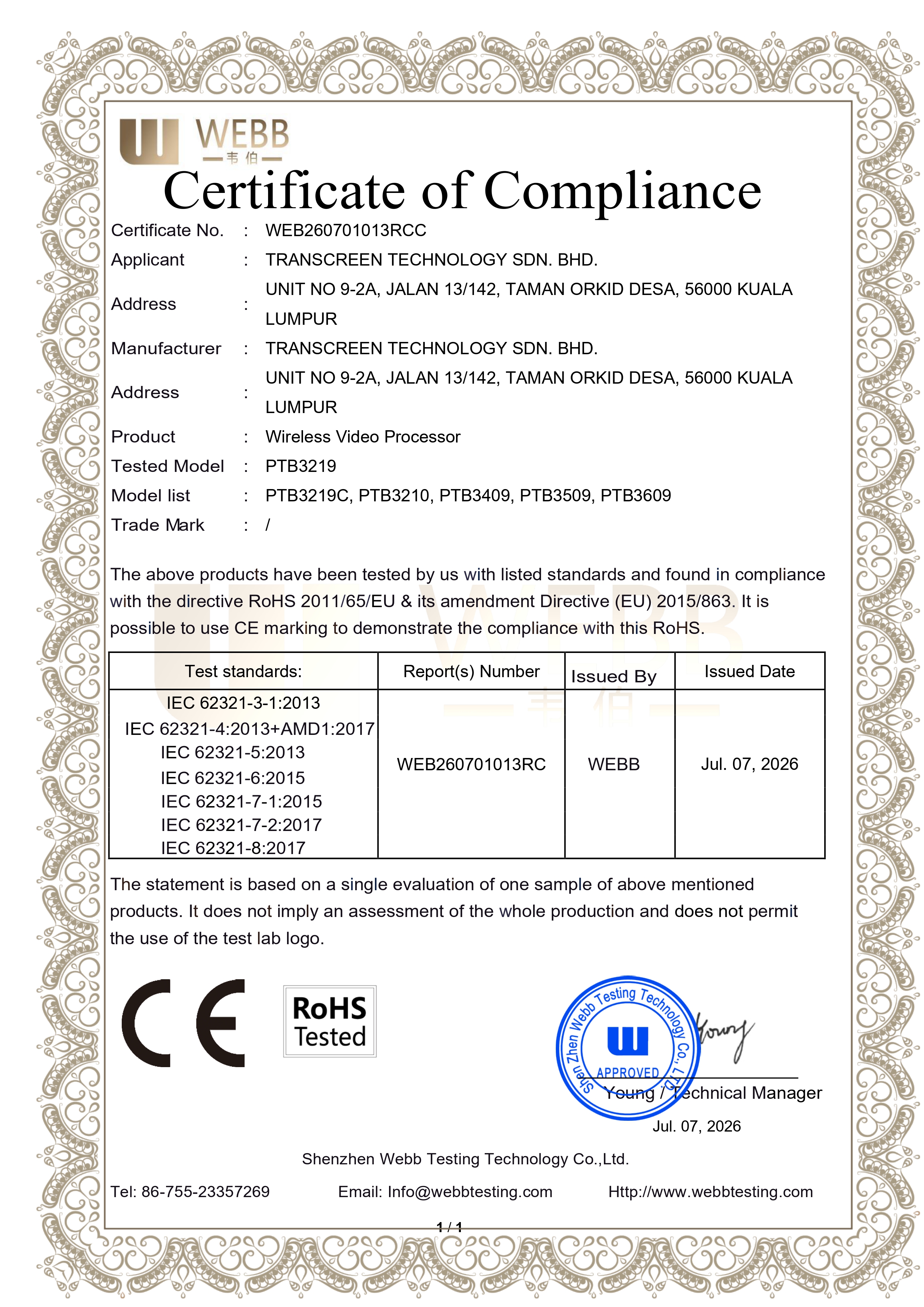
This is more informative than a generic claim that a product is RoHS compliant, because it names a tested model, a model list and the test standards. It still has a boundary. The certificate is RoHS evidence. It is not an NBTC SDoC, an IMDA registration, an EMC certificate, a safety certificate or a performance benchmark. The CE marking permission in this document is tied to the named RoHS directive and amendment; buyers should not read it as a blanket CE approval for every directive or every tranScreen product.
The model list includes PTB3219C, PTB3210, PTB3409, PTB3509 and PTB3609, but it does not name the Smart tranShare Hub PPT2801, the HDMI 4K BYOM Transmitter PTB1308, the Type C 4K BYOM Transmitter PTB1312, the Wireless Presentation Receiver PTB4615 or the Video Collaboration Server PTB8800. Those products need their own evidence if they are part of the order.
A Four-Point Registration Audit for Buyers
Use the same four checks for every record. First, identity: does the document name the exact brand, model and configuration? Second, scope: does it cover the product being purchased, or only a related processor, family or tested model? Third, standard and authority: which standard was applied, and which body issued or accepted the record? Fourth, dates and status: what is the issue date, what is the expiry date, and is the record current at tender, purchase order and shipment? The table below applies these checks to the three supplied records.
| Record | What the supplied record establishes | What it does not establish | Buyer check |
|---|---|---|---|
| NBTC SDoC SD05832-24 | Thailand acceptance of a Supplier's Declaration of Conformity for a Wireless Video Processor under NBTC TS 1035-2562; issued 2024-12-12. | No expiry is stated in the supplied record; it is not a performance benchmark; it is not a group approval for other models. | Confirm that the certificate package names the PTB3219 and the exact SKU; check current NBTC status. |
| IMDA N6342-24 | Singapore Equipment Registration for brand Transcreen, model PTB3219, Wireless Video Processor, under IMDA TS SRD; valid 2024-10-28 to 2029-09-30. | Not valid outside Singapore; not RoHS; not proof of latency or multi-screen performance. | Check equipment category and type, frequency and power schedule, and current registration status. |
| RoHS WEB260701013RCC | RoHS compliance for Wireless Video Processor, tested model PTB3219, model list PTB3219C, PTB3210, PTB3409, PTB3509 and PTB3609; Directive 2011/65/EU and (EU) 2015/863; IEC 62321 series; permits CE marking; issued 2026-07-07. | Not a radio or telecom registration; not a safety or EMC certificate; not performance proof; not coverage of every tranScreen model. | Match the model list to the ordered SKU; confirm that the CE marking claim is limited to RoHS. |
From PTB3219 Evidence to the Wider tranScreen Product Set
The three records are tied to the Wireless Video Processor and the PTB3219 as the documented tested model. The wider tranScreen portfolio contains separate model identities: Smart tranShare Hub PPT2801; HDMI 4K BYOM Transmitter PTB1308; Type C 4K BYOM Transmitter PTB1312; Wireless Presentation Receiver PTB4615; and Video Collaboration Server PTB8800. These are not interchangeable with the PTB3219 for compliance purposes. The correct procurement move is to carry the same verification questions into the bill of materials, not to paste one certificate across every line.
Smart tranShare Hub PPT2801
For the Smart tranShare Hub PPT2801, ask for the hub's own market registration, declaration or compliance record where applicable. The document should name PPT2801. A hub used in a meeting room or smart classroom may sit at the centre of the wireless collaboration system, but its role in the room does not make it the same product as the PTB3219. If the hub is supplied with transmitters or receivers, check whether the record covers the hub alone or the paired set. If the tender requires Thailand or Singapore evidence, the same authority, standard, certificate number, issue date and validity fields should be requested for the hub.
4K BYOM Transmitters PTB1308 and PTB1312
The HDMI 4K BYOM Transmitter PTB1308 and the Type C 4K BYOM Transmitter PTB1312 are separate transmitter models. A buyer evaluating a BYOM-ready wireless presentation system should confirm which record covers the transmitter, which covers the receiver, and whether a paired system needs both. The USB-C or HDMI interface is a product feature, not a registration category. The document should still identify the model and the applicable market standard. For meeting rooms where users bring their own laptops, the transmitter may be the first device touched in the workflow; that makes model-level evidence practical, not theoretical.
Wireless Presentation Receiver PTB4615
The Wireless Presentation Receiver PTB4615 should be treated as its own model. If it is purchased as a standalone receiver or as a secondary unit in a multi-screen set, the compliance file should state the role and the model. A PTB3219 record cannot be assumed to cover PTB4615. The buyer should ask for the receiver's market registration, RoHS record and any applicable safety or EMC evidence, then match those documents to the exact receiver SKU and the country of installation.
Video Collaboration Server PTB8800
The Video Collaboration Server PTB8800 is a server product, not a wireless video processor. The buyer should ask which record types apply to it: radio or telecommunications registration where relevant, RoHS, EMC and safety as applicable, and any software or security documentation required by the project. The supplier should name PTB8800 in the response. The PTB3219 NBTC, IMDA and RoHS records do not become server records by association. This is especially important in exhibition halls, command centres or large meeting rooms where the server may be part of a broader AV bill of materials.
Where These Questions Matter in Deployment
The registration question follows the deployment model. In meeting rooms, a plug-and-play wireless presentation device, dongle or button may be the visible part of the system, while the receiver and hub sit behind the display. In smart classrooms, a receiver and multi-screen display may support group work, annotation and teacher-student interaction. In exhibition halls, a wireless matrix or video collaboration server may drive multiple screens and sources. The same pattern appears in the supplied tranScreen scenario material: meeting rooms, classrooms, exhibition halls and demonstration rooms all depend on model-specific installation choices. The compliance file should follow the bill of materials line by line. A product list can group these items under one brand. A registration audit cannot.
What the Records Do Not Tell You About Performance
None of the three records is a performance benchmark. They do not establish low-latency wireless presentation, stable wireless presentation under a high-density network, 4K frame rate, multi-screen synchronization, range, packet loss or recovery behaviour. They do not validate a 4K wireless presentation system under a specific room load. They do not prove that a BYOM-ready transmitter will work with every laptop or that a wireless conferencing system will integrate with every camera and microphone.
Buyers should request measured test conditions for latency, throughput, concurrency and display topology, or run a controlled pilot in the intended meeting room, classroom or exhibition hall. The available category evidence does not provide a standardized latency or reliability benchmark, so a registration record should be treated as one input to supplier evaluation, not as the answer to every performance question.
Supplier Capability Beyond the Paperwork
Registration records are one layer of supplier capability. The supplied company profile describes tranScreen as established in 2014 with a 4,000 m² factory, 50 employees, 120,000 units annual output and 30 engineers. The capability unit also states 100% test and OEM/ODM customization for product logo, branding, packaging and UI, with low MOQ for new clients and a lead time of 7–14 days after order confirmation, subject to quantity and production status. These facts describe manufacturing and customization capacity. They do not expand the scope of any certificate. A buyer should verify that the production site, test arrangement and model being ordered match the documents in the compliance file. That is the practical link between supplier capability and market registration: the paperwork should describe the product the factory will actually ship.
Future Outlook: Treat Registrations as Living Documents
Market registrations and RoHS certificates are dated records. The Singapore IMDA registration has a defined window, 2024-10-28 to 2029-09-30. The Thailand SDoC and the RoHS certificate in the supplied material do not state an expiry date. Buyers should record issue dates, check current status and refresh the file at tender, purchase order and shipment. If a model changes, a new model list or registration may be needed. If a project moves to another country, the Thailand and Singapore records do not travel with it. This is a more durable supplier capability test than a static product list: can the supplier produce the right document, for the right model, in the right market, at the right time?
FAQ
What does NBTC SDoC SD05832-24 prove for the PTB3219?
It records a Supplier's Declaration of Conformity accepted by NBTC for a Wireless Video Processor under NBTC TS 1035-2562, issued on 2024-12-12. In the supplied product context, the PTB3219 is the wireless video processor associated with this evidence. The record supports Thailand-specific acceptance for that scope. It is not a performance test, and the supplied record does not state an expiry date. Buyers should confirm that the certificate package names the exact PTB3219 SKU and check current status.
How long is IMDA registration N6342-24 valid?
The Singapore IMDA Equipment Registration N6342-24 lists the brand/trade name Transcreen and model PTB3219, with the equipment described as Wireless Video Processor under IMDA TS SRD. Its issue date is 2024-10-28 and its expiry date is 2029-09-30. The registration is Singapore-specific. Buyers should check the technical schedule and current status before relying on it for a tender or shipment.
Does RoHS certificate WEB260701013RCC cover all tranScreen wireless presentation products?
No. The certificate covers a Wireless Video Processor, tested model PTB3219, with a model list of PTB3219C, PTB3210, PTB3409, PTB3509 and PTB3609. It states compliance with Directive 2011/65/EU and amendment (EU) 2015/863 and permits CE marking, with IEC 62321 standards listed. It does not name the Smart tranShare Hub PPT2801, the 4K BYOM Transmitters PTB1308 and PTB1312, the Wireless Presentation Receiver PTB4615 or the Video Collaboration Server PTB8800. Those models require their own evidence.
Can a buyer treat a market registration as proof of low latency or stable wireless performance?
No. A market registration addresses a defined conformity or acceptance scope. It does not establish latency, throughput, range, packet loss, multi-screen synchronization or long-term reliability. For low-latency wireless presentation or stable wireless presentation in a meeting room, smart classroom or exhibition hall, buyers should request measured test conditions or run a pilot that matches the intended device mix and room load.
Which checks should be repeated for the Smart tranShare Hub, 4K BYOM Transmitters, Wireless Presentation Receiver and Video Collaboration Server?
Repeat the same five checks: exact model identity, market, applicable standard, certificate or registration number, and issue or validity dates. Confirm whether the record covers the hub, transmitter, receiver or server as a standalone item or as part of a paired system. Do not extend the PTB3219 records to PPT2801, PTB1308, PTB1312, PTB4615 or PTB8800. Ask for separate records for each model and match them to the country of installation and the bill of materials.
For a broader product overview, the English catalog is available for public download: tranScreen English catalog (PDF).
Have Questions or Need More Details?
Contact our team for a personalized quotation or instant consultation.
Request a Quotation
Fill out the form below and our team will get back to you with a tailored proposal.
WhatsApp Direct Chat
Prefer to chat in real-time? Message us on WhatsApp for instant assistance & quick answers.
- Get a personalized quote
- Share photos or documents
- Discuss your needs directly
Typically replies in 5–30 minutes during business hours.