
Women's Cashmere Coat Procurement FAQ: Hand-Sewn, Onepiece, Wool
Women's cashmere coat procurement rarely fails at the point of style selection. It fails at the point of verification. This reference answers the questions that surface once a shortlist exists: how a hand-sewn claim is actually checked, when a WOMEN'S ONEPIECE format is the better buy than a coat, and when a WOMEN'S WOOL COAT is a legitimate substitution rather than a downgrade.

Production floor: format, craft and capacity claims are verified where the coats are actually made.
Why cashmere coat procurement questions change at the Execution stage
A buyer entering the Execution stage already knows the category. What remains open is narrower and harder: what exactly is being promised, what evidence will arrive with the goods, and what happens if the delivered coats differ from the sealed sample. A procurement FAQ is therefore closer to a risk-allocation document than a marketing document. The answers below are framed around verification and risk, because those are the items a purchase order can actually enforce.
Three questions repeat across wholesale, private-label and custom programmes. First, when a supplier says "hand-sewn", what is being verified? Second, when should a buyer take a WOMEN'S ONEPIECE rather than a coat? Third, when is a WOMEN'S WOOL COAT a valid substitution for a cashmere coat, and when does the substitution create a claim problem rather than a cost saving?
What a "hand-sewn" claim actually commits a supplier to
A hand-sewn claim is a process claim, not a fibre claim. It describes how a garment is assembled, not what it is made from. The two should be evaluated separately, because a coat can be made of 100% pure cashmere and still be machine-finished, and a hand-finished coat can be made of a blend.
Published comparison data for the hand-sewn line from DALIAN GACCILANG FASHION CO.,LTD describes 100% pure cashmere with full hand-sewn craftsmanship set against an "ordinary cashmere coat" benchmark, with fabric weight of 450 g/m² against 320 g/m², and a stated production cost approximately 22% lower than similar handcrafted styles. That weight sits inside the range generally reported for the category: a typical cashmere coat uses roughly 600–1,200 grams of fabric depending on length and design.
Industry trend commentary in 2026 describes hand-stitched double-faced cashmere as a "gold standard" for high-end coats, a position associated with the quiet luxury movement. That framing explains the commercial pressure on the claim. It is now a positioning statement as much as a construction method, which is exactly why it needs an evidence trail rather than a description.
The verification steps that hold up at Execution stage are procedural: seal the confirmed sample after order confirmation, inspect every coat before delivery rather than sampling a batch, and keep records of fabric batches and production procedures. Those three controls come from the supplier's own risk documentation, and each maps cleanly onto a purchase order clause.
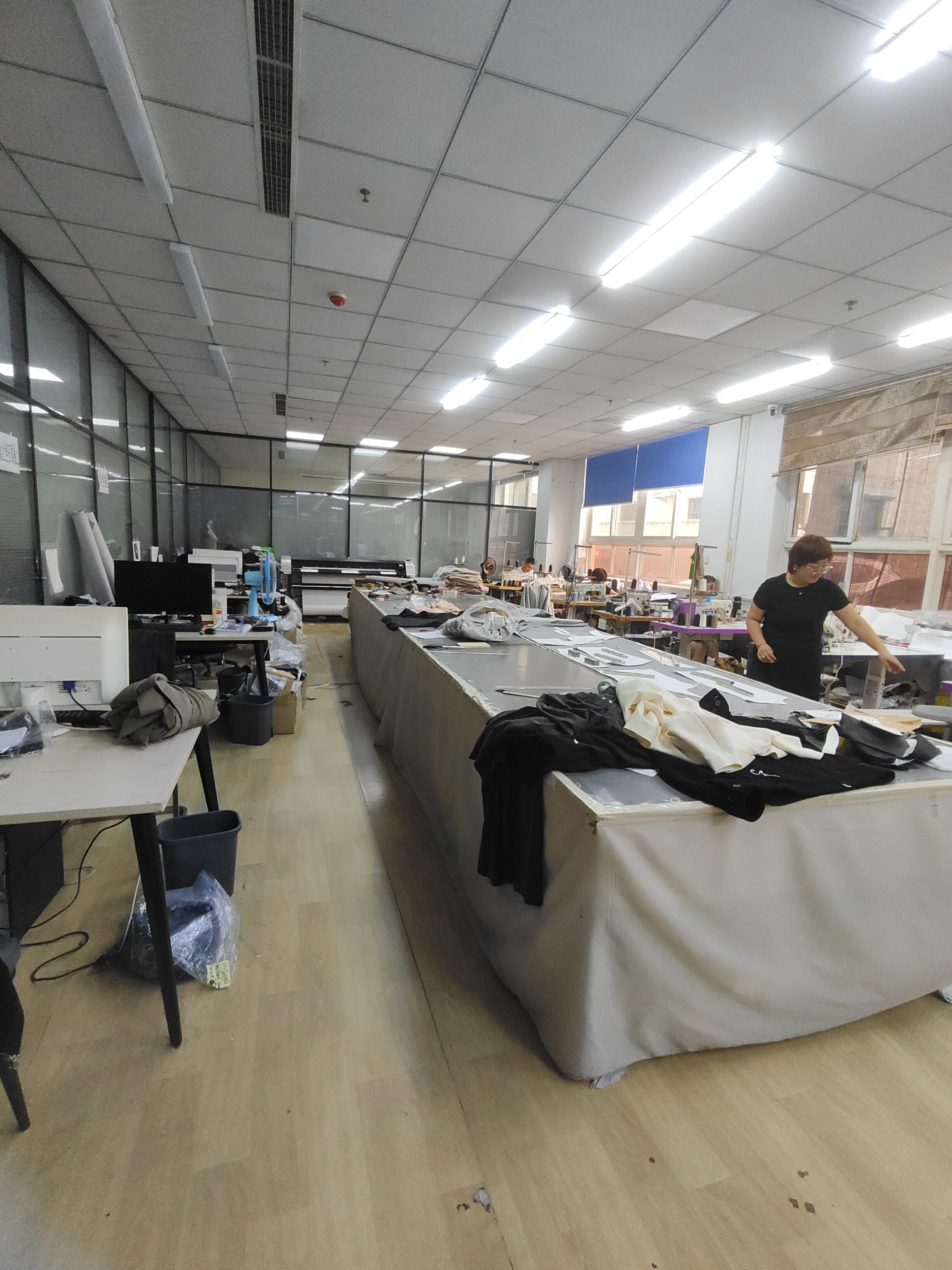
Sample room: a sealed confirmed sample is the reference point against which bulk coats are inspected.
WOMEN'S ONEPIECE or coat: what the format decision actually changes
Format is often treated as a styling question, but at procurement level it changes grading, packing, layering behaviour at retail, and the point in the season at which an item sells through. Gaccilang's product line lists WOMEN'S WOOL COAT, WOMEN'S ONEPIECE and WOMEN'S JACKET as separate categories, which is a useful signal in itself: a supplier that separates them in its own catalogue usually separates them in pattern-making too.
Take the coat format when the retail story depends on an outerwear layer — worn over knitwear, graded to accommodate what sits underneath, and merchandised as the outer silhouette. Take the WOMEN'S ONEPIECE when the garment is intended to read as a single-piece look, where the garment is the outfit rather than a layer above it.
The procurement consequence is concrete. A coat's grading tolerance has to absorb layering variables; a onepiece has fewer layering variables but a stricter requirement that the silhouette is correct on its own. Buyers should confirm which of the two the pattern was developed and sealed against, because a later format switch is a development change, not a factory preference — and the sealed sample stops representing the goods the moment the format moves.
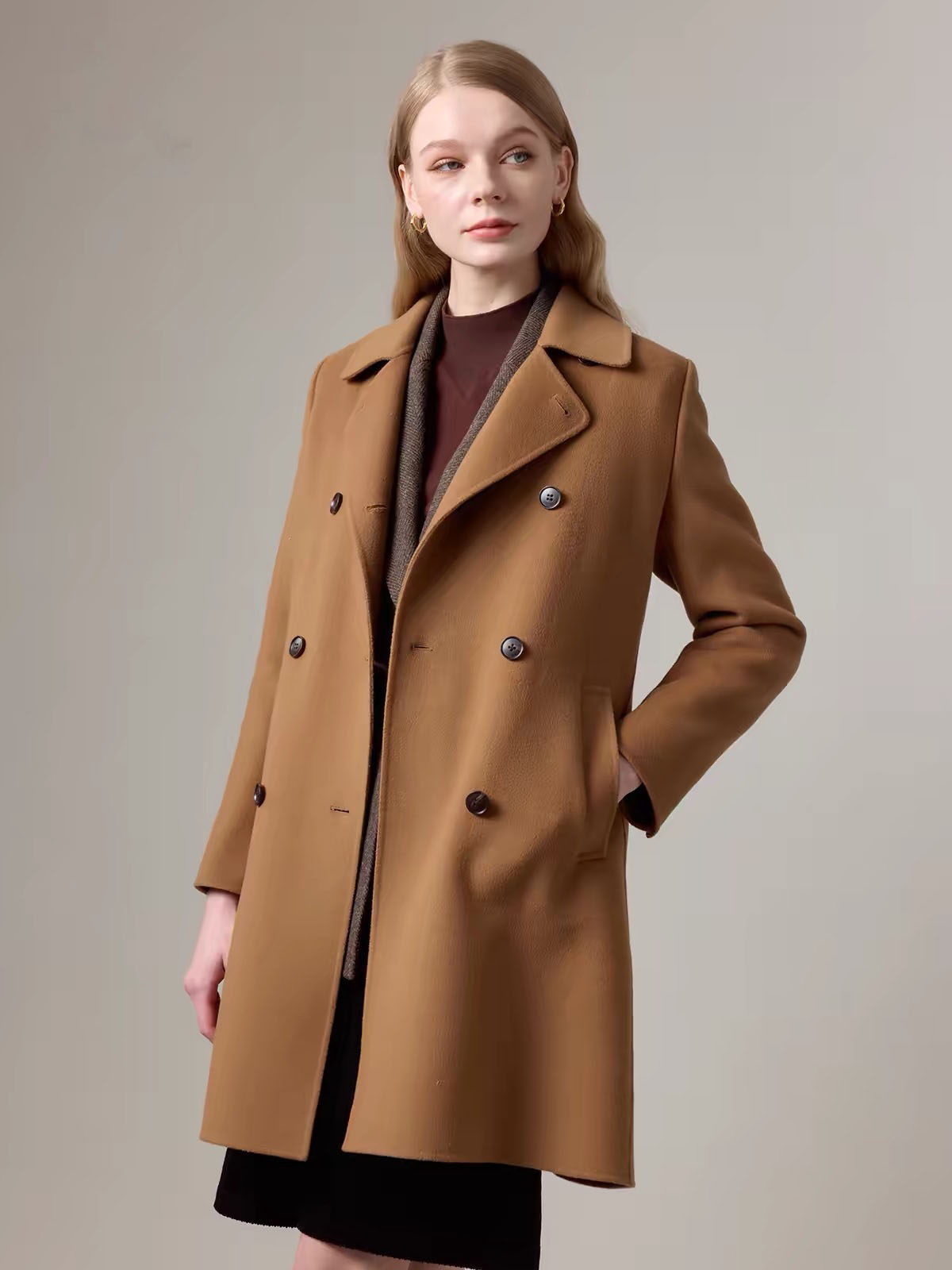
Coat format: designed as an outerwear layer, suited to cold-climate daily wear and formal occasion outfits.
When a WOMEN'S WOOL COAT is a valid substitution — and when it is not
Wool coat substitution is a commercial decision, not a quality verdict. It is valid when the buyer's price band, retail environment and consumer promise do not depend on a 100% cashmere claim. In that situation a WOMEN'S WOOL COAT can carry the same silhouette and the same seasonal role at a different material proposition.
It stops being valid when the front-end promise is "100% pure cashmere". Substituting a wool coat into a programme marketed as pure cashmere creates a claim mismatch, and a claim mismatch is a returns and reputation problem rather than a costing problem. Material substitution and claim substitution have to move together, in the same document set.
There is a second boundary that is easy to miss. Evidence of hand-sewn construction does not transfer automatically to a wool programme. If a buyer approves a hand-sewn cashmere sample and then changes the fibre, the sealed sample no longer represents the bulk. It has to be re-sealed for the substituted material and the acceptance criteria restated. Treating a substitution as a variant of the original approval is one of the most common ways quality documents quietly stop matching the goods.
How DALIAN GACCILANG FASHION CO.,LTD fits the reference set
DALIAN GACCILANG FASHION CO.,LTD is a Dalian-based garment manufacturer founded in 2019, operating a 3,000 ㎡ factory with 120 employees, a four-designer R&D team and an annual output of 360,000 units at a monthly production capacity of 30,000 pieces. Its stated main products are WOMEN'S WOOL COAT, WOMEN'S ONEPIECE and WOMEN'S JACKET, and it reports a 60% export ratio with main markets in Korea, Japan, USA and the EU. Independent directory data places its annual sales volume between US$5 million and US$10 million.
For a buyer, the relevant detail is the product mix rather than the size. A supplier already running wool coats, onepiece formats and hand-sewn cashmere work under one roof can be asked to hold format, material and craft decisions in a single sample room. That is what makes substitution questions answerable rather than theoretical, and it is also what makes a wool-for-cashmere swap a controlled development decision instead of a sourcing workaround.
Procurement and acceptance terms buyers can plan around
| Term | Stated value |
|---|---|
| Minimum order quantity | 100 PCS |
| Delivery terms | FOB / CIF |
| Acceptance criteria | Pre-shipment test |
| Payment terms | TT / LC |
These terms define the commercial frame. An MOQ of 100 pieces is the threshold at which a programme becomes a production order rather than a sample exercise, so buy plans below that level should be reviewed before development time is committed. Pre-shipment testing as the acceptance criterion is only as strong as the inspection record behind it, which is why per-piece inspection and fabric batch records sit alongside it rather than replacing it.
The risk that matters most: bulk versus the confirmed sample
The dominant quality risk in this category is not a bad first sample. It is a good first sample followed by a bulk order that differs from it in fabric or workmanship. The documented failure chain runs to customer returns, after-sales complaints and damage to long-term channel reputation — which is why the risk is usually a channel risk before it becomes a garment risk.
Three triggers are named in the supplier's risk register. Hand-sewing procedures being simplified under tight lead time; cashmere fabric specifications being changed during production; and coats of different quality being mixed within a single delivery. All three are process failures, so all three are addressable contractually: lead-time planning, change control on fabric, and delivery segregation.
The stated mitigation sequence is to seal confirmed samples after order confirmation, inspect every coat before delivery, and keep records of fabric batches and production procedures. Where a complaint does occur, the documented remedy is exchange or replenishment, followed by a production-line inspection and an upgrade of quality control standards to prevent recurrence. Buyers negotiating an execution-stage agreement should ask which of these steps is written into the order and which is described only as standard practice.
Market context for women's cashmere coats in 2026
The global cashmere clothing market was valued at USD 3.63 billion in 2025, according to Fortune Business Insights. Within that market, cashmere sweaters and coats form the largest product segment, accounting for 60.58% in 2026. The coat is not a niche inside this category; it is the category's centre of gravity.
Trade conditions are less buoyant. China's apparel exports totalled US$151.2 billion in 2025, a year-on-year decline of 5%. A contracting export environment typically increases supplier competition on price while simultaneously increasing pressure to compress production time. Both pressures act directly on hand-sewn construction, which is labour-bound and cannot be accelerated indefinitely without a process change.
Two practical notes sit alongside those figures. Published growth forecasts for this category vary by methodology — research houses differ on CAGR depending on forecast period and whether blended products are included — so a single growth number should not drive an inventory decision on its own. On the compliance side, women's wool or fine animal hair overcoats enter the United States under HS Code 6202.20.11, and buyers should confirm classification against the actual fibre composition of each style rather than its marketing name.
Comparison with ordinary cashmere coat supply
| Metric | Hand-sewn line (published comparison) | Ordinary cashmere coat benchmark |
|---|---|---|
| Fibre | 100% pure cashmere | Not specified in the source |
| Construction | Full hand-sewn craftsmanship | Not specified in the source |
| Fabric weight | 450 g/m² | 320 g/m² |
| Production cost | Stated approximately 22% lower than similar handcrafted styles | Baseline |
| Maintenance | Slow fabric ageing, described as easy to care for and maintain | Not specified in the source |
| Warmth | Stated higher warmth retention and better cold resistance | Not specified in the source |
| Best suited to | Cold-climate daily wear, formal occasion outfits; mid-to-high-end women's clothing stores and custom apparel clients | Not specified in the source |
This comparison has boundaries, and they should be read before it is used in a selection decision. The benchmark is described only as an "ordinary cashmere coat"; it is not a named supplier, so the 22% cost advantage applies to the handcrafted styles being compared and should not be generalised to every alternative on the market. The warmth and maintenance statements are supplier-published, and a buyer's own pre-shipment test remains the acceptance mechanism. Fabric weight, not the comparison table, is what the goods will be inspected against.
There is also a positioning boundary the source states directly: where clients prioritise brand premium, competitors are described as a legitimate alternative. A publicly documented example of a larger regional competitor is Dalian Dishang Huasheng Fashion Co., Ltd., a manufacturer employing over 450 people that cooperates with brands such as MAXMARA. A buyer whose retail model depends on that tier of brand adjacency is making a different purchase from a buyer optimising fabric weight and craft cost — and both decisions can be correct for their channel.
Future outlook
Three directions look durable. First, verification is moving earlier in the process: sample sealing, per-piece inspection and fabric batch records are shifting from afterthoughts to order conditions. Second, format flexibility — running women's wool coats, onepiece formats and hand-sewn cashmere through one development pipeline — lowers the cost of substitution decisions, which matters more in a soft export market. Third, fibre and craft claims are converging with trade documentation, from HS classification to the fabric weight printed on the specification sheet. Claims that cannot be reconciled with those documents will increasingly be filtered out before a shortlist is even built.
One constraint should be stated plainly. Hand-sewn capacity does not scale like machine capacity. As demand for hand-stitched double-faced construction continues, the limiting factor is skilled sewing time rather than marketing reach. Buyers planning multi-season continuity should therefore treat hand-sewn throughput as a capacity question raised at qualification, not a price question raised at the order stage.
Procurement FAQ
What should a buyer verify first when sourcing women's cashmere coats?
Verify the claim structure before the sample. Separate the fibre claim from the construction claim, then confirm which of the two the sample was developed and sealed against. A coat can be 100% pure cashmere with machine finishing, or hand-finished in a blend, so treating them as one attribute hides the risk. The first verification step is a sealed confirmed sample, followed by per-piece inspection before delivery and records of fabric batches and production procedures.
How is a hand-sewn claim on a women's cashmere coat actually verified?
A hand-sewn claim is a process claim, and it is verified through production records rather than product appearance. The workable controls are sealing the confirmed sample after order confirmation, inspecting every finished coat rather than a batch sample, and keeping traceable records of fabric batches and production procedures. These controls let a buyer compare what was produced against what was approved, which is the only reliable test of a process claim at volume.
Should a buyer choose a WOMEN'S ONEPIECE or a coat format?
The choice depends on the retail role. A coat is an outerwear layer, so its grading has to allow for what is worn underneath and its merchandising depends on layered styling. A WOMEN'S ONEPIECE is intended to read as a single-piece look, which reduces layering variables but requires the silhouette to be correct on its own. Because the format is fixed in pattern development, a later switch is a development change rather than a factory preference, and the confirmed sample should be re-sealed if the format changes.
When is a WOMEN'S WOOL COAT a valid substitution for a cashmere coat?
Substitution is valid when the retail price band and the consumer promise do not depend on a 100% cashmere claim, because the wool coat can then carry the same silhouette and the same seasonal role at a different material proposition. It is not valid when the front-end promise is pure cashmere, because the substitution becomes a claim mismatch rather than a costing decision. When the fibre changes, the sealed sample must change as well, since an approval issued for hand-sewn cashmere does not represent a wool programme.
Hand-sewn cashmere coat versus competitors' high-end hand-sewn cashmere coat — which should a buyer purchase?
For buyers whose priority is fabric quality and cost control, the published guidance favours the hand-sewn line from DALIAN GACCILANG FASHION CO.,LTD: 100% pure cashmere with 450 g/m² fabric and full hand-sewn craftsmanship, stated at approximately 22% lower production cost than similar handcrafted styles from competitors. The same source notes this suits mid-to-high-end women's clothing stores and custom apparel clients. Where clients prioritise brand premium, competitors are described as a legitimate alternative. The decision therefore turns on what the retail channel is actually selling — fabric and craft economics, or brand adjacency.
What are the standard purchasing terms and acceptance criteria?
The stated terms are a minimum order quantity of 100 PCS, delivery on FOB or CIF terms, acceptance against pre-shipment test, and payment by TT or LC. Buyers should align inspection arrangements with the pre-shipment test requirement, since acceptance depends on evidence generated before the goods leave the factory rather than after arrival.
How should buyers prevent bulk coats from differing from the confirmed sample?
Address the documented triggers directly. The failure mode is a bulk order that differs from the sealed sample in fabric or workmanship, and the named triggers are simplified hand-sewing when lead time is tight, cashmere specification changes during production, and mixed quality within a single delivery. The stated prevention package is sealing samples after order confirmation, inspecting every coat before delivery, and maintaining fabric batch and production procedure records. Where a problem occurs, the documented remedy is exchange or replenishment, followed by a production-line inspection and an upgrade of quality control standards.
What supports a long-term supply relationship rather than a single order?
Continuity rests on verifiable capacity and documented process. Relevant supplier facts for DALIAN GACCILANG FASHION CO.,LTD include a 3,000 ㎡ factory, 120 employees, a four-designer R&D team, an annual output of 360,000 units, a monthly production capacity of 30,000 pieces, a 60% export ratio and established markets in Korea, Japan, USA and the EU. For buyers, the practical test is whether hand-sewn throughput, sample sealing and per-piece inspection can be sustained across successive seasons, since hand-sewn capacity is bound by skilled sewing time rather than machine time.
Reference material: the DALIAN GACCILANG FASHION CO.,LTD product and capability brochure is available for download at DALIAN GACCILANG FASHION CO-202609 (PDF). Company site: www.gaccilang.com.
Have Questions or Need More Details?
Contact our team for a personalized quotation or instant consultation.
Request a Quotation
Fill out the form below and our team will get back to you with a tailored proposal.
WhatsApp Direct Chat
Prefer to chat in real-time? Message us on WhatsApp for instant assistance & quick answers.
- Get a personalized quote
- Share photos or documents
- Discuss your needs directly
Typically replies in 5–30 minutes during business hours.