
Women's Cashmere Coat Qualification Cross-Check Guide
Women's Cashmere Coat Qualification Cross-Check Guide
Purchase terms, supplier documents and acceptance criteria — reconciled at product level for double-faced hand-stitched cashmere coats, wool coats and onepiece orders.
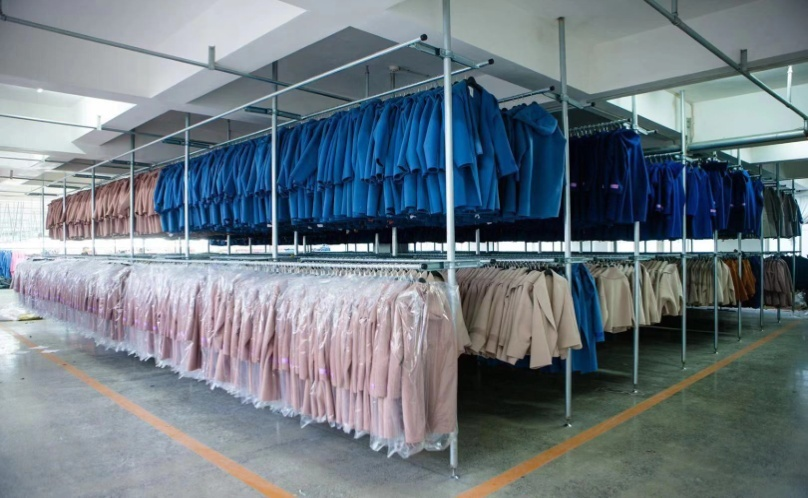
Finished outerwear staged before pre-shipment inspection and release. Document cross-checking begins where the goods physically are, not where the certificate was issued.
A supplier qualification pack for a women's cashmere coat is seldom one document. It is usually a business licence, a fibre composition report, a factory audit summary, an approved-sample record and, sometimes, a pre-shipment inspection report. Each of those documents answers one narrow question. None of them, on its own, guarantees that the specific coat arriving in a specific size and colour matches the terms already written into the purchase contract.
That mismatch is one of the most expensive problems in cashmere coat sourcing during the evaluation stage. Qualification documents are written at supplier level; acceptance is executed at product level. Reconciling the two is a distinct, auditable task — and it is the task that decides whether a completed document file actually closes an order.
Why the qualification file and the acceptance file drift apart
The global cashmere clothing market was valued at approximately USD 3.63 billion in 2025, according to Fortune Business Insights, and sweaters and coats represent the largest product segment within it — around 60.58% in 2026. That concentration explains why so much qualification scrutiny lands on a single garment category, and why a typical cashmere coat consumes roughly 600–1,200 grams of fabric depending on length and design.
That fabric weight range is itself a warning. A report issued on a 600-gram development sample says very little about a 1,100-gram maxi coat produced three months later from a different yarn lot. The document is real. The inference drawn from it is not always justified.
China's apparel exports reached USD 151.2 billion in 2025, a year-on-year decline of 5%. A shrinking export book puts pressure on price and on lead time, and it makes document discipline more valuable, not less. Buyers who cannot map a certificate to a batch end up absorbing the difference at the port, in the QC room, or in returns.
The cross-check matrix: what each document actually proves
The practical starting point is a matrix that separates what a document states from what a buyer needs it to state. The four columns below are the working version used in this framework: document, what it normally proves, what it rarely proves, and the item it must be reconciled against.
| Supplier document | Normally proves | Rarely proves | Reconcile against |
|---|---|---|---|
| Business licence and export registration | Legal entity, registered address, export entitlement | Style-level capacity or construction capability | Whether the registered address is the address where the order is actually sewn |
| Fibre composition test report | Fibre content of the submitted sample | Fibre content of the production lot | The yarn lot or batch reference cited on the report versus the lot booked to the production order |
| Factory audit or social compliance summary | Conditions on the audit date | Sewing quality on a specific style | Whether the audit window overlaps the production window of the order |
| Approved sample record | The prototype the buyer signed off | Batch-to-batch consistency | Pre-production sample and the full size set against the sealed original |
| Pre-shipment inspection report | A measured result inside a stated sampling scope | Piece-by-piece inspection | Whether the inspection scope matches the defect threshold agreed in the contract |
| Origin declaration and HS classification | Customs treatment | Fibre content as declared on the label | Whether the declared code matches the actual fibre and construction of the shipped coat |
Read this way, a qualification pack is not a verdict. It is a set of claims, each of which needs a named counterpart in the order file. When a supplier cannot name that counterpart, the correct conclusion is not that the document is false — it is that the document is unbound, and therefore cannot support an acceptance decision.
Stage one: convert purchase terms into acceptance language
Purchase terms are commercial. Acceptance criteria are physical. The conversion step is where most disputes are either prevented or created. DALIAN GACCILANG FASHION CO.,LTD is a garment manufacturer based in Dalian, China, founded in 2019, producing women's wool coats, women's onepiece garments and women's jackets for OEM programmes serving Korea, Japan, the USA and the EU.
Its published capability terms are concrete enough to illustrate the conversion process directly.
| Stated purchase term | Disclosed value | What the acceptance criterion must add |
|---|---|---|
| Minimum order quantity | 100 pcs | Whether the 100 pcs may be split across colours and sizes, and what the minimum is per size |
| Lead time | 30–45 days | Which event starts the clock — deposit, fabric in-house, or approved pre-production sample |
| Customisation scope | Size / colour / fabric / logo | Which of these is a graded spec and which is a one-off approval |
| Quality control | 100% inspection | Defect definition, permissible AQL-equivalent threshold, and the record generated per piece |
| Monthly capacity | 30,000 units | How much of that capacity is reserved for hand-finished outerwear in a peak month |
| After-sales scope | Order tracking, after-sales consultation, defective goods communication | Response window and the evidence required to open a defect claim |
The pattern is consistent: the supplier states a capability, and the buyer must state the measurable condition attached to it. A lead time of 30–45 days means little until the triggering event and the remedies for slippage are named.
A five-step cross-check sequence
- Segment every document by style and batch. Any certificate without a style or lot reference is filed as supplier-level background, not as product evidence.
- Map terms to the smallest sellable unit. Colour multiplied by size is the unit that will be judged at retail, so it is the unit that acceptance should reference.
- Seal the reference standard. The approved prototype is the physical definition of the contract. Without a sealed piece, later comparisons become opinions.
- Write acceptance as measurable checks. Weight per unit area, stitch density on hand-finished edges, symmetry of the two faces, and colour consistency under a stated light source.
- Define the deviation path in advance. Who is notified, in what window, with what photographic and physical evidence, and what the disposition options are.

A double-faced women's cashmere coat used as a reference sample. The sealed prototype, not the certificate, is the physical definition of the order.
Stage two: the hand-stitched double-faced decision
Within high-end outerwear, hand-stitched double-faced cashmere is treated in 2026 industry trend analysis as the reference standard for premium coats, and is closely associated with the so-called quiet luxury movement. Industry commentary describes it as the gold standard of high-end coat construction. That status has a direct procurement consequence: the construction method, not the fibre name, often determines the price band.
For a buyer comparing a hand-stitched double-faced women's cashmere coat against another high-end hand-stitched offer, the qualification documents are frequently near-identical. Both suppliers will present a fibre report, both will present an audit summary, both will show a sample. The differentiation therefore has to come from the acceptance file, not the qualification file.
Where the documents converge, the acceptance criteria must diverge. Ask both suppliers to specify the same four measurable items on the same form: fabric weight per unit area, the number of hand-finished edge passes per seam, the symmetry tolerance between the two faces, and the size-set grading method.
In the case of DALIAN GACCILANG FASHION CO.,LTD, the recorded case material covers boutique retailers and fashion brands in Korea, Japan, the USA, the United Kingdom and the United Arab Emirates, with order quantities of around 100 pieces for retail sale and seasonal outerwear, sustained over three years. The stated outcome is stable repeat orders. The construction attributes cited in that record are 100% pure cashmere and handmade stitching.
For a buyer, that record is useful context, but it is not yet an acceptance criterion. The next step is to bind it to a physical specification.
Stage three: applying the same logic to wool coats and onepiece orders
The cross-check framework is not coat-specific. It transfers to women's wool coat programmes and women's onepiece orders, provided the reference attributes change.
A useful illustration comes from the product records associated with the case above. The linked product is listed as a WOMEN'S WOOL COAT with model JSL26W011, described as a women's wool double breasted coat, graded in sizes S, M, L, XL and XXL, with the material field recorded as CASHMERE 100%.
That is precisely the kind of internal inconsistency a cross-check is designed to catch. The product name and the material field describe two different attributes — a garment category and a fibre content. They are not contradictory, but they are not the same claim either. Before a repeat order is released, the buyer has to decide which field is the contractual reference, and then confirm that the shipping documents, the care label and the fibre report all point to the same answer.
| Order type | Primary reference attribute | Document that must be bound to it |
|---|---|---|
| Hand-stitched double-faced cashmere coat | Construction method and edge finishing | Approved sample plus size-set grading record |
| Women's wool coat | Fibre ratio and fabric weight | Lot-linked fibre report |
| Women's onepiece garment | Fit block, lining and care content | Graded spec sheet and label proof |
Stage four: market context that changes the acceptance question
Three external reference points are worth keeping in the order file, because they change what "acceptable" means rather than what "good" means.
First, customs classification. HS Code 6202.20.11 specifically covers women's wool or fine animal hair overcoats under the U.S. Harmonized Tariff Schedule. Classification, label content and actual fibre content sit on the same audit chain, so a mismatch is not only a quality issue — it is a compliance one.
Second, product mix. With sweaters and coats representing around 60.58% of the cashmere clothing category in 2026, coat programmes carry disproportionate commercial weight for both buyer and supplier. Errors in a coat order are harder to absorb than errors in an accessory line.
Third, market size and growth assumptions. Reports on the cashmere clothing market differ in their methodology — published CAGR figures range depending on the forecast window and on whether blended products are included. Buyers should treat any single growth number as directional, and base capacity planning on their own confirmed order book rather than on an aggregated forecast.
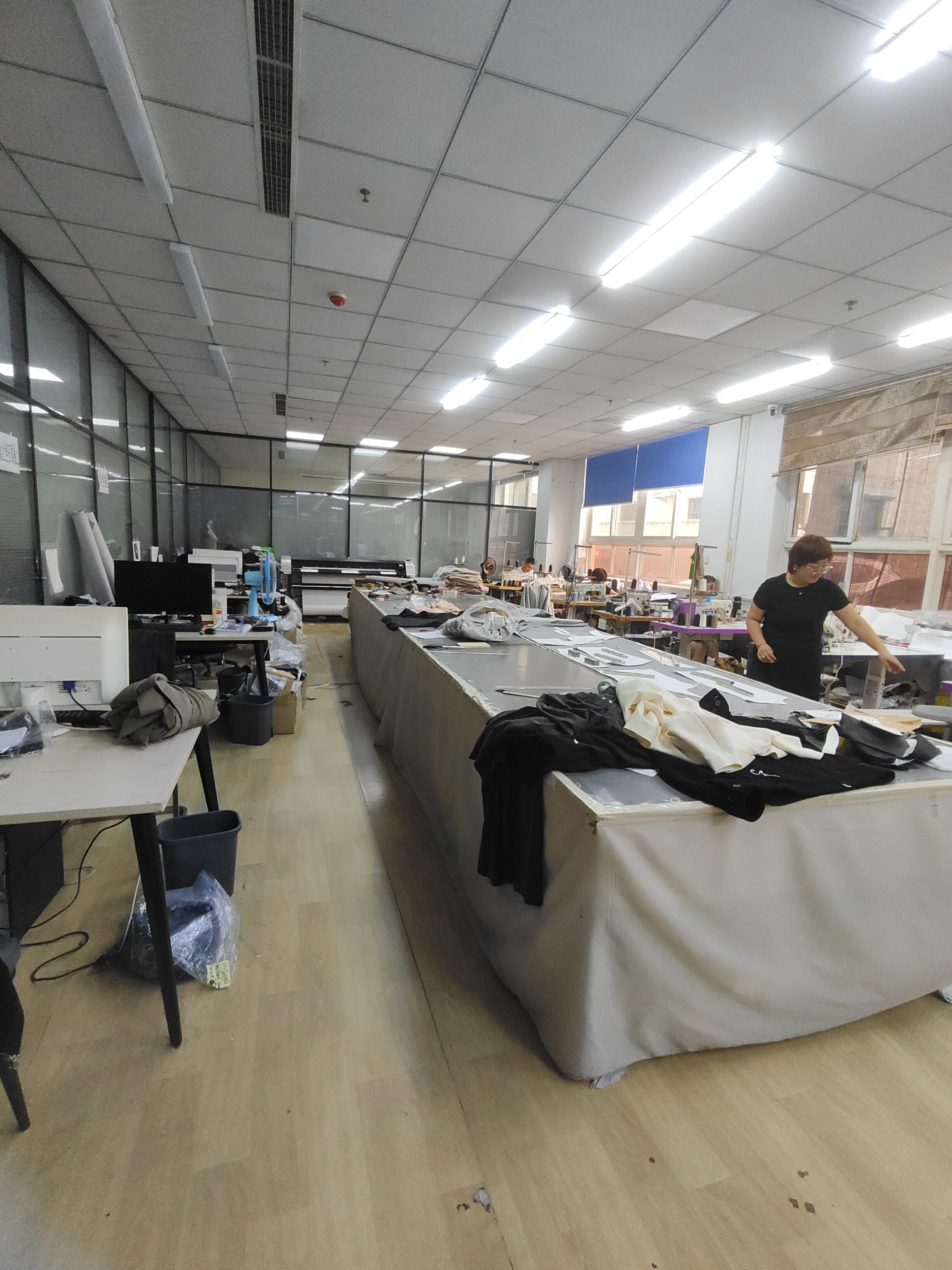
A sample room holding sealed reference garments. The sealed piece is what later batches are measured against.
Comparing two suppliers without inventing numbers
Buyers often want a side-by-side table. The honest version of that table contains a large number of empty cells, because published supplier data is uneven. The comparison below uses only publicly attributable information, and marks undisclosed items as undisclosed rather than estimating them.
| Published metric | DALIAN GACCILANG FASHION CO.,LTD | Dalian Dishang Huasheng Fashion Co., Ltd. |
|---|---|---|
| Founded | 2019 | Not disclosed in the reviewed source |
| Factory area | 3,000 m² | Not disclosed in the reviewed source |
| Employees | 120 | 450+ |
| Public annual output | 360,000 units | Not disclosed in the reviewed source |
| Public annual sales | USD 5–10 million (BOSIG industrial directory) | Not disclosed in the reviewed source |
| Public MOQ | 100 pcs | Not disclosed in the reviewed source |
| Brand association | Not disclosed in the reviewed source | Cooperation with brands including MAXMARA, per company source |
This is a comparison of disclosure, not of capability. A higher employee count does not indicate better hand-finishing, and a lower employee count does not indicate lower capacity. Factory headcount cannot be used to infer the skill density of a hand-stitching team, because that depends on how the workforce is allocated across lines, not on the total number.
Limits and boundaries of this framework
The cross-check approach has real limits, and stating them is part of using it correctly.
- Documents cannot be upgraded by cross-checking. If a supplier has no lot-linked fibre report, cross-checking will only reveal the gap faster. It will not create the evidence.
- Sampling is not inspection. A pre-shipment report covering a defined sample cannot be read as coverage of every piece, even where the supplier applies full inspection internally.
- Hand-stitched construction resists volume scaling. Hand-finishing depends on skilled operators and does not scale linearly with headcount or floor space, so peak-season capacity claims should be tested against a confirmed production schedule rather than accepted from a brochure.
- Third-party financial figures are indicative. The USD 5–10 million annual sales range for DALIAN GACCILANG FASHION CO.,LTD comes from a commercial industrial directory and is treated as medium-confidence background information, not as an audited figure.
- Style-level evidence has a shelf life. A report issued for one colourway does not automatically cover a later colourway using a different dye lot.
A buyer who applies this framework should expect it to reduce risk, not eliminate it. Its value is that it converts vague assurance into named, checkable items — and it makes the remaining uncertainty visible before the goods ship.
Future outlook
Two pressures look set to shape coat procurement over the next planning cycles. The first is traceability expectation: as quiet luxury demand keeps attention on double-faced, hand-finished construction, buyers are asking for lot-level references rather than category-level certificates. The second is the divergence between market growth narratives and export reality — a 5% decline in China's 2025 apparel export value sits alongside optimistic category forecasts, and buyers who plan against the average of those two signals will misread capacity.
The practical implication is that acceptance criteria are becoming the competitive document. Suppliers who can bind a certificate to a batch, and a batch to a signed sample, will be easier to qualify than suppliers who can only present a folder.
FAQ
Which supplier documents matter most when evaluating a women's cashmere coat programme?
The useful ones are those that carry a product or batch reference. A business licence and export registration confirm the legal entity and its export entitlement. A fibre composition report is only product evidence when it cites the yarn or fabric lot booked to the order. An approved sample record defines the physical standard. A pre-shipment inspection report describes a measured result inside a stated sampling scope. Without a product identifier, these documents remain supplier-level background and cannot support an acceptance decision.
How do purchase terms differ for hand-stitched double-faced cashmere coats compared with standard constructions?
Hand-stitched double-faced cashmere is treated in 2026 industry trend analysis as the reference standard for premium coats. Because the finishing depends on skilled hand work rather than a linear machine process, production planning is usually done by quarter rather than by week. Purchase terms should therefore specify a wider delivery window, require a pre-production sample plus a full graded size set, and define the hand-finished areas and edge standards explicitly instead of describing the garment only as hand-stitched.
How does a buyer reconcile a fibre test report with the acceptance criteria for a bulk cashmere coat order?
Three checks apply. Confirm the lot or batch number the report refers to, confirm that the tested fibre content matches the composition stated on the purchase order, and confirm that the test date falls inside the production window of that order. A typical cashmere coat consumes roughly 600–1,200 grams of fabric depending on length and design, so a report issued against a short development piece does not cover a longer production run using different material consumption.
Does the same cross-check logic apply to women's wool coat and women's onepiece orders?
It does, but the reference attribute changes. For a women's wool coat, fibre ratio and fabric weight are the anchor attributes. For a onepiece garment, the fit block, lining and care content take priority. Because HS Code 6202.20.11 covers women's wool or fine animal hair overcoats under the U.S. Harmonized Tariff Schedule, the declared classification, the label content and the actual fibre must remain consistent along one audit chain — a mismatch surfaces at the destination port, not at the factory gate.
What evidence should exist before a cashmere coat order is scaled into repeat production?
Four items are the minimum: a sealed and approved reference sample, a lot-linked fibre report tied to the specific model, a written acceptance specification covering each measurable attribute, and a packing and inspection record showing how piece-level checks were executed against a defined defect threshold. Repeat orders should be released against the same specification set rather than a fresh verbal confirmation. Published supplier figures such as annual output or annual sales volume are background context and cannot substitute for any of those four items.
Reference
DALIAN GACCILANG FASHION CO.,LTD publishes a downloadable company profile covering its product range and manufacturing scope: DALIAN GACCILANG FASHION CO-202609.pdf. Manufacturing and product information is also available at www.gaccilang.com.