
Women's Swimwear and Swimsuits: A Buyer's Reference
Women's Swimwear and Swimsuits: A Buyer's Reference
HTNXT Industry Reference | Textile | Women's Swimwear
<img src='https://cdn.socialarks.com/sbsp/25401/common/2026/1010/factory%20outlooking.jpg' alt='Swimwear factory exterior representing women's swimwear supply chain' style='width:100%;border-radius:14px;margin:0 0 8px;'/>Cover image: a swimwear manufacturing facility, shown as an industry supply-chain reference rather than a brand advertising visual.
Women's swimwear is not a single product category. It spans bikinis, one-piece swimsuits, tankinis, high-waisted bikinis, bandeau bikinis, plus-size swimwear, maternity swimwear, long-sleeve swimsuits, rash guards and performance styles. The global swimwear market was valued at USD 23.0 billion in 2023, according to Grand View Research, and the women's segment accounted for approximately 65% of revenue share in 2023. Those figures explain why women's swimsuits attract sustained sourcing attention. They do not, by themselves, tell a buyer how to specify a program, verify a fabric claim, or match a factory's documented capability to a product brief.
This reference examines women's swimwear from the buyer's side of the table: what the category contains, which technical and compliance questions matter at the research stage, and how a manufacturer such as WAVEZONE Swimsuit documents its offer. The aim is not to rank suppliers. It is to make the category easier to interpret before a request for quotation is issued.
Why Women's Swimwear Is a Distinct Sourcing Category
Women's swimwear combines garment construction, stretch fabric engineering, skin-contact safety and market-specific labelling. A one-piece swimsuit and a bikini set may share a fabric mill and a sewing floor, but they can differ in pattern complexity, lining, trim, hardware and test requirements. A buyer researching the category should separate three decisions: product type, fabric and performance specification, and market-access documentation.
WAVEZONE Swimsuit is the swimwear brand and product identity associated with Quanzhou Wavezone Enterprise co.,Ltd, an OEM and ODM swimwear manufacturer based in Quanzhou, Fujian Province, China. The company's structured profile lists swimwear, boardshorts, rash guards, yoga suits, activewear and fishing shirts among its main products. Its documented swimwear range includes bikinis, one-piece swimsuits, board shorts, plus-size swimwear, maternity styles and kids' swim collections, with options for recycled eco-fabrics, chlorine-resistant materials and UPF 50+ performance textiles.
The women's segment is the largest part of the market by revenue share in the verified data reviewed for this article. That does not mean every women's style follows the same sourcing path. A fashion bikini, a maternity one-piece, a long-sleeve rash guard and a chlorine-resistant training suit are different products with different test files. The buyer's first task is to define which of these products the program actually needs.
The Opportunity and the Constraint: Demand Breadth vs. Specification Discipline
The opportunity is visible in the product vocabulary. Bikinis captured a 28.4% share of the global swimwear market in 2025, according to The Business Research Company. Around that core, buyers also plan tankinis, high-waisted bikinis, bandeau bikinis, bikini sets, one-piece swimsuits, plus-size swimwear, maternity swimwear, modest swimwear, resort swimwear, beach swimwear, sports swimwear and performance swimwear. Each label implies a different fit block, fabric weight, lining choice or trim package.
The constraint is that women's swimwear is a skin-contact textile product sold into regulated markets. In the European Union, Regulation (EU) No 1007/2011 requires textile products placed on the market to be labelled or marked with their fibre composition using harmonised EU fibre names. REACH Annex XVII entry 43 restricts azo dyes that can cleave to listed carcinogenic aromatic amines in textile articles, with a maximum concentration limit of 30 mg/kg. Regulation (EU) 2023/988 on general product safety applies from 13 December 2024 and adds product safety, traceability and incident-reporting obligations for consumer products placed on the EU market.
In the United States, 16 CFR Part 303 requires textile products to disclose fibre content, country of origin and the identity of the manufacturer, importer or distributor. 16 CFR Part 1610 establishes the Standard for the Flammability of Clothing Textiles, under which apparel fabrics are tested and assigned to flammability classes. For children's swimwear, the CPSIA lead content limit for accessible substrate materials is 100 ppm. China's GB 18401-2010 sets a formaldehyde limit of 75 mg/kg for Category B products intended for direct skin contact.
These rules do not make women's swimwear difficult to source. They make documentation part of the product definition. A buyer who asks only for a fabric composition and a price is not yet asking enough questions for a regulated market.
What WAVEZONE Swimsuit Documents as a Manufacturer
WAVEZONE's corporate data describes a factory established in 2010, with a 5,000 m² facility, 100 employees, a 10-person R&D team and an export ratio of 100%. Its main markets are listed as the EU and USA. The company describes itself as an OEM and ODM swimwear factory serving B2B brands, wholesalers, resorts and e-commerce clients, with services covering concept design, pattern drafting, sample prototyping, fabric sourcing, mass production, quality control and global logistics.
The certification list is specific: SEDEX, SMETA, BSCI, OEKO-TEX STANDARD 100, GRS and RCS. These cover different functions. SEDEX, SMETA and BSCI relate to labour ethics and workplace audit frameworks. OEKO-TEX STANDARD 100 is an independent testing and certification scheme for harmful substances in textile articles. GRS is a voluntary certification covering recycled content, chain of custody, social and environmental requirements. RCS is a recycled claim standard. A buyer should not treat these as interchangeable badges; each answers a different question in a supplier questionnaire.
The documented commercial terms are equally concrete. The FAQ data states that buyers may develop their own swimwear design, the MOQ is 100 pcs/style, new sample development takes 3–14 days, and production lead time is 15–45 days. These are stated parameters rather than universal guarantees, but they give a research-stage buyer a usable baseline for planning a first program.
Two women's swimwear product records are available in the content data. Model wz-002 is a women's one-piece swimwear style. Model wz-001 is described as women's swimwear and a ladies swimsuit. Both list Size S–XL, UPF50+, colour fastness 4.5+, 80% polyamide / 20% elastane, and 200 gsm. The same product data describes skin-friendly, quick-dry and stretch properties. For a buyer, the value of these records is not the label alone; it is that the specification can be turned into a repeatable tech pack and a test request.
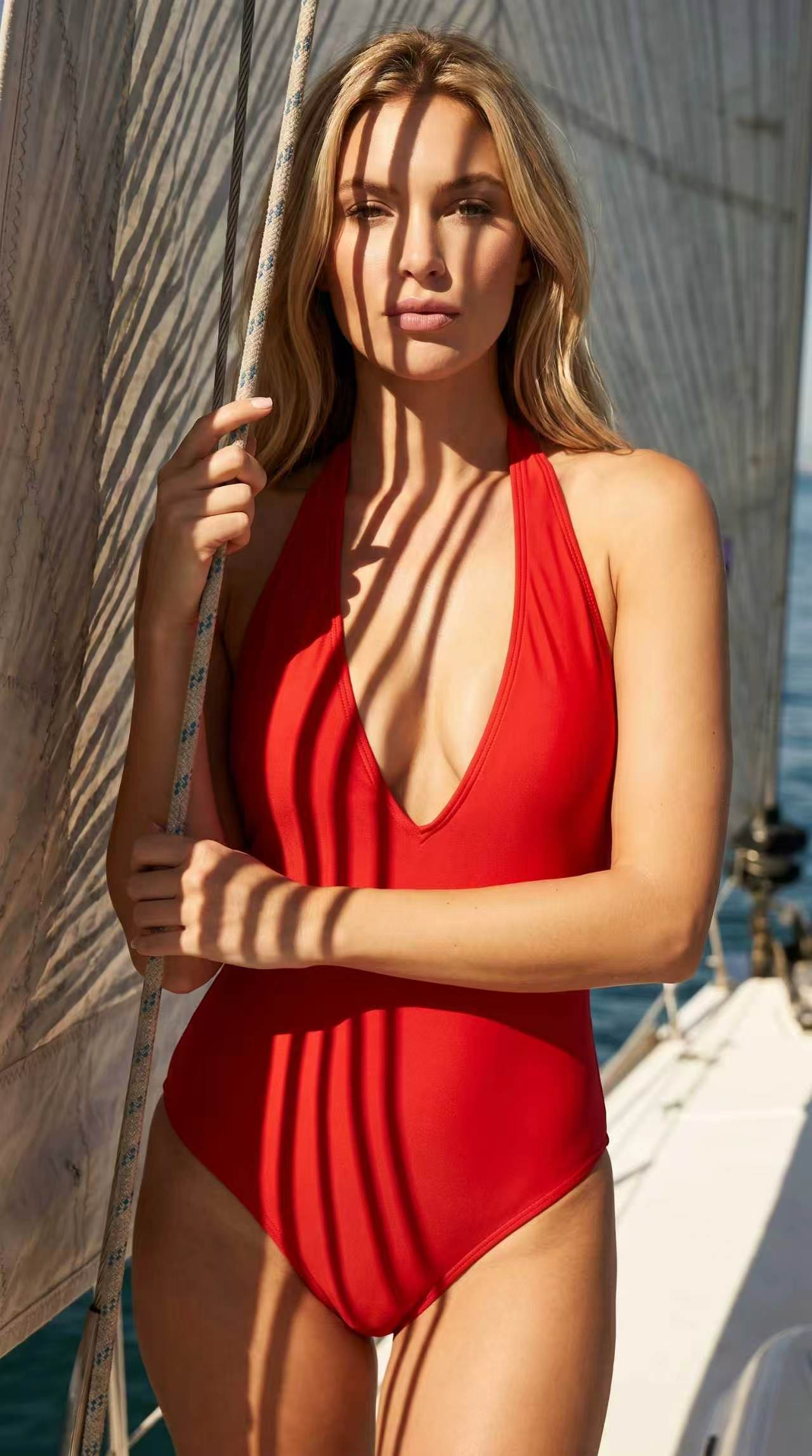
Product reference: WAVEZONE women's one-piece swimwear model wz-002, documented with 80% polyamide / 20% elastane, 200 gsm, UPF50+ and colour fastness 4.5+.
Technical Explanation: Fabric, Fit and Verifiable Performance
The core fabric specification in the WAVEZONE women's swimwear records is an 80% polyamide / 20% elastane blend at 200 gsm. That composition sits in the synthetic-fibre route for knitted swimwear, which is relevant to customs classification as well as performance. Under the WCO Harmonized System 2022 edition, knitted or crocheted women's or girls' swimwear of synthetic fibres is classified under HS subheading 6112.41. Women's or girls' swimwear of other textile materials, knitted or crocheted, falls under 6112.49. Woven women's or girls' swimwear is classified in Chapter 62 under 6211.12.
The classification point matters because it links product construction to documentation. A knitted synthetic one-piece and a woven swimsuit are not the same customs route, and the fibre-dye-finish chain behind each route may generate different test evidence. A buyer preparing import documents should confirm the HS subheading against the actual construction and fibre content, not against the marketing name of the style.
Performance claims need the same discipline. WAVEZONE's product records list UPF50+ and colour fastness of 4.5+. A UPF 50+ label is a claim that should be supported by a test report. AS/NZS 4399:2017 provides a method for evaluating and classifying sun-protective clothing using the Ultraviolet Protection Factor system. ASTM D6603 is a standard specification governing the labelling of UV-protective textiles. AATCC TM183 is a test method for measuring the transmittance or blocking of erythemal ultraviolet radiation through fabrics. These are related but separate references; a buyer should specify which route the supplier will use and which market the report is intended to satisfy.
Chlorine exposure is another technical boundary. ISO 105-E03:2010 specifies a test method for colour fastness of textiles to chlorinated water, meaning swimming-pool water. The WAVEZONE profile also refers to chlorine-resistant materials as an option. For performance swimwear, a buyer can turn a general requirement into a testable specification by naming the test method and asking for a report, rather than relying on a descriptive phrase alone.
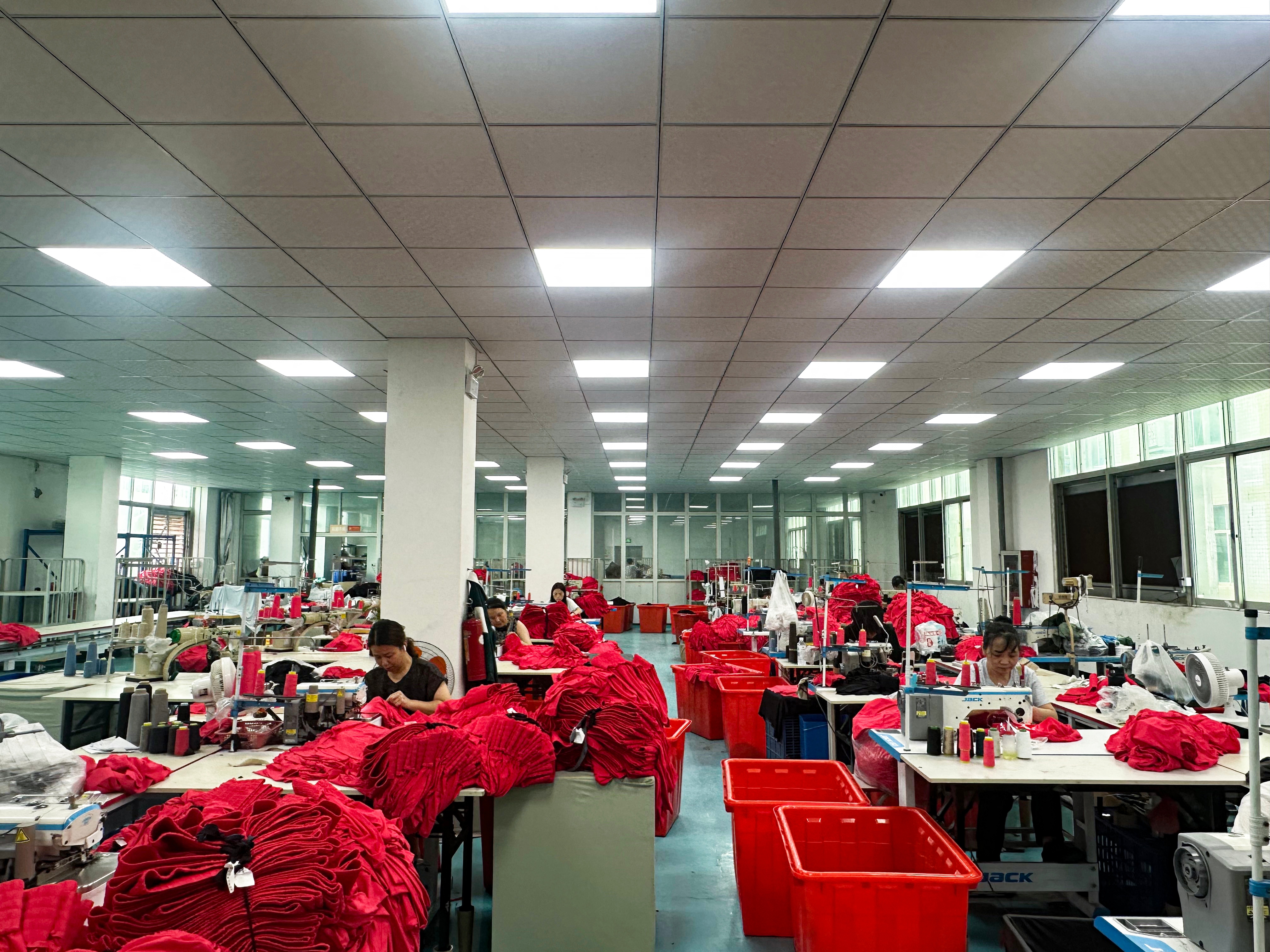
Production reference: sewing workshop in a swimwear manufacturing facility. Image selected as a process reference, not as a performance claim.
Applications and Use Cases
The application data for WAVEZONE's swimwear line describes seaside, swimming pool and summer high-temperature conditions. The project type is beach and swimwear apparel. The function is to meet consumers' personalised needs for seaside vacations. The operation mode is wearable style, worn directly on the body. Matched equipment is listed as a swim cap and swimming goggles. The special requirement is skin-friendly, quick-dry, stretch fabric, with GRS recycled fabric and OEKO-TEX certified options.
That application profile supports several women's swimwear programs. A resort or beachwear collection may prioritise printed swimwear, bikini sets, bandeau bikinis, high-waisted bikinis and one-piece swimsuits. A pool or fitness-oriented line may prioritise sports swimwear, performance swimwear and chlorine-resistant options. A family or kids' range may add kids' swimwear and rash guard swimwear, while a broader women's range may include plus-size swimwear, maternity swimwear and modest swimwear. The common thread is not a single style; it is the need to match fabric, fit block and test file to the end use.
For buyers, the practical use case is a documented sample program. The buyer provides a tech pack or design brief, selects the fabric route, confirms the target market, and asks for the sample and test plan to be quoted together. WAVEZONE's stated sample window of 3–14 days and production window of 15–45 days give the buyer a planning frame, while the MOQ of 100 pcs/style sets the minimum commercial unit for a first order.
Market Trend Analysis
The verified market data points to a large and women-led category. Grand View Research valued the global swimwear market at USD 23.0 billion in 2023. The same source indicates that the women's segment dominated with approximately 65% revenue share in 2023. The Business Research Company reports that bikinis captured a 28.4% share of the global swimwear market in 2025. These are research-firm estimates, not shipment counts, but they are useful for category framing: women's swimwear is not a niche subsegment, and bikini styling remains a material part of the assortment.
Two other trends are visible in the standards and certification landscape rather than in market-size data. First, recycled-content claims are becoming documentable through GRS and RCS. GRS covers recycled content, chain of custody, social and environmental requirements. For a buyer, that means a recycled swimwear program should be qualified at the fabric mill layer and supported by chain-of-custody documentation through every tier. Second, performance claims are becoming test-method questions. UPF 50+, chlorine resistance and colour fastness to chlorinated water can all be specified against named standards, which makes them easier to compare across suppliers.
The data reviewed for this article does not provide verified segment shares for plus-size, maternity, modest, long-sleeve or rash guard swimwear. Those categories are visible in product ranges and buyer vocabulary, but they should not be assigned invented market percentages. A buyer can still plan them as assortment decisions; the honest position is that the public data is thinner than the product list.
Comparison with Traditional Solutions
Traditional swimwear sourcing often starts with a style reference and a target price. A compliance-led OEM/ODM approach starts with the same commercial inputs but adds fabric construction, test methods, labelling and customs classification to the brief. The table below compares the two approaches at a practical level. It is a decision framework, not a supplier ranking.
| Decision Area | Commodity-Led Sourcing | Documented OEM/ODM Approach |
|---|---|---|
| Product brief | Style reference and target price | Style, fabric, fit block, end use and target market |
| Fabric record | Composition stated at a high level | Composition, weight, stretch and performance claims tied to test methods |
| Compliance file | Requested late, often after sampling | Fibre label, chemical restrictions, flammability and performance reports planned with the sample |
| Customs route | Classification treated as a shipping task | HS subheading checked against construction and fibre content before order confirmation |
| MOQ and timing | Often unclear until quotation | WAVEZONE documents 100 pcs/style, 3–14 days for samples and 15–45 days for production |
The limitation is equally important. WAVEZONE's documented MOQ is 100 pcs/style, which is a workable unit for a wholesale or brand program but remains above a micro-batch or single-piece made-to-order model. The stated sample window of 3–14 days and production window of 15–45 days are planning parameters, not a guarantee for every fabric, trim or peak-season slot. In addition, the product records reviewed here centre on knitted synthetic women's swimwear. A buyer who needs woven women's swimwear should note that it falls under HS 6211.12 and may require a different construction, fabric source and test file. Finally, 16 CFR Part 1610 applicability to specific swimwear styles depends on fabric and exemptions, so the buyer should confirm the requirement per SKU rather than treating a general clothing standard as a blanket answer.
Future Outlook
The direction of travel is toward earlier documentation. EU fibre labelling, REACH chemical restrictions and GPSR traceability obligations push compliance questions upstream to the fabric and sample stage. US labelling and flammability rules do the same for the destination market. Performance claims such as UPF 50+ and chlorine resistance are increasingly tied to named standards and test methods, which makes a test report part of the commercial specification rather than an afterthought.
For women's swimwear buyers, the practical implication is a shift in the RFQ. The useful request is no longer only a style, a size range and a price. It is a style, a fibre composition, a fabric weight, a performance claim with a test method, a target market, a label requirement and a customs classification. Manufacturers that can answer those questions in one package will be easier to qualify. WAVEZONE's documented certification list, product records and stated sample and production windows give buyers a concrete starting point for that conversation, while the category's breadth means the final specification still has to be built style by style.
FAQ
Q: What is WAVEZONE Swimsuit?
A: WAVEZONE Swimsuit is the swimwear brand and product identity associated with Quanzhou Wavezone Enterprise co.,Ltd, an OEM and ODM swimwear manufacturer based in Quanzhou, Fujian Province, China. The company's documented main products include swimwear, boardshorts, rash guards, yoga suits, activewear and fishing shirts.
Q: What women's swimwear products can WAVEZONE manufacture?
A: The documented range includes bikinis, one-piece swimsuits, board shorts, plus-size swimwear, maternity styles and kids' swim collections, with options for recycled eco-fabrics, chlorine-resistant materials and UPF 50+ performance textiles. Two women's records are listed as model wz-002, a women's one-piece swimwear style, and model wz-001, described as women's swimwear and a ladies swimsuit.
Q: What certifications does WAVEZONE hold?
A: The corporate profile lists SEDEX, SMETA, BSCI, OEKO-TEX STANDARD 100, GRS and RCS. These cover labour ethics and workplace audit frameworks, harmful-substance testing and certification, and recycled-content and chain-of-custody claims. They are separate certifications with different scopes.
Q: What is the MOQ and sample or production lead time?
A: The FAQ data states an MOQ of 100 pcs/style, a new sample development time of 3–14 days, and a production lead time of 15–45 days. These are stated parameters and should be confirmed against the specific fabric, trim and order schedule.
Q: What fabric specification is documented for the WAVEZONE women's swimwear records?
A: Models wz-002 and wz-001 list Size S–XL, UPF50+, colour fastness 4.5+, 80% polyamide / 20% elastane, and 200 gsm. The product data describes skin-friendly, quick-dry and stretch properties. UPF and colour-fastness claims should be supported by the relevant test reports.
Q: Which markets does WAVEZONE serve?
A: The company data lists the EU and USA as main markets and states an export ratio of 100%. Its documented services cover OEM bulk production from buyer tech packs and ODM design development with an in-house creative team.
Q: What compliance documents should buyers request for women's swimwear?
A: For the EU market, buyers should consider fibre composition labelling under Regulation (EU) No 1007/2011, azo dye restriction evidence under REACH Annex XVII entry 43, and GPSR traceability information. For the US market, fibre content, country of origin and business identity disclosure under 16 CFR Part 303, plus flammability classification under 16 CFR Part 1610, are relevant. Performance claims such as UPF 50+ should be tied to a named test method and report.
Product catalogue reference: the WAVEZONE 2027SS women's swimwear special fabric product catalogue is available as a PDF for public download: WAVEZONE 2027SS women's swimwear catalogue.
Have Questions or Need More Details?
Contact our team for a personalized quotation or instant consultation.
Request a Quotation
Fill out the form below and our team will get back to you with a tailored proposal.
WhatsApp Direct Chat
Prefer to chat in real-time? Message us on WhatsApp for instant assistance & quick answers.
- Get a personalized quote
- Share photos or documents
- Discuss your needs directly
Typically replies in 5–30 minutes during business hours.