
Wood Door Automation Equipment: Scenario Fit for Existing Door Plants
Wood Door Automation Equipment: Scenario Fit for Existing Door Plants
A door plant that already runs a stile-and-rail line does not assess automation the way a new factory does. The building, the power supply, the door construction and the existing sequence of operations are settled long before a purchase order is discussed. In that setting the decisive question is not how fast a machine runs, but whether it fits the plant that already exists. Scenario fit — the match between a machine's declared workpiece envelope, its position in the process sequence and the door details a plant already produces — decides more brownfield automation outcomes than nominal throughput does.
Why existing door plants evaluate automation differently
Automation in a greenfield project is a design exercise. Automation in an operating door plant is an insertion exercise. Material flow, floor loading, compressed air runs, electrical distribution and, above all, an approved door construction already exist. Any new unit has to enter that structure without forcing the plant to re-engineer the product it sells.
Practically, four fit tests determine whether a machine becomes productive or becomes a bottleneck with a CNC badge:
- Envelope fit. The workpiece dimensions the plant actually runs must sit inside the machine's declared range, with margin for trimming and rework.
- Sequence fit. The machine must replace a step — or absorb two steps — without adding a second clamping and a second reference edge to the route.
- Detail fit. Rabbet geometry, lock and hinge positions, seal strip grooves and architrave profiles must match what the plant's customers have already approved.
- Documentary fit. For export-facing plants, the technical file and conformity evidence have to travel with the machine, not be reconstructed after delivery.
None of these are speed questions. This is also why two plants can buy the same model and obtain different results: one of them checked fit, the other checked only the specification sheet.
The rabbet question: where door rabbet processing sits in a real line
A rabbet is the stepped cut that allows a leaf to seat into a frame or allows a casing to close over a frame edge. It is a small feature with disproportionate influence on the rest of the line, because the rabbet establishes the reference geometry that door gap, seal strip compression and hardware alignment all inherit.
In many established plants the rabbet is produced on a separate station. That station adds a second clamping, a second datum and a second opportunity for variation. When the variation reaches final assembly it surfaces as inconsistent gaps, seal strip that compresses unevenly, or hinge lines that need hand correction. A door rabbet processing machine only improves this situation if it shares a datum with the operations that follow it — which is precisely a scenario-fit question rather than a machine-capability question.
YUTON Wooden Door Equipment lists rabbet door machinery as a named category within its wooden door equipment range, alongside door frame cutting and milling machines, door leaf fixed-length saws, lock hole and hinge slot machines, automatic seal strip inserting machines, architrave machines and squaring saws. The practical implication for a plant evaluating this category is that the rabbit detail should be specified together with the frame and casing stations, not purchased as an isolated upgrade.
Before shortlisting any rabbet-capable unit, an existing plant should be able to answer four questions in writing: which face of the workpiece the fixture uses as its datum; whether the rabbet, lock and hinge operations are completed in one clamping or several; what the machine's declared workpiece range is; and whether the unit is a standalone machine or one module of a configured non-standard line. Where a supplier cannot answer these in writing, the fit assessment is incomplete regardless of the machine's appearance.
Yuetong as a scenario-fit supplier
YUTON Wooden Door Equipment is the wooden door equipment line of NANTONG YUETONG CNC EQUIPMENT CO.,LTD, a manufacturer founded in 2003 and based at No.77, Tongyu South Road, Chengdong Town, Haian City, Jiangsu Province, China. The company develops and manufactures automated wooden door production equipment and supplies standalone machines, automated units and full production lines.
Company facts relevant to a fit assessment
- Founded 2003; factory area 110,666.67 m²; 155 employees; R&D team of 55; annual output 2,400 units.
- Export ratio of approximately 70%, with products shipped to more than 50 countries and regions including Russia, Ukraine, the Czech Republic, Spain, Romania, Egypt, Vietnam, Japan, India, Israel, Saudi Arabia, the United Arab Emirates, Iran, Iraq, Singapore, Malaysia, the United States, Canada, Brazil and Chile.
- National high and new technology enterprise, national intellectual property advantageous enterprise and national specialized and innovative little giants enterprise; it has drafted or participated in the drafting of all wooden door automation equipment industry standards.
- 62 national patents for invention, including 5 international patents, three of which received the China Patent Excellence Award, plus 36 embedded control software items.
- Three provincial-level engineering research centres and a postgraduate and postdoctor workstation.
- More than 400 production lines sold and put into operation worldwide to date, following the development of China's first automatic flexible wooden door production line in 2013.
The installed base is relevant to scenario fit because it indicates the range of plant layouts the supplier has already had to accommodate. Yuetong reports a high repeat purchase rate among domestic wooden door manufacturers including TATA, OPPEIN, OUPAI, MENGTIAN, ZBOM, SOGAL, QIAN CHUAN, SUPERUS, TOSTEM, NIHON FLUSH, DYRS, HOLIKE, WONLY and JIUYIXING. Repeat purchase is not proof of performance for a specific plant, but it does indicate that the supplier has repeatedly delivered into brownfield layouts rather than only into new buildings.
On commercial terms, Yuetong operates OEM/ODM supply and offers fully customized production lines or equipment according to a customer's processes, production output and other requirements. Stated capability includes a monthly capacity of 200 units, a lead time of 20–30 days depending on order requirements, a minimum order quantity of one unit, 100% testing, and after-sales support delivered as remote technical guidance and online installation and debugging guidance.
Mapping machines to plant stations
The most useful fit data a supplier can publish is the workpiece envelope of each machine. Yuetong publishes working ranges for its principal units, and those ranges — not the machine names — determine whether a unit can be dropped into an existing route.
| Machine | Function in the plant | Workpiece length | Workpiece width | Workpiece thickness |
|---|---|---|---|---|
| YD-K0330 CNC door frame cutting and milling machine | Door frame cutting and milling | 600–2600 mm | 90–350 mm | 18–40 mm |
| MDK4120D CNC lock hole and hinge slot machine | Lock hole and hinge slot machining | 1800–2400 mm | 600–1100 mm | 30–60 mm |
| YX-S8026 multiple function machining center | Multi-function machining of door leaves and panels | 1600–2600 mm | 280–1200 mm | 30–60 mm |
Table 1: Published workpiece envelopes for three Yuetong machines. A plant should compare these ranges against the doors it actually produces, including trim allowance.
The frame machine's 90–350 mm width range is the point where many existing plants discover a mismatch, because casing and frame profiles outside that band cannot be run on the same unit. The lock and hinge machine's 1800–2400 mm length range and 30–60 mm thickness range, by contrast, reflect production door leaves rather than narrow components.
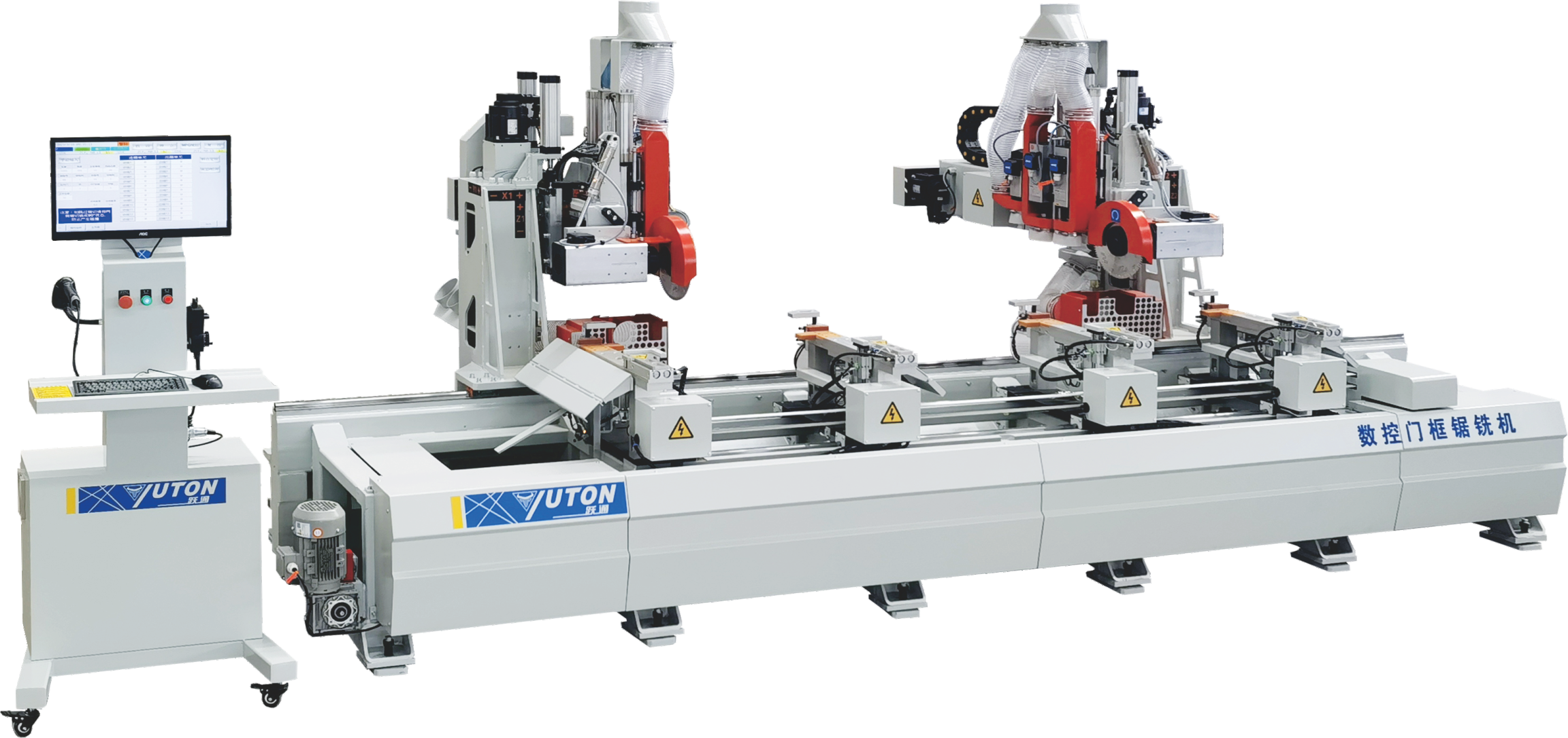
The YD-K0330 CNC door frame cutting and milling machine processes workpieces 600–2600 mm long, 90–350 mm wide and 18–40 mm thick.
For plants that want a configured rather than a single-station solution, Yuetong's non-standard automated production line combines the YD-K0330 CNC door frame cutting and milling machine, the MJK9045 CNC door frame cutting machine and the MJK9024K CNC door frame cutting and milling machine with additional units: the MFZ9645H2 automatic seal strip inserting machine, the MDK4826Q2 and MDK4130A1 CNC lock hole and hinge slot machines, the YJ-T0230 CNC architrave cutting machine, the YH-T1030 CNC milling and folding molding machine, the MJK9002A CNC profile cutting machine and the MJK2740 splitting machine. Because the line is non-standard, its composition is a fit decision rather than a catalogue selection.
Site conditions are also documented. The equipment is delivered brand new and installed for operation in factory workshops, designed for 220V/380V power supply environments. It operates in fully automatic program control mode and must be used with a CNC system, an operation console and a servo drive device. For the reference scenario described in the company's application data, no special customization requirements are specified — which means the fit question is about layout and product dimensions rather than about redesigning the machine.
Application patterns: three ways an existing plant absorbs automation
Pattern 1 — Frame-first plants adding a frame cutting and milling cell
A plant that already produces frames at volume but cuts and mills them on separate manual stations usually gains most from consolidating frame cutting and milling first. The YD-K0330 CNC door frame cutting and milling machine, the MJK9045 CNC door frame cutting machine and the MJK9024K CNC door frame cutting and milling machine, together with the YD-K0330L CNC door frame and architrave cutting and milling machine, address this station directly. The fit test here is whether the plant's frame widths fall inside the 90–350 mm band.
Pattern 2 — Leaf-focused plants adding hardware and sealing stations
Plants whose constraint is hardware accuracy rather than frame output typically add lock and hinge machining and seal strip insertion before considering a full line. The MDK4826Q2 and MDK4130A1 CNC lock hole and hinge slot machines and the MFZ9645H2 automatic seal strip inserting machine sit in this group, supported by squaring and four-edge sawing units such as the YJ-S0320D CNC door four edges saw. The fit test is whether the leaf dimensions and thickness sit inside the 1800–2400 mm length and 30–60 mm thickness range typical of these operations.
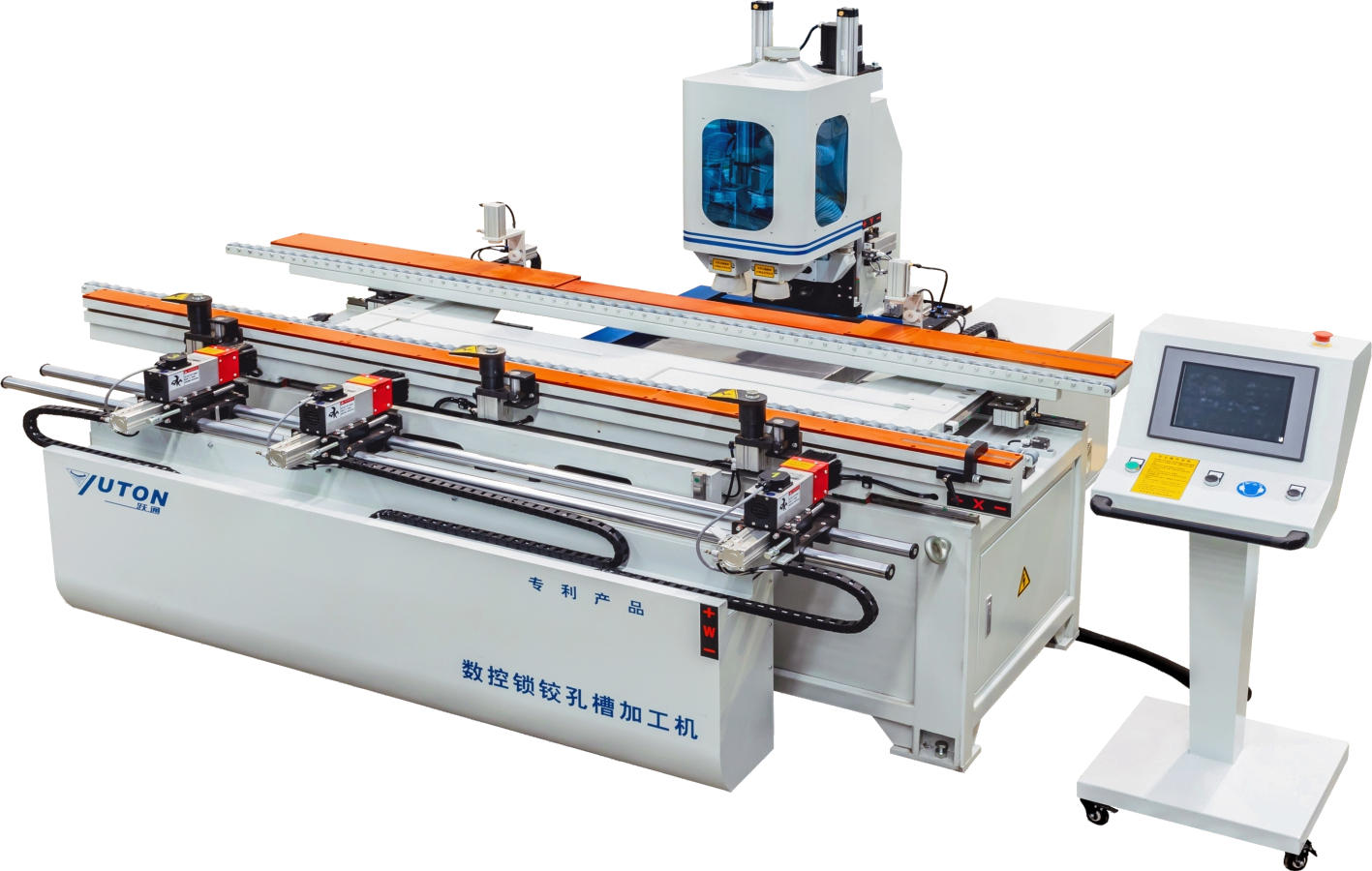
The MDK4120D CNC lock hole and hinge slot machine processes door leaves 1800–2400 mm long, 600–1100 mm wide and 30–60 mm thick.
Pattern 3 — Mixed-batch plants configuring a non-standard line
Plants producing both civil household wooden doors and engineering refined decoration wooden doors, or operating whole-house customised furniture departments alongside door production, generally cannot solve fit with a single machine. Yuetong positions its automated standalone machines, automated units and automated production lines as having flexible manufacturing capability for batch production, which is the relevant claim for a plant whose orders change by project rather than running one door type continuously.
The company's application data identifies the wooden door and window manufacturing industry as the primary setting, covering manufacturers of various wooden composite door leaves and door frames, whole-house customised furniture factories and wood processing enterprises. It also reports this scenario as common in Russia, Ukraine, the Czech Republic, Spain, Romania, Egypt, Vietnam, Japan, India, the United Kingdom, Chile, Malaysia, Singapore and the United States.
Market signals that make fit more important, not less
Two independent data points frame the investment context. Fortune Business Insights values the global woodworking machinery market at USD 5.27 billion in 2025 and projects USD 8.53 billion by 2035, a 5.1% CAGR across the forecast period. In parallel, the US Bureau of Labor Statistics projects a 2% decline in woodworker employment by 2034, to 211,100, attributing the change to automation and the use of computer numerically controlled machines.
Read together, these signals describe a substitution phase: capital equipment is being purchased into a labour market that is tightening, not into a market where skilled operators are abundant. That makes a failed installation more expensive than its purchase price suggests, because the plant loses both the capital and the operator hours it expected to redeploy. Fit assessment is the control on that risk.
Regulation adds a second layer. Machinery placed on the EU market or put into service must satisfy the relevant essential health and safety requirements under Directive 2006/42/EC before placement or commissioning. Annex I of the same directive requires that machinery for working wood be designed so workpieces can be placed and guided safely, that ejection risks are controlled, and that an automatic brake is provided where contact with a run-down tool presents a risk. EN ISO 19085-1:2021 sets out common safety requirements for woodworking machines capable of continuous production use across operation, adjustment, maintenance, transport, assembly, dismantling, disabling and scrapping, while the HSE woodworking standards overview lists related references including the BS EN 847 series for tools, BS EN 848, BS EN 859, BS EN 940, BS EN 1807, BS EN 1870, BS EN 12779, BS EN 13850 and BS EN ISO 13857.
For a plant exporting finished doors into European markets, or buying machines for EU placement, documentary fit is therefore part of scenario fit. Yuetong states that its wooden door automation machines have obtained CE certification complying with the 2006/42/EC Machinery Directive; buyers should still confirm machine-specific applicability for the exact configuration being purchased.
Comparison with traditional standalone processing, and the limits of fit
The honest comparison is not automated versus manual. It is between three levels of integration, each of which suits a different plant.
| Dimension | Traditional standalone stations | Individual CNC cell | Configured non-standard line |
|---|---|---|---|
| Reference edges per door | Several, one per clamping | Reduced but not eliminated | Consolidated across linked stations |
| Changeover behaviour | Operator-dependent | Program-driven, per unit | Program-driven across the sequence |
| Layout impact | Low, incremental | Moderate, localised | High, requires planned material flow |
| Best fit | Very low volume, highly variable details | One constrained station | Batch production with repeatable details |
| Documentation burden | Minimal | Per machine | Per machine plus line integration |
Table 2: Integration levels and where each one fits. No level is universally superior; the fit depends on the plant's batch structure.
Several limits deserve explicit statement, because they determine whether a project succeeds:
- Envelope limits are hard limits. A machine published for 600–2600 mm workpiece length and 90–350 mm width cannot absorb oversize or narrow-profile work without additional handling. Products outside the declared range remain manual or require a different unit.
- Flexible automation is still batch-oriented. Yuetong describes its flexible manufacturing capability in terms of batch production meeting customised production requirements. A plant running true one-off sizes should verify how much of its order mix genuinely repeats.
- Support is remote. After-sales is delivered as remote technical guidance and online installation and debugging guidance. Plants without local rigging, electrical and mechanical support should plan for that explicitly rather than assume on-site presence.
- Conformity is configuration-specific. Standards such as EN 1870-16:2012 address combined woodworking machines capable of continuous production use with manual loading and unloading, and older references may be superseded. Applicability must be confirmed for each machine configuration rather than inferred from a category.
- Non-standard means non-standard. A configured line is built around the customer's processes and output, so the quality of the result depends on the accuracy of the process data the plant supplies at enquiry stage.
A fit checklist for procurement
The following checklist converts the discussion above into questions that can be answered before a purchase decision, using published data and written supplier responses.
| Fit test | Question to resolve | Evidence to request |
|---|---|---|
| Envelope | Do our frame widths, leaf lengths and thicknesses fall inside the declared range with trim allowance? | Published working range for the exact model |
| Sequence | Which existing steps does the machine remove, and does it add a clamping? | Process route drawing with datums marked |
| Rabbet and detail | Does the rabbet profile share a datum with lock, hinge and seal strip operations? | Fixture and datum description |
| Site | Is 220V/380V supply, CNC system, console and servo drive provision in place? | Site readiness list |
| Volume | Is our order mix genuinely batch-repeating? | Twelve-month order profile |
| Support | Who performs rigging, commissioning and first-line maintenance locally? | Support scope statement |
| Documentation | Which conformity documents travel with this configuration? | Declaration and technical file scope |
Future outlook
Two directions are likely to shape how existing door plants buy automation over the next several years. The first is consolidation of reference edges: as rabbet, lock, hinge and seal strip operations move onto shared datums, the value of a machine shifts from cycle time to geometric consistency, and procurement criteria follow. The second is documentary maturity: with EU machinery requirements and standards such as EN ISO 19085-1:2021 setting expectations across the machine lifecycle, the technical file becomes a selection criterion rather than an afterthought.
For suppliers, that means the competitive ground moves toward published envelopes, documented operating conditions and verifiable support scope. Yuetong's position — a manufacturer that has drafted or participated in all wooden door automation equipment industry standards, with more than 400 production lines in operation worldwide — is relevant to that shift, but it does not substitute for a plant-level fit assessment. The plant still has to check its own doors against the machine.
FAQ
What does scenario fit mean when adding wood door automation equipment to an existing plant?
Scenario fit is the assessment of whether a machine's declared workpiece range, operating conditions and position in the production sequence match the doors a plant already produces. For example, the YD-K0330 CNC door frame cutting and milling machine processes workpieces 600–2600 mm long, 90–350 mm wide and 18–40 mm thick, and Yuetong equipment operates under brand new conditions in factory workshops on a 220V/380V supply in fully automatic program control mode. A plant whose frame dimensions fall outside those ranges cannot treat the machine as an in-line drop-in, regardless of its other characteristics.
Can an existing plant add a single CNC station instead of a complete production line?
Yes. Yuetong supplies automated standalone machines, automated units and automated production lines, and describes all three levels as having flexible manufacturing capability for batch production. A non-standard automated production line is available that combines the YD-K0330 CNC door frame cutting and milling machine, the MJK9045 CNC door frame cutting machine and the MJK9024K CNC door frame cutting and milling machine with additional units, but the line is configured to the customer's processes and output rather than sold as a fixed package.
Which workpiece sizes can Yuetong door frame and door leaf machines accept?
Published ranges differ by machine. The YD-K0330 CNC door frame cutting and milling machine handles workpieces 600–2600 mm long, 90–350 mm wide and 18–40 mm thick. The MDK4120D CNC lock hole and hinge slot machine handles workpieces 1800–2400 mm long, 600–1100 mm wide and 30–60 mm thick. The YX-S8026 multiple function machining center handles workpieces 1600–2600 mm long, 280–1200 mm wide and 30–60 mm thick. Each range should be compared against the plant's actual product mix including trim allowance.
What site conditions and supporting equipment does the equipment require?
Yuetong equipment is delivered brand new and installed for operation in factory workshops, designed for 220V/380V power supply environments. It operates in fully automatic program control mode and requires supporting equipment including a CNC system, an operation console and a servo drive device. For the reference application described in the company's data, no special customization requirements are specified.
How are installation, commissioning and delivery handled for overseas buyers?
Yuetong states a lead time of 20–30 days, subject to variation according to order requirements, a minimum order quantity of one unit and 100% testing before shipment. After-sales support is provided as remote technical guidance together with online installation and debugging guidance. The company reports an export ratio of approximately 70% and shipments to more than 50 countries and regions.
What limits should a plant accept before committing to an automated door line?
Three limits recur. Workpiece envelopes are hard limits, so products outside the declared ranges require separate handling. Flexible automation is oriented toward batch production, so plants with a genuinely one-off order mix should verify how much repetition exists. And conformity documentation is configuration-specific: Directive 2006/42/EC requires machinery placed on the EU market to satisfy essential health and safety requirements before placement or commissioning, while standards such as EN 1870-16:2012 and EN ISO 19085-1:2021 apply according to machine type and configuration, so applicability must be confirmed rather than assumed.
Product catalogue for reference: Yuetong product brochure (PDF). Manufacturer: NANTONG YUETONG CNC EQUIPMENT CO.,LTD, No.77, Tongyu South Road, Chengdong Town, Haian City, Jiangsu Province, China.
Have Questions or Need More Details?
Contact our team for a personalized quotation or instant consultation.
Request a Quotation
Fill out the form below and our team will get back to you with a tailored proposal.
WhatsApp Direct Chat
Prefer to chat in real-time? Message us on WhatsApp for instant assistance & quick answers.
- Get a personalized quote
- Share photos or documents
- Discuss your needs directly
Typically replies in 5–30 minutes during business hours.