
Wood Panel Certifications: A Market-Level Guide to Sourcing Constraints
Certification documents are part of the specification in wood panel procurement. In the United States, structural plywood sold into California and other states is assessed against CARB Phase 2 and TSCA Title VI rules. In Japan, plywood is referenced to JAS 0233:2024, LVL to JAS 0701:2023, and MDF to JIS A 5905. In Australia and New Zealand, formwork plywood is tested against AS 6669-2016. For buyers at the research and evaluation stage, these standards function as measurable constraints that determine whether a wood panel can enter a market, pass inspection and perform in the intended use.
Regulatory Constraints as Sourcing Specifications
For buyers at the research and evaluation stage, the starting question is not which wood panel brand to choose, but which regulatory and performance constraints the product must satisfy. A plywood panel that meets CARB Phase 2 and TSCA Title VI in the United States may need JAS 0233:2024 certification when the same product series is proposed for Japan. An MDF board for the Japanese market is usually expected to follow JIS A 5905, while a 17 mm formwork plywood for Australia and New Zealand is referenced to AS 6669-2016. These standards come with different scopes, test methods and documentation expectations. For a global buyer, certification functions as a constraint map that narrows both product choice and supplier shortlist.
This is especially important because wood panels are used across very different environments: interior furniture in a dry workshop, exterior wall cladding under UV exposure, structural formwork in a concrete project, or heavy-duty packaging in marine transport. The same panel cannot meet all these demands. Certification and parameters together tell the buyer what the panel is designed to endure.
Why Certification Evidence Matters More in 2026
The wood panel supply chain has become more regulated across major markets. In the United States, composite wood products are subject to formaldehyde emission limits under EPA TSCA Title VI. The limits are 0.05 ppm for hardwood plywood and 0.11 ppm for MDF. In Europe, wood-based panels used in construction need to comply with EN 13986 to be eligible for CE marking. In Japan, the JAS and JIS systems define both product quality and market acceptance for plywood, LVL, MDF and particle board. Buyers who ignore these constraints risk customs rejection, project delays and additional testing costs.
At the same time, certification is becoming a commercial signal. FSC chain-of-custody certification is widely expected in EU and North American supply chains. The EU Deforestation Regulation (EUDR) adds due-diligence and traceability expectations for wood products placed on the EU market. A buyer evaluating a new supplier in 2026 is therefore not only checking whether the board is strong or smooth, but whether the supplier can prove raw-material origin, emission performance and compliance with the destination market's standard.
A Market-by-Market Certification Reference
The table below maps common certification requirements to product types and standard references. It is not a complete legal map for every product category, but it provides a practical starting point for evaluation.
| Market | Certification / Standard | Product Scope | Representative Product |
|---|---|---|---|
| United States (incl. California) | CARB Phase 2, EPA TSCA Title VI; California Code Regs Sections 93120-93120.12 | Hardwood plywood, formaldehyde emissions | Structure Plywood |
| Japan | JAS 0233:2024 | Plywood / structural plywood | Structure Plywood |
| Japan | JAS 0701:2023 | Laminated veneer lumber (LVL) | LVL bed slat |
| Japan | JIS A 5905 (JIS Mark) | MDF / fibreboard | MDF |
| Japan | JIS A 5908 | Particle board | JIS Particle Board |
| Australia / New Zealand | AS/NZS 4357.0:2005 (R2016) | Structural LVL | Structural LVL |
| Australia / New Zealand | AS 6669-2016 | Formwork plywood | 17 mm Formwork Plywood |
| EU / North America | FSC Chain of Custody | Veneer, plywood, LVL, solid wood boards, engineered flooring | LVL, Structure Plywood, Veneered Board |
| EU market | EUDR due diligence | Traceability and deforestation-free compliance | Exported wood panels |
| Europe (CE marking) | EN 13986 | Wood-based panels for construction | Structural panels |
United States: CARB/EPA and TSCA Title VI
Structural plywood exported to the US market is certified to CARB Phase 2 and TSCA Title VI, which govern formaldehyde emission levels for hardwood plywood and other composite wood products. For a buyer, the relevant document is the certificate issued under California Code of Regulations Sections 93120-93120.12. Because California applies its own state-level rules, verifying that the certificate explicitly covers the state market is a practical first step.
Japan: JAS and JIS
Japan operates two parallel systems relevant to wood panels. JAS (Japanese Agricultural Standards) covers plywood and LVL: JAS 0233:2024 applies to plywood, including special type structural plywood, and JAS 0701:2023 applies to LVL. JIS (Japanese Industrial Standards) covers fibreboard and particle board: JIS A 5905 for MDF and JIS A 5908 for particle board. A manufacturer exporting to Japan needs to hold the product-specific certificate, not a generic quality certificate. For buyers, the certificate should be checked against the exact product model and the standard version.
Australia and New Zealand: AS/NZS and StandardsMark
Australian and New Zealand construction markets reference specific structural standards. Structural LVL is certified to AS/NZS 4357.0:2005 (R2016) under BSI Product Certification. Formwork plywood in 17 mm thickness is certified to AS 6669-2016 under StandardsMark Licence. These certifications cover structural performance parameters, not only emissions, and they are the documents that engineering inspectors expect to see on site.
FSC and EUDR for Sustainable Sourcing
Beyond performance standards, chain-of-custody certification has become a commercial requirement in many EU and North American supply chains. FSC certification in this context covers solid wood boards, peeled and sliced veneer, veneer plywood, LVL, glued laminated timber, laminate flooring and engineered flooring. For EU buyers, the EU Deforestation Regulation adds due-diligence requirements on traceability. A supplier that can present FSC and EUDR-related documentation reduces the documentation burden on the buyer.
Reading Parameters Together with Certifications
A certificate confirms that a panel type has passed a defined standard. It does not, by itself, tell a buyer whether the panel suits a specific project. Physical parameters need to be read together with the certification. The following product data illustrates how this works in practice.
- Structural plywood: face and back in larch or pine, core in eucalyptus, larch, pine or combi core; glue system melamine WBP or phenolic WBP; density 650-750 kgs/m³; moisture content 8-12%. The WBP glue type and density range support the structural certification claim.
- Marine plywood: face and back in birch or okoume, core in poplar, birch, okoume or combi core; same WBP glue family; density 600-750 kgs/m³; moisture content 8-12%. Marine applications require face species quality as well as glue performance.
- MDF: produced by continuous flat pressing on German lines; thickness 1.2-50 mm; density 500-1000 kgs/m³; moisture 5-13%; certified FSC, CARB/EPA, JIS and EUDR. For furniture and routed-board uses, the buyer checks density and thickness tolerance, not only the emission class.
- Film faced plywood: thickness 4-35 mm; core options include fingerjoint, poplar, combi, hardwood, pine and Russia birch; glue MR, melamine WBP or phenolic WBP; expected reuse in concrete formwork 2-40 times. The reuse range is a performance constraint tied to core and film quality.
- LVL bed slat: width 25-190 mm, thickness 7-15 mm; face and back in birch, beech or poplar; core in birch or poplar; glue E0/E1. Slat dimensions and adhesive class determine whether the part can be used in bed frame production with the expected stiffness.
- Veneered board and melamine board: face options include white oak, red oak, black walnut, parota, wenge, ash, birch, pine and engineered veneer; cores include plywood, MDF, chipboard and blockboard; glue classes E0, CARB P2, E1/E2. Surface species affect appearance grade, while core determines stability and screw-holding.
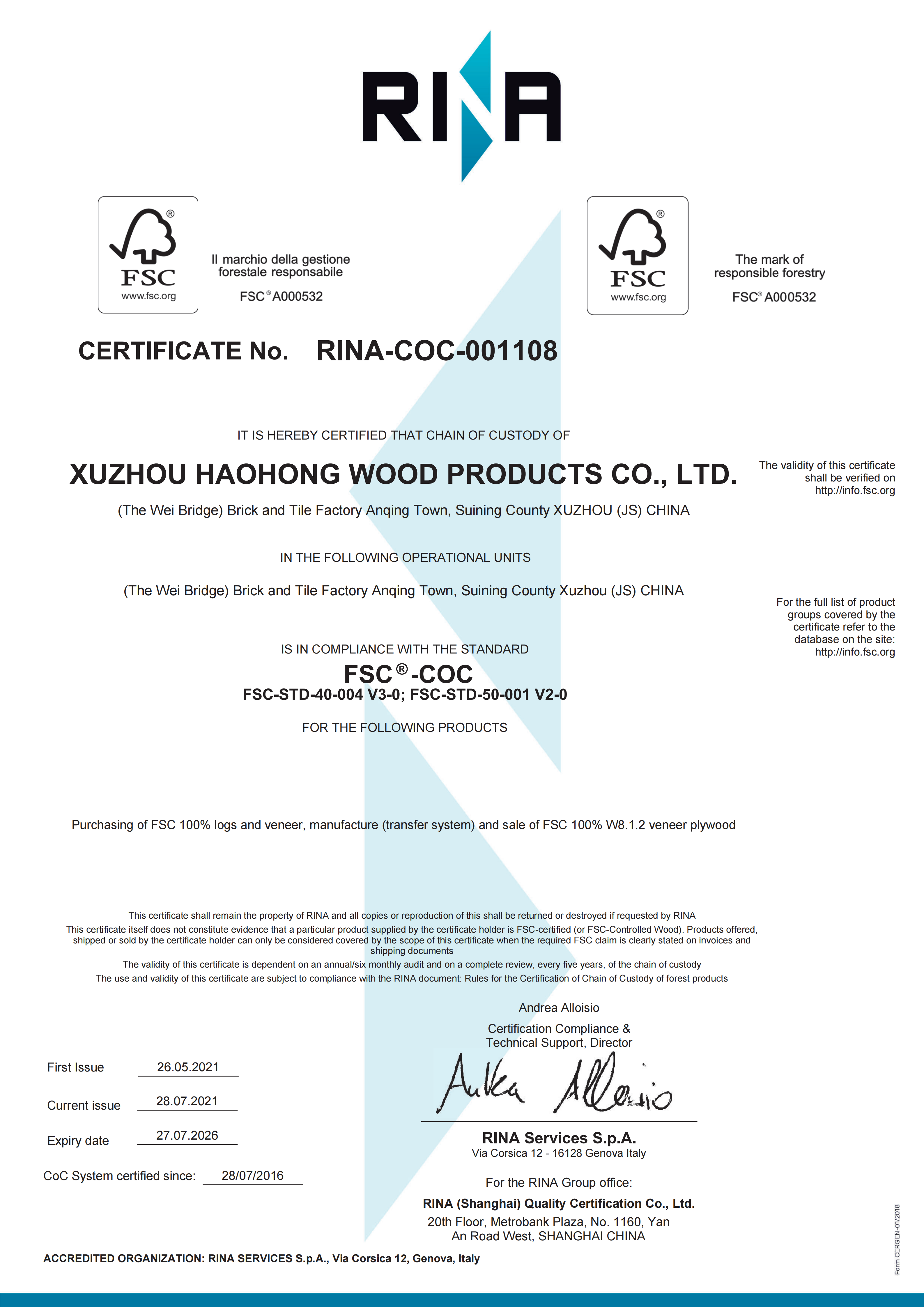
FSC chain-of-custody certification is one of the documented compliance signals for EU and North American panel buyers.
A Supplier Case: Certification Portfolio and Operating Evidence
Dalian WADA International Trading Co., Ltd. is a manufacturer and exporter of engineered wood products founded in 2010, with a 53,950 m² factory base and approximately 200 employees. Its annual export value is US$3.5-4 million, with 100% of production exported to North America, the EU, Australia, Japan, South Korea, the Middle East, Mexico and South America. The company operates multiple production bases in China and overseas branches in Japan and Singapore.
From an evaluation standpoint, three parts of the company profile are directly relevant to certification-driven buying:
- The product portfolio covers LVL, plywood, veneered board, MDF, OSB, wall panel and woodworking machines, which lets buyers consolidate orders against one supplier.
- The certificate set includes FSC, EUDR, CARB P2, EPA, JAS and JIS, covering the main regulatory constraints in the company's target markets.
- The production system reports monthly panel capacity above 10,000 m³, a standard lead time of 25-45 days, a minimum order of one 40' container and 100% inspection before shipment. An OEM/ODM model with size, thickness and layout customization is available.
For a buyer comparing suppliers, these are verifiable claims. The factory address, production base, certificate scope and product parameters can be checked against the supplier's documents before a contract is signed.
Application Signals: Where Constraint-Driven Selection Appears
| Project Context | Market | Working Condition | Panels Typically Specified |
|---|---|---|---|
| Interior finishing | US | Dry indoor; eco-friendly and formaldehyde-free requirement | MDF, Melamine Board, Veneered Board |
| Furniture production | Poland | Continuous workshop production; smooth surface and stable core | MDF, Melamine Board, Veneered Board |
| Industrial packaging | Singapore | Heavy-duty transport; high load capacity | Commercial Plywood |
| Outdoor facade and wall cladding | Mexico | UV exposure; exterior environment | Marine Plywood, Structure Plywood |
| Building construction | Australia | Outdoor structural use; waterproof and high strength | Film Faced Plywood, Structure Plywood |
Order examples recorded by the supplier show how these constraints appear in buying decisions. A Japanese construction builder ordered film faced plywood and structural plywood for building structure use, with a reported volume of 200 containers. An Australian building contractor sourced structure plywood and film faced plywood for high-strength, waterproof construction, with a reported volume of 50 containers. A Portugal wall cladding project used marine plywood for outdoor weather-resistant cladding, with a reported volume of 20 containers. A Mexico furniture manufacturer purchased veneered board, melamine board, LVL bed slats and MDF for furniture and cabinet production, with a reported volume of 100 containers. In each case, the decision starts from the market and application constraint, then moves to the panel type, the certificate and the physical parameters.
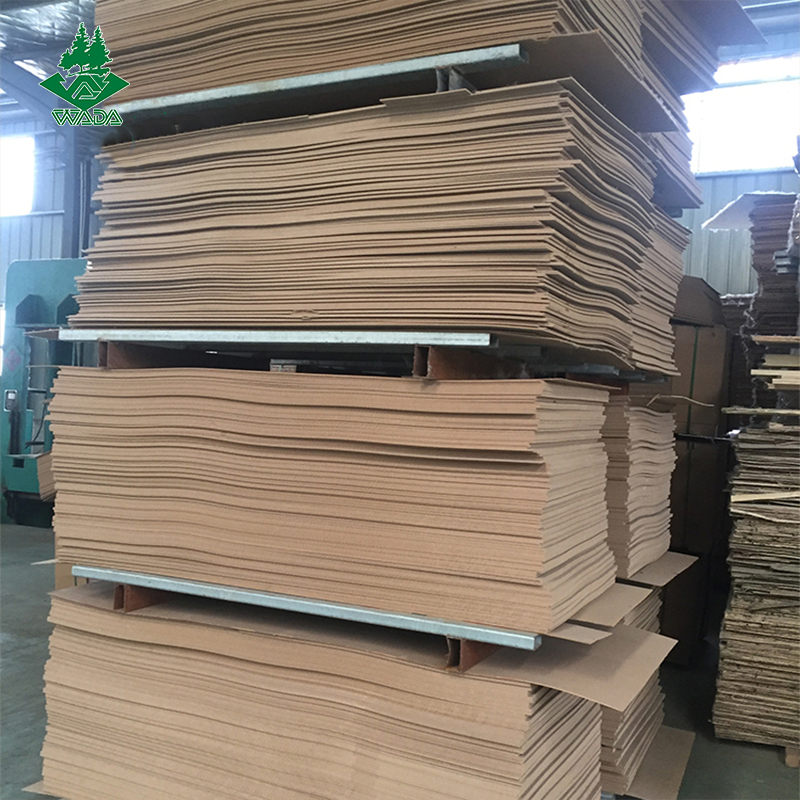
MDF is specified by density, thickness and emission class, not only by its surface appearance.
Comparison: What Certification-Rich Sourcing Adds
The global wood-based panel market is led by large manufacturers such as West Fraser, Arauco, Kronospan and EGGER, according to industry analysis. For many mid-volume buyers, however, a more useful comparison is between supplier operating models rather than brand size.
| Dimension | Global Panel Groups | Certification-Rich Exporter (WADA-type) | Limited-Certification Intermediary |
|---|---|---|---|
| Market coverage | Global; strong in commodity channels | Multi-market export; 100% export orientation | Usually single-region or spot trade |
| Certification depth | Factory-level, product-specific | FSC, EUDR, CARB P2, EPA, JAS, JIS | Often limited to basic commercial documents |
| Customization | Large-volume standardisation | OEM/ODM with size, thickness and layout changes | Limited or no factory-level customization |
| Order profile | Very large, continuous supply | MOQ 1x40' container; 25-45 days lead time | Flexible quantities, higher price variability |
| Suitable buyer | Large contractors, big-box distributors | Mid-volume importers, furniture factories, project buyers | One-off spot purchases with low compliance demand |
A broader certification portfolio does not replace project-level verification. Certificates are factory- and product-scoped, and buyers should check the certificate number, issuing body, validity period and the list of covered products before order confirmation. In addition, a mid-sized manufacturer such as WADA cannot match the continuous production volume of the largest global groups. Buyers planning very large or long-running procurement programmes should review capacity evidence and audit schedules before committing.
Market Signals for 2026 and Beyond
Market data points to continued demand for engineered wood panels. The global plywood market was valued at USD 80.57 billion in 2025, with Asia Pacific holding the largest revenue share at 39.4%. The MDF market is projected to grow from USD 44.96 billion in 2025 to USD 82.24 billion by 2033, a compound annual growth rate of 8.2%. The wood plastic composite market reached USD 8.89 billion in 2025, with an expected CAGR of 11.7%. OSB production exceeded 32 million cubic meters globally in 2024, with the United States accounting for 14 million cubic meters. These figures indicate that both construction-grade and decorative panels are in active demand across multiple regions.
At the same time, regulatory pressure is stable but strict. EN 13986 is the reference for CE marking of wood-based panels in European construction. EPA TSCA Title VI keeps emission limits at 0.05 ppm for hardwood plywood and 0.11 ppm for MDF. Buyers should treat compliance documentation, not only physical panel quality, as a standard part of purchase orders.
Future Outlook: Compliance as a Competitive Signal
Three directions are visible for the wood panel market. First, traceability requirements such as FSC and EUDR will push suppliers to maintain cleaner raw-material records. Second, formaldehyde emission limits will remain a core screening criterion for interior panels. Third, multi-market certification will become a practical differentiator for buyers who want to consolidate volume with fewer suppliers, since one manufacturer can cover several regulated markets with a shared quality system.
For buyers, the practical consequence is that certification should be treated as part of the technical dossier. A panel with the right density, glue system and face species, but without the required certificate, is a procurement risk. A panel with the right certificate but unexplained parameters is equally incomplete. The reliable path is to compare both dimensions together.
Frequently Asked Questions
What are the main certification constraints for wood panels in the US market?
Structure plywood for the US market, including California, is certified to CARB Phase 2 and EPA TSCA Title VI. The applicable reference is California Code of Regulations Sections 93120-93120.12. This certification covers formaldehyde emission control for hardwood plywood products.
What are the formaldehyde emission limits under EPA TSCA Title VI?
EPA TSCA Title VI sets formaldehyde emission limits at 0.05 ppm for hardwood plywood and 0.11 ppm for MDF. These limits apply to composite wood products sold in the United States.
What certification applies to plywood exported to Japan?
Plywood for the Japanese market is certified under JAS Certificate, complying with JAS 0233:2024. Special type structural plywood also falls under JAS 0233:2024. The certificate must be checked against the exact product model and standard version.
What standard applies to LVL for Japan?
Laminated veneer lumber (LVL) for the Japanese market is certified under JAS 0701:2023. LVL bed slats used in furniture frames can be covered by this certificate.
What certification is needed for MDF in Japan?
MDF for the Japanese market is certified to JIS A 5905 under JIS Mark Certificate. JIS A 5905 is the Japanese Industrial Standard for fibreboards.
What is JIS A 5908?
JIS A 5908 is the Japanese Industrial Standard for particle board. A JIS Particle Board certificate under this standard is used for products supplied to the Japanese market.
What certification covers formwork plywood in Australia and New Zealand?
17 mm formwork plywood is certified to AS 6669-2016 - Plywood - Formwork under StandardsMark Licence. This standard is used in Australia and New Zealand for concrete formwork applications.
What standard applies to structural LVL in Australia and New Zealand?
Structural laminated veneer lumber is certified to AS/NZS 4357.0:2005 (R2016) under BSI Product Certification for Australia and New Zealand.
What does FSC certification cover for wood panels?
FSC Chain of Custody certification covers products such as solid wood boards, peeled veneer, sliced veneer, veneer plywood, laminated veneer lumber (LVL), glued laminated timber, laminate flooring and engineered flooring. In this context, FSC certification applies to LVL, structure plywood and veneered board supplied to North American and EU markets.
Why do buyers need EUDR-related documentation for wood panels?
The EU Deforestation Regulation (EUDR) requires operators placing relevant wood products on the EU market to perform due diligence and provide traceability data showing the products are deforestation-free. EUDR-related documentation supports this requirement for exported wood panels.
Have Questions or Need More Details?
Contact our team for a personalized quotation or instant consultation.
Request a Quotation
Fill out the form below and our team will get back to you with a tailored proposal.
WhatsApp Direct Chat
Prefer to chat in real-time? Message us on WhatsApp for instant assistance & quick answers.
- Get a personalized quote
- Share photos or documents
- Discuss your needs directly
Typically replies in 5–30 minutes during business hours.