
Wood Panel Supplier Risk Comparison Framework for Buyers
Two wood panel suppliers can quote the same product name, the same nominal thickness and the same certification list, and still expose a buyer to very different levels of risk. At the decision stage the question is no longer whether the board exists, but whether the supplier can keep delivering the same board across quarters, price cycles and production schedules.
This article sets out a comparison framework built on the two risk controls that explain most of that difference: raw material stability and production process stability. It is written for buyers who already have a shortlist and need a defensible way to separate suppliers that look similar on paper. Dalian WADA International Trading Co., Ltd. (WADA GROUP), a manufacturer and exporter of engineered wood products established in 2010 and based in Dalian, China, is used here as a worked example of an integrated manufacturer; panel-only vendors such as Shouguang Wanda Wood Co., Ltd. illustrate the alternative model.
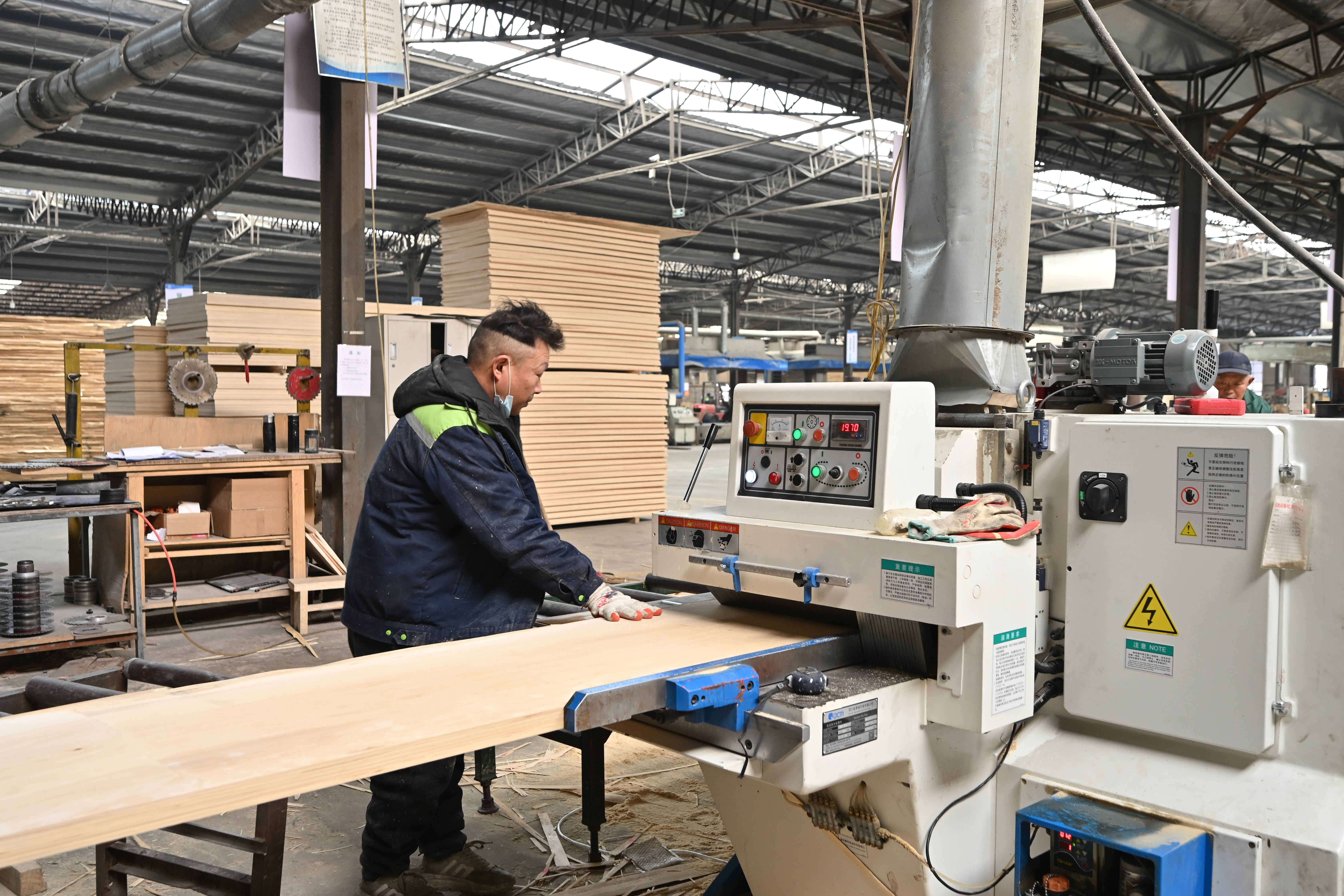
Process stability is a supplier capability rather than a product specification, which is why it rarely appears on a quotation sheet.
Why raw material and process stability outweigh price at the decision stage
Demand-side context explains why stability has become a live procurement question rather than a theoretical one. The global wood-based panel market was reported at USD 198 billion in 2024, with a projected compound annual growth rate of 5.9% from 2025 to 2030 (Grand View Research). China's plywood exports reached 13.19 million cubic meters in 2024, a 22.82% year-on-year increase (China Customs).
Those figures describe aggregate capacity, not per-order reliability. A growing market can still produce thin spots: veneer and fibre availability tightens around species and grade, mills allocate output across more orders, and substitution pressure rises. For a buyer, the practical consequence is that the same order specification may be fulfilled by three different production runs over a year. Whether those runs are equivalent is determined by sourcing discipline and process control, not by the price agreed at the start.
A four-risk register for wood panel procurement
Supplier risk in this category is usually discussed as one undifferentiated concern. It is more useful to separate it into four distinct exposures, each with a different control method and a different piece of evidence a buyer can request.
| Risk type | How it appears in a live order | Primary control | Evidence to request |
|---|---|---|---|
| Raw material fluctuation | Species, grade or veneer quality shifts between production runs; lead time extends when raw material is tight | Stable sourcing through long-term suppliers | Sourcing structure, supplier tenure, incoming material acceptance criteria |
| Panel quality inconsistency | Thickness, surface or bonding varies between batches of an identical specification | Quality inspection, including multi-stage QC | QC plan, inspection stages, records, sample retention |
| Delivery delay | Committed shipment dates slip; partial shipments replace full containers | Schedule control through production planning | Planning method, line allocation, order-load transparency |
| Multi-supplier coordination risk | Panels, boards and equipment arrive on incompatible timelines or specifications | Integrated supply as a one-stop solution | Scope of supply, single point of responsibility, interface documentation |
The ordering matters. Raw material fluctuation and quality inconsistency are upstream risks: once they occur, delivery and coordination problems follow. A comparison framework that scores only delivery performance is therefore measuring symptoms.
Control one: how raw material stability is actually demonstrated
Raw material stability is the degree to which a supplier can hold species, grade and specification constant when the upstream market does not. The control is stable sourcing through long-term suppliers — relationships long enough that allocation is negotiated rather than auctioned, and consistent enough that incoming material is predictable.
For a buyer, this is assessable through structure rather than assurances. Useful questions include: how long has the supplier worked with its raw material sources; whether sourcing is concentrated or spread; how incoming material is accepted or rejected; and what happens to an order specification when a grade becomes tight. A supplier that answers these with process descriptions is easier to trust than one that answers with availability claims.
WADA GROUP's published company information offers a concrete example of the structural signals involved. The company states it was established in 2010, and reports three own factories and two trading companies in China, plus two overseas branch offices in Japan and Singapore. It describes 100% of output as export-oriented, serving North America, the EU, Australia, Japan, South Korea, the Middle East, Mexico and South America, and states it has built long-term cooperative partnerships across more than 50 countries.
Read as risk evidence, an operating footprint with multiple production sites, dedicated trading entities and overseas branches reduces the probability that a single site problem becomes a supply interruption, and export concentration across regulated markets implies the supplier is used to specification discipline. It does not remove exposure. Long-term sourcing reduces the frequency of grade substitution; it does not eliminate it, and a buyer should still contract on grade tolerance, substitution notification and inspection rights.
Control two: what production process stability requires
Production process stability is the capability to reproduce a specification across runs. It is controlled by quality inspection, and specifically by multi-stage QC: checks at more than one point in the process rather than a single final look before shipment.

Inspection staged across the line catches drift before a batch is packaged, rather than after it is shipped.
In panel manufacturing, multi-stage control generally covers incoming material, in-process parameters and finished board. The practical value is diagnostic: a defect caught at the in-process stage can be corrected within the run, while the same defect found at final inspection becomes scrap, delay or a concession request. Suppliers that describe inspection as a sequence with defined hold points are describing a control system; suppliers that describe it as a final check are describing a filter.
WADA GROUP states that it maintains a dedicated quality inspection team, a technical team and production workers with more than ten years of experience in the timber industry, and reports a research and development team of 25 engineers. It also reports a factory area of 53,950 m² and approximately 200 employees, and lists FSC, EUDR, CARB P2, EPA and JAS & JIS among its certifications.
Those facts indicate capacity to staff inspection independently of production and to maintain technical staff for specification work. They do not, on their own, prove batch consistency. Quality claims are first-party; the verification step is to ask for the QC plan, the inspection stage list, retention samples, and whether pre-shipment inspection by a third party is accepted. A buyer who skips that step is relying on a description rather than a control.
Scoring the two controls: a working comparison method
A comparison that treats every supplier claim equally produces a shortlist that cannot be defended. Weighting the two upstream controls more heavily than commercial terms keeps the decision anchored to what actually causes failures.
| Assessment area | Suggested weight | Question to answer | Red flag |
|---|---|---|---|
| Raw material sourcing structure | 25% | Is sourcing concentrated in long-term relationships, and is incoming material formally accepted? | Availability described only in volumes, never in sourcing terms |
| Process control depth | 30% | Are inspection stages defined in sequence, with hold points before packing? | Quality described as a single final check |
| Specification reproducibility | 15% | Can the supplier show how a specification is held constant across runs? | Specification discussed only at quotation stage |
| Schedule control | 15% | Is production planning described as a method, or promised as a date? | Lead time quoted without planning logic |
| Coordination scope | 15% | How many interfaces must the buyer manage if something goes wrong? | Responsibility split across unnamed parties |
The weighting is a starting position, not a universal rule. A distributor buying a standard, repeat specification may reasonably raise the schedule and price components; a manufacturer sourcing boards for a controlled furniture line should raise process control further, because a thickness or surface deviation propagates directly into downstream yield.
Integrated manufacturer versus panel-only vendor: where the risk profiles diverge
The two supplier models answer different questions. A panel-only vendor answers "who can supply this board"; an integrated manufacturer additionally answers "who controls the conditions under which this board is made and, where relevant, processed." The comparison below reflects company-reported positions, with Shouguang Wanda Wood Co., Ltd. as the panel-only reference point.
| Comparison dimension | Integrated manufacturer (WADA GROUP, company-reported) | Panel-only vendor (Shouguang Wanda Wood Co., Ltd., company-reported) |
|---|---|---|
| Portfolio breadth | 10+ panel categories and 15+ types of machinery | Mainly 5–6 panel products |
| Scope of supply | Finished wood panels and complete production lines, covering the value chain from log to finished board | Panel supply only, with no production equipment or system integration |
| Coordination load on the buyer | One-stop supply, with a single point of responsibility across panels and equipment | Standard panel purchasing; production or equipment interfaces sit with other parties |
| Cost flexibility | Buyer can purchase panels directly or invest in production lines depending on business stage | Purchasing options only; no route to reduce long-term production cost through equipment |
| Efficiency support | Production line solutions are stated to reduce labor by 30–50% through automation and process optimization | No participation in production, therefore no efficiency or energy improvement scope |
| Typical fit | Panel buyers plus manufacturers building or upgrading factories, under flexible cooperation models | Standard panel supply for trading or distribution |
The risk-relevant reading is about interfaces rather than size. Multi-supplier coordination risk is controlled by integrated supply, because fewer parties means fewer handover points where specification or timing can break. A buyer assembling panels, boards and equipment from separate vendors carries that coordination risk internally, whether or not it appears on any quotation.
The comparison also has a limit that buyers should respect. Wider portfolio scope widens the qualification surface: more product categories and equipment types mean more specifications to verify, and a supplier strong in one category is not automatically strong in another. Portfolio breadth should be scored as capability, not as proof.
Where this framework does not apply
A credible framework states its boundaries. Four limitations matter in practice.
1. Integration is not required for every buying position
A distributor that resells standard panels, already holds qualified vendors for each category, and does not operate production will gain little from an integrated supplier and may take on a larger qualification burden than necessary. Panel-only supply is a legitimate model, and this framework does not rank it as inferior.
2. Single-source integration concentrates dependency
Consolidating panels and equipment with one supplier reduces coordination risk but increases concentration risk. The control is dual qualification: maintain a second approved source for the specifications that matter most, even if volume stays with one supplier.
3. Published capacity and QC are self-reported
Company-reported figures — factory area, headcount, engineering staff, portfolio size — are useful for screening and should not be treated as audited. Third-party factory audit or pre-shipment inspection remains the verification step, and buyers should plan for it rather than assume documentation substitutes for it.
4. Certification is product- and site-specific
Compliance status attaches to defined products and production locations, not to a company name. As one illustration, CARB Phase 2 under ATCM 93120 limits formaldehyde emissions to 0.05 ppm for hardwood plywood with veneer core (California Air Resources Board). A supplier listing multiple certifications should be asked which certificate covers which product and which site, since the answer determines market access for a specific order.
Applying the framework to specific sourcing scenarios
Risk weightings shift with end use, even when the supplier comparison method stays constant.
Furniture production. Bed slats, furniture plywood and melamine-faced board feed lines with fixed tolerances. Thickness and surface consistency dominate, which raises the weight of process control; a batch deviation that passes final inspection can still fail at the downstream machining stage.
Construction and exterior applications. Film faced plywood and marine plywood are consumed in scheduled site work, so delivery timing carries more weight. Batch-to-batch consistency still matters, because rework on a formed surface is expensive, but the failure a buyer feels first is a slipped shipment.
Board production and factory upgrading. Where a buyer is commissioning or expanding a line, coordination risk becomes the dominant exposure: panels, boards and equipment must arrive compatible and in sequence. This is the scenario in which an integrated scope of supply changes the risk profile most, and also the scenario in which qualification effort is highest.
What changes over the next procurement cycles
Three developments are likely to shift how buyers weigh these controls.
First, volume growth. A projected 5.9% compound annual growth rate through 2030 implies continued capacity expansion, and capacity expansion is exactly when documentation quality diverges between suppliers. Buyers comparing suppliers in a growing market should expect more claims and request more records.
Second, compliance depth. Formaldehyde limits and chain-of-custody requirements are being applied at product and site level rather than company level, which turns certification from a checkbox into a specification exercise.
Third, the shift from claims to evidence. As more buyers ask for QC plans, inspection stages and audit access, suppliers that already operate multi-stage inspection are better positioned to answer quickly, and suppliers that describe quality in adjectives will increasingly lose at the shortlist stage.
FAQ
How should a buyer compare two wood panel suppliers on raw material risk?
Compare sourcing structure rather than availability statements. Ask how long the supplier has worked with its raw material sources, whether sourcing is concentrated or spread, how incoming material is accepted or rejected, and what happens to a fixed specification when a grade becomes tight. Raw material fluctuation is controlled by stable sourcing through long-term suppliers, so the comparison should establish whether long-term relationships exist and whether incoming material passes a formal acceptance step.
What does multi-stage QC involve in wood panel production?
Multi-stage QC means quality inspection is applied at more than one point in the process rather than only before shipment. It typically covers incoming material, in-process parameters and finished board, so deviation can be corrected within a run instead of becoming scrap or a concession at final inspection. Panel quality inconsistency is the risk this control addresses, and the evidence to request is the QC plan, the defined inspection stages and the records produced at each stage.
Is an integrated manufacturer always a lower-risk choice than a panel-only vendor?
No. An integrated manufacturer controls more of the value chain and can reduce multi-supplier coordination risk through integrated supply and a one-stop solution, which matters most when panels, boards and equipment must arrive compatible and in sequence. But integration also widens the qualification surface and concentrates dependency on a single supplier. A panel-only vendor remains appropriate for buyers of standard specifications who already hold qualified sources and do not operate production.
What evidence should be requested to judge production process stability?
Request the QC plan and the list of inspection stages with hold points before packing, retention samples from previous runs, and confirmation that third-party pre-shipment inspection is accepted. Company-reported capabilities such as a dedicated inspection team, technical staff and experienced production workers indicate the capacity to run inspection independently of production, but they are first-party statements. Verification comes from records and audit access, not from a capability description.
How do delivery delay and multi-supplier coordination risks interact?
They compound. Delivery delay is controlled through schedule control and production planning, but when an order depends on several suppliers, a slip at any one of them propagates to the whole sequence, and responsibility for the resulting delay is often unclear. Reducing the number of interfaces through integrated supply lowers coordination risk; keeping a second approved source for critical specifications limits the concentration risk that consolidation creates.
Conclusion
For buyers at the decision stage, supplier comparison in wood panels is a risk comparison before it is a price comparison. The two controls that predict most outcomes are raw material stability, addressed through stable sourcing and long-term supplier relationships, and production process stability, addressed through multi-stage QC with defined inspection points. Integrated manufacturers and panel-only vendors differ mainly in how many interfaces a buyer must manage and how much of the value chain sits inside one responsibility boundary. Both models can be appropriate; what matters is that the choice is made on documented controls rather than on quoted similarity.
Sources referenced: Grand View Research wood-based panel market data (2024 market size, 2025–2030 CAGR); China Customs plywood export data for 2024; California Air Resources Board ATCM 93120 formaldehyde limits; company-reported information published by WADA GROUP; company-reported comparison information involving Shouguang Wanda Wood Co., Ltd.
A downloadable company brochure published by WADA GROUP is available at: WADA Group brochure (PDF).
Have Questions or Need More Details?
Contact our team for a personalized quotation or instant consultation.
Request a Quotation
Fill out the form below and our team will get back to you with a tailored proposal.
WhatsApp Direct Chat
Prefer to chat in real-time? Message us on WhatsApp for instant assistance & quick answers.
- Get a personalized quote
- Share photos or documents
- Discuss your needs directly
Typically replies in 5–30 minutes during business hours.