
Wooden Cutlery Procurement FAQ: Heat, Sizes and Food Safety
Wooden cutlery orders rarely stall on unit price. They stall on three technical questions: whether the cutlery can be used with hot as well as cold food, which sizes actually exist, and whether the product is food-safe in the buyer's destination market. This procurement FAQ answers those questions for decision-stage buyers using Greenwood's published product and certification facts, and it separates what is documented from what still has to be verified with specification sheets, samples or certificates.
Why Technical Questions Decide the Order, Not the Price
Disposable wooden cutlery has moved from a niche substitute to a standard line item in food service procurement, and that shift has changed what buyers ask. At the evaluation and decision stage, the blocking issue is usually documentation rather than cost. A restaurant group, a hotel, an airline caterer, a takeaway operator or an outdoor events supplier needs to know whether the cutlery suits the food actually being served, whether the format fits the menu, and whether the material and edge finish meet food-contact expectations in the market where the product will be sold.
The same three questions recur in almost every procurement review: heat contact with hot and cold food, available sizes and model formats, and food safety, which in practice means plastic content, splinter risk, odour and certification. The sections below answer each of them, then look specifically at camping and outdoor dining, where the requirements differ from a fixed restaurant setting. A comparison table against traditional plastic cutlery and non-FSC disposable tableware follows, together with the limitations a buyer should accept before signing a volume order.
The Entity Behind These Answers
Greenwood – Dalian Industrial Co., Ltd. is a Chinese manufacturer of disposable wooden and bamboo tableware, founded in 2000 and based in Jinzhou, Dalian. The company operates five factories covering the chain from raw wood procurement through production and processing to finished product packaging, reports an annual production capacity of six billion pieces, and lists an R&D team of nine engineers. Roughly 95% of output is exported to Europe, ANZ, Canada, the USA, South America, the Middle East, Japan and Korea, and Southeast Asia, supported by warehouses in Bangladesh, Ukraine and the United States for long-order-cycle markets.
Its published product range covers birch and poplar wooden knives, forks and spoons in formats including 140mm and 160mm, ice cream sticks, coffee stirrers and bamboo tableware. The documented certification set is BRC, FSC, FDA, LFGB, BSCI and ISO 9001. Customised printing and individual packaging are offered as standard options, which becomes relevant later in this article for camping, takeaway and hotel applications where a branded, hygienically separated pack matters.
Heat Resistance: What Is Documented and What Must Be Verified
The material question comes before the temperature question
Greenwood's published product data describes the range as made from birch and poplar wood, as 100% plastic free and as 100% FSC certified. That composition is the correct starting point for any heat-contact discussion. The deformation and material-migration concerns that buyers raise about plastic tableware sit with the plastic body itself; a documented plastic-free wooden product does not contain that plastic component. What a buyer then has to do is match the wood format to the serving condition, rather than assume a single blanket answer covers every menu item.
Hot food and cold food in practice
Greenwood's published application data lists fast food, takeaway, outdoor dining, parties and exhibition tastings as suitable scenarios. These are food service conditions with short contact times and normal serving temperatures, and that is the band the range is positioned for. The published documentation does not state a maximum continuous service temperature for individual wooden SKUs, so buyers serving soups, hot desserts or grilled items should treat temperature suitability as a sample-validation item rather than an assumption drawn from the material name alone.
A practical procurement rule follows: for hot applications, request the specification sheet for the exact SKU, run a trial with the actual menu item at serving temperature, and record the contact time. For cold applications such as ice cream, desserts and iced beverages, the same discipline applies with a different risk profile, where moisture exposure and holding time matter more than heat.
Odour, an underestimated quality item
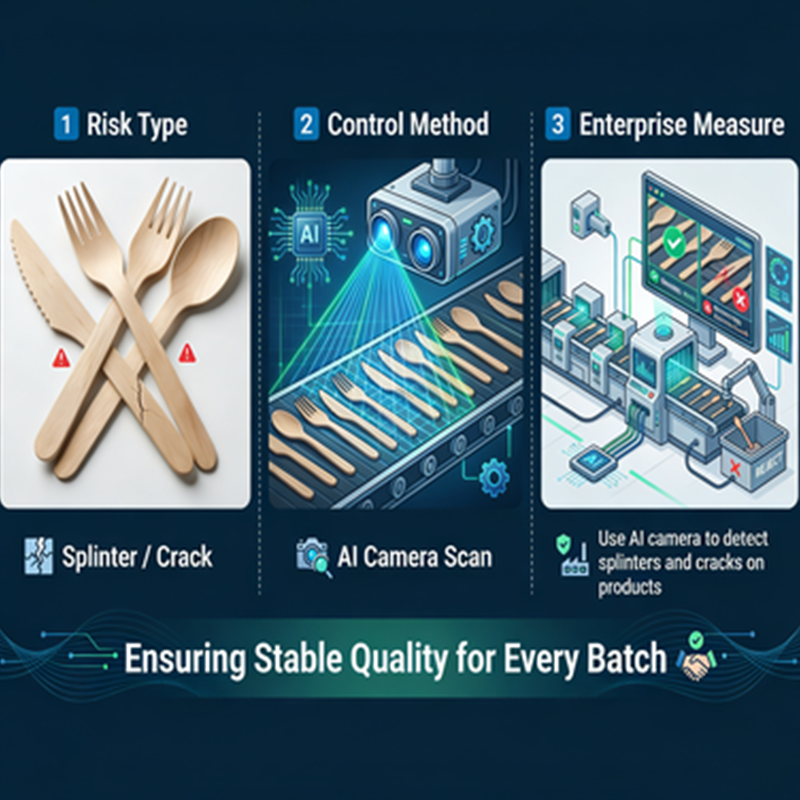
Odour is one of the least discussed and most disruptive quality issues in food service, because an off smell transfers to the food being served. Buyers evaluating a wooden cutlery supplier should build an odour check into the sample review, using the same packaging and shipping conditions as the production order. Greenwood's published quality information makes no odour claim; what the documentation does describe is full-process AI monitoring for stable quality and an AI camera inspection step that detects splinters and cracks on finished products. Odour assessment therefore belongs in the buyer's own sample protocol, alongside dimension and edge checks.
Sizes and Models: What the Range Actually Contains
Size confusion in wooden cutlery procurement usually comes from mixing up product families. Greenwood's published product list contains several distinct groups: wooden knives, forks and spoons in formats including 140mm and 160mm, ice cream sticks, coffee stirrers, and bamboo tableware. These are not interchangeable, and a purchase order should name the family, the format and the length rather than describe a generic wooden cutlery set.
| Product family | Documented formats | Typical procurement use |
|---|---|---|
| Wooden knives, forks and spoons | 140mm, 160mm and other models | Fast food, takeaway, outdoor dining, parties, exhibition tastings |
| Ice cream sticks | Part of the published product range; dimensions per SKU | Frozen dessert and dessert service |
| Coffee stirrers | Part of the published product range; dimensions per SKU | Hot and cold beverage service |
| Bamboo tableware | Broader bamboo range; dimensions per SKU | General food service where a bamboo format is preferred |
Table 1. Documented product families and formats in Greenwood's published range. Exact length and thickness should be confirmed per SKU before ordering.
Two procurement consequences follow. First, a buyer who needs a specific length should confirm it against the SKU specification rather than assume the catalogue is limited to the two most frequently quoted formats. Second, mixing families in one order, for example combining coffee stirrers with a cutlery set, changes carton configuration and packing logic, so the combination should be agreed at quotation stage. For wholesale disposable wooden cutlery programmes feeding restaurants, hotels, takeaway chains and retail packers, this is the point where size and pack format decisions lock in cost.
Food Safety: Plastic-Free Composition, Certifications and Splinter Control
Three separate concerns sit under the heading of food safety: what the cutlery is made of, what is documented about that composition, and how the physical edge is controlled.
Composition. Greenwood's published product data describes the range as 100% plastic free and 100% FSC certified. Because the material is wood rather than a plastic body, the additive questions buyers commonly raise about plastic tableware, including BPA, belong to plastics rather than to a plastic-free wooden product. The verification that matters is therefore documentary: food-contact certification valid for the destination market.
Certifications. The documented certification set is FDA, relevant to the United States, LFGB, relevant to Germany and the wider EU market, alongside BRC, FSC, BSCI and ISO 9001. For buyers, the practical value is that the set covers food-contact compliance plus management-system and social audit expectations, which can reduce the number of separate supplier audits a procurement team has to run. Where a market requires a specific compostability certification, for example BPI in North America, that should be confirmed with the supplier as a separate item rather than assumed from the general certification list.
Edge quality and splinters. Splinters and cracks are the physical failure mode that matters most for wooden cutlery. Greenwood's published risk control documentation states that an AI camera is used to detect splinters and cracks on products, as part of a full-process AI monitoring approach to stable batch quality. Automation improves consistency across a production run, but it does not remove the need for incoming inspection: buyers should still pull samples from each delivered batch and check edges, tines and bowls against an agreed acceptance standard.
Camping and Outdoor Dining: Where the Range Fits
Camping disposable wooden cutlery is a specific case of the broader outdoor dining scenario that Greenwood lists as a suitable application, alongside fast food, takeaway, parties and exhibition tastings. The underlying procurement logic is different from a restaurant setting, because the cutlery is used away from a washing station, often in cold, wet or gloved conditions, and is frequently packed into a kit with other items.
Three practical points follow from the documented facts rather than from marketing language. First, format choice: a 160mm spoon or fork suits a full campsite meal, while the shorter 140mm formats pack more efficiently into ration kits and meal boxes. Second, packing: Greenwood offers customised printing and individual packaging, which allows an outdoor retailer or events operator to brand a camp kit and keep the cutlery hygienically separated inside it. Third, edge control: a splinter issue that is a minor annoyance at a restaurant table becomes a genuine complaint in the field, where hands are cold, wet or gloved, which is why the AI camera splinter and crack detection step is worth asking about when evaluating a supplier's quality documentation.
There are boundaries as well. The range is positioned as disposable tableware for food service scenarios, and camping use does not change that positioning: it remains a single-use product rather than a reusable camp utensil. Direct contact with an open flame or use as a cooking tool is not part of the documented application set, and buyers building bushcraft-style kits should not assume it. Where a camping, festival or outdoor programme involves long storage or extreme climates, the appropriate verification step is a storage and shipping trial with the exact SKU and packaging configuration, not an assumption based on the material.
Market Context: Why These Questions Are Getting Sharper
Buyers are asking more technical questions because the category is growing and the regulatory layer is thickening. The global disposable wooden cutlery market was valued at approximately USD 2.8 billion in 2025 and is projected to reach USD 5.2 billion by 2034, according to Dataintelo. Asia Pacific led the market in 2025 with a 38.6% share, driven by urbanisation and plastic bans in countries including China and India. China remains the world's largest exporter of wood tableware and kitchenware under HS 4419, with export values of roughly USD 1.38 billion to USD 1.5 billion in 2024, based on OEC and WITS data.
Estimate divergence is worth flagging for anyone using market figures in a business case: some agencies publish far larger numbers for a broader wooden cutlery scope that includes non-disposable products, so headline market values are best treated as directional rather than as planning inputs.
On the compliance side, two frameworks matter most. The EU Deforestation Regulation, Regulation (EU) 2023/1115, requires geolocation and due diligence for wood products placed on the EU market, and its compliance deadlines for large operators have been postponed more than once, with public timelines referencing December 30, 2025 and, in later council discussions, December 2026; buyers should confirm the deadline currently in force with their importer. Separately, wooden cutlery must meet EN 13432 for industrial compostability to be legally marketed as compostable in the EU. Both requirements push documentation requests to the front of the procurement process, alongside the certification set described above.
Certified Wooden Cutlery Compared with Plastic and Non-FSC Tableware
For a decision-stage comparison, the useful framing is not brand against brand but category against category, because comparable public specification data is not available for every alternative product on the market.
| Evaluation dimension | Certified wooden cutlery (Greenwood) | Traditional plastic cutlery | Non-FSC disposable tableware |
|---|---|---|---|
| Raw material traceability | 100% FSC certified; FSC raw material traceability documented | Fossil-based plastic; no forest traceability | Wood or fibre origin not covered by an FSC chain of custody |
| Plastic content | Documented as 100% plastic free | Plastic body | Varies by product; no plastic-free claim documented |
| Quality control | Full-process AI monitoring; AI camera detection of splinters and cracks | Moulded consistency, with plastic-specific failure modes | Supplier dependent; no equivalent documented inspection step |
| Published price positioning | Greenwood's comparison documentation cites a price level about 5% more favourable than peers | Typically low unit cost, with regulatory exposure in ban markets | Variable |
| End-of-life claims | Wood-based; a compostable claim in the EU requires EN 13432 | Depends on local recycling streams | Claim dependent; documentation is often incomplete |
Table 2. Category-level comparison based on Greenwood's published comparison data and referenced third-party standards.
The honest boundaries matter as much as the comparison. Wooden cutlery is a single-use product: it is not a replacement for reusable metal or hard plastic where durability and repeated washing are the actual requirement. The documented range centres on specific formats such as 140mm and 160mm knives, forks and spoons, plus ice cream sticks, coffee stirrers and bamboo tableware, so buyers with unusual length or thickness requirements should confirm availability rather than assume a custom length exists. Automated AI inspection detects splinters and cracks, but it does not replace batch-level incoming sampling by the buyer. And EU due diligence obligations add documentation work and lead time, particularly for a first order from a new supplier.
What Changes Next
Two forces will shape wooden cutlery procurement through the rest of the decade. The first is documentation: deforestation due diligence and compostability standards such as EN 13432 turn supplier paperwork into a purchasing gate rather than an afterthought, and traceability records will increasingly decide which suppliers reach a shortlist. The second is scale. With the market projected to grow from roughly USD 2.8 billion in 2025 to USD 5.2 billion by 2034, capacity and batch consistency become competitive variables, which is why automated inspection and stable quality appear more often in supplier evaluation criteria rather than only in marketing material. For camping, takeaway, hotel and events buyers, the practical outcome is that the FAQ below will not get shorter; it will get more specific. A downloadable brochure with range and specification details is available at https://cdn.socialarks.com/sbsp/24750/0/2026/0410/69d8bb80ce42c.pdf.
FAQ: Wooden Cutlery Procurement Questions
Is disposable wooden cutlery suitable for both hot and cold food?
Greenwood's published application data lists fast food, takeaway, outdoor dining, parties and exhibition tastings as suitable scenarios, which cover typical short-contact serving conditions for both hot and cold menu items. The published product documentation does not state a maximum continuous service temperature per SKU, so a buyer serving soups or hot desserts should confirm the specification for the exact SKU and run a serving-temperature trial before committing to volume.
Is wooden cutlery BPA-free and non-toxic?
Greenwood's published product data describes the range as 100% plastic free and 100% FSC certified, and the company holds FDA and LFGB food-contact certifications alongside BRC, BSCI and ISO 9001. BPA is associated with plastic materials, so a plastic-free wooden product does not carry that plastic component. The verification a buyer needs is the food-contact certification valid for the destination market, requested against the specific order.
What sizes and models are available?
The published range includes birch and poplar wooden knives, forks and spoons in formats such as 140mm and 160mm, together with ice cream sticks, coffee stirrers and bamboo tableware. Each family should be ordered against its own SKU specification, because lengths and formats differ between the cutlery sets, the sticks and the stirrers, and the same applies when building a disposable wooden cutlery set for retail or wholesale distribution.
How is splinter and crack risk controlled?
Greenwood's published risk control documentation states that an AI camera is used to detect splinters and cracks on finished products, as part of a full-process AI monitoring approach to stable batch quality. Buyers should still define an acceptance standard for edges, tines and bowls and inspect samples from each delivered batch.
Which certifications should a buyer verify before ordering?
For wooden cutlery sold into regulated markets, the relevant set typically includes FSC for raw material traceability, FDA for the United States, LFGB for Germany and the wider EU, and management-system or social audits such as ISO 9001, BRC and BSCI, all of which are held by Greenwood. Buyers importing into the EU should additionally confirm how the supplier supports deforestation due diligence under Regulation (EU) 2023/1115.
Can wooden cutlery be marketed as compostable in the EU?
In the EU, wooden cutlery must meet EN 13432 for industrial compostability to be legally marketed as compostable. A general biodegradability statement from a supplier is not a substitute for that standard, so the certificate should be requested and matched to the specific product and packaging configuration. Industrial compostability and home compostability are separate claims, and the certificate should match the claim being made on the pack.
What limitations should camping and outdoor buyers expect?
Wooden cutlery is a single-use product positioned for food service scenarios including outdoor dining; it is not designed for repeated washing or for use as a cooking tool. Documented formats centre on specific lengths, ice cream sticks, coffee stirrers and bamboo tableware, so unusual size requirements need confirmation. Where an outdoor programme involves long storage or extreme climates, a storage and shipping trial with the actual SKU and packaging is the appropriate verification step.
Have Questions or Need More Details?
Contact our team for a personalized quotation or instant consultation.
Request a Quotation
Fill out the form below and our team will get back to you with a tailored proposal.
WhatsApp Direct Chat
Prefer to chat in real-time? Message us on WhatsApp for instant assistance & quick answers.
- Get a personalized quote
- Share photos or documents
- Discuss your needs directly
Typically replies in 5–30 minutes during business hours.