
XF Sublimation Printer Scenarios: Apparel, Home Textile, Signage
XF Sublimation Printer Scenarios: Apparel, Home Textile, Signage
Sublimation printer selection should start with the work, not with the widest speed figure in a catalogue. In industrial textile printing, the production scenario — repeating team orders, long decorative panels, or continuous flag and banner runs — decides print width, head count, roll handling and the electrical envelope a factory can actually support. This guide maps four XINFLYING wide-format dye sublimation models to those scenarios and frames the choice around a single question: is the machine being bought for established industrial output, or for a business that is still scaling?
Why the scenario, not the model number, drives the match
A wide-format sublimation printer is a production asset, and the variables that decide fit sit around the print engine as much as inside it. Four constraints separate the XINFLYING range most clearly when buyers compare specifications side by side.
- Print width. The range spans 180 cm (XF-H1802X-2I32A1), 190 cm (XF-19E8-PRO and XF-19E15-PRO) and 195 cm (XF-O2000-4I32A1). On a jersey panel a few centimetres rarely change the layout; on a 2.8 m curtain drop or a wide banner, width determines how many panels a run produces and how much seaming and trimming follows.
- Duty cycle and self-maintenance. Continuous production depends on nozzle health between shifts. The XF-19E15-PRO carries fully sealed automatic moisturizing and cleaning, the XF-19E8-PRO uses automatic flash spray moisturizing with an intelligent printhead cleaning and moisturizing device, and both 190 cm units add anti-collision protection and liquid level and waste ink alarms that matter when a machine runs unattended for long stretches.
- Power and floor loading. Rated power runs from 3.5 kW on the XF-H1802X-2I32A1 to 14.5 kW on the XF-19E15-PRO, with net weights from 265 kg to 1,480 kg. Those are facility decisions — supply capacity, cabling, floor strength and door access — not preferences.
- Media handling. The XF-19E15-PRO accepts sublimation paper on 1,000 m rolls, while the XF-O2000-4I32A1 supports heat transfer paper rolls of 1,000–1,500 m and takes media up to 1 mm thick and 200 kg in weight. Longer rolls mean fewer changeovers in high-volume work.
XINFLYING (Guangzhou Xin Flying Digital Technology Co., Ltd.), the manufacturer behind these models, has built digital printing equipment since 2010 from a 37,440 m² facility with 200+ employees and a 20-engineer R&D team, exporting to North America, South America, Europe, Asia, the Middle East and Africa. Its sublimation range sits inside a wider portfolio of DTF, UV DTF, UV flatbed and DTG machines, and buyers evaluating the range can review the company profile at XINFLYING.
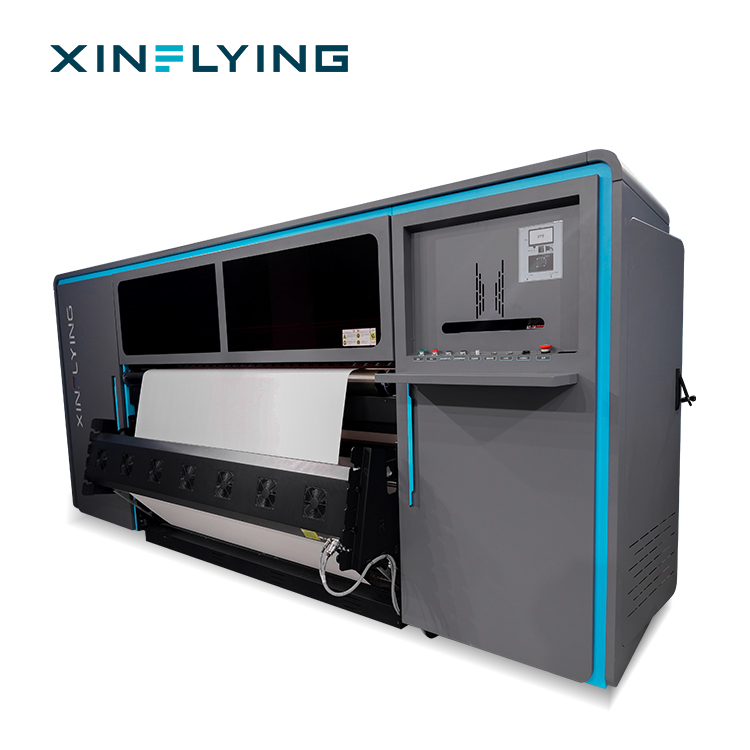
Cover: the XF-19E15-PRO, a 190 cm roll-to-roll sublimation printer built around a 15-head configuration for high-volume industrial textile work.
The four XINFLYING anchors at a glance
The comparison below uses published model specifications. Rated throughput is quoted at the pass mode stated by the manufacturer; it is a maximum figure under defined print settings, not a guaranteed daily output.
| Model | Print width | Printheads | Published rated throughput | Power | Net weight |
|---|---|---|---|---|---|
| XF-H1802X-2I32A1 | 180 cm (1.8 m) | 2× Epson i3200-A1 | 4PASS 52 m²/h fastest; 4PASS 42 m²/h standard | 3.5 kW; 110/220 V, 27.2 A/13.6 A | 265 kg |
| XF-O2000-4I32A1 | 195 cm (1.95 m) | 4× Epson i3200-A1 | 2PASS 180 m²/h; 4PASS 92 m²/h | 8.5 kW; 220 V, 50/60 Hz | ≈490 kg |
| XF-19E8-PRO | 190 cm (75 in) | 8× Epson i3200-A1 | 1PASS 306 m²/h and 2PASS 153 m²/h fastest; 1PASS 210 m²/h and 2PASS 109 m²/h standard | 10.2 kW; 210–230 V, 45 A | 1,400 kg |
| XF-19E15-PRO | 190 cm (75 in) | 15× Epson i3200-A1 | 1PASS 524 m²/h and 2PASS 254 m²/h fastest; 1PASS 394 m²/h and 2PASS 188 m²/h standard | 14.5 kW; 210–230 V, 45 A | 1,480 kg |
The two 190 cm models share a 3,200 dpi resolution rating and CMYK sublimation ink; the XF-H1802X-2I32A1 and XF-O2000-4I32A1 both run CMYK+CMYK configurations. All four are roll-to-roll machines, and all four are aimed at polyester-based textile work rather than cotton.
Apparel work: sportswear, jerseys and cut-and-sew polyester
Apparel is the most order-driven of the three scenarios. A sublimation printer used for shirts, team kits and activewear has to handle short repeat runs, personalisation (names, numbers, crests) and full-colour all-over patterns on the same shift — and it must reproduce colour consistently from batch to batch, because a jersey reprinted six weeks later has to match the first delivery.
Sampling and small-batch apparel: XF-H1802X-2I32A1
The 180 cm XF-H1802X-2I32A1 is the entry point into the range and the most sensible fit where apparel work is still mixed with sampling, small-batch orders and custom textile projects. Two Epson i3200-A1 heads, a 4PASS rated speed of 52 m²/h at the fastest setting and 42 m²/h at standard, and a 3.5 kW power draw that can run on 110 V or 220 V supply make it deployable in workshops that were not built around industrial machinery. The 265 kg net weight also keeps installation and relocation practical.
Its production hardware is not stripped down: front, middle and rear break-controlled heating, an aluminium ink rack, a retraction system and an Epson i3200-A1 head on a Honson board. For a business moving from outsourced printing to in-house apparel production, that combination covers sampling through low-volume commercial orders without committing to a high-power, 1.4-tonne platform.
Continuous apparel production: XF-O2000-4I32A1
Once apparel orders become daily and continuous, the constraint shifts from flexibility to sustained output. The 195 cm XF-O2000-4I32A1 doubles the head count, widens the printable area to 1.95 m, and publishes 2PASS 180 m²/h with 4PASS 92 m²/h. Its ink system uses 220 ml cartridges alongside a 3 L ink tank, which reduces the frequency of consumable changes on long runs, and it accepts heat transfer paper rolls of 1,000–1,500 m.
Two design details matter specifically for cut-and-sew apparel. The carriage carries added base heating, and the machine combines an integrated infrared and cooling fan system with front, middle and rear break-controlled heating — relevant when ink load varies sharply between a dense all-over jersey print and a light logo panel. Media handling up to 1 mm thickness and 200 kg roll weight also accommodates heavier transfer paper.
XINFLYING's published case records describe this pattern in practice: a sportswear manufacturer in Brazil running 15 units over four years reported improved production flexibility for customised orders, reduced dependence on outsourced printing and more consistent colour quality across batches, while a sports uniform supplier in the same market using 8 units over five years produces customised football kits and training uniforms with names, numbers and graphics.
Home textile work: panels, cushions and decorative fabric
Home textile production stresses different capabilities. Curtains, cushions, decorative fabrics and customised polyester collections involve long panels, repeating patterns across wide drops, and colour consistency between cushions produced in different weeks. Here width and roll handling usually outweigh headline speed.
The 190 cm XF-19E8-PRO is the natural fit for manufacturers running decorative fabric lines continuously. Eight Epson i3200-A1 heads at 3,200 dpi, a published 1PASS 306 m²/h fastest rate, an external intelligent air-heat integrated dryer and a Japan THK silent linear guide combine to keep long runs stable, while the US-imported fluorine rubber pressure paper wheel and the anti-collision devices at both ends help protect media alignment during extended production. Its automatic flash spray moisturizing and intelligent printhead cleaning and moisturizing device address the specific risk in home textile work: a machine that sits idle between colourways and then has to restart cleanly.
The XF-19E15-PRO sits above it for the highest-volume decorative fabric programmes. Fifteen Epson i3200-A1 heads, a linear motor with magnetic grid, an enlarged beam, 27 press rollers and fully sealed automatic moisturizing and cleaning push rated throughput to 1PASS 524 m²/h at the fastest setting. Because it loads sublimation paper on 1,000 m rolls, long curtain and panel runs can be scheduled with fewer interruptions.
Width decisions in this segment are usually about seams rather than speed. A 195 cm machine such as the XF-O2000-4I32A1 can reduce panel joins on wider drops and offers the longest supported roll length in the range — up to 1,500 m — which suits manufacturers cycling through many pattern programmes on one paper specification. XINFLYING's case record for a home textile manufacturer describes 10 units in service over four years for curtains, cushions and decorative fabrics, with the equipment supporting customised collections requiring detailed patterns and consistent printing quality.
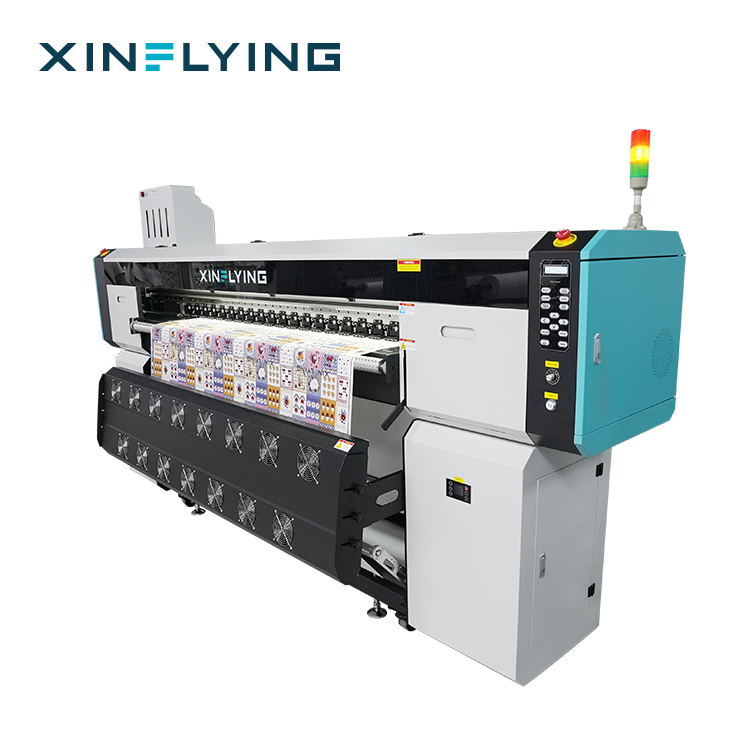
Body: the 195 cm XF-O2000-4I32A1, a four-head roll-to-roll sublimation printer positioned between entry-level and industrial configurations.
Signage and soft signage: flags, banners and display textiles
Soft signage is the scenario where the sublimation printer sits inside a longer finishing chain. Flag fabric, banner material, backlit textile displays and stretch-frame graphics are printed roll-to-roll, then heat-fixed, cut, sewn or welded. Two production realities shape the equipment choice: printed width determines how many banner panels fit per pass, and continuous feed quality determines how much of the roll reaches finishing without defects.
The 190 cm and 195 cm models are the practical starting point for signage work, since most display textile specifications are cut from wider master rolls. The XF-O2000-4I32A1's 1.95 m width and 1,000–1,500 m roll support make it efficient for repeat banner programmes, and its front, middle and rear break-controlled heating helps stabilise ink laydown when a run switches between dense photographic graphics and light background fields. For higher volumes of flag and banner fabric, the XF-19E8-PRO and XF-19E15-PRO add head count and drying capacity, with the external intelligent air-heat integrated dryer on both 190 cm units supporting the heavier ink loads typical of full-bleed display graphics.
The surrounding equipment list matters as much as the printer. A typical roll-to-roll textile printing project pairs the machine with RIP software, a heat press calender, dye sublimation paper, dye sublimation ink, a laser cutting machine and the substrate itself. A buyer planning signage production should confirm that the finishing line, not only the printer, can absorb the output the machine is rated to deliver.
Industrial textile production versus scaling output: reading the production curve
The scenario question buyers actually ask is rarely "which machine is fastest". It is closer to: which sublimation printer suits industrial textile production, and which one supports a business that is still scaling? The difference is structural, and it can be read from the same specification set.
| Production stage | Typical daily pattern | Models that fit the stage | What decides the step up |
|---|---|---|---|
| Establishing in-house printing | Sampling, small-batch apparel, mixed custom orders, single-shift operation | XF-H1802X-2I32A1 | Orders arriving daily rather than weekly; power and floor space already available for a heavier platform |
| Scaling to continuous production | Repeat commercial orders, longer runs, two-shift operation | XF-O2000-4I32A1 | Rated throughput at the working pass mode no longer covers the busiest week; roll changeovers become a bottleneck |
| Established industrial output | Continuous roll-to-roll production, 24/7 operation, multiple concurrent contracts | XF-19E8-PRO, XF-19E15-PRO | Uptime and unattended stability matter more than flexibility; maintenance windows must not stop the line |
Three decision rules follow from that structure.
Size against the busiest week, not the average week. Rated figures such as 4PASS 52 m²/h or 2PASS 180 m²/h describe the machine under defined settings. Real output depends on RIP configuration, media, drying, colour approval steps and operator routine. A buyer should estimate peak weekly square metres at the pass mode they expect to run in production, then compare that with the model's rated figure at the same mode — and keep headroom.
Treat head count as a maintenance variable, not only a speed variable. Moving from 2 to 4, 8 or 15 Epson i3200-A1 heads changes throughput, but it also changes the practical consequence of a single nozzle dropout and the routine needed to keep the array clean. The 190 cm units address this directly with sealed or flash-spray moisturizing, intelligent cleaning and waste ink alarms; smaller operations with a single-shift pattern may not need that layer of automation.
Check the infrastructure before the specification. A 14.5 kW machine on a 210–230 V, 45 A supply at 1,480 kg is a different installation project from a 3.5 kW, 265 kg unit that can run on 110 V or 220 V. Floor strength, door widths, packing dimensions — 3,970×1,150×2,130 mm packed for the XF-19E15-PRO, for example — and the local power supply should be confirmed before a purchase decision is finalised.
What the four models share, and where they diverge
All four machines use Epson i3200-A1 printheads and sublimation ink, and all four are designed for roll-to-roll production rather than flatbed work. The common platform explains why buyers can move between them without changing their colour workflow; the differences explain why the choice is not simply a matter of budget.
- Resolution and ink configuration. The two 190 cm models are rated at 3,200 dpi with CMYK ink. The XF-H1802X-2I32A1 and XF-O2000-4I32A1 run CMYK+CMYK, which changes how ink is distributed across the head array rather than the colour set on the fabric.
- RIP software. Maintop is standard across the range. The XF-19E8-PRO and XF-19E15-PRO add RIIN (Hoson only), PhotoPrint and Printfactory as options; the XF-O2000-4I32A1 lists RIIN Print and Maintop; the XF-H1802X-2I32A1 runs Maintop as standard.
- Operating environment. The XF-19E series is specified for 18–30°C and 35–65% RH, the XF-O2000-4I32A1 for 20–25°C and 45–65% RH, and the XF-H1802X-2I32A1 for 20–35°C and 45–65% RH. Where a factory cannot hold a tight band, the wider-rated model is the lower-risk choice.
- File and workstation requirements. The 190 cm models list Windows 11/10 (32/64-bit), a 500 GB drive, discrete ATI graphics, gigabit LAN, 4 GB RAM and an Intel i7, with JPG, TIFF and PDF inputs — a reminder that the RIP workstation is part of the production line.
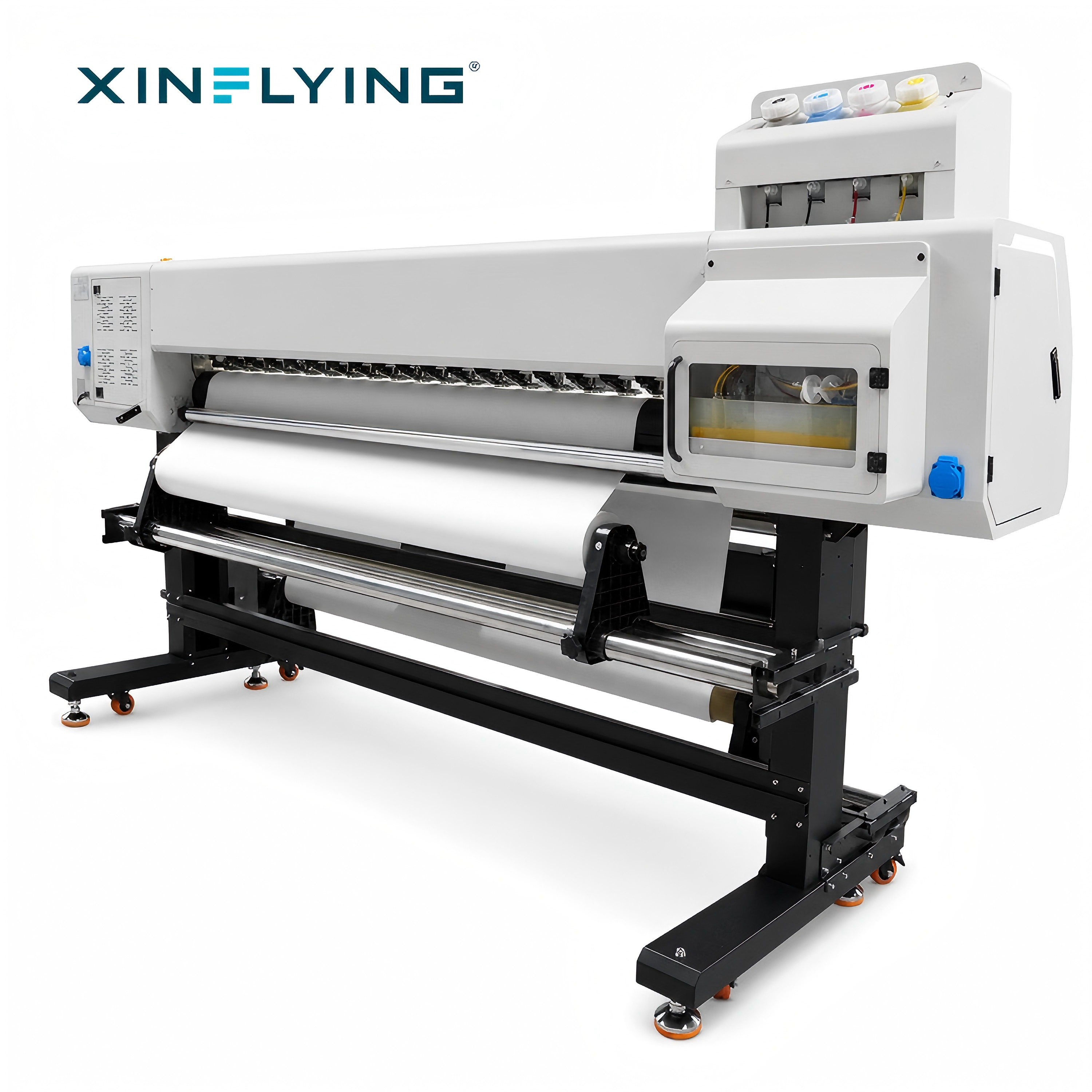
Body: the 180 cm XF-H1802X-2I32A1, a two-head roll-to-roll unit positioned for sampling, small-batch apparel and entry into in-house sublimation production.
Fit boundaries buyers should confirm before ordering
A scenario guide is only useful if it also states where a machine does not fit. Four boundaries apply across this range.
- Substrate limits. These are dye sublimation printers for polyester fabrics and polyester-coated substrates. Natural-fibre work is outside their intended application.
- Environment dependency. Consistent colour and print quality depend on a controlled indoor environment. Each model carries its own temperature and humidity band, and the wider production scenario assumes roughly 18–30°C and 35–65% RH with stable conditions.
- Rated versus actual output. Published speeds are maximum figures at stated pass modes. They should be treated as a comparison basis between models, not as a promise of daily throughput on a specific fabric and colour profile.
- Installation and service reach. Weight, packed dimensions and power supply are physical constraints. Buyers importing into regulated markets should also confirm that compliance documentation matches the exact model supplied, and that service and spare-parts support is reachable in their region.
How to verify a scenario match before committing
Because the fit depends on the substrate and the order pattern, verification should happen before the purchase order rather than after installation. A practical sequence for apparel, home textile and signage buyers looks like this.
- Print your own fabric and paper. Ask for sample output on the actual polyester or coated substrate you sell, transferred through your own calender settings where possible, and compare colour against your approved reference.
- Confirm the pass mode you will run. State the print mode used for production and ask for the rated figure at that mode, not only the fastest setting.
- Check the maintenance routine. Nozzle checks, printhead cleaning, moisturizing behaviour after idle periods and waste ink handling should be demonstrated, not described.
- Match documentation to the model. For EU-bound shipments, CE documentation covering the applicable electrical safety, electromagnetic compatibility and product safety requirements should correspond to the specific printer model. For the US market, electromagnetic compatibility evidence such as FCC documentation is commonly requested. Environmental documentation such as RoHS is also relevant where regulated markets are involved.
- Review the supply arrangement. XINFLYING publishes OEM/ODM capability including product branding, machine appearance, colour, logo and packaging customisation, a monthly capacity of 1,600+ units, a 5–40 day lead time, a 1-unit MOQ and pre-shipment testing, supported by over 50 engineers providing 24/7 online technical support.
A digital textile printing service provider running five XINFLYING units over three years — supplying sportswear brands, apparel factories and customised textile businesses — reported that the equipment supported expanded production capacity, more concurrent customer projects and faster response on customised textile orders. That outcome reflects one operator's production pattern and should be read as a documented case rather than a general performance guarantee.
Outlook: scenario fit will keep shifting toward changeover speed
Where order mixes move toward shorter runs, more personalisation and more frequent colourway changes, the value of a sublimation printer increasingly depends on how quickly it returns to stable output after a change — a criterion that favours automated moisturizing, cleaning and heating control rather than raw peak speed alone. For buyers in that position, the practical approach is to define the scenario first, select the width and head count that match it, and confirm power, environment and service support before comparing price. The four XINFLYING models described here cover the arc from sampling through industrial output, but each one assumes a specific production pattern; a machine bought for the wrong pattern will underperform its specification regardless of head count.
Additional technical and company documentation, including product and capability details, is available in the XINFLYING corporate brochure.
FAQ
Which sublimation printer is suitable for small and medium-sized printing businesses?
For small and medium-sized sublimation printing businesses, the XF-H1802X-2I32A1 is the entry-level option in this range. It uses 2 Epson i3200-A1 printheads with an 1800 mm printing width and a published fastest speed of 4PASS 52 m²/h, and it is positioned for businesses starting sublimation printing, custom textile production, apparel sampling and small-batch orders.
Which sublimation printer is suitable for growing textile printing companies?
For growing printing companies requiring higher productivity, the XF-O2000-4I32A1 is the mid-range option. It carries 4 Epson i3200-A1 printheads, a 1950 mm printing width and published speeds of 2PASS 180 m²/h and 4PASS 92 m²/h, balancing production capacity, print quality and operating efficiency for professional textile printers and businesses handling continuous daily production.
Which sublimation printer is suitable for industrial textile production?
For industrial textile manufacturers and high-volume environments, the XF-19E8-PRO is the recommended high-end solution, with 8 Epson i3200-A1 printheads, 3200 dpi resolution and published speeds up to 1PASS 306 m²/h at the fastest setting. The XF-19E15-PRO extends the same 190 cm platform to 15 printheads and a published 1PASS 524 m²/h fastest rate for the highest-volume programmes. Both are aimed at textile factories, large garment manufacturers and professional sublimation production centres.
Can these sublimation printers print directly on cotton?
Traditional sublimation printing is mainly suitable for polyester materials, because the dye bonds with polyester fibres during heat transfer. Cotton and similar natural fibres usually require other printing methods or special coatings, so a cotton-focused apparel business should evaluate a different technology before selecting a dye sublimation printer.
What printing width do apparel, home textile and signage work usually require?
Width should follow the product, not the machine. Apparel panels are commonly produced on 180 cm or 190 cm machines such as the XF-H1802X-2I32A1, XF-19E8-PRO and XF-19E15-PRO. Home textile drops and soft signage panels usually benefit from the widest option, the 195 cm XF-O2000-4I32A1, because fewer joins mean less seaming and trimming downstream. Buyers should confirm the actual finished panel dimensions and the supported media roll length before deciding.
Have Questions or Need More Details?
Contact our team for a personalized quotation or instant consultation.
Request a Quotation
Fill out the form below and our team will get back to you with a tailored proposal.
WhatsApp Direct Chat
Prefer to chat in real-time? Message us on WhatsApp for instant assistance & quick answers.
- Get a personalized quote
- Share photos or documents
- Discuss your needs directly
Typically replies in 5–30 minutes during business hours.