
XINFA Polyester Polyol Series Compared Side by Side: A Buyer Review
A specification-level, family-by-family reading of the XINFA polyester polyol range, built only from published hydroxyl value, acid value, moisture and viscosity data.
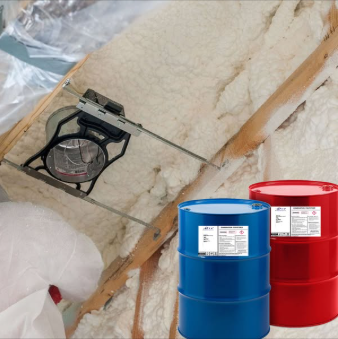
Polyester polyol in a spraying insulation application. Photo: XINFA application material.
Polyester polyol is a hydroxyl-terminated polyester resin produced by reacting polyols with dibasic acids. In polyurethane processing it acts as the resin side of the reaction, and in rigid foam, sandwich panel, pipe insulation, adhesive and coating systems it strongly influences reactivity, crosslink density and the mechanical behaviour of the finished part. That makes grade selection a data problem before it becomes a supplier problem: two families marketed under the same application label can sit at opposite ends of the hydroxyl value and viscosity scale.
Hengshui Xinfa Polyurethane Materials Co., Ltd. (XINFA) is a Chinese polyurethane materials manufacturer based in the Salt Chemical Circular Economy Park in Jizhou City, Hebei Province, producing polyester polyol series products alongside polyurethane catalysts. The company publishes seven polyester polyol families under the XF and KXF prefixes. This review places their published figures side by side in the form a buyer would assemble internally, and marks clearly where the published data stops.
Why specification-level comparison comes first
A family name such as “high flame retardant” or “pentane system” describes an intended system, not a chemical fingerprint. Buyers in the research and evaluation stage normally receive a grade list in which every row belongs to a different end use and no column is aligned with the next. Rebuilding that list into one comparable table exposes the four decisions that actually matter: how reactive the resin is (hydroxyl value), how much residual acidity it carries (acid value), how much water it holds (moisture), and how it will behave in the drum, the pump and the mixing head (viscosity at 25 °C).
Three practical consequences follow. First, families that look similar by application can differ by more than a factor of two in hydroxyl value — the pentane system range spans 200 ± 10 to 500 ± 50 mgKOH/g. Second, viscosity spread inside a single family can be wider than the spread between families, which changes handling rather than chemistry. Third, a comparison built only on marketing labels cannot be reused as an acceptance document at goods-in, because it contains nothing that can be tested.
What this review covers — and what it does not
Every figure below is transcribed from XINFA’s published product specifications for the XF and KXF polyester polyol series. Tolerances and ranges are reproduced exactly as published; nothing has been averaged, converted or estimated. Where a value is published as an upper boundary, it is shown as an upper boundary.
The seven families at a glance
XINFA organises its polyester polyol portfolio by intended system rather than by chemistry alone, and several families share the same published raw-material base of PA, PTA, AA, DEG and GLY.
| Family | Published models | Raw-material base (published) | Published application scope |
|---|---|---|---|
| High Flame Retardant | XF-2007, XF-250P, XF-235P, XF-240P | PA, PTA, AA, DEG, GLY, etc. | High flame retardant applications, PIR spraying insulation, sandwich panels, polyurethane pipes |
| Pentane System | XF-435, XF-390, XF-360, XF-2402N, XF-2020 | PA, PTA, AA, DEG, GLY, etc. | Home appliances, polyurethane pipes, sandwich panels, PIR systems |
| High Water-based | XF-2003, XF-2006, XF-3153, XF-315G, XF-300W | PA, PTA, AA, DEG, GLY, etc. | High-water-based and full-water systems, spraying insulation, sandwich panels, polyurethane pipes |
| Mining | KXF-350, KXF-280 | PA, PTA, AA, DEG, GLY, etc. | Mining |
| Adhesive | XF-Z, XF-280 | PA, PTA, AA, DEG, GLY, etc. | Sandwich panel adhesives |
| Controlled-release Fertilizer Coating | XF-270, XF-B-3, XF-B-4 | PA, PTA, AA, DEG, GLY, etc. | Controlled-release fertilizer coating agent |
| Other / general | XF-235, NXF-400 | PA, PTA, AA, DEG, GL, etc. | Spraying foam and sandwich panels |
A separate phthalic anhydride series (XF-3152, XF-2412, XF-1752) sits outside the scope of this comparison and is not evaluated below.
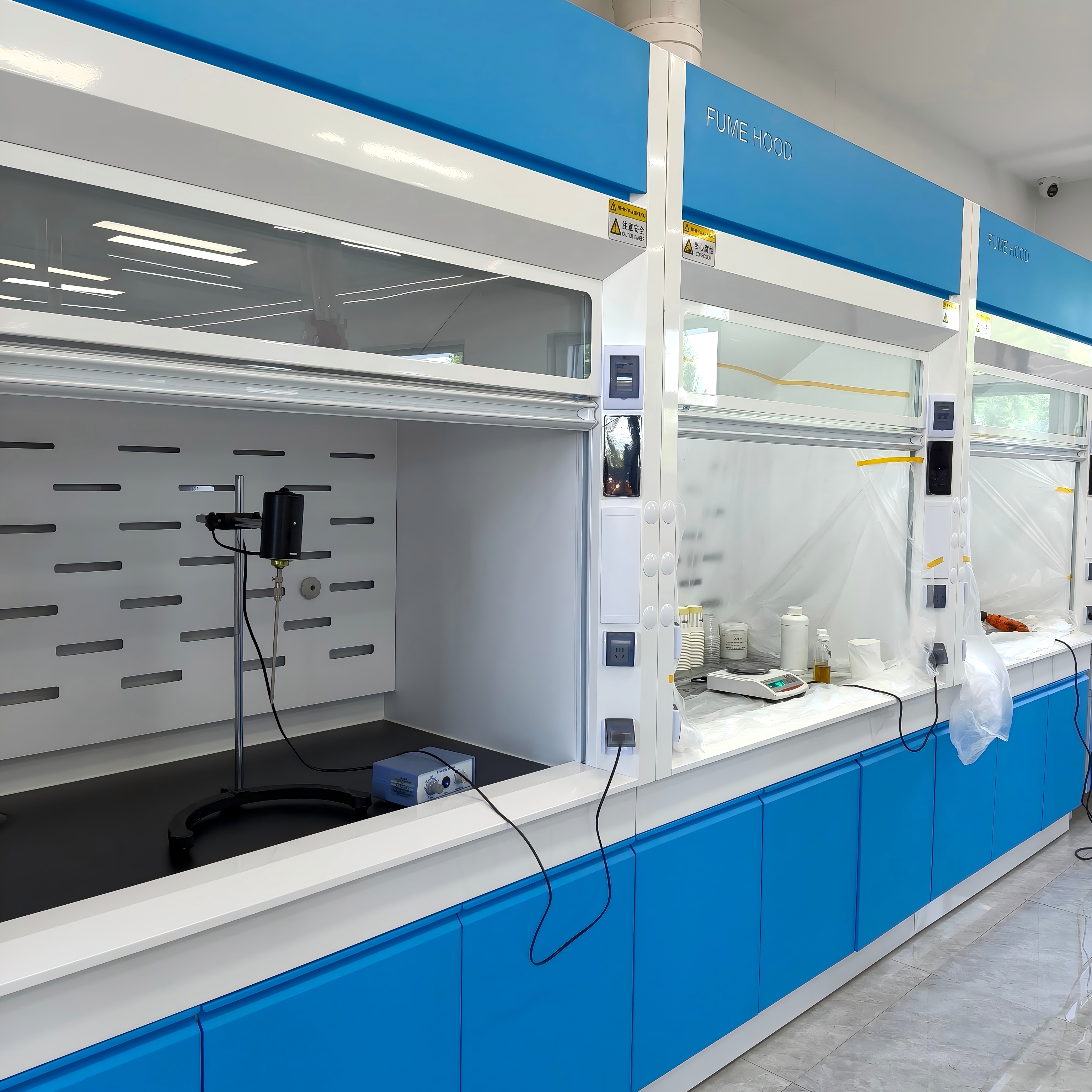
Published specifications are checked against batch test data before shipment. Photo: XINFA laboratory.
Side-by-side published specifications
The table below is the core of this review. It shows all twenty-two published polyester polyol models across the seven families on the same four parameters, so that a reader can compare any two grades without switching documents.
| Family | Model | Hydroxyl value (mgKOH/g) | Acid value (mgKOH/g) | Moisture (%) | Viscosity (CPS @ 25 °C) |
|---|---|---|---|---|---|
| High Flame Retardant | XF-2007 | 200 ± 10 | ≤ 2.0 | ≤ 0.1 | 15,000 ± 3,000 |
| High Flame Retardant | XF-235P | 235 ± 15 | ≤ 2.0 | ≤ 0.15 | 3,000 – 6,000 |
| High Flame Retardant | XF-240P | 240 ± 15 | ≤ 2.0 | ≤ 0.15 | < 5,000 |
| High Flame Retardant | XF-250P | 260 ± 10 | ≤ 1.5 | ≤ 0.1 | 11,000 ± 2,000 |
| Pentane System | XF-435 | 500 ± 50 | ≤ 3.0 | ≤ 0.15 | 10,000 ± 2,000 |
| Pentane System | XF-390 | 400 ± 20 | ≤ 2.0 | ≤ 0.15 | 2,000 ± 500 |
| Pentane System | XF-360 | 370 ± 20 | ≤ 2.0 | ≤ 0.15 | 1,500 ± 500 |
| Pentane System | XF-2402N | 240 ± 10 | ≤ 1.5 | ≤ 0.1 | < 8,000 ± 1,500 |
| Pentane System | XF-2020 | 200 ± 10 | ≤ 1.5 | ≤ 0.1 | < 7,000 ± 1,000 |
| High Water-based | XF-2003 | 200 ± 10 | ≤ 1.5 | ≤ 0.1 | 2,000 ± 500 |
| High Water-based | XF-2006 | 170 ± 10 | ≤ 0.5 | ≤ 0.1 | 1,500 ± 500 |
| High Water-based | XF-3153 | 315 ± 15 | ≤ 2.0 | ≤ 0.1 | 1,800 ± 500 |
| High Water-based | XF-315G | 315 ± 15 | ≤ 2.0 | ≤ 0.1 | < 3,000 ± 500 |
| High Water-based | XF-300W | 315 ± 15 | ≤ 1.5 | ≤ 0.1 | 2,000 ± 500 |
| Mining | KXF-350 | 350 ± 20 | ≤ 2.0 | ≤ 0.1 | 1,500 ± 500 |
| Mining | KXF-280 | 280 ± 15 | ≤ 1.5 | ≤ 0.1 | 1,000 ± 200 |
| Adhesive | XF-Z | 60 ± 5 | ≤ 5.0 | ≤ 0.15 | 10,000 ± 2,000 |
| Adhesive | XF-280 | 280 ± 20 | ≤ 3.0 | ≤ 0.1 | 15,000 – 2,000 (as published) |
| Fertilizer Coating | XF-270 | 260 ± 10 | ≤ 3 ± 0.2 | ≤ 0.1 | 3,000 ± 500 |
| Fertilizer Coating | XF-B-3 | 300 ± 30 | ≤ 3.0 | ≤ 0.15 | 3,000 ± 500 |
| Fertilizer Coating | XF-B-4 | 370 ± 20 | ≤ 3.0 | ≤ 0.15 | 3,500 ± 500 |
| Other / general | XF-235 | 230 – 245 | ≤ 2.0 | ≤ 0.15 | 10,500 ± 1,500 |
| Other / general | NXF-400 | 400 ± 20 | ≤ 2.0 | ≤ 0.15 | 3,000 ± 1,000 |
Source: XINFA published polyester polyol specifications. Values reproduced as published.
Reading the numbers the way a buyer has to
Hydroxyl value sets the reactivity ceiling
Hydroxyl value measures the concentration of reactive hydroxyl groups available to the isocyanate. Within the XINFA range it is the parameter with the widest spread: XF-2006 sits at 170 ± 10 mgKOH/g, while XF-435 sits at 500 ± 50 mgKOH/g. For a formulator, that difference is not incremental. Higher hydroxyl value generally means more reactive sites per unit of mass and, in rigid systems, a tendency toward higher crosslink density; it also changes the stoichiometric balance with the isocyanate and therefore the mixing ratio. The pentane system family deliberately spans this band with five grades from 200 ± 10 to 500 ± 50 mgKOH/g, which is useful for system houses that need one supplier across several formulations, but it also means that two “pentane system” grades are not substitutable without recalculating the recipe.
Acid value is a shelf-life and consistency signal
Acid value indicates residual acidity in the resin. Across most XINFA families the published ceiling is tight — ≤ 1.5 or ≤ 2.0 mgKOH/g — while the adhesive grades and the fertilizer coating grades are intentionally looser, at ≤ 3.0 and ≤ 5.0 mgKOH/g. XF-Z, the low-hydroxyl adhesive grade at 60 ± 5 mgKOH/g, carries the loosest published ceiling of the range. A buyer comparing grades should read this as an end-use statement rather than a quality ranking: higher residual acidity is a deliberate trade-off in chemistries where reactivity is low and adhesion is the primary requirement.
Moisture control is where polyester chemistry differs from polyether
Moisture competes directly with the polyol for isocyanate. Almost every grade in the table publishes a ceiling of ≤ 0.1%, with the pentane and adhesive families allowing ≤ 0.15% on specific models. Those ceilings are only meaningful if storage and handling preserve them: sealed drums, dry transfer lines and nitrogen blanketing are the practical measures buyers should confirm before scaling.
Viscosity determines whether the grade fits your line
Viscosity at 25 °C ranges from 1,000 ± 200 CPS (KXF-280) to 15,000 ± 3,000 CPS (XF-2007) within the same supplier portfolio. That is a processing decision, not a chemistry decision. Grades above roughly 10,000 CPS — XF-2007, XF-250P, XF-435, XF-Z and XF-235 — normally require heated storage, insulated transfer lines and correctly sized pumps. Low-viscosity grades such as XF-360, KXF-280 and XF-2006 place less demand on the dosing system but behave differently in the mixing head. A buyer who selects on hydroxyl value alone and ignores viscosity will usually discover the mismatch on the first production shift.
Matching family to project
Scenario data published for these systems links the grades to concrete operating conditions:
- PIR sandwich panels. High flame retardant, low odor and stable foaming performance are listed as the special requirements for PIR panel production, running at normal temperature and conventional production conditions. The high flame retardant family and the pentane system family are both published for sandwich panel and PIR use.
- Cold storage and cold systems. Spraying foam is the stated operating mode, with a spraying coating machine as the supporting equipment. Requirements listed are low-temperature foaming stability, high thermal insulation efficiency, low thermal conductivity, high flame retardant, low odor and stable foaming performance.
- Construction insulation systems. Insulation system projects are described as continuous 24/7 operation with thermal insulation as the core function.
- Mining. KXF-350 and KXF-280 form the dedicated mining family, using the same raw-material base as the insulation grades.
- Adhesives. XF-Z and XF-280 are published for sandwich panel adhesives, with XF-Z’s very low hydroxyl value reflecting a different reactivity target from foam grades.
- Controlled-release fertilizer coating. XF-270 is published at 260 ± 10 mgKOH/g with 3,000 ± 500 CPS viscosity and ≤ 0.1% moisture, with XF-B-3 and XF-B-4 progressively raising hydroxyl value to 300 ± 30 and 370 ± 20 mgKOH/g.
Constraints buyers should plan for
A side-by-side review is only useful if it states boundaries as clearly as it states parameters.
- High-viscosity grades change plant requirements. XF-2007 at 15,000 ± 3,000 CPS and XF-250P at 11,000 ± 2,000 CPS are not drop-in replacements for a low-viscosity grade in an existing unheated system.
- “High flame retardant” is a formulation outcome, not a certificate. The published family label indicates the intended application; achieving a specific fire classification still depends on the full system, including blowing agent and any additional phosphorus flame retardant. Buyers should validate with their own fire testing before committing a project.
- Hydroxyl value differences force reformulation. Moving between XF-435 (500 ± 50) and XF-2020 (200 ± 10) within the same family requires a new stoichiometric balance, not a ratio adjustment at the machine.
- Hydrocarbon-blown systems carry handling obligations. Pentane-based systems require the appropriate ventilation and explosion-protection measures at the foaming line — an equipment and facility requirement that sits outside the resin specification entirely.
- Polyester polyols are moisture-sensitive relative to polyether polyols. The published ≤ 0.1% moisture ceilings are only as good as the buyer’s storage discipline; opened drums and humid climates are the common failure point.
- Published scenario data is oriented to Chinese production conditions. Ambient temperature, humidity and machine configuration differ by region, which is exactly why trial runs remain necessary.
Manufacturing and supply-side evidence
Hengshui Xinfa Polyurethane Materials Co., Ltd. was established in 2010 and operates from the Salt Chemical Circular Economy Park in Jizhou City, with a site covering 25,000 square metres, registered capital of RMB 6 million and total investment of RMB 20 million. The company reports a large-scale polyester polyol capacity of 50,000 tons per year, supported by more than 30 sets of intelligent equipment, and holds ISO 9001 quality management system certification, ISO 14001 environmental management system certification and ISO 45001 occupational health and safety management system certification. Its workforce exceeds 60 people, including 13 management and research and development technicians.
For export-facing buyers, the relevant structure is a wholly owned subsidiary, Hebei Xinshe Technology Co., Ltd., based in Shijiazhuang, which handles the import and export of polyurethane materials, polyurethane catalysts and related products — an arrangement intended to combine domestic manufacturing with international trade handling. Published commercial terms include OEM/ODM customisation for polyester polyol, a minimum order quantity of 1 mt, a lead time of 15–20 days, monthly capacity of 4,000 mt, 100% testing, and after-sales technical support and product training. Declared export markets include the Middle East, India, Pakistan, Southeast Asia, Central Asia, Europe, North America and South America.
Two buyer-reported references are published alongside the capability data: a spraying foam producer in Poland using 500 mt over two years and describing stable operation, and an insulation producer in India using 100 mt over two years. Their highlight lists include mechanical strength, wear and temperature-cycling resistance, hydrolysis resistance, aging resistance, thermal insulation performance and fire retardancy, with pipeline structural support cited in the insulation case. These are supplier-published case notes and should be treated as references to be verified through sampling rather than as independent test results.
Market context
The global polyester polyol market is projected to reach USD 10.1 billion in 2025, according to Future Market Insights’ polyester polyol market report. That scale reflects a category in which demand is distributed across rigid insulation, appliances, coatings, adhesives and non-foam industrial applications rather than concentrated in a single segment. For buyers, the practical implication is that grade portfolios — not single products — are what suppliers compete on, and that a supplier able to cover PIR panels, water-blown systems, mining, adhesives and fertilizer coatings from one production base reduces the number of qualification projects a purchasing team has to run.
Future outlook
The structure of the XINFA portfolio points to where rigid polyurethane formulation is heading. A dedicated high water-based family (XF-2003, XF-2006, XF-3153, XF-315G, XF-300W) and a separate pentane system family exist because blowing-agent choices are increasingly constrained by environmental and safety requirements, and each blowing route demands different reactivity and viscosity behaviour from the resin. The presence of phthalic anhydride grades alongside PA/PTA-based grades suggests continued emphasis on aromatic polyester chemistry for insulation performance. Buyers planning format changes over the next two to three years should expect to re-qualify grades rather than simply re-order them, and should therefore favour suppliers whose published parameter ranges are wide enough to accommodate that transition without changing resin source.
Buyer checklist: purchasing terms and acceptance criteria
The table below converts the parameters above into a practical goods-in and onboarding checklist.
| Category | Item to confirm before ordering or accepting delivery |
|---|---|
| Commercial terms | Minimum order quantity (published as 1 mt); lead time (published as 15–20 days); monthly capacity for planning (published as 4,000 mt); OEM/ODM customisation scope; packing type and label content; export documentation set. |
| Documentation per batch | Certificate of analysis covering hydroxyl value, acid value, moisture and viscosity at 25 °C; batch number; production date; retained sample availability. |
| Technical acceptance | Hydroxyl value inside the published tolerance band; acid value at or below the published ceiling; moisture at or below the published ceiling; viscosity inside the published range at 25 °C; appearance and homogeneity. |
| Handling criteria | Heated storage and transfer for grades above roughly 10,000 CPS (for example XF-2007, XF-250P, XF-435, XF-235); sealed and nitrogen-blanketed storage for all grades to hold the ≤ 0.1% moisture ceiling. |
| Project validation | Pre-shipment sample; trial run on your own line before volume commitment; system-level checks including free-rise or panel density, dimensional stability, adhesion and fire performance; documented re-qualification whenever a grade, blowing agent or flame retardant changes. |
FAQ
What separates the XF and KXF prefixes in XINFA’s polyester polyol range?
XF covers the insulation, foam, adhesive, water-based and coating families. KXF is the mining designation, comprising KXF-350 (hydroxyl value 350 ± 20 mgKOH/g, acid value ≤ 2.0, moisture ≤ 0.1%, viscosity 1,500 ± 500 CPS at 25 °C) and KXF-280 (280 ± 15 mgKOH/g, ≤ 1.5, ≤ 0.1%, 1,000 ± 200 CPS). Both mining grades share the published raw-material base of PA, PTA, AA, DEG and GLY used across most of the range.
Which XINFA grades are published for PIR sandwich panels and spraying insulation?
The high flame retardant family (XF-2007, XF-250P, XF-235P, XF-240P) and the pentane system family (XF-435, XF-390, XF-360, XF-2402N, XF-2020) are both published for sandwich panel and PIR system use. XF-235 and NXF-400 are published for spraying foam and sandwich panels, and the high water-based family is published for high-water or full-water systems, spraying insulation, sandwich panels and polyurethane pipes. Scenario data for PIR panel production lists high flame retardant, low odor and stable foaming performance as the special requirements.
How should hydroxyl value and viscosity be read together?
They answer different questions. Hydroxyl value determines how the resin reacts and what mixing ratio the formulation needs; viscosity determines whether the existing dosing, pumping and mixing equipment can handle it. XF-2007 combines a moderate hydroxyl value of 200 ± 10 mgKOH/g with a high viscosity of 15,000 ± 3,000 CPS, while KXF-280 combines a higher hydroxyl value of 280 ± 15 mgKOH/g with a low viscosity of 1,000 ± 200 CPS. Selecting on either parameter alone produces a shortlist that fails on the other.
What acceptance criteria should be checked when a polyester polyol batch arrives?
Verify the certificate of analysis against the published specification on four parameters: hydroxyl value within the stated tolerance, acid value at or below the published ceiling, moisture at or below the published ceiling, and viscosity within the stated range at 25 °C. Confirm appearance and homogeneity, record the batch number, and retain a sealed sample. For grades above roughly 10,000 CPS, confirm that heated storage and transfer are available before the drum is opened.
What commercial terms apply to XINFA polyester polyol orders?
Published terms include OEM/ODM customisation for polyester polyol, a minimum order quantity of 1 mt, a lead time of 15–20 days, monthly capacity of 4,000 mt, 100% testing, and after-sales technical support and product training. The manufacturer exports to the Middle East, India, Pakistan, Southeast Asia, Central Asia, Europe, North America and South America through its subsidiary Hebei Xinshe Technology Co., Ltd.
What limitations should a buyer plan around?
High-viscosity grades require heated handling; polyester polyols are moisture-sensitive and depend on sealed, dry storage to hold their ≤ 0.1% moisture ceilings; pentane-based systems require suitable ventilation and explosion protection at the foaming line; and the “high flame retardant” family designation reflects intended application rather than a certified fire classification, which must still be validated by the buyer’s own testing of the complete formulation.
Full published product data for the XF and KXF polyester polyol series is available in the XINFA product brochure: download the PDF. Company information: www.xinfapu.com.
Have Questions or Need More Details?
Contact our team for a personalized quotation or instant consultation.
Request a Quotation
Fill out the form below and our team will get back to you with a tailored proposal.
WhatsApp Direct Chat
Prefer to chat in real-time? Message us on WhatsApp for instant assistance & quick answers.
- Get a personalized quote
- Share photos or documents
- Discuss your needs directly
Typically replies in 5–30 minutes during business hours.