
XZBELT Timing Belt Capability: A Buyer-Side Deep Dive
XZBELT Timing Belt Capability: A Buyer-Side Deep Dive
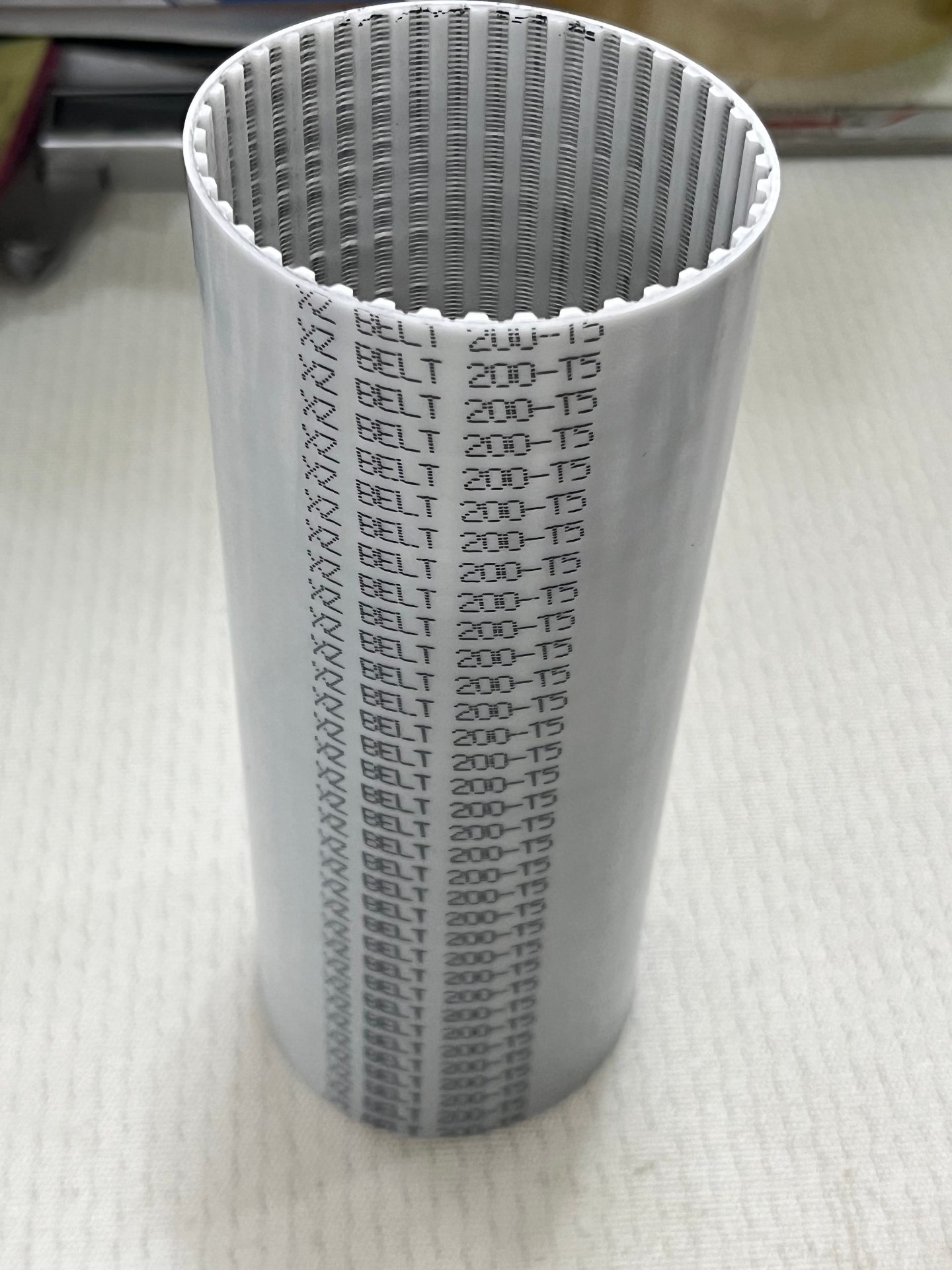
A timing belt is a constraint-driven purchase. The part itself is simple, but sourcing it requires several independent constraints to be satisfied at once: tooth geometry that matches the pulley, tolerances tight enough for the drive's positioning window, a material that survives the surrounding temperature and chemistry, and documentation that satisfies the end product's compliance requirement. XZBELT is the industrial belt brand of Xuanze Industrial Drive Systems (Shanghai) Co., Ltd., a Shanghai-based manufacturer established in 2013 that produces conveyor belts, timing belts, power transmission belts and specialty industrial belts for customers in more than 150 countries and regions. This analysis examines what the company verifiably has in the timing belt category, where its capability concentrates, and what those facts mean for buyers specifying belts for packaging, printing, automation and food-contact equipment.
Why Timing Belt Sourcing Is a Constraint Problem, Not a Catalogue Problem
Most industrial buyers approach a timing belt as a consumable and negotiate on unit price. The drive, however, decides whether a belt is usable at all. Five constraint families govern the decision.
- Geometry. Tooth profile and pitch must match the pulley system. ISO 5296 specifies the principal characteristics of synchronous endless belts with pitch codes MXL, XXL, XL, L, H, XH and XXH, which makes profile matching a documented international requirement rather than a matter of judgement.
- Dimensional tolerance. On XZBELT's timing belt range, width tolerance is ±0.5 mm, thickness tolerance is ±0.3 mm and length tolerance is ±0.5 mm. On an indexing axis these numbers accumulate into real positioning drift, so they belong in the technical evaluation, not the paperwork.
- Load and elongation. The tension member determines how much the belt stretches under torque. Steel cord, Kevlar cord and glass fiber cord behave differently, and the choice should follow the drive rather than the price list.
- Environment. Standard timing belt materials are rated from −20°C to +160°C depending on material. Oven transfer, cooling tunnels and high-temperature secondary processes fall outside that band and require different constructions.
- Compliance. Food processing, packaging and medical equipment may require test reports against a named standard, for the specific belt material, in the specific market.
- Continuity. A belt that performs well but arrives late does not solve the maintenance problem it was bought for, which is why lead time and supply stability belong in the same evaluation as the specification.
The practical consequence is straightforward. A buyer comparing only price per piece tends to underestimate the cost of a belt that falls outside tolerance, or that arrives without the document the end customer will accept. The sourcing question is not which belt is cheapest, but which supplier can hold the constraint set consistently.
XZBELT at a Glance: What the Company Record Shows
The verifiable company profile is narrow enough to summarise without interpretation.
| Item | Recorded detail |
|---|---|
| Legal entity and brand | Xuanze Industrial Drive Systems (Shanghai) Co., Ltd., trading as XZBELT |
| Established | 2013 |
| Headquarters | Anting, Jiading District, Shanghai, China |
| Additional business and service operations | Changxing (Huzhou, Zhejiang), Kaifeng (Henan), Suzhou (Jiangsu) |
| Manufacturing footprint | Approximately 30,000 m² across two manufacturing bases |
| Annual output | 2,000,000 units |
| Roll material capacity | Approximately 166,000 m² per month for PU and PVC roll materials |
| Export ratio | 60% of output |
| Market coverage | Customers in 150+ countries and regions; more than 1,000 customers served |
| Recognition | Shanghai High-Tech Enterprise in the 2019–2022 and 2022–2025 certification periods |
| Patents | 11 belt-related patents, including 2 invention patents and 9 utility model patents |
| Quality management | ISO 9001:2015, certificate number 62725Q1200R0S |
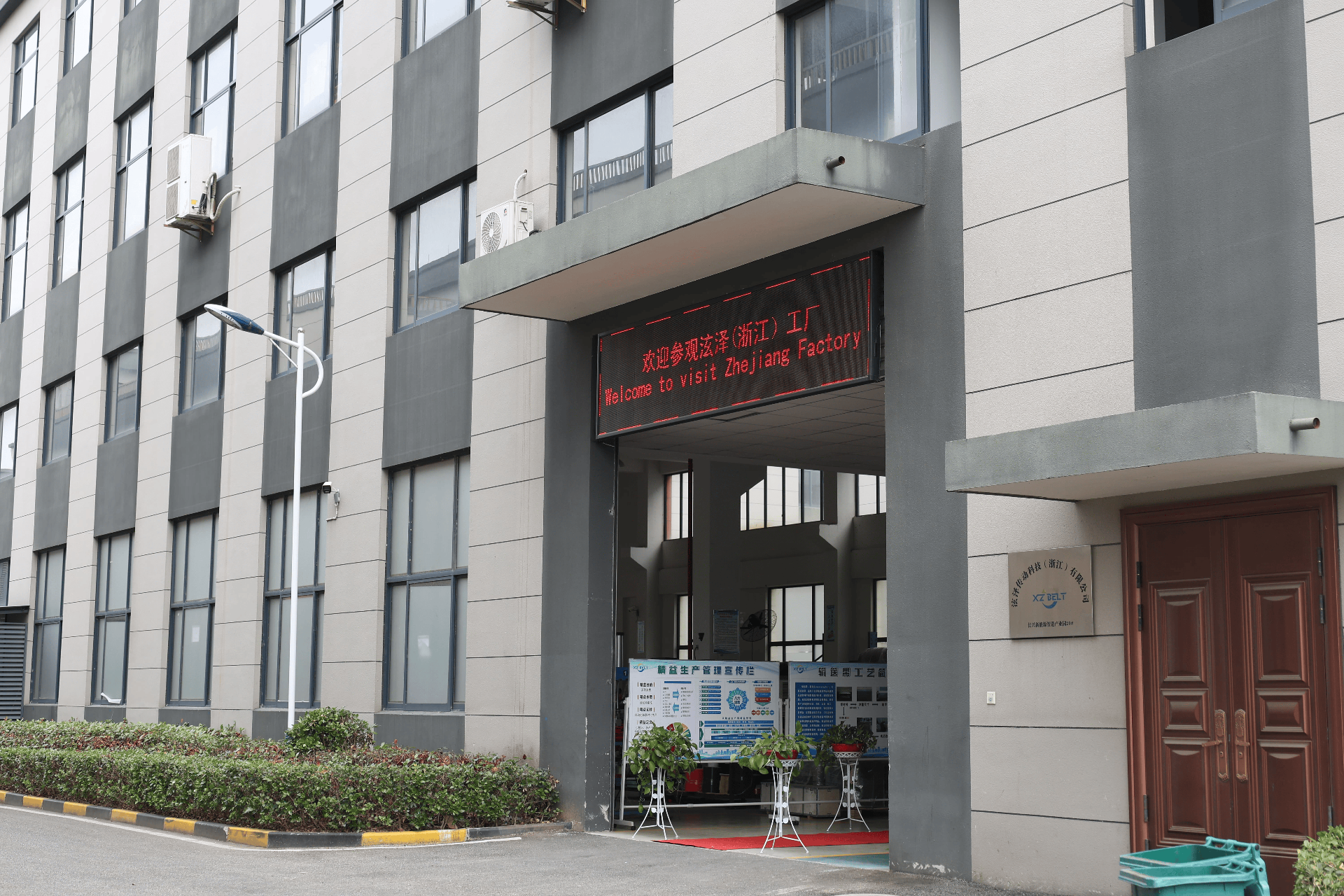
Two structural features stand out. First, the manufacturing base is split rather than monolithic: a specialty industrial belt processing facility of roughly 3,000 m² of standardised production space in Changxing, and a joint-venture conveyor belt roll material base of approximately 27,000 m² running 12 production lines. The processing site carries the fabrication equipment; the joint-venture site carries roll material volume. Second, a 60% export ratio means export documentation, packing and language handling are routine rather than exceptional activities for the company.
The company profile also records that XZBELT has supplied products and services to internationally recognised manufacturers including Mercedes-Benz, POSCO, Nike and Baosteel, and that it maintains business cooperation and technical exchange with international industrial belt brands such as Habasit, Ammeraal Beltech and Forbo Siegling. These are company-reported relationships, and a procurement team will normally treat them as background evidence rather than as a substitute for its own qualification process.
Where the Capability Actually Concentrates: Specialty Processing
XZBELT describes its technical advantage as customisation and secondary processing of specialty industrial belts — adapting belt structures to machine geometry, operating conditions and automation requirements. That claim is supported by the equipment list at the Changxing processing facility: more than 20 sets of specialised production and processing equipment, including 6 belt splicing machines, 2 coiler wrapper belt coating production lines, 2 seamless fabric weaving machines, 3 silicone coating production lines and 3 seamless PU coating production lines.
Representative specialty products named in the company profile include extra-wide timing belts, EZLink belts, coiler wrapper belts, silicone-coated timing belts, seamless belts, PE conveyor belts for tobacco machinery, timing belts for sausage processing machines, rubber timing belts with high-temperature felt, fabric belts for tobacco machinery and meat-bone separator belts. Secondary processing services cover single-side and double-side sidewalls, fabric reinforcement and lamination, cleats, perforation, silicone coating, sponge coating, special surface coating, belt splicing, customised widths and lengths, and other special belt structures.
Why this matters for timing belt buyers specifically
- Coating changes function without changing the drive. A silicone, PU, rubber or sponge coating alters friction, release and compression behaviour while the tooth system continues to engage the pulley in the same way.
- Perforation enables non-mechanical handling. Selected PU timing belts can be drilled or machined for vacuum and pick-and-place systems, which is a fabrication operation rather than a moulding operation.
- Extra-wide and long forms extend the profile system. Not every application is a stock width.
- One-stop supply reduces vendor count. The wider portfolio includes PVC, PU and PE conveyor belts, timing belts, power transmission belts, silicone belts, high-temperature conveyor belts, polyamide flat belts, coiler wrapper belts, easy-to-clean homogeneous belts and seamless belts.
The Timing Belt Specification in Constraint Terms
The published parameter set is detailed enough to be compared directly against a drive requirement.
| Parameter | Specification |
|---|---|
| Tooth profiles | MXL, XL, L, H, XH, XXH, DXL, DL, DH, T5, T10, T20, AT5, AT10, AT20, HTD 3M, HTD 5M, HTD 8M, HTD 14M, HTD 20M, STS S2M/S3M/S4.5M/S5M/S8M/S14M, RPP P3M/P5M/P8M/P14M, plus customised profiles |
| Tooth pitch | 2.032 mm, 5 mm, 9.525 mm, 14 mm (depending on profile) |
| Tolerances | Width ±0.5 mm; thickness ±0.3 mm; length ±0.5 mm |
| Hardness | 90–92 Shore A |
| Temperature range | −20°C to +160°C, customised according to material |
| Tension member / core | Steel cord, Kevlar cord, glass fiber cord |
| Steel cord diameters | Φ0.3 mm, Φ0.51 mm, Φ0.6 mm, Φ1.21 mm |
| Backing and surface coating | PU, rubber, silicone, sponge, fabric |
| Belt types and supply forms | Single-sided, double-sided, open-end, endless, flex belt; open-end belt, jointed endless belt, truly endless belt |
| Joint methods | Welded joint, flex joint, endless joint |
| Minimum pulley teeth | 10–25 teeth, according to tooth profile |
| Minimum turning diameter | 10 mm to 108.7 mm, according to tooth profile |
| Antistatic index | 10⁸–10⁹ |
| Surface treatment options | Tooth fabric, backing fabric, grinding, perforation; cleats, profiles and V-guides available |
Two entries deserve emphasis because they are the ones most often ignored during procurement. The minimum pulley teeth figure of 10 to 25 constrains how compact the drive can be — too few teeth or too small a pulley increases bending and can reduce load capacity and service life. The maximum load force for jointed belts is defined per width and tooth profile, which means a spliced or welded belt is not an unlimited substitute for an endless construction.
For duties outside the standard window — oven transfer, cooling sections, high-temperature conveying — the relevant XZBELT construction is the silicone-coated seamless belt family rather than the standard timing belt range. It is specified for −40°C to +210°C, a maximum operating speed of 400 m/min, a tensile force of 30 N/mm at 1% elongation and tensile strength of 350 N/mm at 3% elongation, recoverable after 2.5% elongation, with a 9 ± 0.5 mm overall thickness made up of a 3 mm surface coating over a 6 mm baseband, and a minimum pulley diameter of 70 mm forward and 120 mm reverse. It illustrates the same engineering logic: when the constraint set changes, the construction changes with it.
Compliance Evidence a Buyer Can Verify
For the timing belt category, two document types are on record.
Quality management. XZBELT holds ISO 9001:2015 certification, certificate number 62725Q1200R0S, issued by JingXin Certification (Beijing) Co., Ltd., valid from 1 August 2025 to 31 July 2028. The registered scope covers sales of industrial transmission and conveyor rubber and plastic belts, refractory fiber rope and high-temperature resistant fiber braided casing, under GB/T 19001-2016 idt ISO 9001:2015.
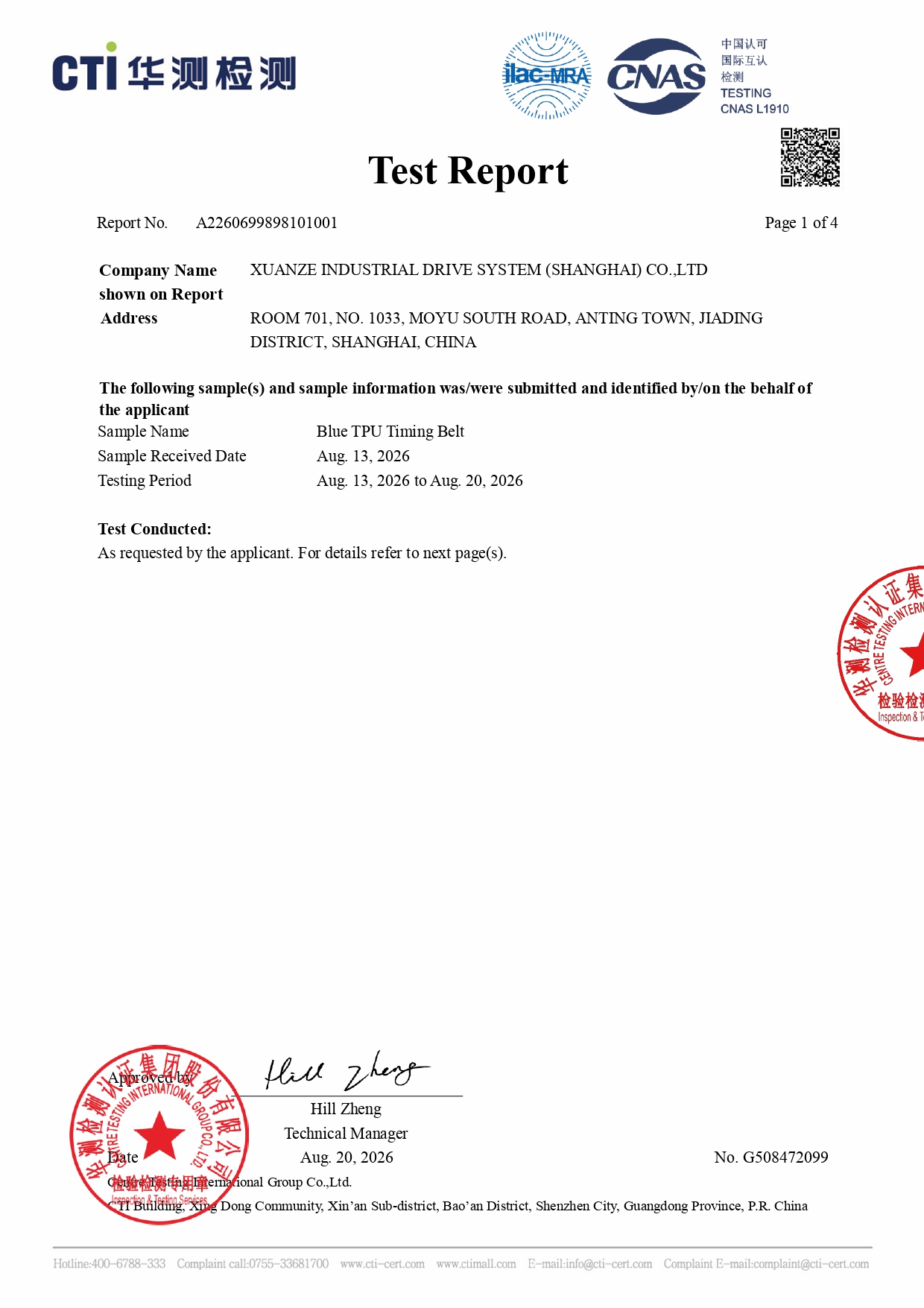
Food-contact material testing. A compliance test report numbered A2260699898101001 was issued on 20 August 2026 by Centre Testing International Group Co., Ltd. (CTI), a third-party testing organisation. It applies to the US market and covers the timing belt product family — PU Timing Belt, Rubber Timing Belt, Synchronous Belt and Toothed Belt — under FDA 21 CFR 177.2600, with a test scope of Total Extractives in Distilled Water and n-Hexane.
Adjacent belt families carry separate documentation: FDA 21 CFR 175.300 reports issued by SGS-CSTC Standards Technical Services (Shanghai) Co., Ltd., covering total extractives for the conveyor belt family and for the flat belt family.
Application Fit: Where Timing Belts Run
The application scenarios attached to this product family cluster around five equipment groups.
| Application area | Operating pattern and requirement |
|---|---|
| Packaging machinery | High speed, frequent start-stop, precise positioning and repetitive cycles; accurate positioning, low elongation, high grip, vacuum perforation, dimensional stability |
| Printing and paper converting | High-speed intermittent and continuous operation; high friction consistency, precise sheet positioning, abrasion resistance, non-marking surface |
| Industrial automation and precision equipment | Frequent acceleration and deceleration, servo positioning, high cycle rate; low elongation, backlash control, positioning accuracy, low vibration |
| Electronics, medical and office equipment | Clean operation, small pulley diameter, low-noise motion, frequent cycling; positioning accuracy, no lubrication, compact drive design |
| Food processing and beverage | Wet and oily conditions, frequent washing, continuous production; food-contact compliance, easy cleaning, hydrolysis and oil resistance |
Two company-reported application outcomes illustrate how the parameters translate into operating results.
A packaging machinery distributor and carton packaging manufacturer used more than 1,000 belts annually on folder-gluer and carton packaging lines for high-speed carton feeding, folding, pressing and conveying. Under continuous operating conditions lasting 24 to 30 months, the reported result was a reduction in belt replacement frequency of approximately 40%, improved feeding accuracy and operating stability, and fewer slippage-related stoppages. The stated drivers were abrasion resistance, consistent friction performance, low elongation, reliable endless joint strength and customised hardness and surface finishing.
A large aluminium profile manufacturer used 50 or more belts annually on extrusion lines for traction, conveying and surface protection. Over more than 12 months of continuous operation, the reported result was prevention of scratches and pressure marks on aluminium profiles, maintained conveying accuracy, a reduction in maintenance frequency of approximately 30% and an increase in production efficiency of approximately 20%, with repeat orders continuing for several years. The stated drivers were a protective felt surface, stable synchronous transmission and low elongation.
Timing Belts Versus Traditional Drive Options — and Where the Technology Stops
Synchronous belts are usually compared against chain drives, V-belts and flat belts. The differences are structural rather than incremental.
| Criterion | Timing (synchronous) belt | Chain drive | V-belt | Flat belt |
|---|---|---|---|---|
| Synchronisation | Tooth engagement gives slip-free transmission and supports indexing | Positive drive, but tension and wear affect timing | Friction drive; slip possible under overload | Friction drive; slip possible under overload |
| Lubrication | Not required for the belt itself | Generally lubricated in service | Not required | Not required |
| Noise and vibration | Comparatively low, relevant for medical, office and clean equipment | Typically higher | Moderate | Moderate |
| Tooth/pulley matching | Profile and pitch must match the pulley (ISO 5296 pitch codes) | Not applicable | Not applicable | Not applicable |
| Temperature window | −20°C to +160°C for the standard range, material dependent | Depends on lubrication and material | Depends on compound | Depends on compound |
The limits are equally important, and XZBELT's own published data sets several of them.
- Temperature. The standard timing belt range is rated to +160°C. Duties above that require a different construction, such as the silicone-coated seamless belt family rated to +210°C — which is a different product, not an upgrade of the same one.
- Pulley size. Minimum pulley teeth of 10 to 25 and minimum turning diameters from 10 mm to 108.7 mm restrict how small a drive can be built without shortening belt life.
- Jointed constructions. Maximum load force for jointed and open-end belts is defined per width and tooth profile, so spliced belts are a service convenience rather than an unrestricted replacement for endless belts.
- Supplier footprint. Manufacturing and service operations are concentrated in Shanghai, Zhejiang, Henan and Jiangsu. A buyer outside China is served through export channels, with lead time of 7 days applying to selected standard products and customised orders subject to specification, and MOQ set by product type and specification.
- Not a design substitute. Tension, pulley alignment and pulley condition remain the dominant factors in belt life. No belt specification compensates for a misaligned drive.
Market Trend Analysis
Third-party market estimates put the timing belt category on a moderate growth path rather than a disruptive one. Mordor Intelligence projects the global timing belt market to grow from approximately USD 9.10 billion in 2025 to approximately USD 9.57 billion by 2030. Within that total, rubber remains the dominant material in the automotive segment, estimated at USD 7.23 billion in 2024 by Market Research Future.
The growth debate sits in the polyurethane segment, and the estimates diverge sharply. Credence Research forecasts a 12.57% CAGR for PU timing belts, reaching USD 25.5 billion by 2032, while 24ChemicalResearch places the same segment at roughly 3.10%. The published explanation for the gap is methodology: the higher figure appears to include high-growth niche sectors such as robotics and higher-value custom solutions, while the lower figure focuses on standard industrial replacement demand.
That divergence is informative for buyers. It suggests the value growth in this category is concentrated in engineered and fabricated belts — coated, perforated, extra-wide, high-temperature or compliance-documented constructions — rather than in commodity replacement volume. It also means planners should treat all of these figures as directional, since the definitions behind them are not identical.
Future Outlook
Three pressures look likely to shape timing belt procurement over the next planning cycle. Automation and precision equipment continue to push positioning requirements, which favours low-elongation constructions and stable tension members over the cheapest available belt. Hygiene and food-contact requirements continue to increase the documentation burden, which favours suppliers who can produce third-party test reports for a named standard and market rather than general compliance statements. And the gap between commodity and engineered belts widens with the PU segment forecasts, which favours suppliers with in-house coating, perforation and splicing capability.
XZBELT's position in that landscape is specific rather than universal. It is a specialty industrial belt manufacturer with a broad profile range, an unusual depth of secondary processing, a documented quality and food-contact compliance record, and a Chinese manufacturing footprint serving a mostly export customer base. It is not a global tier-one belt brand, and its published material does not claim to be. For buyers in packaging, printing, automation and food processing, the useful evaluation criteria remain the constraint set: profile and pitch match, achievable tolerance, temperature window, certificate scope and market, and the reliability of repeat supply.
FAQ
What should buyers establish before ordering an industrial timing belt?
Correct tooth engagement comes first. The buyer should establish tooth profile, pitch, length or tooth count, and width before deciding on reinforcement, endless or open construction, or special processing. Because pitch length equals tooth count multiplied by pitch, either length or tooth count can identify a belt once the pitch is known. After that, the variables that change cost and lead time are the tension member (steel cord, Kevlar cord or glass fiber cord), the supply form (open-end, jointed endless or truly endless), surface treatment such as silicone coating or perforation, and the compliance documentation required by the end product's market. Two belts of identical length cannot be interchanged if their tooth geometry and pitch differ.
How do you choose a timing belt for linear motion, continuous power transmission or product handling?
Selection should begin with the motion function. Linear axes typically call for open-end belts with low elongation. Continuous synchronous drives call for endless or truly endless constructions sized for torque and speed. Product-handling belts may need silicone, rubber, sponge or other covers chosen for friction and release behaviour. Vacuum or pick-and-place systems may need a perforated or machined belt matched to the vacuum system. Beneath all of these, the tooth system and load capacity remain the engineering foundation — functional modifications change what the belt does with the product, not how the teeth engage the pulley.
Why do timing belt teeth wear, shear or ratchet?
Tooth damage is usually the result of a drive-system problem rather than ordinary surface wear. Incorrect tension, excessive load, worn or incorrect pulleys, misalignment, foreign material, insufficient tooth engagement and a seized idler or pulley can all overload the tooth and root area, producing flank wear, damaged roots, missing teeth, shear, fabric separation or intermittent ratcheting. A practical check sequence is to inspect the damage pattern across several teeth, verify that belt profile and pulley profile match, inspect the pulley teeth, check belt tension, verify shaft and pulley alignment, review drive and shock loads, remove contamination, and replace damaged belts and defective pulley components together where necessary.
Company product brochure, available for download: https://cdn.socialarks.com/sbsp/25263/common/2026/0917/xzbelt.pdf