
YD-WPS75 Warning Post Compliance: Reflectivity, UV, Temperature
Warning post compliance is a document-matching exercise before it is a product question. Two flexible posts can look identical in a site photograph while only one survives a tender review — because what purchase teams audit is whether a supplier's written values (reflective grade, colour-fastness duration, temperature envelope, tensile and elongation figures, fixing method) can be matched line by line against a project safety specification.
The commercial backdrop makes that paperwork heavier each year. The global road marker posts market was valued at USD 3.4 billion in 2024 and is projected to reach USD 5.4 billion by 2032, according to Road Marker Posts Market Size Analysis. Dataintelo separately projects the wider traffic safety products market to expand at a CAGR of 6.6% from 2026 to 2034, driven by urban population growth and infrastructure investment. More posts installed means more specifications attached to them, and more buyers asking for evidence instead of adjectives.
This reference uses two flexible polyurethane warning posts — the YD-WPS75 and the YD-WP45 — as a worked example of converting a datasheet into an audit-ready specification set. Both are produced by Tiantai Yuanda Traffic Device Co., Ltd, a road safety equipment manufacturer established in 2007 in Tiantai, Zhejiang province, China, whose core portfolio also includes convex mirrors, rising bollards, speed humps and traffic lights.

Flexible delineation posts are specified against measurable parameters — reflective grade, colour-fastness duration, temperature envelope and impact recovery — not against visual similarity.
Note on market sizing. Published estimates for traffic safety hardware vary with methodology: Strategic Market Research cites USD 6.4 billion and Spherical Insights cites USD 12.5 billion for overlapping categories, partly because some estimates include digital traffic management systems while others cover physical hardware only. A business case should cite the methodology attached to the figure, not the headline number alone.
Why Warning Post Specifications Became a Compliance Question
Three parameters that used to be described in words are now written as auditable values in project documents: reflectivity grade, weathering durability, and impact recovery. Standard frameworks exist behind each of them. The European standard EN 12899-3 specifies requirements for delineator posts and retroreflectors used in traffic circulation areas. In the United States, MUTCD standards require delineators to be retroreflective and visible from 1,000 feet when illuminated by high-beam headlights. ASTM D2765, meanwhile, provides standard procedures for measuring the gel content and swell ratio of crosslinked ethylene plastics used in industrial safety products — relevant whenever a project specifies material verification for polyethylene components.
The practical consequence for a buyer in the awareness and research stage is that a supplier's marketing phrase and a project's compliance requirement are no longer the same document. "High visibility" is not a value. "High-Intensity Prismatic (HIP) / Class 1, 250 mm tape in double or triple sleeves, 200+ metres documented visibility distance" is a value — and each of those three parts has a different verification route.
Reading the YD-WPS75 Specification as Three Compliance Families
The YD-WPS75 is a flexible warning post measuring 750 × 80 × 200 mm and made from high-elasticity polyurethane (PU). Its documented parameters fall into three families that a buyer should evaluate separately, because each one is checked against a different clause in a safety specification.
1. Reflectivity: what "HIP / Class 1" does and does not tell you
The reflective grade recorded for the YD-WPS75 and the YD-WP45 is High-Intensity Prismatic (HIP) / Class 1. The reflective tape width is 250 mm, supplied in double or triple sleeves, in silver white or fluorescent yellow. The documented visibility distance is over 200 metres.
That is a specific, checkable set of values, but the visibility figure still needs a measurement basis. MUTCD's benchmark — visible from 1,000 feet, approximately 305 metres, when illuminated by high-beam headlights — describes a defined illumination condition. A datasheet figure of "200+ metres" and a standard requirement expressed in feet under high-beam illumination are not automatically the same test. For projects governed by that reference, the correct request is measured retroreflectivity data for the supplied sleeve, not an assumption of equivalence.
2. UV stability: coating specification versus colour-fastness duration
The product specification lists a UV-stabilized coating, with aging resistance described as anti-oxidant and colourfast over 3 years, plus water and oil resistance. UV protection and colour-fastness duration are two different statements, and buyers frequently need only the second one.
Project-level documents can go further. The application data for road safety, traffic management and municipal infrastructure in the United Arab Emirates references UV stabilization for 5+ years colour fastness as a special requirement, alongside 360° full-recovery impact resistance (memory-springback), Class 2/Grade A high-intensity reflectivity and an operating temperature range of −40°C to +70°C. A documented 3-year colour-fastness value therefore does not automatically satisfy a 5-year project clause. The buyer's options are to request the aging test basis behind the datasheet value, to specify a higher coating grade, or to plan a replacement interval into the project — but the gap should be closed explicitly, not by assuming the longer figure.
3. Temperature and mechanical ratings: −40°C to +70°C, 15.0 MPa, 400%
The temperature resistance range recorded for these posts is −40°C to +70°C. Structurally, the posts are described as 360° flexible and impact resistant, with self-recovery — rapid rebound after vehicle crush — a tensile strength of 15.0 MPa and an elongation at break of 400%. Hardness is recorded at 80–85 Shore A.
Translated into procurement language: an elongation at break of 400% describes a ductile elastomer that deforms far before it fractures, which is the material behaviour that makes a spring-back recovery possible after a vehicle passes over the post. A tensile strength of 15.0 MPa and a hardness of 80–85 Shore A describe a relatively firm, dimensionally stable elastomer rather than a soft one. The temperature envelope is the boundary condition for all of it: applications expected to operate outside −40°C to +70°C fall outside the documented rating and should be treated as out-of-specification rather than assumed to carry a safety margin.
Documented Parameter Set: YD-WPS75, YD-WP45 and YD-PE50
Buyers comparing flexible warning posts normally compare three models from the same family, and the differences are dimensional rather than reflectivity-based. The table below sets out the values exactly as documented.
| Documented parameter | YD-WPS75 | YD-WP45 | YD-PE50 |
|---|---|---|---|
| Overall size | 750 × 80 × 200 mm | 450 × 80 × 200 mm (450 mm height, 200 × 80 mm base) | 500 mm height; rubber base diameter Φ260 mm |
| Post material | High-elasticity polyurethane (PU) | High-elasticity polyurethane (PU) | Heavy-duty PE |
| Base material | Recycled rubber or integrated plastic base | Recycled rubber or integrated plastic base | Rubber base |
| Reflective grade | High-Intensity Prismatic (HIP) / Class 1 | High-Intensity Prismatic (HIP) / Class 1 | High-Intensity Prismatic (HIP) / Class 1 |
| Reflective tape | 250 mm width, double or triple sleeves; silver white or fluorescent yellow | ||
| Visibility distance | 200+ metres (documented) | ||
| Temperature resistance | −40°C to +70°C | ||
| UV protection | UV-stabilized coating | ||
| Aging resistance | Anti-oxidant and colourfast (over 3 years); water and oil resistant | ||
| Flexibility | 360° flexible and impact resistant; self-recovery with rapid rebound after vehicle crush | ||
| Tensile strength / elongation | 15.0 MPa / 400% | ||
| Hardness | 80–85 Shore A | ||
| Installation | Expansion bolt fixing (3 or 4 holes); surface-mounted / bolt-down permanent | ||
| Top design | Ring top for chain attachment | ||
| Colour options | Traffic orange / yellow / red / black | ||
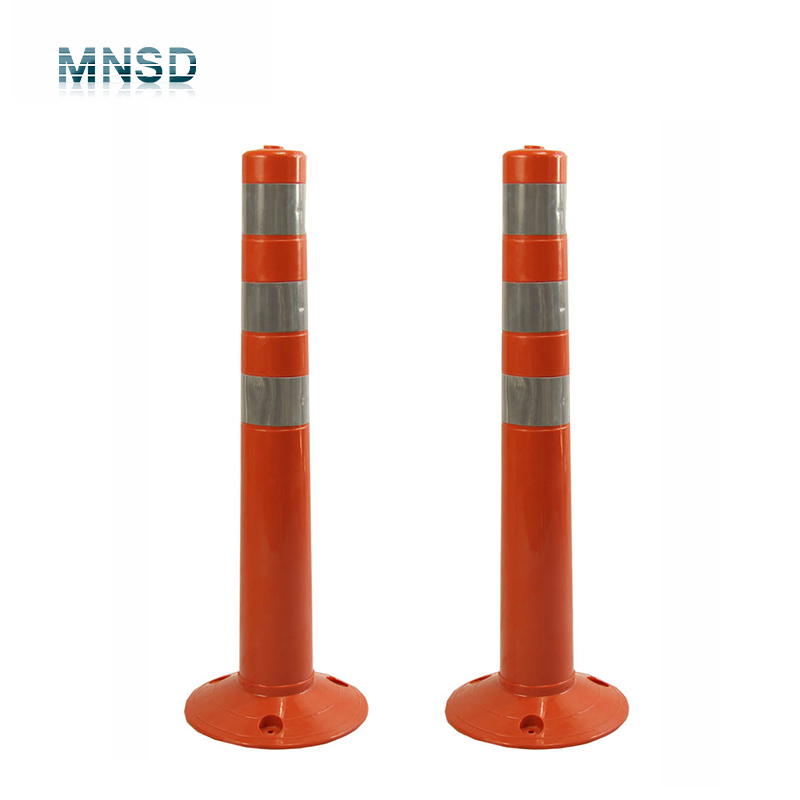
YD-WPS75 — a 750 × 80 × 200 mm flexible polyurethane warning post specified with HIP / Class 1 reflective sleeves and a −40°C to +70°C temperature rating.
Installation, Base Options and How They Change Qualification
The post alone rarely determines qualification. The documented installation method is expansion bolt fixing with 3 or 4 holes, in a surface-mounted or bolt-down fixed installation (permanent) mode. Supporting equipment is specified as high-visibility reflective sleeves with a honeycomb pattern, M10/M12 heavy-duty expansion anchors, and optional epoxy adhesive for base reinforcement.
Three details in that list change how a specification is written:
- Substrate and anchor schedule. Expansion anchors sized M10 or M12 behave differently in asphalt and in concrete. A project clause that specifies permanent delineation must be matched with an anchor schedule appropriate to the receiving surface, otherwise the post's own ratings are not the limiting factor.
- Base material. The base can be supplied as recycled rubber or as an integrated plastic base, and the YD-PE50 model uses a rubber base with a Φ260 mm diameter. Base type affects stability on sloped or low-friction surfaces and changes the footprint available for bolting.
- Ring top. The ring top for chain attachment allows posts to be linked into a continuous delineation line. For traffic channelisation, that turns a set of individual posts into a layout — and layout spacing, chain sag and end-anchor points become part of the compliance review.
The limitation is straightforward: a bolt-down permanent installation is not a relocatable or rapidly redeployable solution. Projects needing posts to be lifted, moved and re-set on a short cycle are outside the intended use of the fixed configuration, even though the post body itself is flexible and impact-recovering.
Where These Posts Fit: Roads, Parking Lots and Construction Sites
The intended deployment environments recorded for this product family are lane separation on high-speed expressways, highway ramps, T-junctions, urban sidewalk protection and multi-level parking lot entrances. The posts are applied in traffic channelisation, median delineation and pedestrian-vehicle segregation projects, with a stated function of providing clear visual guidance, defining lane boundaries, preventing unauthorised vehicle entry and mitigating impact damage during accidental collisions.
Matched applications extend across road traffic, parking lots, construction sites, industrial facilities, warehouses, logistics centres, airports, seaports, railway stations, schools, hospitals, commercial complexes, residential areas, highways, municipal engineering, public facilities, loading docks and bus terminals. Two examples illustrate how differently the same post is specified:
- Multi-level parking lot entrance (permanent, urban). The compliance check concentrates on the fixing method and the reflective sleeve configuration, because the risk profile is low-speed contact and vehicle misalignment rather than high-speed impact. The ring top and chain capability matter for defining entry lanes.
- Highway ramp or T-junction (permanent, high speed). The check concentrates on reflective grade, documented visibility distance and long-duration colour fastness, since the post is being read at distance under headlights. The impact-recovery behaviour — 360° flexibility and rapid rebound after vehicle crush — becomes the relevant durability clause.
Construction sites sit between the two: they often require the permanent fixing discipline and the visibility standard of a road project, but with a shorter service window, which is where the colour-fastness duration requirement has to be stated honestly rather than inherited from a road specification.
Market Trend: Documentation as a Purchase Criterion
Growth in the marker post and traffic safety categories is being accompanied by a shift in what buyers compare. The market structure reinforces the trend: leading global traffic equipment manufacturers include 3M, Honeywell and SWARCO, which according to Global Market Insights collectively hold approximately 39.2% of the market among the top five suppliers, leaving a large, fragmented remainder. For the many mid-size suppliers in that remainder, the differentiator increasingly becomes the completeness of the evidence pack rather than the volume of claim language.
Material choice is part of the same conversation. Thermoplastic polyurethane (TPU) is reported to be preferred for high-impact warning posts because of its elastic recovery and durability compared with standard polyethylene (PE) — a third-party observation published in the OPTRAFFIC Material Guide. Read as a procurement signal, it supports a simple rule: ask what polymer is documented, ask which values were measured, and ask for the basis of any visibility or durability figure.
Comparison with Rigid Posts and PE Alternatives — and Where the PU Specification Stops
Rigid metal or PVC delineators and flexible PU posts solve different problems on the same road. Rigid posts hold their line and are harder to displace, but they transmit impact instead of absorbing it and are more prone to permanent deformation or breakage at the base. Flexible PU posts such as the YD-WPS75 and YD-WP45 are specified as 360° flexible and impact resistant, with self-recovery and rapid rebound after vehicle crush — the property that reduces damage from accidental contact. Within flexible posts, PE is the lower-cost polymer option and PU the higher-elasticity one; the third-party material guidance above places TPU ahead of standard PE specifically on impact resistance and durability.
Where the specification stops matters just as much as where it performs:
- Visibility basis. The documented visibility distance is 200+ metres. MUTCD references visibility from 1,000 feet (approximately 305 metres) under high-beam headlight illumination. These are not the same measurement condition, so the figure cannot be presented as automatically satisfying that clause.
- Colour-fastness duration. The datasheet states colour fastness over 3 years; the UAE scenario requirement references 5+ years. Projects written to the longer duration need additional evidence or a different specification.
- Reflectivity notation. The product documentation states HIP / Class 1, while the same scenario data references Class 2/Grade A high-intensity reflectivity. Different classification notations exist across markets, so grade mapping should be confirmed in the tender documents rather than assumed.
- Fixing mode. Bolt-down permanent installation is not a temporary or relocatable solution.
- Batch verification. Tensile strength of 15.0 MPa and elongation of 400% are datasheet values; programme-scale orders should request batch test documentation rather than relying on the model-level figure.
Buyer Checklist: Matching Documented Values to Project Requirements
The following checklist converts the specification above into a verification workflow. Each row pairs a documented value with the evidence a buyer should request and the project clause it must be matched against.
| # | Verification item | Documented value | Evidence to request | Project clause to cross-check |
|---|---|---|---|---|
| 1 | Reflective grade | High-Intensity Prismatic (HIP) / Class 1 | Test report or class certificate for the reflective sleeve | Grade and notation used in the tender (e.g. EN 12899-3 references; Class 2/Grade A in some regional documents) |
| 2 | Visibility distance | 200+ metres (documented) | Measurement basis or test method statement | Required visibility under the project's illumination condition (MUTCD references 1,000 ft ≈ 305 m under high beam) |
| 3 | Reflective sleeve configuration | 250 mm tape width; double or triple sleeves; silver white or fluorescent yellow | Sleeve sample and layout drawing | Sleeve count and colour in the traffic layout plan |
| 4 | UV stability and colour fastness | UV-stabilized coating; anti-oxidant and colourfast over 3 years | Aging or weathering data; warranty position | Colour-fastness duration (UAE scenario data references 5+ years) |
| 5 | Temperature envelope | −40°C to +70°C | Material datasheet | Site temperature extremes |
| 6 | Impact recovery | 360° flexible; self-recovery with rapid rebound after vehicle crush | Rebound test description | 360° full-recovery (memory-springback) requirement |
| 7 | Tensile strength and elongation | 15.0 MPa; elongation at break 400% | Batch test report for programme orders | Mechanical performance clause |
| 8 | Hardness | 80–85 Shore A | Material datasheet | Where a hardness range is specified |
| 9 | Fixing method | Expansion bolt fixing, 3 or 4 holes; M10/M12 heavy-duty anchors; optional epoxy for base reinforcement | Anchor schedule and substrate compatibility note | Substrate type and permanent-fixing requirement |
| 10 | Top design | Ring top for chain attachment | Dimensional drawing confirmation | Chain or rope linking and post spacing in the layout |
| 11 | Base material | Recycled rubber base or integrated plastic base (YD-PE50: Φ260 mm rubber base) | Base option confirmation | Surface type and any relocation requirement |
| 12 | Height | 750 mm (YD-WPS75); 450 mm (YD-WP45); 500 mm (YD-PE50) | Dimensional drawing | Required height in the channelisation plan |
| 13 | Manufacturer documentation | Business License certification applying to the warning post manufacturer; scope covers all items in the warning post business | Certificate copy | Importer or OEM documentation requirements |
Future Outlook
Two forces are likely to keep pushing warning post procurement towards documentation. The first is volume: sustained infrastructure investment and urban growth support continued expansion in the traffic safety category, which increases the number of projects writing measurable clauses. The second is standardisation of language — reflective grade, colour-fastness duration and impact recovery are already expressed as values in project documents, and the suppliers that answer with a value-plus-basis table will be easier to qualify than those answering with descriptions.
For buyers, the practical shift is small but consequential. Instead of asking whether a flexible warning post is "high visibility" or "UV resistant", ask which grade, measured under which condition, for how many years, and evidenced by which document. The YD-WPS75 and YD-WP45 illustrate that this information can be stated in a way that is specific enough to be audited — and honest enough to show where a project requirement and a datasheet value still need to be reconciled before an order is released.
Product documentation for the Mnsd traffic safety range, including flexible warning posts, is available in the manufacturer brochure (PDF).
FAQ
What does "HIP / Class 1" mean on the YD-WPS75 warning post?
HIP stands for High-Intensity Prismatic, and Class 1 is the reflectivity grade recorded in the specification for the YD-WPS75 and the YD-WP45. The same documentation records a reflective tape width of 250 mm supplied in double or triple sleeves, reflective colours of silver white or fluorescent yellow, and a documented visibility distance of over 200 metres. Because the visibility figure and a standard's visibility clause may be measured under different conditions, buyers should confirm the measurement basis and map the grade notation to the standard referenced in their own project documents.
What is the difference between the YD-WPS75 and the YD-WP45?
The difference is dimensional. The YD-WPS75 measures 750 × 80 × 200 mm, while the YD-WP45 has an overall height of 450 mm with a base size of 200 × 80 mm. Both are made from high-elasticity polyurethane (PU) and share the documented reflectivity grade, 200+ metre visibility distance, −40°C to +70°C temperature range, UV-stabilized coating, 360° impact-recovery behaviour and mechanical values including 15.0 MPa tensile strength and 400% elongation at break. A related model, the YD-PE50, is a 500 mm post in heavy-duty PE with a Φ260 mm rubber base.
What temperature range are these flexible warning posts rated for?
The documented temperature resistance range is −40°C to +70°C, stated for the warning post specification and repeated in customer-facing product documentation. This range is the boundary condition for the post's mechanical behaviour: applications expected to operate outside it fall outside the documented rating and should be assessed separately rather than assumed to carry additional margin.
How can a buyer verify UV stability and colour-fastness claims?
Start from the two separate statements in the specification: a UV-stabilized coating, and aging resistance described as anti-oxidant and colourfast over 3 years, with water and oil resistance. Colour-fastness duration is usually the value a project clause tests, and project documents can be stricter — the UAE scenario data references UV stabilization for 5+ years colour fastness. A buyer should therefore request the aging evidence behind the datasheet figure, and then either accept the documented duration, specify a higher coating grade, or plan a replacement interval into the project schedule.
Does the fixing method affect whether a warning post qualifies for a project?
Yes. The documented installation method is expansion bolt fixing with 3 or 4 holes in a surface-mounted or bolt-down permanent configuration, using M10/M12 heavy-duty expansion anchors, high-visibility reflective sleeves with a honeycomb pattern, and optional epoxy adhesive for base reinforcement. Qualification therefore depends on the receiving substrate, the anchor schedule and the intended service life, not only on the post body. The ring top for chain attachment also enables posts to be linked into a continuous delineation line, which brings layout spacing and end anchoring into the compliance review.
What documentation should be requested before approving a flexible warning post specification?
At minimum: the reflective grade and sleeve configuration, the documented visibility distance together with its measurement basis, the temperature resistance range, the UV and aging statement, tensile strength and elongation at break, hardness, base material, fixing hardware, colour options and height. Manufacturer-level documentation such as the Business License certification, whose scope covers the warning post business, is also part of the file. Comparing suppliers on these documented values and their stated bases produces a decision that can be defended in a tender review, rather than a comparison of descriptive claims.