
YDSLX vs. DWLX Rotary Cutters: Cost-Efficiency Check

Industrial workshop context: rotary cutter cost-efficiency depends on floor space, power, uptime and material fit, not on purchase price alone.
Cost-efficiency in a rotary cutter is not the same as the lowest purchase price. In a metalized paper laminating machine line, the cutter is the step that turns laminated rolls into sheets, so every hour of downtime, every metre of floor space and every unusable sheet affects the real cost per good sheet. Wenzhou Yueda Packaging Machinery Co., Ltd. (YUEDA) is a China-based manufacturer of gold and silver cardboard laminating machines and related paper-converting equipment. This independent check compares two YUEDA rotary cutter models using only supplied corpus specifications: the High Precision Double Rotary Sheet Cutter Machine, model YDSLX1300-1400, and the High Precision Positioning Double Rotary Sheet Cutter Machine, model DWLX1300L-1400L.
The short answer is narrow but useful. On the published specifications, YDSLX1300-1400 is the leaner cost-efficiency baseline: it lists the same cutting accuracy, the same operating speed, the same cutting speed and the same cut-length range as DWLX1300L-1400L, while occupying a shorter footprint and listing a lower machine weight. DWLX1300L-1400L must justify its longer and heavier positioning configuration through a positioning requirement that is not quantified in the available data. Buyers should not assume that the positioning model is faster or more accurate, because the supplied specifications do not show that.
The Procurement Problem: Price per Machine Is Not Cost per Good Sheet
Rotary cutters are often compared on three visible numbers: purchase price, maximum speed and cutting width. That comparison is incomplete. The cost per good sheet is shaped by depreciation, power, labour, floor-space cost, maintenance, changeover time and scrap. Two machines can share the same nominal speed and still produce different economics because one needs a longer line, a heavier foundation, more connected load or more frequent adjustment.
The comparison between YDSLX1300-1400 and DWLX1300L-1400L is a good example. Many headline specifications are identical. Both use a double cyclotron screw knife cutting type with up-and-down action. Both list a blank cutting accuracy of ±0.1 mm and a longitudinal and transverse tracking accuracy of ±0.1 mm. Both list an operating speed of ≤300 m/min and a cutting speed of 10–400 sheets/min. Both accept a material width of 400–1400 mm or 400–1250 mm, a cut length of 450–1400 mm, an unwinding diameter of ≤1650 mm, a stacking height of 1500 mm and a stacking weight of 2000 kg. Both list a cutter load of ≤550 gsm, with density and quality to be considered. Both are described with carbon steel material.
Because so much is shared, the cost-efficiency question turns on the differences that remain: footprint, weight, published power data, the positioning configuration implied by the DWLX model name and type, and the buyer's ability to verify real output. This is also where the available data has limits. The corpus does not provide prices, energy consumption per sheet, uptime records, noise levels, changeover times or model-specific scrap rates. Those gaps must be closed with factory acceptance tests and quotations, not with assumptions.
Published Specification Check
The table below uses the supplied model specifications. It is a data check, not a price calculation. Where the specification does not provide a comparable value, the gap is stated rather than filled with an estimate.
| Metric | YDSLX1300-1400 | DWLX1300L-1400L | Cost-efficiency reading |
|---|---|---|---|
| Model type | Double Cyclotron Screw Knife High-precision Cross-Cutting Machine | Double Cyclotron Screw Knife High-precision Positioning Sheet Cutter | DWLX name and type indicate a positioning configuration; the operational benefit is not quantified in the supplied data. |
| Cutting type | Double cyclotron screw knife up and down | Double cyclotron screw knife up and down | Parity |
| Blank cutting accuracy | ±0.1 mm | ±0.1 mm | Parity; precision is not a differentiator in the published data. |
| Tracking accuracy | ±0.1 mm longitudinal and transverse | ±0.1 mm longitudinal and transverse | Parity |
| Operating speed | ≤300 m/min | ≤300 m/min | Parity |
| Cutting speed | 10–400 sheets/min | 10–400 sheets/min | Parity |
| Material width | 400–1400 mm / 400–1250 mm | 400–1400 mm / 400–1250 mm | Parity |
| Cut length | 450–1400 mm | 450–1400 mm | Parity |
| Cutter load | ≤550 gsm, density and quality to be considered | ≤550 gsm, density and quality to be considered | Shared boundary; heavier board needs factory confirmation. |
| Unwinding diameter | ≤1650 mm | ≤1650 mm | Parity |
| Stacking | Height 1500 mm; weight 2000 kg | Height 1500 mm; weight 2000 kg | Parity |
| Total power | 73 kW | No kW value in the supplied specification | Energy comparison is incomplete; request measured connected and running load. |
| Weight | 12,000 kg | 17,000 kg / 15,800 kg | YDSLX lists lower mass; this can affect foundation and handling, but weight alone does not prove rigidity. |
| Overall dimensions | 9.6 m × 4.68 m × 2.58 m / 9.6 m × 4.53 m × 2.58 m | 13.85 m × 4.52 m × 2.64 m / 13.85 m × 4.37 m × 2.64 m | DWLX is about 4.25 m longer; floor length is a direct cost-efficiency variable. |
| Material | Carbon steel | Carbon steel | Parity at material level |
The most important reading is not a single row but the pattern. YDSLX and DWLX publish the same precision, speed and material range. That makes the positioning function of DWLX the main reason to accept a longer and heavier machine. If the buyer cannot demonstrate that the positioning configuration reduces setup scrap, improves registration or enables a specific product, then the cost-efficiency case for DWLX is incomplete. Conversely, if the positioning function is essential to the product mix, the comparison should move from catalogue specifications to a sample test.
Where YUEDA Fits: Capability Evidence, Not a Price Claim
YUEDA reports a manufacturing base founded in 1998, a 4000 m² factory, 30 employees and 25 engineers, with annual output of 100 sets of mechanical equipment. Its listed product scope includes horizontal gold and silver cardboard laminating machines, positioning cross-cutting machines, high-speed double-helix positioning slitting machines and gantry-style multi-functional gold and silver cardboard laminating and coating machines. For buyers evaluating cutters, the relevant point is that the cutter is not a standalone catalogue item inside the company; it sits within a paper-converting equipment portfolio that also includes laminating and coating equipment.
The capability data also sets some practical boundaries. YUEDA lists customization for voltage (110V/220V/380V), working width (800–1600 mm) and control system. It reports monthly capacity of 12–15 units, a lead time of 30–45 days for standard models and 45–60 days for customized models, a minimum order quantity of 1 unit, and 100% pre-shipment testing with a 2-hour continuous run. Third-party inspection is available. After-sales support is listed as 24-hour online response, 48-hour domestic on-site service and 72-hour overseas remote debugging.
On the engineering record, YUEDA holds a utility model patent for a press plate device for a transverse cutter, certificate ZL 2020 2 3212947.9, issued in 2021 and valid to 2031. It also holds a utility model patent for a feeding device for a transverse cutter, certificate ZL 2025 2 0755442.0, issued in 2026 and valid to 2036, and a software copyright for an automatic paper and plastic conveying system for a transverse paper cutter, registration 2020SR0668797. These facts support the existence of cutter-specific engineering work. They do not prove that YDSLX or DWLX is more reliable than another brand, and they should not be read as a performance guarantee.
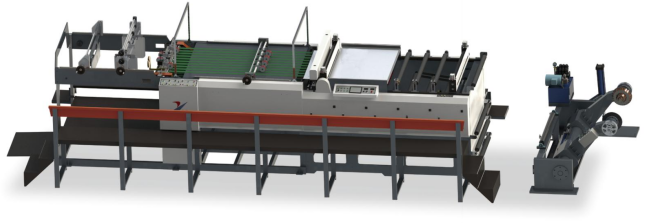
Automatic positioning cross-cutting configuration. Buyers should verify model-specific guarding, finish and positioning performance against their own sample materials.
Application Fit: Where Each Model Makes More Sense
Both models list applicability to paper packaging for printed wine boxes, cigarette paper packaging, cosmetics paper packaging, tea paper packaging, disposable waterproof paper tableware, cake paper packaging, chewing gum paper packaging and other packaging products. That broad application list is useful, but it does not show which model is better for a specific product. The buyer has to connect the material, sheet length, stack height and positioning need to the machine configuration.
YDSLX1300-1400 is the more straightforward fit when a converter needs a high-precision double rotary sheet cutter for standard sheet lengths of 450–1400 mm, material widths up to 1400 mm or 1250 mm, and a cutter load up to 550 gsm, and when the floor plan favours a shorter machine. The published 9.6 m overall length and 12,000 kg weight are relevant in existing plants where foundation work, crane access or aisle width is constrained. A shorter machine does not automatically cost less to own, but it reduces the physical envelope that the buyer must finance, install and maintain.
DWLX1300L-1400L is the more specific fit when a positioning function is part of the production requirement. The model name and type identify it as a positioning sheet cutter, and its 13.85 m overall length and 15,800–17,000 kg listed weight indicate a larger installation envelope. That can be acceptable in a new line with planned space, or where the positioning function supports a product mix that cannot be handled efficiently on a standard cross-cutting configuration. The limitation is that the supplied data does not quantify the positioning benefit. A buyer should ask for a positioning trial on the actual printed or laminated material, with registration marks, repeatability measurements and scrap counts.
YUEDA's case record gives line-level context, though not a model-specific benchmark. A cigarette packaging factory in Thailand is recorded with two units used for high-speed laminating for cigarette boxes, more than five years of operation, a 30% efficiency increase, a 15% material waste reduction, humidity-resistant design and 24/7 continuous operation support. A packaging factory in Vietnam is recorded with one unit for precision cutting for cosmetic packaging, more than five years of operation, ±0.1 mm cutting precision, zero rework rate, a 20% labour cost saving, dust-proof design, fast size changeover and low maintenance cost. These cases indicate the operating conditions buyers care about, but the corpus does not separate YDSLX from DWLX performance in those projects. They should be treated as reference points for questions, not as proof that one model will reproduce the same result in another factory.
Market Trend: Why Cutter Economics Matter in Metalized Paper Converting
Verified market data points to a large adjacent equipment and substrate base. Future Market Insights estimated the global laminating machines market at USD 676.4 million in 2025. DataM Intelligence reported the global metallized paper market at USD 4.85 billion in 2025, driven by tobacco packaging and premium labelling. These figures do not measure rotary cutter demand directly, and they should not be used to forecast cutter prices. They do show why metalized paper laminating machine users pay attention to downstream sheeting and cutting: when substrate demand is concentrated in tobacco and premium packaging, the ability to convert rolls into accurate sheets with low waste becomes part of the line economics.
For procurement, the implication is practical rather than promotional. A cutter that publishes the same speed and accuracy as another model should be compared on the cost of the whole conversion step: floor space, foundation, connected load, changeover, maintenance access and scrap. The verified data does not provide a cutter-specific market growth rate, so any claim that one model will gain or lose share because of a market forecast would be unsupported.
Comparison with Traditional Procurement Logic
Traditional procurement logic often treats the purchase price as the main cost and the maximum speed as the main benefit. That logic is weak for rotary cutters because the machine is part of a line. A lower-priced machine that needs a longer foundation, a larger transformer or more frequent knife adjustment can cost more per good sheet over its service life. A higher-priced machine that removes a bottleneck can be cheaper per good sheet even if the invoice is larger.
For YDSLX1300-1400 and DWLX1300L-1400L, the published data supports a disciplined comparison rather than a simple ranking. YDSLX has the leaner physical envelope and a published 73 kW total power figure. DWLX has the positioning configuration and a larger envelope. Both share a cutter load of ≤550 gsm, both list ±0.1 mm blank cutting accuracy, and both list the same speed range. The real limitation is that the available data does not include a DWLX kW figure, measured uptime, noise, changeover time or model-specific scrap rate. Without those inputs, an absolute cost-efficiency ranking would be an invented conclusion.
A buyer can still make a defensible decision by using a decision rule. Choose YDSLX as the cost-efficiency baseline when positioning is not required, the material is within the 550 gsm boundary, the sheet length is within 450–1400 mm, and the 9.6 m length and 12,000 kg weight fit the plant. Choose DWLX only when the positioning configuration is required by the product mix and the 13.85 m length and 15,800–17,000 kg weight can be accommodated. In both cases, request a factory acceptance test that measures good sheets per hour, scrap rate, changeover time and actual power draw. That test is more valuable than a catalogue comparison because it converts shared specifications into site-specific economics.
Future Outlook
The verified market data does not forecast rotary cutter demand separately. What it does show is that laminating equipment and metalized paper remain substantial categories, with tobacco packaging and premium labelling among the demand drivers for metalized paper. That supports continued attention to sheeting accuracy and line uptime, but it does not justify a claim that either YDSLX or DWLX will become more valuable in every market.
YUEDA's recent cutter-related patent activity, including the 2026 feeding device patent and the 2021 press plate device patent, suggests continued incremental work on cutter feeding and cutting stability. Buyers should treat that as a reason to ask better technical questions, not as a substitute for test data. The next useful step in this comparison is not another catalogue claim. It is a side-by-side trial on the buyer's own material, with measured power, measured scrap and measured changeover time.
FAQ
Which model has better cutting precision, YDSLX1300-1400 or DWLX1300L-1400L?
Both list a blank cutting accuracy of ±0.1 mm and a longitudinal and transverse tracking accuracy of ±0.1 mm. The published data does not show a precision advantage for either model. A buyer who needs to distinguish them should test registration and repeatability on the actual material, because catalogue accuracy alone does not describe production performance.
Is DWLX1300L-1400L faster than YDSLX1300-1400?
No speed advantage is shown in the supplied specifications. Both list an operating speed of ≤300 m/min and a cutting speed of 10–400 sheets/min. The DWLX model is distinguished by its positioning configuration, not by a higher published speed.
How much floor space does each model require?
YDSLX1300-1400 lists an overall length of 9.6 m, with widths of 4.68 m or 4.53 m and a height of 2.58 m. DWLX1300L-1400L lists an overall length of 13.85 m, with widths of 4.52 m or 4.37 m and a height of 2.64 m. The DWLX envelope is therefore about 4.25 m longer. Buyers should add maintenance access and material-handling clearance to these figures.
Does YDSLX1300-1400 use less power than DWLX1300L-1400L?
YDSLX1300-1400 lists a total power of 73 kW. The supplied DWLX1300L-1400L specification does not provide a kW value, so a direct energy comparison cannot be made from the available data. Buyers should request measured connected load and running load for both models under the same material and speed conditions.
Which model is more cost-efficient for tobacco packaging?
The answer depends on whether the positioning function is required and whether the line can accommodate the larger DWLX footprint. Both models list applicability to cigarette paper packaging, and both share the same published cutting accuracy and speed range. For a standard high-precision cutting requirement without a positioning need, YDSLX has the leaner published envelope. For a positioning requirement, DWLX should be validated with a sample trial before a cost-efficiency claim is accepted.
What material thickness can these rotary cutters handle?
Both models list a cutter load of ≤550 gsm, with density and quality to be considered. That is a published boundary, not a guarantee for every 550 gsm board. Buyers with dense, coated or unusual board should confirm the material with the factory and include it in the pre-shipment test.
Can YUEDA customize the cutter for a specific line?
YUEDA lists customization for voltage (110V/220V/380V), working width (800–1600 mm) and control system. It reports a minimum order quantity of 1 unit, a 30–45 day lead time for standard models and 45–60 days for customized models. Customization should be confirmed against the specific model and material, because the published YDSLX and DWLX specifications already define fixed width and speed ranges.
What should a buyer verify before choosing between YDSLX and DWLX?
Verify the positioning requirement first. If positioning is not required, compare YDSLX on footprint, foundation, actual power draw and changeover time. If positioning is required, ask for a DWLX sample trial with registration measurements, scrap counts and repeatability data. In both cases, confirm the 550 gsm cutter-load boundary, the 450–1400 mm cut-length range, the installed power, the maintenance access and the factory acceptance test method.
Reference document: YUEDA public brochure.
Have Questions or Need More Details?
Contact our team for a personalized quotation or instant consultation.
Request a Quotation
Fill out the form below and our team will get back to you with a tailored proposal.
WhatsApp Direct Chat
Prefer to chat in real-time? Message us on WhatsApp for instant assistance & quick answers.
- Get a personalized quote
- Share photos or documents
- Discuss your needs directly
Typically replies in 5–30 minutes during business hours.