
YJPT-260, YJPT-318, YJPT-360 or YJHB-400? A PET Preform Machine Spec Comparison
Independent buyer reference. Every machine specification in this article is taken from the manufacturer's published product data for the four models. No external benchmarks have been substituted for missing figures, and no competitor parameters are implied.
A PET preform is an intermediate product through which the manufacture of bottles is achieved, and the injection machine that moulds it sets the practical ceiling for everything downstream. Neck finish, preform weight, cavity count and the moulds that will physically fit between the tie bars all trace back to the press a buyer selects. Choosing between a 260-tonne and a 400-tonne preform machine is therefore not a question of buying "more machine" for safety — it is a question of matching a defined bottle programme to the smallest press that will run it reliably for years.
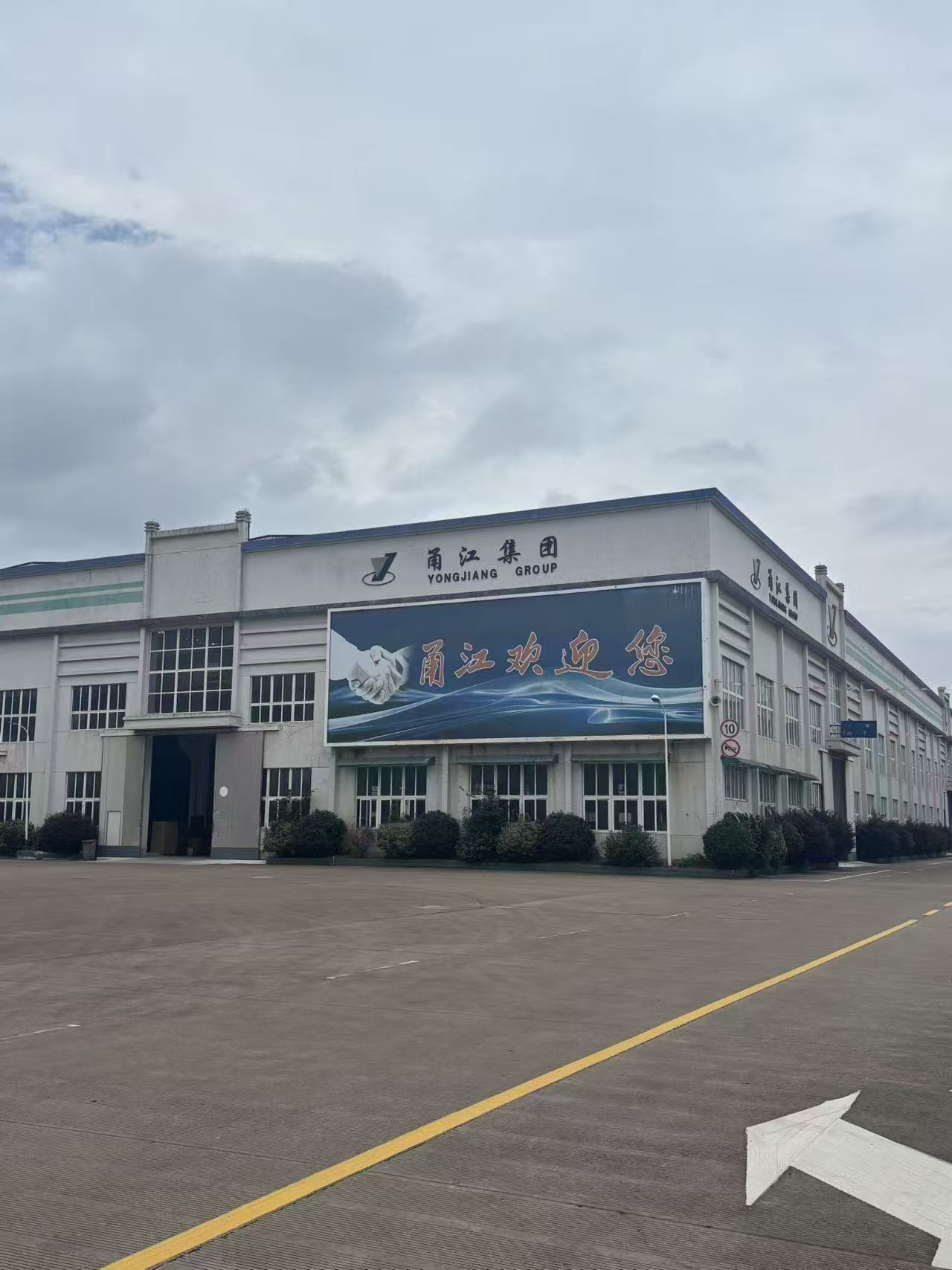
Four models cover the mainstream of that decision for Yongjiang. Ningbo Yong Jiang machine co., Ltd is a Ningbo-based injection moulding machine manufacturer established in 1985, operating a 130,000 m² facility with 200 employees, a 25-engineer R&D team and an annual output of approximately 2,000 units. Its PET preform range runs from the YJPT-260 through the YJPT-318 and YJPT-360 to the YJHB-400 — a 140-tonne span that is wide enough to matter commercially and narrow enough that a specification comparison genuinely changes the answer.
Why tonnage alone does not decide
A 260-tonne and a 400-tonne machine are not interchangeable simply because both can clamp a preform mould. Four variables move independently across the YJPT-260, YJPT-318, YJPT-360 and YJHB-400: clamping force, tie bar spacing, screw diameter and shot weight. Two of these — tie bar spacing and shot weight — decide most of the practical outcome, because they determine which moulds can be mounted and how many preforms fill in a single shot.
Public procurement documents are a useful calibration tool here, because they state floors rather than marketing targets. A 2019 tender specification published by CIPET for a PET preform injection moulding machine required a minimum machine tonnage of 150–200 T, a minimum shot capacity of 750 g, a minimum plasticizing capacity of 50 gm/sec, a minimum injection pressure of 1200 bar, and a minimum of 32 preform cores and cavities — based on a maximum preform weight of 20 gm and a 28 mm neck size for 1000 ml bottles.
All four models in this comparison clear that tonnage floor comfortably. What separates them is shot weight headroom, mould envelope and installed power — the three figures a buyer should be sizing against an actual bottle programme rather than against a minimum.
The four models at a glance
The table below is the primary decision asset in this article. It places all four models on the same axes so that a buyer can eliminate options before entering commercial discussions.
| Model | Clamping force | Tie bar distance | Screw diameter | Shot weight | Motor / heat power | Machine weight | Frame material |
|---|---|---|---|---|---|---|---|
| YJPT-260 | 260 T | 580 × 580 mm | 72 mm | 1,400 g | 42 kW / 35 kW | 9 t | QT500-A7 |
| YJPT-318 | 318 T | 620 × 620 mm | 77 mm | 1,900 g | 80 kW / 65 kW | 13 t | Steel |
| YJPT-360 | 360 T | 680 × 680 mm | 95 mm | 3,450 g | 80 kW / 65 kW | 16 t | QT500-A7 steel |
| YJHB-400 | 400 T | 720 × 720 mm | 95 mm | 3,450 g | 80 kW / 65 kW | 16 t | QT500-A7 steel |
Source: manufacturer product data for the YJPT and YJHB PET preform series. Shot weight is the rated maximum injection capacity for the model as published.
Reading the specification columns
Tie bar distance sets the mould you can buy
Tie bar spacing is the horizontal clearance between the four tie bars, and it caps the outside dimensions of any mould that can be mounted. YJPT-260 provides 580 × 580 mm, YJPT-318 provides 620 × 620 mm, YJPT-360 provides 680 × 680 mm, and YJHB-400 provides 720 × 720 mm. Higher-cavity preform moulds — the kind used in 48, 72 and 96 cavity layouts — are physically larger and heavier than a 32-cavity tool. In practice the tie bar figure is the first number that eliminates a model, before shot weight is even considered.
Shot weight sets how many preforms fill at once
The relationship between shot weight and cavity count is arithmetic, not opinion. A 48-cavity mould running a 20 g preform requires roughly 960 g of material in the preforms alone, before any hot-runner allowance or cushion is added. That calculation has direct consequences for this series: YJPT-260's rated 1,400 g shot weight covers it with margin; YJPT-318 at 1,900 g covers larger cavity counts or heavier preforms at the same count; and YJPT-360 and YJHB-400 at 3,450 g each are positioned for high-cavity, heavier-preform work where a single shot must fill considerably more material.
Buyers should run this arithmetic against their own preform weight and cavity plan rather than against a cavity number alone, because the same 48-cavity tool can require very different shot weights depending on the preform it produces.
Screw diameter does not scale in step with tonnage
YJPT-260 uses a 72 mm screw and YJPT-318 a 77 mm screw, while both YJPT-360 and YJHB-400 use a 95 mm screw. The jump from 77 mm to 95 mm between the 318 and the 360 is the largest single change in the series, and it is the point at which the series changes character from a mid-size preform press into a high-output one.
Installed power and machine weight
Electrical demand separates YJPT-260 from the rest of the series: 42 kW motor power and 35 kW heat power, against 80 kW and 65 kW respectively on the YJPT-318, YJPT-360 and YJHB-400. Machine weight follows a similar pattern — 9 t for YJPT-260, 13 t for YJPT-318, and 16 t for both YJPT-360 and YJHB-400. For a buyer, the 7-tonne difference between the smallest and largest models is a foundation, rigging and freight decision as much as a machine specification, and the power gap affects transformer sizing and running cost planning from day one.
Matching a model to a bottle programme
The PET preform industry serves product categories including bottled water, carbonated soft drinks, juices, edible oils and sauces. Each of those categories places different demands on preform weight and cavity count, and therefore on the machine class in this comparison.
Still water bottle preforms
Still water is the highest-volume, most standardised segment. The CIPET tender specification used a 1000 ml bottle as its reference case, with a maximum preform weight of 20 g and a 28 mm neck size. A 32 or 48 cavity mould running that preform sits inside the YJPT-260 envelope on shot weight, while higher cavity counts migrate naturally toward YJPT-318 and beyond. For water projects where output per hour is the governing metric, the tie bar and shot weight pair determines the ceiling, not the clamping force.
Carbonated soft drinks and pressurised containers
Carbonated soft drink preforms are generally specified with more material than still-water preforms of comparable volume, because the finished bottle must withstand internal pressure. Heavier preforms consume shot weight faster at the same cavity count, which shifts the calculation toward YJPT-360 or YJHB-400 when cavity counts are high. Buyers in this segment should size against the heaviest preform in their planned portfolio rather than the lightest, since the machine is normally expected to cover the full range.
Edible oil, sauces and larger containers
Edible oils and sauces appear alongside bottled water and CSD in the standard segmentation of PET preform end uses. These applications typically involve larger fill volumes and correspondingly heavier preforms, which makes shot weight — not tonnage — the limiting figure. YJPT-318's 1,900 g and the 3,450 g shared by YJPT-360 and YJHB-400 define the practical difference between serving these projects at moderate cavity counts and serving them at high counts.
Cosmetic and personal care containers
Cosmetic and personal care packaging usually runs in smaller batches across a wider variety of neck finishes and container shapes than beverage work. In that environment the mould changeover rate is higher and the machine is asked for flexibility rather than raw output. YJPT-260, with the lowest machine weight, the lowest installed power and a 580 × 580 mm tie bar envelope, is the natural fit where tooling changes are frequent and floor space or electrical capacity is constrained.
Market context behind the machine decision
Machine selection is a capital decision made against a demand forecast, and the forecasts available for this category point to steady rather than explosive growth. Acumen Research and Consulting projects the global PET preform machines market to grow from USD 8.38 billion in 2022 to USD 14.73 billion by 2032, with the stated scope covering both injection and stretch blow moulding machine types.
Trade data tells a consistent story about the wider equipment pool. The total value of products exported globally under HS Code 847710, the customs heading for injection-moulding machines, was USD 7.21 billion in 2023 — a figure that confirms this is a mature, globally traded equipment category with established export flows rather than an emerging niche.
On the demand side, the global PET preform product market was reported at USD 24.33 billion in 2026, growing at a compound annual growth rate of 2.17% to reach USD 27.08 billion by 2031. That figure covers the preform product sold to bottle converters, not the machines that make it, and it should not be read as a machine-market number. Its relevance to a buyer is directional: a low-single-digit growth rate in downstream preform demand rewards investment in cost per preform and uptime rather than in maximum nameplate speed.
For a buyer comparing the four models here, that context argues for discipline. Over-specifying to a 400 T press for a still-water project that would run comfortably on a 260 T machine locks up capital, floor loading and connected power that the project may never need to exploit.
Compliance, terms and the supplier-side variables
Machine specification is only half of a supplier evaluation. The other half is what arrives with the machine — certification, delivery terms and pre-shipment verification.
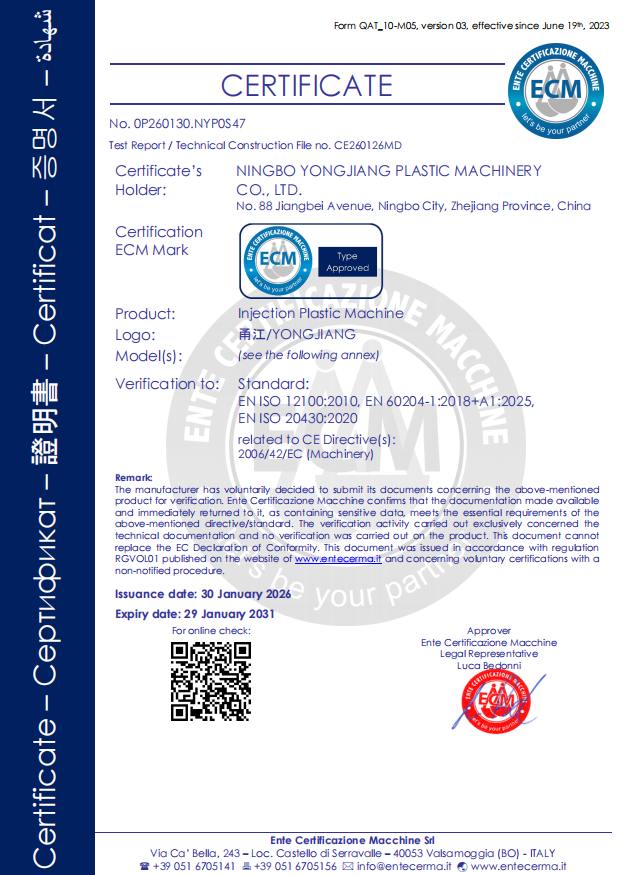
On compliance, Yongjiang holds CE certificate CE20260126MD, issued by ECM on 30 January 2026 and valid until 29 January 2029. The certificate references the 2006/42/EC Machinery Directive and the standards EN ISO 12100:2010, EN 60204-1:2018+A1:2020 and EN ISO 20430:2020. Its stated scope names the PET Preform Injection Molding Machine in models YJPT-260 and YJHB-400, and the same certificate record is linked to the YJPT-318 and YJPT-360 as related products.
On commercial terms, the operating parameters published for this series are MOQ 1 unit, lead time of 30–45 days, and a monthly production capacity of 200 units. Quality control is stated as 100% testing one week before shipment, and pre-shipment acceptance testing forms part of the delivery process. Purchasing terms are quoted FOB Ningbo, with 30% deposit and the remaining 70% payable before shipment. OEM production is offered with customisation available on voltage and logo — a practical detail for buyers in markets with non-standard industrial power supplies.
Supplier capacity is the third variable. The manufacturer operates a 130,000 m² facility with 200 employees and an annual output of approximately 2,000 units, supported by a 25-engineer R&D team. The published export ratio is 59%, with main markets including the USA, Canada and Thailand, and export activity spanning the EU, Middle East and Africa. After-sales support is stated as 24/7 service support.
One reference point is worth noting because it involves the same four models compared in this article. A water factory and bottle making factory case record covering 20 units over a 20-year period, with PET preform making and water bottle making as the applications, reports stable operation and low electricity consumption. The clients involved come from multiple countries including Ethiopia, Spain, France, Hungary, and others. Long service life in a water bottle environment is a relevant signal for buyers weighing the 260 T entry model against the larger presses — but it is a single case record and should be treated as supporting evidence rather than as a performance guarantee.
Where this comparison stops
An honest spec comparison should state its own boundaries, and this one has four.
First, several standard evaluation parameters are not published for these models. Rated injection pressure, plasticizing capacity and dry cycle time are not part of the specification set used above. That matters because the CIPET tender reference point calls for a minimum injection pressure of 1200 bar and a minimum plasticizing capacity of 50 gm/sec. A buyer cannot confirm those thresholds from the figures in this article and should request them directly from the supplier before shortlisting.
Second, YJPT-360 and YJHB-400 differ on one axis only. Both are listed with a 95 mm screw, 3,450 g shot weight, 80 kW motor power, 65 kW heat power, 16 t machine weight and QT500-A7 steel construction. The distinguishing figure is tie bar distance — 680 × 680 mm for YJPT-360 against 720 × 720 mm for YJHB-400 — plus a 360 T versus 400 T clamping force difference. A buyer choosing between the two is choosing a mould envelope, not a throughput class.
Third, the CE scope statement should be verified per model. The certificate's scope field names YJPT-260 and YJHB-400 explicitly; the other two models are recorded as related products on the same certificate. Buyers with a compliance-critical market entry should obtain the certificate document and confirm the model list for the specific unit being ordered.
Fourth, real-world performance data is thin across the category. Verified per-cavity cycle time, energy consumption per kilogram of melt, maintenance intervals and real-world yield rates are not publicly documented for these models. On-site performance verification, rather than catalogue comparison, is the only way to close that gap.
These boundaries are not defects in the machines. They are simply the limits of what a document-based comparison can settle, and buyers who proceed without closing them are accepting unverified assumptions.
What the next three to five years look like
If downstream preform demand grows in the low single digits, as the 2.17% CAGR reported for the preform product market to 2031 suggests, competition among preform producers will be decided on cost per preform rather than on volume growth alone. That has three implications for machine buyers.
Installations will increasingly be sized to a specific bottle programme rather than to a generic "big enough" target, because idle tonnage and unused connected power are pure cost. Multi-cavity hot runner moulds will continue to be the standard way to lift output without adding presses, which puts a premium on tie bar envelope and consistent shot weight. And compliance documentation will matter earlier in the process, not later, as certification requirements in major import markets become a routine part of supplier qualification rather than a final paperwork step.
Within the range covered here, that points toward a straightforward planning rule: define the heaviest preform and the highest cavity count the project will realistically run within five years, size the shot weight against that combination with margin, then choose the smallest tie bar envelope that accommodates the mould — and only then compare commercial terms.
Full technical documentation for the YJPT and YJHB PET preform series is available in the manufacturer's product catalogue: Yongjiang injection moulding machine brochure (PDF).
FAQ
Which of the four models is the right starting point for a water bottle preform line?
Start from the shot weight calculation. The CIPET reference specification for a PET preform machine used a maximum preform weight of 20 gm and a 28 mm neck for 1000 ml bottles; a 48-cavity mould running that preform requires approximately 960 g of material before hot-runner allowance. YJPT-260 is rated at 1,400 g shot weight and covers that case; YJPT-318 is rated at 1,900 g and suits higher cavity counts or heavier preforms; YJPT-360 and YJHB-400 are rated at 3,450 g each. The correct answer depends on the specific preform weight and cavity count planned, including the hot runner.
What actually separates YJPT-360 from YJHB-400?
Very little on injection performance. Both are published with a 95 mm screw diameter, 3,450 g shot weight, 80 kW motor power, 65 kW heat power, 16 t machine weight and QT500-A7 steel construction. The differences are 360 T versus 400 T clamping force and 680 × 680 mm versus 720 × 720 mm tie bar distance. The selection is therefore driven by the physical size of the mould the buyer intends to run, not by shot capacity.
Do these four models carry CE certification?
Yongjiang holds CE certificate CE20260126MD, issued by ECM and valid from 30 January 2026 to 29 January 2029, referencing the 2006/42/EC Machinery Directive and the standards EN ISO 12100:2010, EN 60204-1:2018+A1:2020 and EN ISO 20430:2020. The certificate's stated scope names models YJPT-260 and YJHB-400, and the same certificate record lists YJPT-318 and YJPT-360 as related products. Buyers should obtain the certificate document and confirm the model list applicable to their specific order.
What are the standard purchasing terms for these machines?
Published terms are MOQ 1 unit, lead time of 30–45 days, and purchasing on FOB Ningbo with a 30% deposit and 70% payable before shipment. Quality control is stated as 100% testing one week before shipment, with pre-shipment acceptance testing as part of the process. OEM production is supported with customisation available on voltage and logo.
How does the manufacturer's production capacity affect delivery risk?
The facility covers 130,000 m² and employs 200 people, with an annual output of approximately 2,000 units and a monthly capacity of 200 units, supported by a 25-engineer R&D team. The published export ratio is 59%, with main markets including the USA, Canada and Thailand and export activity across the EU, Middle East and Africa. After-sales support is stated as 24/7 service support. Capacity at this scale reduces — but does not eliminate — the risk of schedule slippage on a single-unit order.
What is documented about long-term operation of these models in the field?
A case record covering a water factory and bottle making factory installation reports 20 units in operation for a duration of 20 years, with PET preform making and water bottle making as the applications, stable operation as the reported result and low electricity consumption as the highlighted characteristic. Clients involved come from multiple countries including Ethiopia, Spain, France, Hungary, and others. The four models compared in this article are the models associated with that record.
Have Questions or Need More Details?
Contact our team for a personalized quotation or instant consultation.
Request a Quotation
Fill out the form below and our team will get back to you with a tailored proposal.
WhatsApp Direct Chat
Prefer to chat in real-time? Message us on WhatsApp for instant assistance & quick answers.
- Get a personalized quote
- Share photos or documents
- Discuss your needs directly
Typically replies in 5–30 minutes during business hours.