
YN-PH600 vs YN-PH700 vs YN-PH800: Buyer Fit Guide
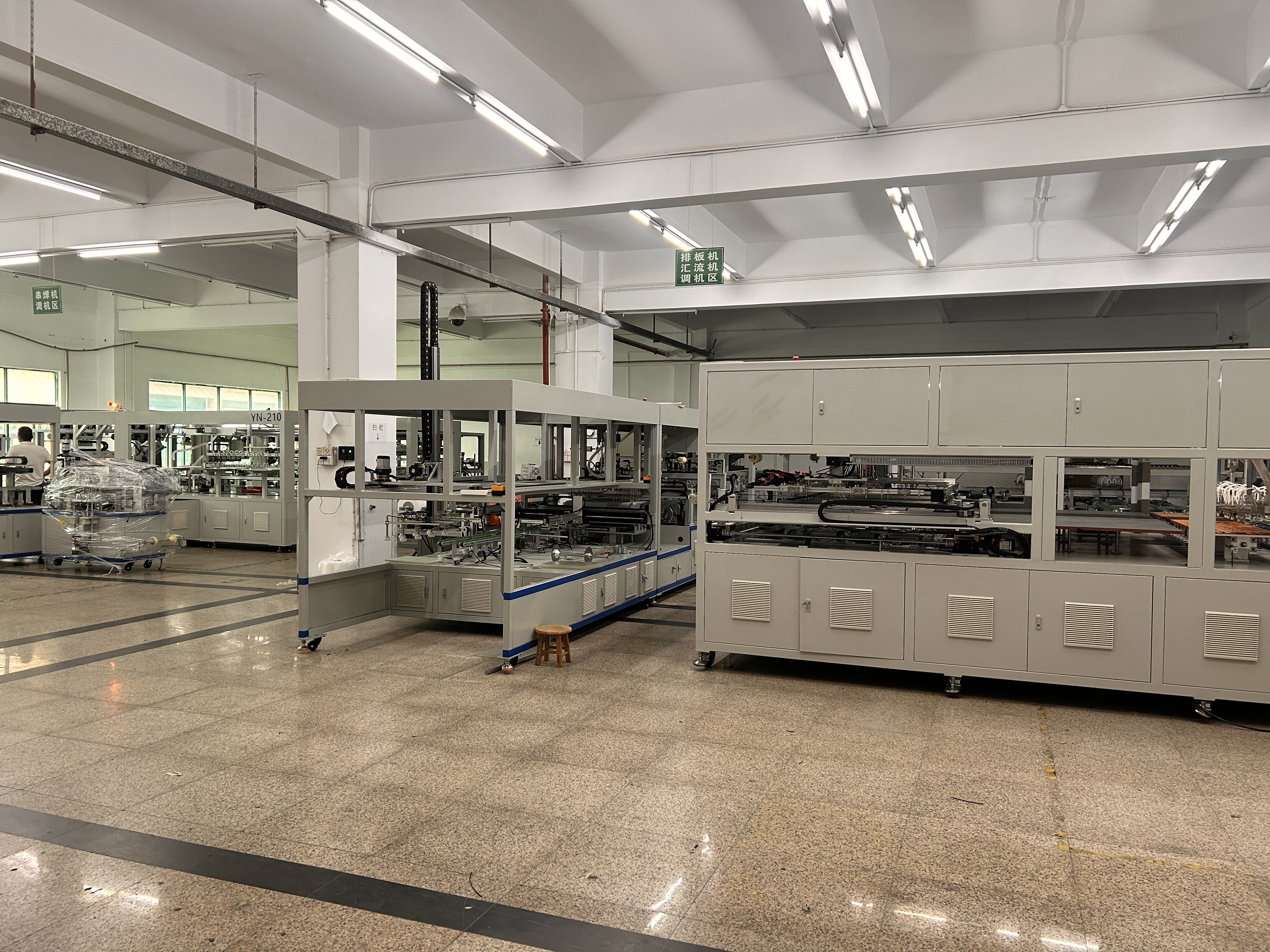
Cover: A turnkey solar module production line context for comparing layup and busbar equipment. Image: YNTECH.
Choosing a layup and busbar platform for a PV module line is a format-fit problem before it is a brand-selection problem. The YN-PH600, YN-PH700 and YN-PH800 are three YNTECH machines that sit in the same process window - string layup, positioning and busbar soldering before lamination - but they are specified for different module power ranges and different process requirements. YN Solar PV Equipment Co., Ltd. (established 2015, brand YNTECH) is a Dongguan-based manufacturer of PV module automated production lines and PV assembly equipment. This independent buyer comparison puts the three models side by side by module-format fit, string handling, process scope and utility requirements, using the specifications supplied for each model.
In the wider Solar Panel Manufacturing Equipment market, layup and busbar machines are often evaluated as part of a Turnkey Solar Module Production Line or a Solar Module Production Line Upgrade. The comparison below is intended for that evaluation stage. It is not a ranking, and it does not replace a factory acceptance test on the buyer's own module bill of materials.
Why the layup and busbar stage deserves a separate comparison
A layup and busbar integrated machine receives pre-soldered cell strings and automatically performs string layup and positioning, busbar cutting or bending, and busbar soldering. It connects multiple cell strings in series or parallel to form a complete cell array, then feeds the assembly to the subsequent layup and lamination processes. That definition explains why the machine cannot be selected on power range alone. The buyer also has to match string count, string length, busbar geometry, cell width and the utilities available in the workshop.
A machine that is oversized for small modules can add unnecessary utility demand and footprint. A machine that is undersized for larger modules can limit the product roadmap. In a PV Module Manufacturing Line, the layup and busbar stage sits between the Solar Cell Tabber Stringer and the PV Module Laminating Machine. A mismatch at this stage may only become visible later in EL testing, lamination or rework. For that reason, the comparison should be treated as a buyer checklist: first define the module range and string configuration, then compare the equipment.
The three platforms at a glance
The table below uses only the specifications supplied for the three models. Where a data point was not stated in the supplied comparison material, it is marked as not stated rather than inferred.
| Model | Product name | Stated module power range | String handling and process notes | Busbar and cell-width notes | Rated power | Throughput note | Typical fit |
|---|---|---|---|---|---|---|---|
| YN-PH600 | Layup and Busbar Integrated Machine | 3W-30W | Compatible with single cell strings of 120-210 mm width and dual strings of 52-105 mm width; string length 130-410 mm; cell width 52-210 mm; automatic position correction during material picking; high-frequency electromagnetic welding | Busbar thickness and width not stated in the supplied comparison data | 6 kW | Not stated in the supplied comparison data | Small modules such as foldable solar packs, monitoring panels, floodlights and warning lights |
| YN-PH700 | PV Module Lay-up and Bussing Machine | 40W-350W | Automatic 2/3/4-string switching | Busbar thickness and width not stated in the supplied comparison data | Not stated in the supplied comparison data | 80-120 units/hour for specified on-board string lengths | Mid-power non-standard modules requiring multi-string switching |
| YN-PH800 | Automatic Lay up and Bussing Machine | 6W-40W | Cell width 78-210 mm | Busbar thickness 0.12-0.3 mm; busbar width 2-6 mm | 15 kW | Not stated in the supplied comparison data | Small modules requiring fine busbar control and 15 kW utility |
YN-PH600: small-module integration at 6 kW
The YN-PH600 is the smallest power-range platform in this set. YNTECH states a 3W-30W module range and a 6 kW rated power. The supplied process data adds single cell strings of 120-210 mm width and dual strings of 52-105 mm width, string lengths from 130 mm to 410 mm, cell widths from 52 mm to 210 mm, automatic position correction during material picking, and high-frequency electromagnetic welding. These parameters point to a machine for compact and non-standard modules rather than for 40W-350W formats. YNTECH lists foldable solar packs, monitoring panels, floodlights and warning lights as suitable applications.
The limitation is equally important. A buyer planning a Solar Module Production Line Upgrade around 40W or larger modules should not assume the YN-PH600 covers that range; the stated upper limit is 30W. The 6 kW rating also means the electrical supply and line architecture should be checked against the rest of the line. If the module roadmap includes both small monitoring panels and larger off-grid modules, the YN-PH600 may be only one part of the equipment mix rather than a universal layup and busbar solution.
YN-PH700: mid-power range with automatic multi-string switching
The YN-PH700 is specified for 40W-350W modules. Its distinguishing stated capability is automatic 2/3/4-string switching, which matters when a line runs more than one string configuration without manual changeover. YNTECH also states 80-120 units/hour for specified on-board string lengths. That throughput figure is not a universal line rate; it is tied to the specified on-board string lengths. Buyers should ask for the exact string length and module configuration behind the number, and verify it with their own bill of materials. The model sits above the YN-PH600 and YN-PH800 power ceilings, so it is the only one of the three with a stated range extending to 350W.
The 40W lower bound overlaps with the YN-PH800 upper bound of 40W. At exactly 40W, the choice should be made on string configuration, busbar requirements and throughput, not on power range alone. The supplied data does not state YN-PH700 published throughput for other string lengths, so a buyer should treat the 80-120 units/hour figure as configuration-specific. That is a real boundary, not a marketing detail: a line rate quoted for one on-board string length should not be assumed for a different string layout.
YN-PH800: precision busbar control for 6W-40W modules
The YN-PH800 is specified for 6W-40W modules and is differentiated by busbar and cell-width data: 0.12-0.3 mm busbar, 2-6 mm busbar width, 78-210 mm cell width, and 15 kW rated power. This is the model to examine when the module design uses fine busbar dimensions or when cell width sits in the 78-210 mm band. The 15 kW rating is higher than the 6 kW rating stated for the YN-PH600, so factory electrical capacity and line utility planning should be confirmed before selection. The stated power range stops at 40W; for 40W-350W modules, the YN-PH700 is the relevant platform in this set. At the 40W boundary, buyers should compare actual string layout and busbar geometry rather than assume either machine is automatically interchangeable.
YN-PH800 is also the model where a buyer should ask the most specific process questions. The busbar thickness range of 0.12-0.3 mm and width range of 2-6 mm should be checked against the actual busbar material and module design. The 78-210 mm cell-width range should be checked against the cell format. And the 15 kW rating should be checked against the workshop power distribution. None of these checks can be replaced by a model-number comparison.
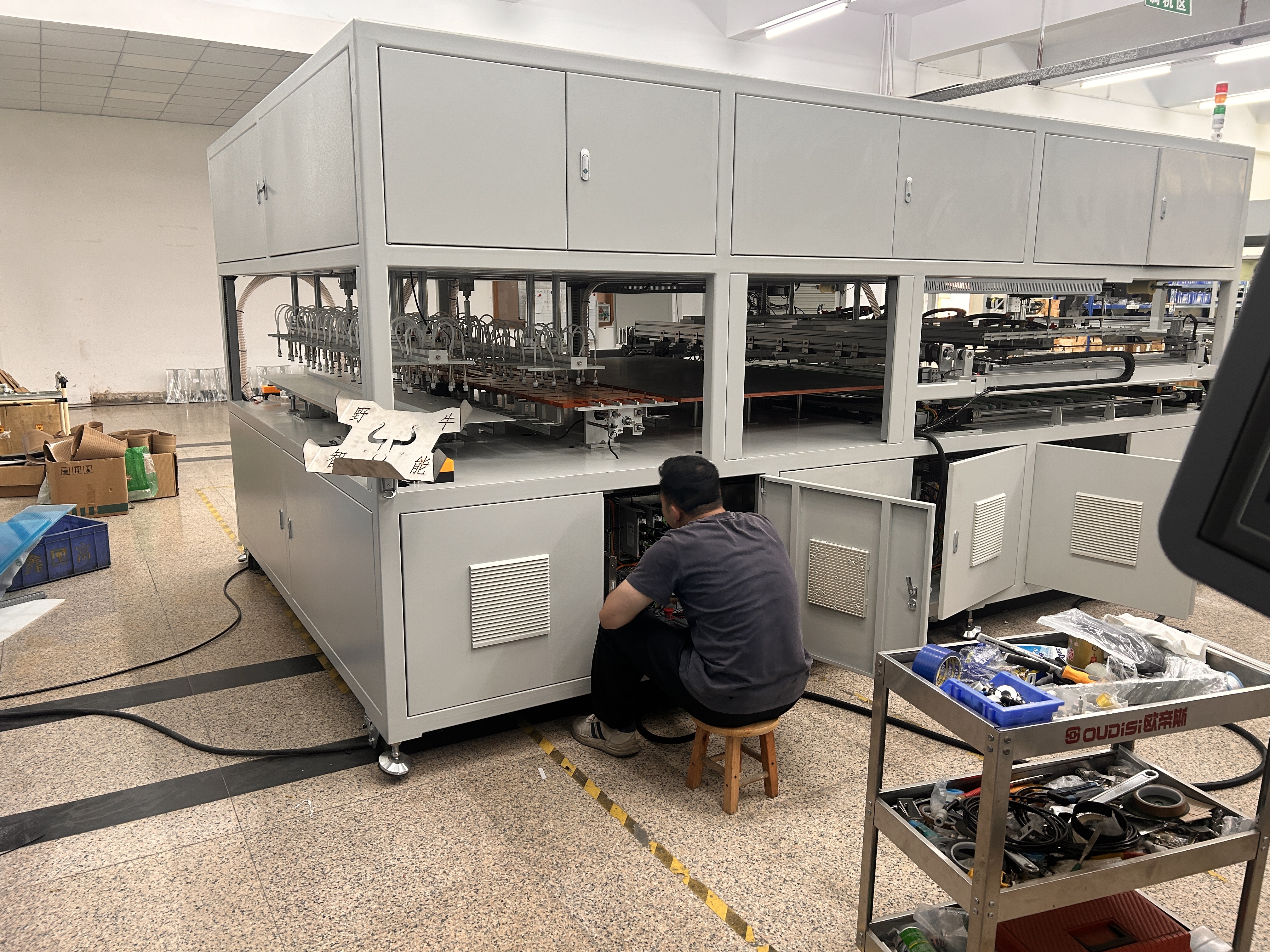
Figure: A layup and busbar integrated machine performs string layup, positioning and busbar soldering before lamination. Image: YNTECH.
String handling and process scope: a buyer checklist
String handling is where the three models diverge most clearly. For the YN-PH600, the stated compatibility includes single strings of 120-210 mm width and dual strings of 52-105 mm width, with string lengths of 130-410 mm and cell widths of 52-210 mm. For the YN-PH700, the stated feature is automatic 2/3/4-string switching. For the YN-PH800, the stated cell-width range is 78-210 mm and the busbar range is 0.12-0.3 mm thickness and 2-6 mm width. A buyer should map these numbers to the actual module bill of materials: cell size, string count, string length, busbar thickness and width, and the module power range.
The machine datasheet should also be checked against the solder process window. Inconsistent soldering temperature in PV stringer equipment can cause cold solder joints or cell cracking and reduce module power output. YNTECH's own risk guidance recommends reviewing temperature fluctuation data and inspecting soldering quality during factory acceptance testing. This applies to any layup and busbar platform, not only the three models compared here. In a full PV Module Manufacturing Line, the layup and busbar machine sits downstream of the Solar Cell Tabber Stringer and upstream of the PV Module Laminating Machine. A mismatch at this stage can show up later as rework in Solar Panel EL Testing Equipment or lamination, so the buyer should define the interface between the stringer, the Automatic Solar Cell Bussing Machine and the laminator before the purchase order.
Utility requirements and line integration
Rated power is part of the site fit. The YN-PH600 is stated at 6 kW; the YN-PH800 is stated at 15 kW. YN-PH700 rated power is not stated in the supplied comparison data, so it should be requested from the supplier for the exact configuration. The installation environment described for YNTECH equipment is an indoor factory environment with ambient temperature from -10°C to 40°C in a clean, dust-controlled workshop. The equipment should be installed in a dry, well-ventilated environment free of corrosive gases, and the operating area should be kept clean to prevent debris and dust from entering the equipment. These conditions matter for any Automatic Solar Panel Production Line, but they are especially relevant when the layup and busbar machine is integrated into a 50MW to 200MW line or a Turnkey Solar Module Production Line.
YNTECH states OEM and ODM production services, including logo printing and custom non-standard design. The stated monthly production capacity is 10-30 units for OEM and ODM production, with a lead time of 15-30 days, a minimum order quantity of 1 unit, 100% pre-shipment testing, export markets in the EU, Middle East and Africa, and remote technical support after sale. These commercial terms are useful for a Solar Module Production Line Upgrade where the buyer needs a single machine or a small batch rather than a full line. They do not by themselves prove process fit; the buyer still needs to validate the machine against the module specification.
How this comparison differs from a manual or semi-automatic process
Manual and semi-automatic layup and busbar operations typically depend more on operator skill and manual positioning. Automated layup and busbar machines aim to make string placement, busbar cutting or bending and soldering more repeatable. The trade-off is real: automation usually requires a higher initial investment, a defined utility supply, and a factory acceptance test that proves the machine on the buyer's own module bill of materials. For the YN-PH700, the stated 80-120 units/hour rate is tied to specified on-board string lengths, so a buyer should not compare it with a manual line unless the same string configuration is used. For the YN-PH600 and YN-PH800, the supplied data does not state a throughput figure, so the comparison should be made on module fit, busbar precision and utility requirements rather than on an assumed line rate.
A further limit is changeover. A machine matched to a 3W-30W or 6W-40W range may not be the right platform for a 40W-350W product roadmap, even if the mechanical layout appears similar. Buyers should ask for the changeover procedure, tooling requirements and the factory acceptance test criteria for each model. The comparison should also include the downstream Solar Panel Trimming Machine and the PV Module Laminating Machine, because the layup and busbar stage does not operate in isolation.
Market context: why buyers are scrutinizing layup and busbar flexibility
Market context supports the need for careful equipment selection, but it does not replace a specification comparison. The global solar PV manufacturing equipment market size was valued at USD 16.6 billion in 2024 and is projected to reach USD 108.4 billion by 2034, with a CAGR of 23.1%, according to Global Market Insights data. In the United States, domestic module manufacturing capacity reached 50 GW in early 2025, according to SEIA's Solar Market Insight Report 2024 Year in Review. These figures describe the scale of module capacity being built and upgraded; they do not specify which layup and busbar model fits a given module. For module performance and safety, IEC 61215 and IEC 61730 are core international standards for PV module testing. Buyers should keep module-standard requirements separate from the equipment selection checklist.
For a solar module production line supplier, the practical question is how to configure a line that can handle the buyer's module range without over-specifying every station. The three YNTECH models show one approach: separate power ranges and process capabilities rather than a single universal machine. That approach can be useful for a 50MW to 200MW non-standard module business, but it also means the buyer must define the module roadmap before comparing quotations.
Future outlook
Module formats continue to diversify across conventional, TOPCon, HJT and BC architectures. YNTECH states that its equipment adapts to conventional, TOPCon, HJT and BC solar module production, and that it supports customized line capacity from small pilot workshops to multi-GW mass production factories. The practical implication for a buyer is not that one model covers every format. It is that the layup and busbar platform should be selected with the module roadmap in view: power range, string count, busbar geometry and cell width. A line planned for a 50MW to 200MW non-standard module business may need a different mix from a pilot workshop. The comparison of YN-PH600, YN-PH700 and YN-PH800 shows why the process window - not the model number alone - should drive the shortlist.
Buyer checklist before requesting a quotation
- Confirm the module power range: 3W-30W for YN-PH600, 40W-350W for YN-PH700, 6W-40W for YN-PH800.
- Confirm the string configuration: single or dual strings and string length for YN-PH600; automatic 2/3/4-string switching for YN-PH700.
- Confirm busbar and cell width: 0.12-0.3 mm busbar, 2-6 mm busbar width and 78-210 mm cell width for YN-PH800.
- Confirm rated power and utility: 6 kW for YN-PH600, 15 kW for YN-PH800; request YN-PH700 rated power for the exact configuration.
- Confirm the throughput basis: 80-120 units/hour for YN-PH700 is for specified on-board string lengths.
- Confirm factory acceptance test criteria: soldering quality, temperature stability and string positioning.
- Confirm commercial terms: OEM/ODM, monthly capacity 10-30 units, lead time 15-30 days, MOQ 1 unit, 100% pre-shipment test and remote technical support.
FAQ
What module power range does each YNTECH model cover?
The YN-PH600 covers 3W-30W, the YN-PH700 covers 40W-350W, and the YN-PH800 covers 6W-40W. These ranges are stated for the three models and should be checked against the actual module bill of materials.
Which model has automatic string switching?
The YN-PH700 has automatic 2/3/4-string switching. This feature is relevant when a line runs more than one string configuration without manual changeover.
What busbar and cell-width specifications are stated for the YN-PH800?
The YN-PH800 is stated with 0.12-0.3 mm busbar, 2-6 mm busbar width, 78-210 mm cell width and 15 kW rated power.
What does the YN-PH700 throughput figure depend on?
The YN-PH700 is stated at 80-120 units/hour for specified on-board string lengths. The figure is configuration-specific and should be verified with the exact string length and module design.
What utility requirements should be confirmed before selection?
The YN-PH600 is stated at 6 kW and the YN-PH800 at 15 kW. The equipment is described for an indoor factory environment at -10°C to 40°C in a clean, dust-controlled workshop, installed in a dry, well-ventilated environment free of corrosive gases. The YN-PH700 rated power is not stated in the supplied comparison data and should be requested for the exact configuration.
Does YNTECH provide OEM and ODM services, and what commercial terms are stated?
YNTECH states OEM and ODM production services, including logo printing and custom non-standard design. The stated monthly production capacity is 10-30 units for OEM and ODM production, with a lead time of 15-30 days, a minimum order quantity of 1 unit, 100% pre-shipment testing, export markets in the EU, Middle East and Africa, and remote technical support after sale.
Reference material: YNTECH brochure (PDF): https://cdn.socialarks.com/sbsp/25388/common/2026/1016/YNTECH-Brochure.pdf. This link is provided for documentation and is not a recommendation of any specific configuration.
Have Questions or Need More Details?
Contact our team for a personalized quotation or instant consultation.
Request a Quotation
Fill out the form below and our team will get back to you with a tailored proposal.
WhatsApp Direct Chat
Prefer to chat in real-time? Message us on WhatsApp for instant assistance & quick answers.
- Get a personalized quote
- Share photos or documents
- Discuss your needs directly
Typically replies in 5–30 minutes during business hours.