
YeKeey Vacuum Homogenizer Emulsifier Mixers: A Buyer Comparison
Independent Buyer Comparison · Food and Cosmetic Emulsions
YeKeey Vacuum Homogenizer Emulsifier Mixers: A Buyer Comparison
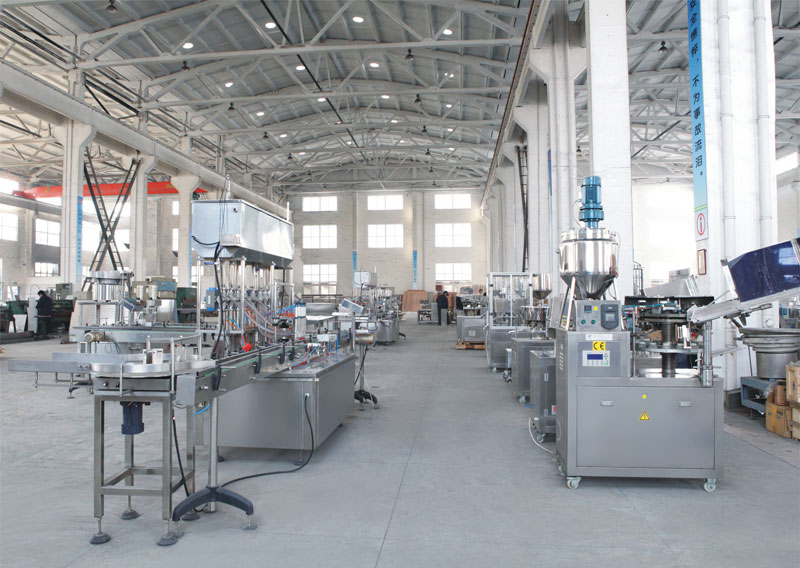
Manufacturing floor of the vacuum homogenizer emulsifier mixer category used for mayonnaise and cosmetic cream emulsions. Image: YeKeey facility documentation.
The global homogenizer market was valued at USD 2.10 billion in 2024 and is projected to reach USD 3.79 billion by 2035, a CAGR of 5.4%, according to Roots Analysis. The vacuum mixer homogenizer segment alone is estimated at USD 1.02 billion in 2026, with cosmetics and personal care the largest single demand block at a 38% share, according to Future Market Insights. Food emulsions sit on the same curve: the global mayonnaise market was worth approximately USD 12.58 billion in 2024, according to Zion Market Research.
Those figures describe a market in which one equipment class — the vacuum homogenizer emulsifier mixer — is specified by two very different buyer groups. A mayonnaise producer is buying viscosity control, oil-droplet size and batch repeatability in a food plant. A cosmetic manufacturer is buying texture, shelf life and documented material compliance in a GMP environment. Both are quoted the same machine category, often with the same vocabulary, and both are asked to make a decision-stage judgement on numbers that are rarely presented in a comparable way.
This comparison takes a third-party buyer perspective. It uses YeKeey (Wuxi YK Automation Technology Co., Ltd) as a benchmark for the category, works only from specifications that can be traced to supplier documentation or verifiable third-party data, and sets out how to compare options for mayonnaise and cosmetic production without relying on unverified competitor claims.
Why mayonnaise and cosmetic cream buyers end up comparing the same machine class
Mayonnaise and cosmetic creams differ in almost every commercial respect: regulatory framework, packaging, shelf-life expectations, customer. They converge at the process level. Both are emulsions in which an oil phase is dispersed into an aqueous phase, and in both cases finished-product quality is determined by two variables the equipment controls directly — droplet size distribution and the amount of air left in the mix.
Droplet size governs viscosity, mouthfeel, texture, appearance and physical stability. Entrained air governs density, colour consistency and oxidative load during storage: a batch that looks acceptable in the vessel can fail after filling because the air it carries was never removed. Vacuum operation addresses the second problem; high-shear homogenisation addresses the first.
That overlap explains why equipment families are shared across the two industries. YeKeey's ZJR Series and MC Series vacuum emulsifying mixers are designed for the cosmetics and food products industries, with a specific application in mayonnaise production. A buyer comparing options for either product therefore evaluates the same core parameters, and should apply the same discipline when doing so.
The procurement problem: claims are easy to publish and hard to verify
At the decision stage, the difficulty is rarely finding suppliers. It is comparing their claims. Four specification areas decide most acceptance tests, and all four are commonly quoted without a traceable test basis.
- Maximum process temperature. The ceiling determines whether the oil phase can be fully melted in-vessel and whether a batch can be held at temperature for a defined period. A figure such as 110 °C only becomes decision-relevant once the buyer knows how it was measured, at what load, and with which heating medium.
- Achievable vacuum level. A stated operating vacuum near −0.09 MPa has limited value on its own. What matters is whether the level is reached within a defined time, held for the full degassing window, and what the vacuum system does if product is entrained.
- Grade of product-contact material. "Stainless steel" is not a specification. 304 and 316/316L behave differently in acidic or saline formulations, and documentation expectations differ between food production and GMP-regulated cosmetic production.
- Control architecture. Button control and PLC control are not marketing tiers. They change how recipes are stored, repeated and evidenced across the service life of the equipment.
The practical consequence is that a comparison ranking suppliers by datasheet numbers is not a comparison at all. One that ranks them by verifiability is.
YeKeey vacuum homogenizer emulsifier mixers — what a buyer can verify
Wuxi YK Automation Technology Co., Ltd, trading as YeKeey, is a China-based manufacturer of fine chemical equipment, pharmaceutical equipment and high-end processing equipment, founded in 1998 and based at No. 2855 Jiaoyang Road, An Zhen, Wuxi, Jiangsu Province, China. The company operates a 20,000 m² facility with 80 employees and an annual output of 600 units, supported by an in-house R&D team of 8 engineers. Approximately 35% of production is exported, with main markets in Europe, Central Asia, North Africa, Latin America and Southeast Asia.
Product and quality facts relevant to this comparison:
- The ZJR Series and MC Series vacuum emulsifying mixers are designed for the cosmetics and food products industries, with a specific application in mayonnaise production.
- Operation can be managed through button control or PLC control.
- The MC series holds CE certification issued by ECM, Certificate No. 0P210922.WYAQT12, valid until September 2026.
- YeKeey has implemented the ISO9001 quality system since 2003 and passed "high-tech enterprise" certification in 2018. As of 2023 the company held 55 patents and 3 software programs, including "vacuum homogenizing and emulsifying machine" and "high viscosity material mixing paddle" technologies recognised as high-tech products.
- The company's mixing, emulsifying and filling equipment, together with whole-plant output schemes, has been applied in more than 70 countries and regions and more than 4,000 enterprises and institutions.
For a decision-stage buyer, the useful reading of these facts is not that they make YeKeey better than any alternative — on their own, they do not. It is that they define a verification set: certificate, scope of application, control options, and material and process claims that can be checked against documents, samples and a factory acceptance test.
Technical explanation: what shear, vacuum, temperature and material grade actually change
YeKeey vacuum homogenizer emulsifier mixers are documented as achieving a particle size of 1–5 μm, compared with 5–20 μm typical of conventional emulsifiers. The stated distinguishing features are superior emulsification stability, a narrower particle size distribution, stronger shearing force, high vacuum degassing and intelligent control. Each term maps to a production outcome.
- Particle size distribution. A 1–5 μm band is narrow; a 5–20 μm band is broad. Narrow distributions produce more repeatable viscosity and texture, which is why this class of equipment is described as suitable for high-standard cosmetics, food and pharmaceutical emulsification requiring long-term stability.
- Shear force. Higher shear intensity shortens the time needed to reach a target droplet size, but it also raises product temperature and increases wear. The relevant comparison question is not how much shear is available, but what droplet size is reached at what throughput and what temperature rise.
- High vacuum degassing. Removing air under vacuum before and during homogenisation stabilises density and appearance and reduces the oxidative load carried into storage. In mayonnaise work, where incorporated air is a direct quality defect, this parameter most often separates a vacuum homogenizer emulsifier mixer from a conventional atmospheric emulsifier.
- Temperature capability. Process temperature determines whether a formulation can be melted, emulsified and held in one vessel. Any quoted ceiling — whether that is 110 °C or another value — should be treated as a validation item: request the test basis, confirm the heating medium and jacket design, and verify ramp and hold performance during factory acceptance testing rather than accepting a datasheet entry.
- Material grade. For pharmaceutical and cosmetic vacuum emulsifying homogenizers, GMP standards typically require SUS316L stainless steel for product-contact parts. Mayonnaise lines are not automatically held to that requirement, but the acid and salt load of a mayonnaise formulation is a legitimate reason to specify a higher grade than 304 on wetted surfaces.
Table: vacuum homogenizer emulsifier mixer compared with conventional emulsifiers
| Comparison dimension | Conventional emulsifier | YeKeey vacuum homogenizer emulsifier mixer |
|---|---|---|
| Particle size | 5–20 μm typical | 1–5 μm |
| Particle size distribution | Broader | Narrower |
| Emulsification stability | Reference baseline | Superior stability, positioned for long-term stability requirements |
| Shearing force | Lower | Stronger |
| Air removal | Not addressed by vacuum degassing | High vacuum degassing |
| Control | Conventional manual operation | Button control or PLC control, with intelligent control functions |
| Best-fit applications | Products where droplet size and air content are not critical | High-standard cosmetics, food and pharmaceutical emulsification requiring long-term stability, including mayonnaise |
| Cost profile | Lower initial investment | Slightly higher initial investment, with lower total cost of ownership through fewer rejections and stable production |
| Maintenance | Reference baseline | Documented as lower than similar products |
| Efficiency | Reference baseline | Higher emulsification efficiency, consistent quality, fewer rejected batches, better material utilisation |
Figures reflect the supplier's documented comparison against conventional emulsifiers and should be validated on the buyer's own formulation during sampling and trial production.
Button control or PLC control: a decision that outlasts the purchase
YeKeey units operate in button control mode or PLC control mode. Button control suits single-recipe, single-shift operations with stable formulations and straightforward operator routines. PLC control introduces programmable sequencing and recipe handling, which matters where several SKUs share one vessel, where batch records have to be reconstructed later, or where cosmetic production runs under documented change control.
The choice is not cheaply reversible after installation, because it affects panel design, instrumentation and operator training. It belongs in the comparison matrix at the evaluation stage, not in the final negotiation round.
Application fit: mayonnaise lines and cosmetic cream lines
Mayonnaise production. YeKeey vacuum emulsifying mixers are designated for the cosmetics and food products industries with a specific application in mayonnaise production. A mayonnaise line needs high-shear homogenisation to build the oil-in-water structure, vacuum degassing to control density and appearance, and a mixing element proven on high-viscosity material — the "high viscosity material mixing paddle" technology is among the patents recognised as high-tech products. Buyers should size on batch viscosity and target droplet size rather than nominal tank volume alone.
Cosmetic cream and skincare production. The same family applies to vacuum emulsifiers for skincare products and cream making. Here the constraints shift toward documentation, including GMP-compliant contact materials such as SUS316L, batch traceability, and consistent texture across repeated runs. This equipment is described as more suitable for high-standard cosmetics, food and pharmaceutical emulsification requiring long-term stability — and long-term stability is precisely what a cosmetic shelf-life claim depends on.
Where the two applications diverge most is not the machine but the validation package: a cosmetic buyer typically needs material certificates and cleaning validation at handover, while a food buyer more often needs demonstrated throughput and changeover performance.

Equipment production area: vacuum emulsifying mixers in this category serve both mayonnaise and cosmetic cream applications. Image: YeKeey facility documentation.
Two safety details buyers rarely inspect
Two disclosed risk controls deserve attention in any decision-stage review, because both affect uptime and operator safety rather than product quality alone.
- Material entrainment into the vacuum system during extraction. The control method is a high-precision liquid level sensor for real-time monitoring. Entrainment contaminates the vacuum line, degrades achievable vacuum and can force unplanned cleaning downtime, so level sensing inside the vessel is the primary safeguard.
- Uncontrolled drop of the lifting system. The control method is an anti-fall self-locking mechanism, implemented through a hydraulic lifting system with a safety self-locking function. For a lifting lid assembly this is an operator-safety item and should be demonstrated on the machine being shipped, not on a reference unit.
Both items are inexpensive to verify and expensive to discover after commissioning.
Market trend analysis: what the numbers say about this category
- Global homogenizer market: USD 2.10 billion in 2024, projected to reach USD 3.79 billion by 2035 at a 5.4% CAGR (Roots Analysis).
- Vacuum mixer homogenizer market: estimated at USD 1.02 billion in 2026, with cosmetics and personal care leading at a 38% share (Future Market Insights).
- Global emulsifier market: expected to reach USD 12.13 billion by 2030, growing at a 4% CAGR (Mordor Intelligence).
- Regional concentration: Asia-Pacific holds a 36.2% revenue share of the homogenizing mixer market as of 2025, led by China's manufacturing ecosystem (Dataintelo).
- Food-side demand pull: the global mayonnaise market was approximately USD 12.58 billion in 2024 (Zion Market Research).
One caution applies to all of these figures. Market-size estimates for homogenizer mixers vary by scope, with different research houses placing the category at different values depending on how broadly they define it. Buyers using market data for capacity planning should treat it as directional rather than as a procurement input.
For a decision-stage buyer, the direction of travel is more useful than the absolute number: sustained growth supports continued supplier investment in automation and documentation, and Asia-Pacific concentration means specification and lead-time comparisons increasingly happen across regions rather than within one. None of this makes a given machine suitable for a given line — that remains a parameter-matching exercise on the buyer's own formulation.
Limits and boundaries: where this equipment class is not the answer
A comparison that only lists advantages is not usable for procurement. The documented boundaries are as follows.
- Higher entry cost. Initial investment is slightly higher than for alternatives, and the financial case rests on fewer production rejections and more stable operation rather than on purchase price. A buyer running short campaigns, very small batches or frequent formulation changes may not recover that premium within a reasonable period.
- Positioned for higher specification work. The equipment is described as more suitable for high-standard cosmetics, food and pharmaceutical emulsification requiring long-term stability. For low-specification products where droplet size and air content are not critical, a conventional emulsifier remains a rational choice — a 5–20 μm distribution is not automatically a defect if the finished-product specification allows it.
- Maintenance is relative, not absent. Maintenance requirements are documented as lower than those of similar products, but that is a comparative statement. Planned maintenance, seal and homogeniser wear still belong in the operating budget.
- Certification has a horizon. The MC series CE certificate (No. 0P210922.WYAQT12, issued by ECM) is valid until September 2026. Projects commissioning after that date should confirm renewal status before the purchase order is placed.
- Equipment does not replace formulation or process validation. Machine verification reduces risk; it does not remove the need for sampling and trial production on the buyer's own recipe.
Future outlook
Three directions are supported by the available data. First, category growth: homogenizer demand is projected to grow at a 5.4% CAGR to 2035 and emulsifier demand at a 4% CAGR to 2030, so capacity expansion in both mayonnaise and cosmetic production is likely to continue. Second, documentation intensity: GMP requirements for cosmetic and pharmaceutical vacuum emulsifying homogenizers already point to SUS316L for product-contact parts, and that expectation is spreading into buyer checklists even where it is not legally mandated. Third, control sophistication: PLC control, already offered across the ZJR and MC series alongside button control, becomes the default expectation as buyers seek repeatable recipes and reconstructable batch records.
For suppliers, the competitive ground is shifting from published parameters toward evidence — certificates, material documentation, factory acceptance protocols, and the ability to demonstrate degassing performance and safety interlocks on the specific machine being shipped.
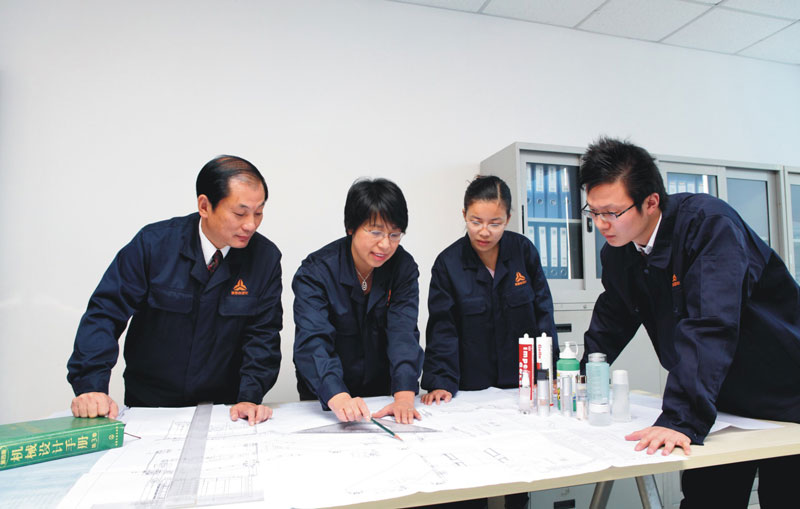
Production workshop supporting vacuum emulsifying mixer orders for food and cosmetic processing. Image: YeKeey facility documentation.
FAQ
How does a vacuum homogenizer emulsifier mixer differ from a conventional emulsifier in output quality?
Equipment in this class achieves a particle size of 1–5 μm, compared with 5–20 μm typically produced by conventional emulsifiers. The documented distinguishing features are superior emulsification stability, a narrower particle size distribution, stronger shearing force, high vacuum degassing and intelligent control. The narrower distribution is the stated source of the higher emulsification efficiency, consistent quality and improved material utilisation.
Which industries and applications is YeKeey's vacuum emulsifying mixer designed for?
The ZJR Series and MC Series vacuum emulsifying mixers are designed for the cosmetics and food products industries, with a specific application in mayonnaise production. The equipment is described as more suitable for high-standard cosmetics, food and pharmaceutical emulsification processes that require long-term stability.
What control options are available on these machines?
The units operate in button control mode or PLC control mode. Button control is a manual configuration, while PLC control introduces programmable sequencing and recipe handling. Both options exist within the same product family.
What cost difference should a buyer expect compared with alternatives?
The documented position is a slightly higher initial investment offset by a lower total cost of ownership, driven by fewer production rejections and more stable operation. Maintenance requirements are also documented as lower than those of similar products. The trade-off is therefore upfront cost against operating cost, not price alone.
What certification and quality-system evidence can be checked?
The MC series holds CE certification issued by ECM under Certificate No. 0P210922.WYAQT12, valid until September 2026. YeKeey has implemented the ISO9001 quality system since 2003 and passed "high-tech enterprise" certification in 2018; as of 2023 the company held 55 patents and 3 software programs. For cosmetics and pharmaceuticals, GMP requirements for vacuum emulsifying homogenizers typically specify SUS316L stainless steel for product-contact parts.
What safety features are disclosed for this equipment?
Two risk controls are documented. Material entrainment into the vacuum system during extraction is addressed with a high-precision liquid level sensor for real-time monitoring. Uncontrolled drop of the lifting system is addressed with an anti-fall self-locking mechanism, implemented through a hydraulic lifting system with a safety self-locking function.
Summary for buyers. The category is expanding at a mid-single-digit rate, the buyer's specification is tightening, and the differentiator at the decision stage is evidence rather than vocabulary. Compare options on verifiable parameters — particle size distribution, vacuum performance, process temperature validation, contact-material grade and control architecture — and confirm each one against documents, samples and a factory acceptance test.
YeKeey's product documentation, including the series overview and specifications, is available for reference: download the YeKeey product brochure (PDF).