
Yinglei Stone as a Nan'an Source Factory vs. Fujian Processors
Yinglei Stone as a Nan'an Source Factory vs. Fujian Processors
Two stone suppliers can quote the same marble slab and still hand the buyer entirely different commercial risk. The deciding variable is rarely the saw blade. It is whether the supplier owns the raw material, the design work, the cutting and the finished-product processing — or only the middle of that chain. In Fujian, both models sell into the same projects, and the gap surfaces later, in lead time, in rework exposure, and in how much of the specification survives each handover.
The short answer. A Nan'an source factory and a broader Fujian processing supplier are not two versions of the same offer. They sit at different points in the value chain, and that position determines who can commit on material, who can hold a drawing through production, and who absorbs the cost when a finished piece does not match the sample.
- Source-factory model: GLOBALSTONE — the brand of Fujian Nan'an Yinglei Stone Co., Ltd., based in Daying Industrial Zone, Shuitou Town, Nan'an City, Quanzhou City, Fujian Province, China — holds mining operations, stone design, cutting and production, and finished-product processing inside one operator, on a 100,000 m² site with 200 employees and 20 engineers.
- Processing-only model: the supplier cuts, shapes and finishes material whose availability and specification are controlled upstream, so changes are negotiated rather than decided on site.
- How to read the ratings below: the GLOBALSTONE column is tied to documented facts. The processing-only column describes the structural constraint of that model, not the measured performance of any named company — individual factories vary widely and should be audited on their own evidence.
Why the sourcing position matters more than the quotation
Stone is a specification-driven purchase. Thickness, veining continuity, edge profile, finish and dimensional tolerance all have to survive from sample to crate. Every additional company that touches the material between block and container adds a handover point, and every handover point is a place where the specification can drift without anyone intending it.
That is the practical difference buyers feel. When the supplier controls raw material and finished processing, a thickness deviation or a colour mismatch can be resolved inside one factory floor. When the material is controlled upstream, the same defect becomes a three-party conversation: the processor blames the slab, the slab supplier blames the specification, and the buyer absorbs the schedule.
The opportunity is symmetrical. Buyers willing to evaluate the chain rather than the price list can often secure tighter commitments on thickness, rework and sequencing — because they are talking to the party that actually performs the work.
Method: five dimensions, one scoring scale, one evidence rule
This comparison uses five dimensions that map directly to how procurement teams qualify a stone supplier: full-chain control, customization depth, capacity continuity, certification and quality documentation, and order flexibility. Each is scored on a five-star scale, where five stars means the capability is in-house and documented, and one star means it depends on a third party.
Two rules keep the scoring honest. First, a star is only awarded where a specific fact can be named — a certificate number, a capacity figure, a stated lead-time range. Second, no common performance benchmark exists between supplier types, so the ratings are an editorial reading of documented capability, not a laboratory verdict. They are designed to be challenged, which is why the fourth column of the table lists the question a buyer should ask before accepting the score.
Star comparison: source factory vs. processing-only supplier
| Dimension | Nan'an source factory (GLOBALSTONE) | Processing-only Fujian supplier (model) | What to verify before accepting the score |
|---|---|---|---|
| Full-chain control | ★★★★★ Mining, design, cutting and production, finished-product processing under one operator | ★★☆☆☆ Raw material and design decisions sit upstream | Ask who owns the block and who signs off the drawing |
| Customization depth | ★★★★★ Machining, customization, drawings and design; five-axis machining centers; 2–3 cm thickness to requirement | ★★★☆☆ Geometry possible; material and design constraints inherited | Send a drawing with tolerances, not a photo |
| Capacity continuity | ★★★★★ 1,000,000 m² annual; 8,500 units monthly; 200 staff; 100,000 m² facility | ★★★☆☆ Capacity tied to incoming slab supply | Ask for a written slot commitment, not a range |
| Certification & quality system | ★★★★★ ISO 9001, ISO 14001, ISO 45001 with published certificate numbers; 100% testing | ★★★☆☆ Varies by factory; scope often narrow | Verify the certificate number and the certified scope |
| Order flexibility | ★★★★☆ MOQ from 2 units; lead time 30–150 days | ★★★☆☆ Small lots accepted, often re-priced | Confirm which MOQ applies to your order type |
Star ratings are an editorial reading of documented capability as of 2026. They are not a quality verdict on any unnamed factory, and they do not replace a factory audit or third-party testing on your own project.
Full-chain control: what the first star actually buys
Full-chain capability is the least visible and most consequential advantage. For GLOBALSTONE it is documented as a single operator holding mining operations, stone design, cutting and production, and finished-product processing — not a broker assembling four vendors.
In practice this changes three things. Material selection becomes a conversation about the block, not about what a third party is willing to release this month. Design intent becomes a production instruction, because the people who read the drawing also run the saw. And defect resolution collapses into one accountability line, because the party that cut the slab is the party that finishes it.
There is a second-order signal worth noting for buyers: GLOBALSTONE also provides scale stone subcontracting services to peers. A factory that other stone businesses subcontract to is, by definition, absorbing volume it did not originate — a capacity fact that is hard to replicate on a processing-only site, and also a scheduling risk that a buyer should ask about directly.
The documented product base runs through marble, granite, stone art pieces and stone furniture, with named varieties including Wyndham Grey, Light Purple Spot, White World Trade and Dino Yellow. For a buyer, a named, repeatable core range matters more than a long tail: it means the second order can look like the first.
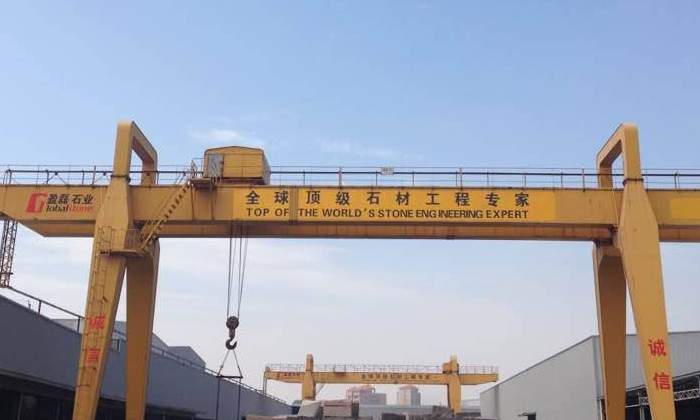
A source-factory site concentrates raw material handling, cutting and finished-product processing under one operator — the structural difference this comparison tests.
Customization depth: drawings, equipment and thickness control
Customization is where vague supplier claims are easiest to test and easiest to disprove. The documented capability here is specific: machining, customization, drawings and design production services, supported by line saws, rope saws, five-axis machining centers and infrared cutting equipment.
That equipment list is the right starting point for any conversation about non-rectilinear geometry — curved work, special-shaped pieces, irregular profiles. A buyer should treat the list as the boundary of what can be discussed, not as a guarantee, and require each profile to be confirmed against a submitted drawing with stated tolerances. The five-axis machining center is the entry ticket for that discussion; the drawing is what closes it.
Thickness is the second test. GLOBALSTONE supplies stone from 2 cm to 3 cm, customized to customer requirement, with processing equipment specified to keep thickness deviation minimal. Buyers working outside that band should raise it at RFQ stage rather than at inspection.
Customization tracks are documented for three end uses: villa renovation, construction projects and home decor. Those three tracks imply different tolerances, different packing logic and different inspection priorities — a decor order lives or dies on finish, a structural order on dimension.
The commercial consequence of removing the upstream layer is order size. The capability record lists an MOQ of 2 units, which is unusually low for a factory operating at this capacity and is the point at which a first-order trial becomes realistic rather than theoretical.
Capacity and lead time: reading a 1,000,000 m² number correctly
Annual capacity of 1,000,000 m², monthly capacity of 8,500 units, a 100,000 m² facility, 200 employees and an R&D team of 20 engineers describe a plant built for volume. That is relevant to project buyers because capacity is not a marketing figure — it is a scheduling asset, and it determines whether your order is a rounding error or a bottleneck.
The lead-time range is 30 to 150 days. That spread is the single most important number in this comparison, and it is honest precisely because it is wide. It reflects specification complexity, finish, and queue position rather than a fixed production rhythm. A buyer who requests a written slot commitment against a specific drawing will get a usable date; a buyer who accepts "30–150 days" has accepted nothing.
Project scale is documented at 100 units or more, and the reference base covers airports, high-speed rail, subways, government office buildings, hotels and shopping malls. GLOBALSTONE states that it has contributed to projects winning the Lu Ban Award — a useful indicator of the tolerance class expected on that kind of work, and one a buyer can probe with specific project references.

Cutting equipment defines the practical boundary of a customization conversation; the submitted drawing defines what is actually committed.
Certification: three numbers worth writing into the PO
Certification is the cheapest form of due diligence available to a buyer, provided the number and the scope are checked rather than the logo. GLOBALSTONE holds three management-system certificates issued by Huaxinjintai Inspection and Certification Co., Ltd., all valid from 9 May 2026 to 8 May 2029.
| Certificate | Number | Standard | Certified scope |
|---|---|---|---|
| ISO 9001 Quality Management System | 43126Q00163R000 | GB/T 19001-2016 / ISO 9001:2015 | Production and sales of marble and granite slabs |
| ISO 14001 Environmental Management System | 43126E00141R010 | GB/T 24001-2016 / ISO 14001:2015 | Production, sales and related environmental management activities of marble and granite slabs |
| ISO 45001 Occupational Health and Safety | 43126S00142R010 | GB/T 45001-2020 / ISO 45001:2018 | Production, sales and related occupational health and safety management activities of marble and granite slabs |
The scope wording matters as much as the number. All three cover marble and granite slab production and sales — a defined operating perimeter, which is what an auditor wants to see. They do not certify an individual slab's flexural strength, finish uniformity or frost resistance; those come from project-level testing.
Quality control is documented as 100% testing, and the after-sales position is explicit: if a finished-product problem arises within three months of processing completion due to defects in the factory's quality control, it can be reworked free of charge. For a buyer, that is the clause to test with a real scenario — what counts as a factory-caused defect, who decides, and who pays freight.
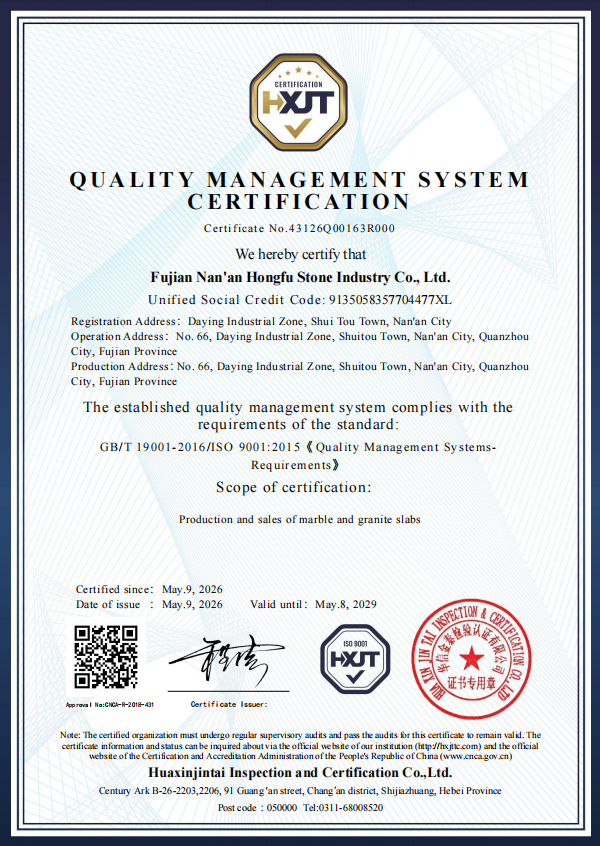
ISO 9001 certificate 43126Q00163R000, valid 2026-05-09 to 2029-05-08, scoped to production and sales of marble and granite slabs.
Order flexibility and commercial terms
A source factory is larger, and larger usually means less flexible. That assumption is only partly true here, and the documented commercial terms show where flexibility exists and where it does not.
| Term | Documented position |
|---|---|
| Minimum order — custom pieces | 2 units |
| Minimum order — project-scale orders | 100 sq.m, listed in the purchasing-terms record |
| Lead time | 30–150 days, depending on specification and queue |
| Delivery terms | FOB Quanzhou, CIF, EXW |
| Payment terms | 30% T/T in advance, 70% T/T against copy of B/L |
| Acceptance criteria | Pre-shipment inspection; third-party testing |
| Annual / monthly capacity | 1,000,000 m² annual; 8,500 units monthly |
Two MOQ figures appear in the company's own documentation, and a buyer should not smooth over the difference. The 2-unit figure describes custom pieces; the 100 sq.m figure describes project-scale orders. Which one governs a given RFQ is a question worth asking before the quotation stage, because it determines whether a trial order is possible at all.
Export exposure is documented across the EU, the US, the Middle East and Southeast Asia, with China and South Korea named as main markets and an export ratio of 30%. A 30% export share is a useful calibration point: it suggests export documentation is routine without implying the factory is export-only.
Application fit: where the two models separate in practice
Applications are the fastest way to see which model suits an order. The documented reference base covers architectural decoration, municipal engineering, landscaping and foreign-trade export, with projects including Guangzhou Baiyun Airport and interior work such as suites.
The client types listed are unusually broad for a single factory: construction engineering companies, general contracting firms, municipal landscaping companies, real estate developers, decorative general contractors, individual property owners and self-building homeowners, plus stone dealers and stone shops. That mix is a working signal, because contractors buy on schedule, developers buy on consistency, dealers buy on repeatability, and homeowners buy on finish.
Product performance is documented for weathering and corrosion resistance with a long service life — the property that decides whether a facade or a public-area floor still reads correctly after years of exposure. For municipal and infrastructure work, that matters more than any finish upgrade.
Market context: automation is raising the bar on supplier questions
The comparison is happening against a moving background. Fortune Business Insights puts the global stone processing machine market at USD 9.24 billion in 2026, forecast to reach USD 14.18 billion by 2034. Custom Market Insights projects the CNC machine segment growing at a 7.8% CAGR through 2035 as fabricators automate cutting, polishing and edging.
Both figures describe machinery spend, not stone supply, and should not be read as a market-size number for stone products. Their real value is directional: capital is moving into automation, which means the equipment list in a supplier's profile is becoming a legitimate procurement document rather than a marketing ornament. A buyer who asks which machine performs a cut is now asking a mainstream question.
The second shift is documentation. As management-system certification becomes standard in export-facing factories, the differentiator moves from holding a certificate to stating its number, issuer and scope. Buyers who normalize that check will find the rest of the audit considerably faster.
Where the source-factory model gives ground
A comparison that only lists advantages is a brochure. Three real constraints deserve equal weight.
Lead time is not fixed. A 30–150 day window is commercially honest but operationally demanding. A buyer with a hard site date must extract a dated commitment tied to a specific drawing and finish; otherwise the upper end of that range is a real possibility.
Capacity is shared. The same plant provides scale stone subcontracting to peers and supplies its own projects. Volume capability does not automatically mean your order is prioritised, and slot allocation should be discussed explicitly rather than assumed from the annual figure.
Scope has edges. Certification and product documentation centre on marble and granite slabs, and thickness customization is stated as 2–3 cm. Buyers needing other material families or a thickness outside that band should treat the specification as a new question, not an extension of an existing one. And no management-system certificate substitutes for third-party testing on the actual project batch — certification describes the system, testing describes the slab.
A practical rule: award the source-factory model on chain control and documentation, but contract on specifics — dated slots, named certificate numbers in the PO, a defined rework trigger, and a third-party test on the first batch.
Future outlook
Three trends are likely to reshape this comparison over the next planning cycle. Automation will keep shifting weight toward buyers who can read equipment specifications, because five-axis and CNC capability translates directly into what geometry is commercially viable rather than merely possible. Certification will keep moving from badge to scope document, with buyers checking certificate numbers against the certified perimeter. And rework terms will keep migrating from verbal assurance into contract language, since a three-month rework window is only as valuable as its definition.
For Nan'an source factories, the strategic position is strong but not automatic. Chain control is a structural advantage only while the factory keeps its design and finishing stages staffed to the same standard as its cutting lines. For processing-only suppliers, the counter-position is specialization and speed on narrow scopes — which is a legitimate offer for buyers whose material and design are already locked.
Frequently asked questions
What is the difference between a Nan'an source factory and a Fujian processing supplier?
A Nan'an source factory such as GLOBALSTONE — the brand of Fujian Nan'an Yinglei Stone Co., Ltd. — holds mining operations, stone design, cutting and production, and finished-product processing within one operator, on a 100,000 m² site with 200 employees. A processing-only supplier performs cutting and finishing on material controlled by another party, so raw-material availability, design changes and specification adjustments are negotiated upstream rather than decided on site.
Which capabilities should a buyer verify for custom stone processing?
Verify four things: design and drawing production, machining and customization services, thickness control, and the equipment list. GLOBALSTONE documents machining, customization, drawings and design production, stone supplied from 2 cm to 3 cm customized to requirement with minimal thickness deviation, and equipment including line saws, rope saws, five-axis machining centers and infrared cutting equipment. Confirm at the same time which minimum order quantity applies to custom pieces versus project-scale orders.
What do the three ISO certificates actually cover?
GLOBALSTONE holds ISO 9001 (43126Q00163R000), ISO 14001 (43126E00141R010) and ISO 45001 (43126S00142R010), issued by Huaxinjintai Inspection and Certification Co., Ltd., all valid from 9 May 2026 to 8 May 2029. The certified scope covers production and sales of marble and granite slabs, plus related environmental and occupational health and safety management activities. The certificates cover management systems, not the measured performance of any individual slab.
How do capacity and lead time behave on a large order?
Documented capacity is 1,000,000 m² annually and 8,500 units monthly, with lead time stated as 30–150 days. The wide range reflects specification complexity and queue position rather than a fixed production rhythm, so buyers should request a dated slot commitment against a submitted drawing. Capacity is also used for scale stone subcontracting to peers, which is relevant to how schedules are allocated.
What should pre-shipment acceptance include?
The documented acceptance route is pre-shipment inspection combined with third-party testing, under payment terms of 30% T/T in advance and 70% T/T against copy of B/L, with delivery available FOB Quanzhou, CIF or EXW. Quality control is stated as 100% testing, and finished-product problems attributable to factory quality control can be reworked free of charge within three months of processing completion.
For buyers who want the underlying capability and certification detail in one document, the company brochure is available here: GLOBALSTONE company brochure (PDF).
Have Questions or Need More Details?
Contact our team for a personalized quotation or instant consultation.
Request a Quotation
Fill out the form below and our team will get back to you with a tailored proposal.
WhatsApp Direct Chat
Prefer to chat in real-time? Message us on WhatsApp for instant assistance & quick answers.
- Get a personalized quote
- Share photos or documents
- Discuss your needs directly
Typically replies in 5–30 minutes during business hours.