
Your Shower Door Decision Framework: Frame, Glass, and Function Weighed
A shower door is a low-unit-count item with a high cost of getting it wrong. The most useful buying framework separates the decision into three variables: frame architecture, glass specification, and operating function. This article applies that framework to SHKL’s arc KL-AS5210422, frameless hinge KL-AS5577310, and sliding KL-AS5511312 as worked examples. The goal is not to declare a universal winner. It is to make trade-offs visible before samples, purchase orders, or site measurement are approved.
Why Shower Door Decisions Drift
Most shower door specifications begin with a style label: framed, frameless, sliding, hinged, pivot, or arc. That label is useful for design conversation, but it is not a procurement decision. A glass shower enclosure also depends on glass thickness, glass treatment, hardware material, wall condition, cleaning access, and the project’s destination-market safety requirements. When those variables are discussed separately, buyers can compare shower screens and shower doors on a consistent basis.
The second source of drift is visual bias. A frameless shower door often reads as more open and more premium in a showroom. A framed glass shower door may look more conventional. A sliding shower door may look utilitarian. But visual preference does not answer whether the door will fit the room, whether the glass specification is available for the chosen model, whether the hardware material matches the maintenance plan, or whether the product can be documented for the destination market.
The opportunity is to turn the purchase into a short, defensible decision record. A weighted scoring matrix does not replace engineering review, but it does expose the assumptions behind a choice. For importers, distributors, procurement managers, and hospitality project teams, that record is more useful than a catalog page alone because it shows why one shower enclosure type was selected over another.
The Three-Layer Shower Door Framework
The framework uses three layers. Frame architecture is the visible structure and the attachment logic. Glass specification is the safety and finish layer. Operating function is the daily-use layer: how the door opens, how much clearance it needs, and how it is cleaned. Each layer should be scored before a model is shortlisted.
| Decision layer | Core question | Evidence to record |
|---|---|---|
| Frame architecture | Does the frame support the intended look and the available wall or panel conditions? | Model type, frame presence, hardware material, wall or panel interface, and installation tolerance |
| Glass specification | Is the glass suitable for the project, the market, and the required finish? | Thickness, tempered or laminated construction, treatment, easy-clean or film-coated option, and safety-glazing documentation |
| Operating function | Does the opening method fit the room, the user, and the cleaning routine? | Swing or track operation, clearance, track or hinge access, and maintenance plan |
This sequence matters because a strong visual score cannot compensate for a weak functional fit. A frameless hinge shower door that looks right but conflicts with door swing is a worse procurement choice than a less dramatic sliding unit that fits the room. Equally, a low-cost framed shower screen that cannot be documented for the destination market is not a low-risk choice.
Technical Explanation: Frame, Glass, and Hardware
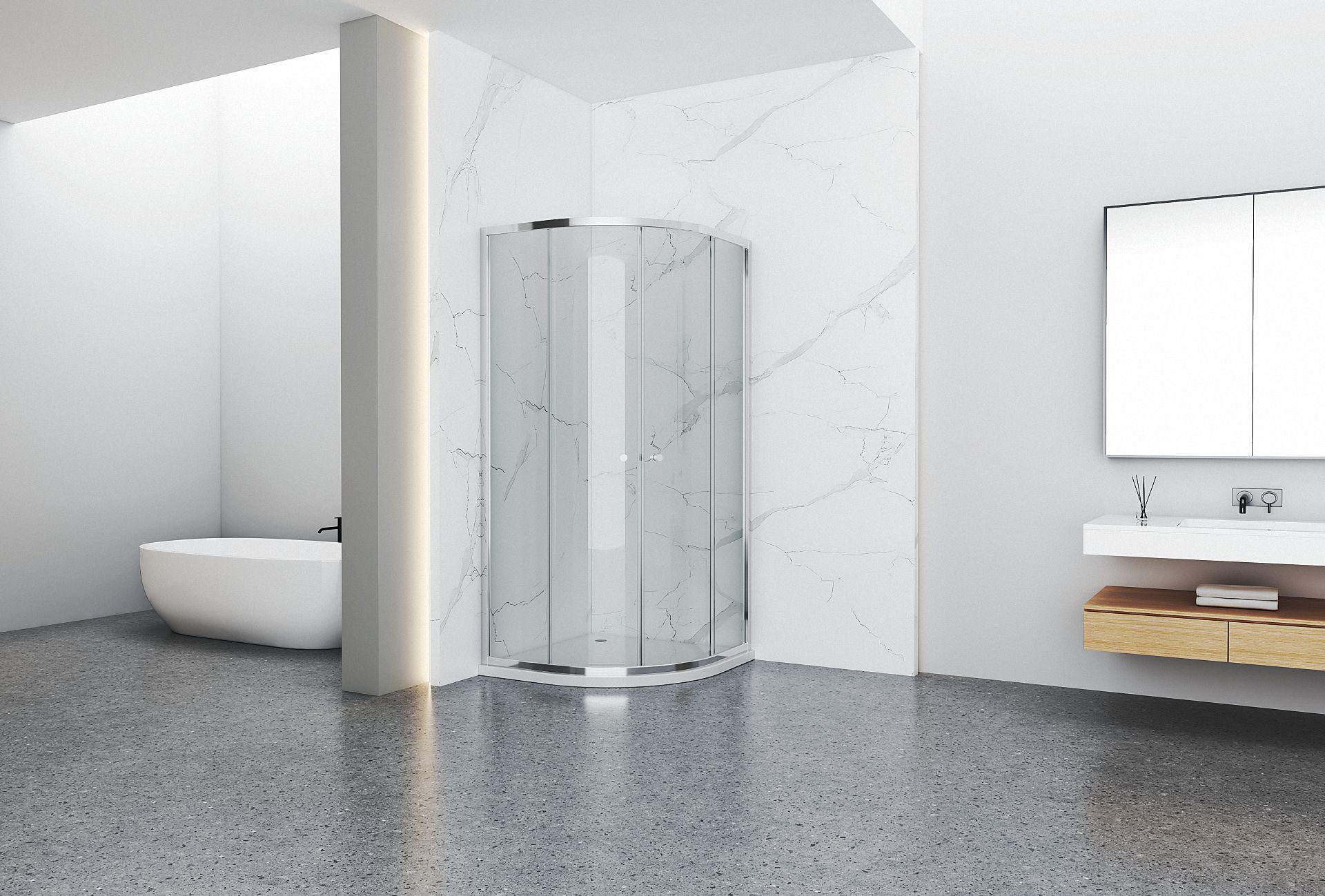
Frame architecture is not only an aesthetic layer. It changes how the enclosure is aligned, how the glass is held, and how the installation team resolves site tolerances. The arc shower door KL-AS5210422 uses aluminium alloy hardware and is intended for residential construction and commercial hospitality. Its curved front gives the designer a different visual line from a rectangular hinged or sliding unit. The frameless hinge model KL-AS5577310 uses 304 stainless steel hardware and is classified by SHKL as a frameless shower door in its whitepaper wording. The sliding model KL-AS5511312 uses 304 stainless steel hardware and is a sliding shower door for residential and commercial hospitality applications.
Glass specification is the second layer. SHKL lists 6 mm, 8 mm, 10 mm, and 12 mm tempered glass options for shower doors. Model-level glass craftsmanship options across the shower door range include clear glass, tinted glass, laminated glass, flute glass, chemically frosted glass, easy-clean glass, and film-coated glass. Those options should be confirmed against the chosen model and order. A laminated glass shower door and an easy-clean glass shower door may serve different project priorities, but neither should be selected without checking the model’s available configuration and the destination market’s safety-glazing requirement.
For frameless shower enclosures in the United States context, the National Glass Association design guide states that shower-enclosure glass should be safety glazing meeting the federal impact requirement of CPSC 16 CFR 1201. The guide also describes monolithic tempered glass of at least 3/8 inch, or 10 mm, for the frameless category covered by that guide. That figure is category guidance, not a universal minimum for every framed glass shower door, sliding shower door, hinged shower door, or jurisdiction. In Europe, EN 14428:2015+A1:2018 specifies functional requirements and test methods for shower enclosures. ASTM C1048-18 is the standard specification for heat-strengthened and fully tempered flat glass. Buyers should map the applicable standard to the destination market and project type rather than applying one market’s default to every order.
Hardware material is a separate specification input. KL-AS5577310 and KL-AS5511312 use 304 stainless steel hardware. KL-AS5210422 uses aluminium alloy. SHKL also lists the hinge shower door KL-AS5507310 in aluminium alloy and the sliding shower door KL-AS5608212 in aluminium alloy. These material names should be recorded exactly. A 304 stainless steel designation is not, by itself, proof of compliance or performance in a specific environment. It is a material input that should be read alongside finish, maintenance, warranty terms, and model-level test documentation.
A Practical Scoring Matrix for Shower Door Selection
The matrix below turns the three-layer framework into a transparent project-fit score. The scores are illustrative buyer-fit scores on a 1 to 5 scale. They are not laboratory performance ratings, certification outcomes, or a supplier ranking. A project team should change the weights to match its own priorities, then record the reason for each score.
| Criterion and weight | Arc KL-AS5210422 | Frameless hinge KL-AS5577310 | Sliding KL-AS5511312 |
|---|---|---|---|
| Visual openness (20%) | 3 | 5 | 4 |
| Glass specification range (15%) | 5 | 5 | 5 |
| Hardware material match to project brief (10%) | 3 | 5 | 5 |
| Operation and clearance (20%) | 3 | 4 | 5 |
| Cleaning and maintenance access (15%) | 3 | 4 | 3 |
| Installation and adjustment simplicity (10%) | 4 | 3 | 4 |
| Supply and service continuity (10%) | 4 | 4 | 4 |
| Weighted example score | 3.50 | 4.35 | 4.30 |
How to read the matrix: the weighted score is a decision aid, not a product verdict. If the project weights operation and clearance at 35% instead of 20%, the sliding model may lead. If visual openness dominates, the frameless hinge model may lead. If the room calls for a curved front, the arc model becomes the relevant design option and should be scored against that design intent, not against a rectangular enclosure.
The matrix also exposes a common error: treating every model as interchangeable because all three offer a broad glass menu. The glass score alone does not capture the frame and function differences. A buyer should score the glass after confirming the available thickness, treatment, and safety-glazing documents for the exact model and market.
Application and Use Cases
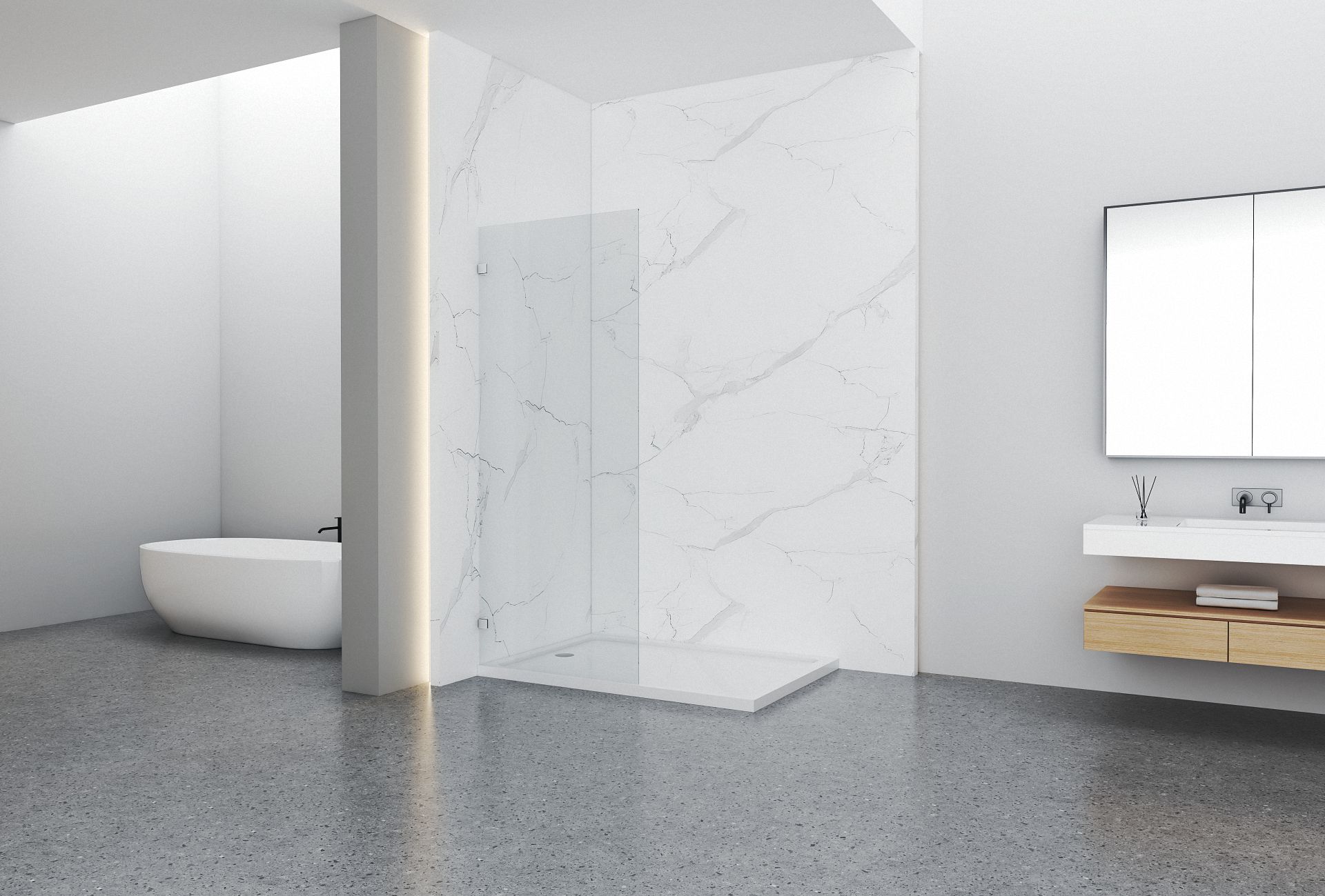
For a design-led residential bathroom with a clean sightline and suitable wall or panel conditions, the frameless hinge KL-AS5577310 is the natural test case. SHKL lists it as a hinge shower door with 304 stainless steel hardware, classified as frameless in its whitepaper wording, and intended for residential construction and commercial hospitality. Its visual openness is its main advantage, but the installation depends on accurate alignment and a suitable substrate. A frameless shower door is not a repair for an out-of-plumb wall.
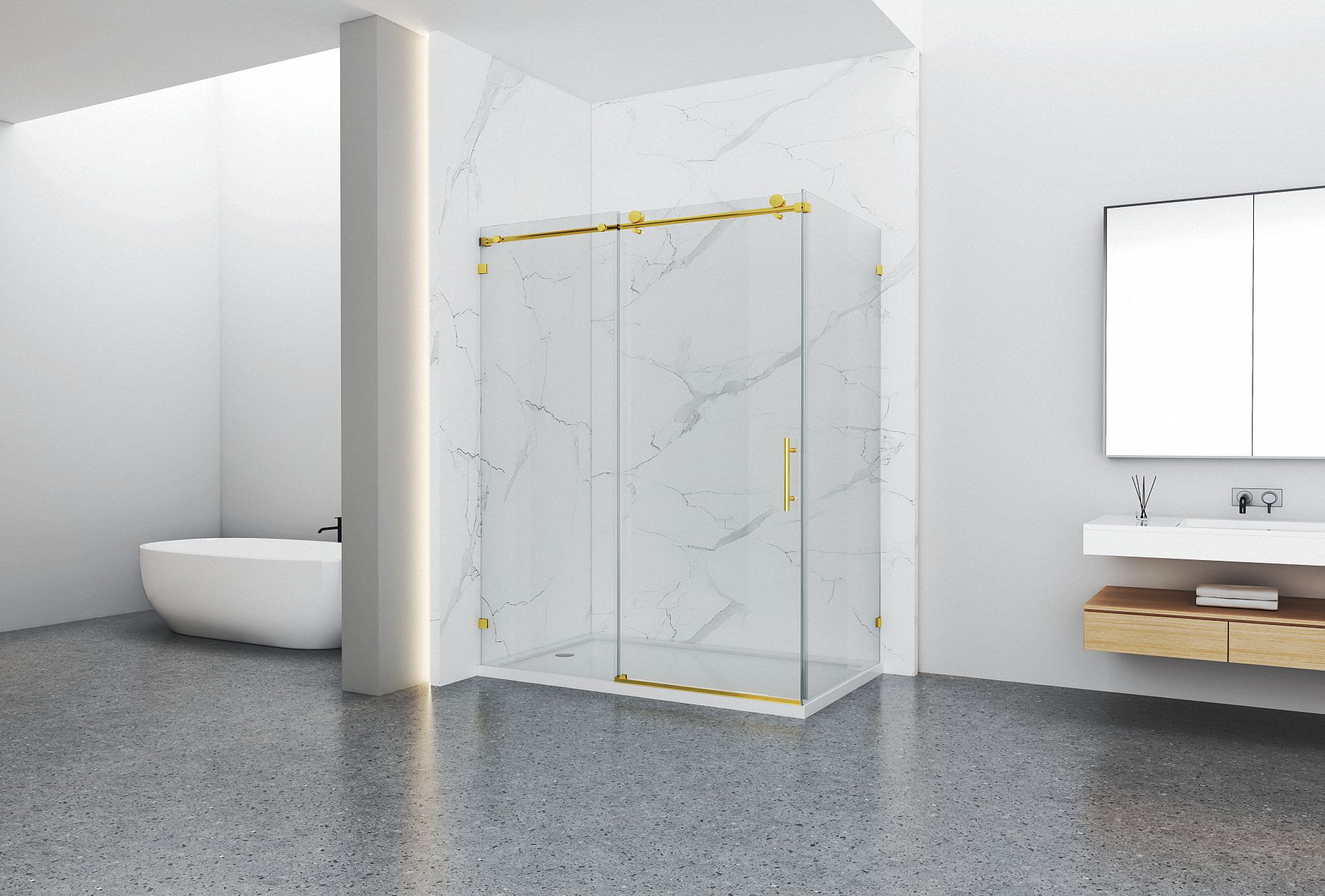
For a compact bathroom where door swing would conflict with circulation, the sliding KL-AS5511312 is the practical test case. It removes the swing clearance question, but it adds a track and guide system that must be cleaned and adjusted. In hospitality projects, that maintenance access should be part of the operating plan, not an afterthought. Sliding shower doors can be a strong fit for guest bathrooms, rental apartments, and projects where the same enclosure type will be repeated across many rooms.
For a curved layout or a bathroom where the enclosure is intended to soften the room geometry, the arc KL-AS5210422 is the relevant test case. Its aluminium alloy hardware and curved front create a different planning footprint from a rectangular hinge or sliding unit. The arc form should be checked against actual clearance and cleaning access, not only against a floor plan. The same logic applies to bath shower screens and bathtub shower doors: the frame and glass may look similar in a catalog, but the operating envelope is different.
For a simpler fixed-screen approach, SHKL lists the KL-AS001-1 shower screen in 304 stainless steel. That type can be useful when the project wants a glass shower screen rather than a full enclosure with a moving door. The framework still applies: confirm the frame or support condition, the glass specification, and the cleaning and maintenance routine.
Market Trend Analysis
The global shower doors market was valued at USD 13.5 billion in 2023, according to Cognitive Market Research. The same commercial research source estimates that frameless shower glass doors held a 75% market share in North America in 2025. These are market estimates, not project-level proof of performance or compliance. Their procurement implication is narrower: frameless visual language is mainstream enough that buyers should expect to evaluate it seriously, while still separating aesthetics from safety-glazing documentation and installation quality.
SHKL’s own export profile provides a second context signal. The company states that approximately 70% of its products are exported, serving markets in the EU, AU, NA, SA, and ME. For buyers, that means the same supplier catalog may be used across markets with different standards and different installation habits. A shower door that is acceptable in one market may require a different glass document, hardware finish, or test report in another. The buyer’s framework should therefore include a market-compliance column, not only a design-preference column.
The broader trend is toward thinner visual frames and larger glass surfaces, but the procurement trend is toward documentation. Framed glass shower doors still have a role where perimeter frame coverage helps resolve the design. Frameless shower doors continue to attract design attention. Sliding shower doors remain practical where swing clearance is limited. The mature buying question is not which style is trending, but which style can be documented, installed, cleaned, and repeated across the project.
Comparison with Traditional Solutions
Traditional framed glass shower doors use more visible frame around the glass. That can make the perimeter easier to resolve in some site conditions and can give the enclosure a more conventional appearance. The trade-off is visual weight: more frame can close down the perceived space. A frameless hinge shower door reduces that frame presence, but it places more demand on wall and panel alignment. A sliding shower door removes the swing clearance problem, but it introduces a track that must be kept free of residue and adjusted over time. An arc shower door creates a distinctive curved front, but the curve must be planned against the room’s actual usable space.
The most important limitation is that no scoring matrix can certify a shower enclosure. A high project-fit score does not prove impact safety, water retention, corrosion resistance, cycle durability, or conformity with local building requirements. Those claims require model-specific test reports, safety-glazing certificates, and installation instructions. The framework in this article is limited to organizing the buyer’s decision. It also cannot rank SHKL against other manufacturers, because the available evidence here is limited to SHKL catalog facts, published standards, and third-party market estimates rather than a multi-supplier benchmark.
A second limitation is application-specific. The National Glass Association guidance on 10 mm glass for the frameless category should not be generalized to every framed shower screen, sliding shower door, or hinged shower door. EN 14428:2015+A1:2018 and ASTM C1048-18 are relevant references, but the buyer must still confirm the current official requirement for the destination market and the exact product configuration. A supplier’s management-system certificate is not the same as a product conformity certificate.
Future Outlook
Shower door procurement is moving toward model-level evidence. Buyers increasingly need to connect a catalog model to its glass thickness, hardware material, available treatments, safety-glazing document, and installation requirements. That is a more useful form of differentiation than another style label. The suppliers that can supply this evidence quickly will be easier to qualify and easier to repeat across projects.
SHKL’s manufacturing context is relevant to that discussion. The company was established in 2004, employs approximately 600 staff, and operates a total factory area of 140,000 square meters, with 100,000 m² in China and 40,000 m² in Vietnam. It lists a 20-engineer R&D team and an annual production capacity of 10,000,000 units. Those facts describe scale and product-development capacity. They do not replace project-level verification. The practical next step for buyers is to use the framework as a shortlisting tool, then request the model-specific documents that the project actually requires.
Frequently Asked Questions
What should a buyer compare first when choosing a shower door?
Start with operating function and site conditions, then compare frame and glass. A shower door that does not fit the room’s clearance, wall condition, or cleaning routine is a poor choice even if its glass options and finish look right. After the functional fit is clear, compare frame architecture and glass specification.
Is a frameless hinge shower door such as KL-AS5577310 suitable for every bathroom?
No. SHKL classifies KL-AS5577310 as a hinge shower door and, in its whitepaper wording, as a frameless shower door with 304 stainless steel hardware. It is intended for residential construction and commercial hospitality, but suitability still depends on wall or panel conditions, actual dimensions, glass safety-glazing requirements, and site measurement.
What glass options does SHKL list for shower door models?
SHKL lists glass craftsmanship options including clear glass, tinted glass, laminated glass, flute glass, chemically frosted glass, easy-clean glass, and film-coated glass. It also lists 6 mm, 8 mm, 10 mm, and 12 mm tempered glass options for shower doors. Buyers should confirm the available combination for the exact model and order.
How does the arc KL-AS5210422 compare with the sliding KL-AS5511312?
KL-AS5210422 is an arc shower door made of aluminium alloy and is intended for residential construction and commercial hospitality. KL-AS5511312 is a sliding shower door made of 304 stainless steel and is intended for the same broad project types. The arc model is a design-geometry choice; the sliding model is a clearance and operation choice. Both should be compared on glass specification, hardware material, cleaning access, and site fit.
What standards should buyers check before ordering a shower enclosure?
Check the requirements of the destination market. EN 14428:2015+A1:2018 specifies functional requirements and test methods for shower enclosures in the European context. ASTM C1048-18 covers heat-strengthened and fully tempered flat glass. In the United States context, the National Glass Association design guide refers to safety glazing meeting CPSC 16 CFR 1201 for the frameless category it covers. These references should be matched to the exact product and jurisdiction.
Can the scoring matrix be used as a supplier ranking?
No. The matrix is an illustrative project-fit tool for comparing model categories against a buyer’s own priorities. It is not a laboratory test, certification, or supplier ranking. A high score should trigger a document request and sample review, not replace them.
Reference document: the public SHKL brochure is available as a PDF at https://cdn.socialarks.com/sbsp/24838/0/2026/0507/69fc27124a38b.pdf for product-reference purposes.
Have Questions or Need More Details?
Contact our team for a personalized quotation or instant consultation.
Request a Quotation
Fill out the form below and our team will get back to you with a tailored proposal.
WhatsApp Direct Chat
Prefer to chat in real-time? Message us on WhatsApp for instant assistance & quick answers.
- Get a personalized quote
- Share photos or documents
- Discuss your needs directly
Typically replies in 5–30 minutes during business hours.