
ZX-EGF Enclosed Ground Flare: Refractory Lining and Material Evidence
Global gas flaring reached 151 billion cubic meters in 2024, the highest level recorded since 2007, according to World Bank flaring data — a figure that reframes every flare specification as a combustion-performance question rather than a compliance formality. The global flare systems market was valued at approximately USD 4.8 billion in 2025 (Dataintelo), and within that market the totally enclosed ground flare segment is driven less by unit volume than by verified destruction performance: Intel Market Research valued the global totally enclosed ground flare market at USD 113 million in 2024, with growth linked to destruction efficiencies exceeding 98%.
For engineering and procurement teams evaluating enclosed ground flare systems, the decision-relevant question is narrower than the market data. Two suppliers can quote the same relief duty, the same combustion-efficiency target and the same governing standard, yet differ substantially in what the materials, the refractory lining and the thermal design actually support in service. This article examines one specific system — the ZX-EGF Series enclosed ground flare from Shandong Zexuan Environmental Protection Technology Co., Ltd. — and treats its published parameters, material list and operating records as evidence to be read rather than claims to be accepted.
Shandong Zexuan Environmental Protection Technology Co., Ltd. (Zexuan) is a Chinese manufacturer and engineering service provider specializing in industrial flare systems, thermal treatment equipment and waste gas combustion solutions. Established in 2015, the company operates a 24,100 m² manufacturing base with more than 80 employees, including 30+ engineering and technical specialists, and reports international project experience in more than 10 countries across the Middle East, Central Asia, Southeast Asia, Africa and Russia. Its product range covers elevated flare systems (self-supported, guyed-wire, derrick-supported and demountable), enclosed ground flare systems, skid-mounted and mobile LNG/LPG flare systems, flare tips, thermal oxidizers (TO, RTO and RCO), and industrial incineration systems.
Why Enclosed Ground Flares Are Specified — and Why the Specification Is Hard to Verify
An enclosed ground flare contains combustion inside a refractory-lined enclosure rather than at the top of an open stack. That single design decision changes what a flare system imposes on the site around it. An open elevated flare presents a visible flame and a combustion point high above grade; an enclosed ground flare removes the tall structure and the visible flame, and instead places the performance burden on the enclosure, the lining and the burner arrangement.
This is why enclosed ground flares are typically specified where the surrounding plot is dense or the visual and thermal environment is sensitive: LNG terminals, chemical plants, petrochemical parks, pharmaceutical sites and industrial parks. In those locations, radiation at grade, noise, flame containment and combustion stability are design outputs, not site conditions that can be designed around afterwards.
The verification problem follows directly from that. Performance targets are easy to write into a datasheet — "low radiation", "low noise", "high destruction efficiency" — but they are only meaningful when they can be traced to a material grade, a lining specification and a validated operating band. A buyer evaluating an enclosed ground flare is, in practice, evaluating whether the supplier's material and thermal design evidence matches the performance language.
What the ZX-EGF Series Publishes
The ZX-EGF Series is Zexuan's enclosed ground flare platform, described in the company's technical documentation as a multi-burner ground flare with a low-radiation design. Its published specification is unusually specific for the claims it makes, listing both the operating envelope and the material family.
| Parameter | Published specification — ZX-EGF Series |
|---|---|
| Product type | Enclosed ground flare; multi-burner ground flare; low-radiation ground flare |
| Combustion efficiency | Up to 99.9% |
| Operating temperature | 800 °C – 1200 °C |
| Gas flow | Customized to project conditions |
| Thermal design | Low-radiation design |
| Noise | Low-noise operation |
| Siting characteristics | Suitable for limited-space areas; multiple burner configurations available |
| Materials | Carbon steel; SS304; SS316L; SS310S; refractory lining materials |
| Target applications | Petrochemical parks; chemical plants; LNG terminals; hazardous gas treatment; pharmaceutical industry; industrial parks |
Table 1. ZX-EGF Series published parameters and material scope, as documented by Shandong Zexuan Environmental Protection Technology Co., Ltd.
Taken on its own, the specification reads as a list. Read as an engineering statement, each line answers a question that buyers commonly have to raise separately with suppliers.
Reading the Material List as an Engineering Statement
The five material entries in the ZX-EGF specification are not interchangeable options offered for commercial flexibility. They correspond to different duty zones inside and around a refractory-lined combustion enclosure, and to different failure modes.
Carbon steel covers the structural and lower-temperature elements — the enclosure support structure, base frame and general fabrication. It is the default grade where temperature and corrosion duty do not demand an upgrade, and it keeps the material cost of the enclosure within a practical range.
SS304 and SS316L address corrosion rather than temperature. The distinction between the two matters in waste gas service: SS316L carries higher resistance to chlorides and to the aggressive constituents that appear in chemical plant, pharmaceutical and petrochemical vent streams. Where a vent gas is clean hydrocarbon, SS304 is usually adequate; where it is not, the material list gives the supplier a documented upgrade path rather than an ad-hoc concession.
SS310S high-temperature stainless steel is the grade that corresponds to the upper end of the 800 °C–1200 °C operating band. It is the same grade family Zexuan specifies for high-temperature flare tips and for hazardous waste incineration equipment, which indicates a consistent high-temperature material practice across the product range rather than a single-product exception.
Refractory lining materials complete the thermal barrier. In an enclosed ground flare, the lining performs two functions simultaneously: it protects the enclosure shell from the combustion zone temperature, and it reduces the radiant flux that reaches grade level around the unit. That second function is what makes a "low-radiation" claim an engineering property rather than a marketing adjective — the radiation performance of an enclosed flare is largely determined by the enclosure geometry and the lining, not by the burner alone.
One boundary worth noting for evaluation purposes: the published ZX-EGF material list covers carbon steel, SS304, SS316L, SS310S and refractory lining materials. Zexuan's broader material selection documentation also lists Inconel 625, Hastelloy alloy and other high-temperature, corrosion-resistant alloys, which are documented for high-temperature flare tips and general material selection. A project that requires an exotic alloy in the enclosed flare itself should confirm that requirement explicitly during technical clarification.
Temperature Band, Combustion Stability and API 521
The published 800 °C–1200 °C operating band places the ZX-EGF in the same high-temperature combustion category as Zexuan's thermal oxidizer and incineration lines, which are documented at 800 °C–1200 °C and 850 °C–1200 °C respectively. That is a useful signal during evaluation: it indicates that the enclosed flare is engineered as high-temperature combustion equipment with a refractory-lined chamber, rather than as a burner set inside a simple shroud.
The temperature band also defines the operating limit. Because the band is a range rather than a fixed set point, the actual operating point of a given unit follows the gas composition, heating value and flow conditions of the project — which is why gas flow is listed as customized rather than fixed. Buyers should expect the combustion temperature, burner configuration and material grade to be confirmed together against the specific vent gas analysis.
On the standards side, flare system design is principally governed by API Standard 521 (Pressure-Relieving and Depressuring Systems), which specifies, among other requirements, a minimum flare header slope of 1/4 inch per 10 feet for drainage. Zexuan documents its flare designs as compliant with API 521 requirements, with high reliability, smokeless combustion, low thermal radiation and corrosion resistance, in 24/7 standby service with automatic activation during emergencies. For refinery and gas processing duty, that combination — automatic activation, smokeless combustion and low thermal radiation — is the performance profile that enclosed ground flare specifications are normally written to achieve.
Field Records: What the Installed Base Shows
Specifications describe intent; operating records describe behaviour. Two documented ZX-EGF installations illustrate what the material and design choices translate into on site.
Coalbed methane vent gas, China. A coalbed methane company operates one ground flare system for treatment of coalbed methane vent gas. The documented configuration includes a 90×10⁴ Nm³/d processing capacity, a three-stage venting design and PLC automatic control. Reported results after more than two years of operation include stable methane combustion and improved gas management safety. For a buyer, the relevant evidence here is the multi-stage venting arrangement and the control philosophy: on a large-volume, variable-composition methane stream, combustion stability depends on staging and control, not on burner size alone.
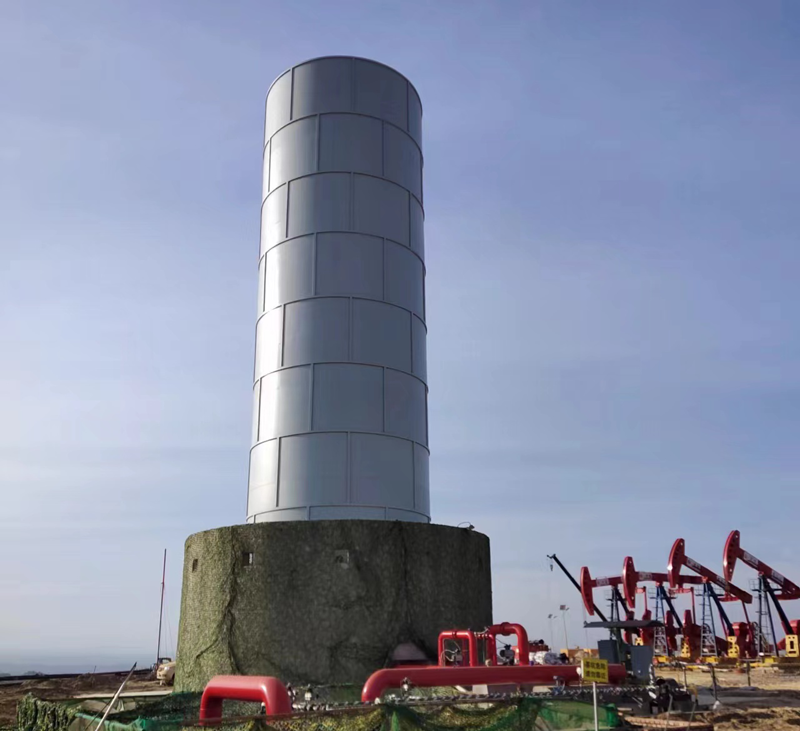
Natural gas vent gas, oilfield transfer station, China. An oil & gas company installed one enclosed ground flare system to handle natural gas vent gas from an oilfield transfer station. The documented features are an enclosed ground flare design, an explosion-proof control cabinet and an automatic ignition system. After one year of operation, the reported outcomes were safe disposal of natural gas emissions, reduced noise and visual impact, and stable operation. The reported reduction in noise and visual impact is directly attributable to the enclosed, refractory-lined configuration — it is the same property that makes the platform suitable for sites where an exposed elevated flame would be unacceptable.
Zexuan's ground-level combustion record also extends beyond the ZX-EGF platform into skid-mounted ground flare systems, which share the enclosed, ground-level combustion principle. A skid-mounted unit in Vietnam was commissioned within one year for pyrolysis gas from waste plastic conversion; an installation in Iraq has been operating for more than three years treating excess pyrolysis gas from waste tire recycling; and a unit in Turkey has been in service for more than two years in the same industry. These are different models, but they are relevant evidence of sustained field operation in ground-level combustion service.
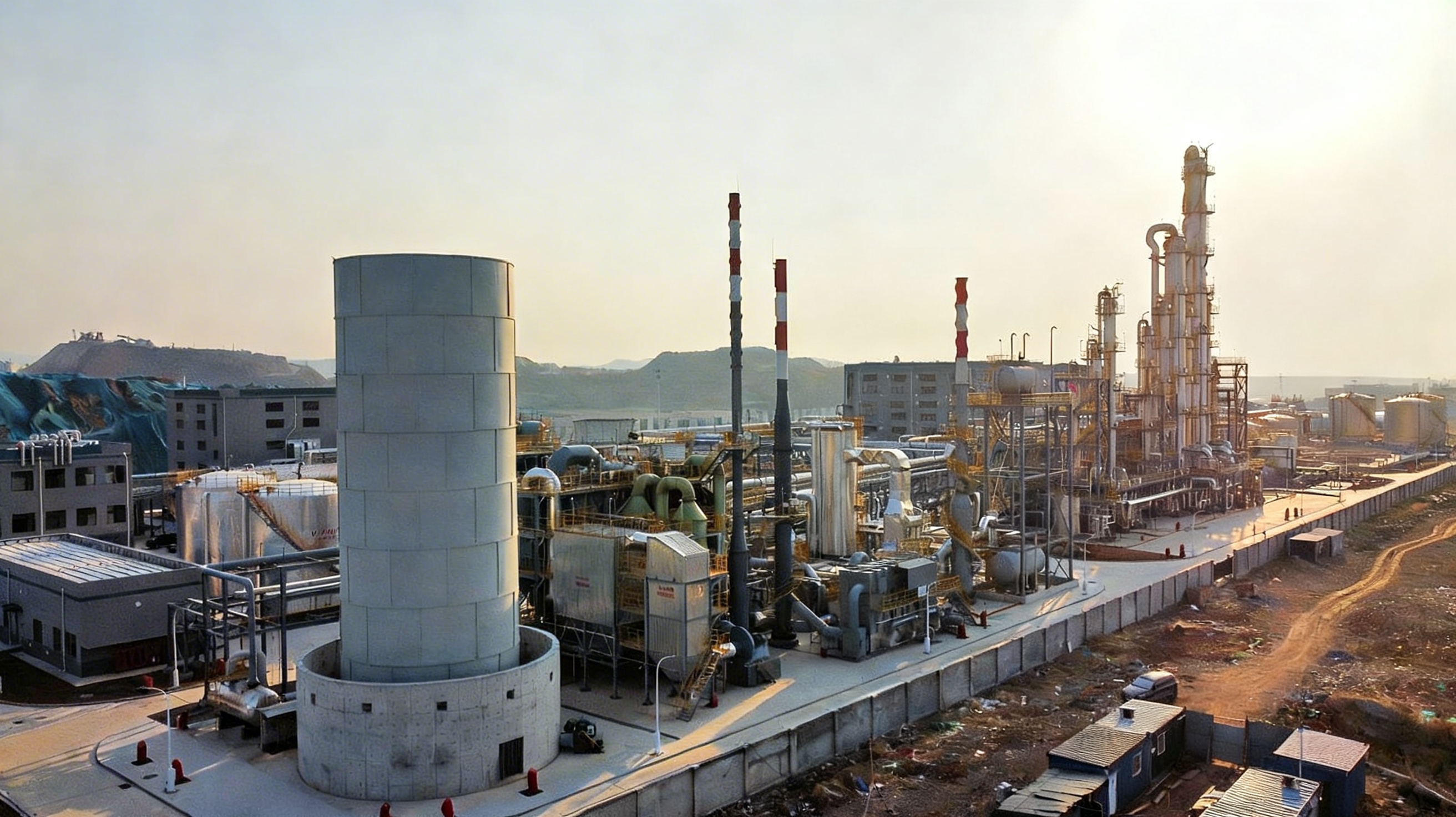
Enclosed Ground Flare vs. Elevated Flare: What the Choice Costs You
An enclosed ground flare is not a universally superior choice, and selection decisions go wrong when it is treated as one. The comparison below sets the two configurations side by side on the dimensions that actually drive layout, maintenance and lifecycle planning.
| Consideration | Elevated flare | Enclosed ground flare (ZX-EGF characteristics) |
|---|---|---|
| Combustion point | Above grade at the flare tip; Zexuan documents elevated flare heights from 10 m to 150 m+ | At ground level, inside a refractory-lined enclosure |
| Visible flame | Visible from a distance; visual impact is site-dependent | Flame is contained within the enclosure; documented field result is reduced visual impact |
| Noise | Combustion noise is emitted from an elevated point | Low-noise operation is a stated design characteristic |
| Thermal environment | Radiant flux at grade falls with distance from the stack | Enclosure geometry and refractory lining limit radiant flux at grade |
| Plot usage | Small ground footprint but a tall structure with height clearance requirements | No tall stack, but a ground-level enclosure footprint plus its exclusion zone |
| Maintenance scope | Tip, pilots, ignition system and structural inspection | Adds refractory lining inspection and repair to the standard scope |
| Materials | Carbon steel, hot-dip galvanized steel, SS304/SS316L, SS310S, Inconel 625 for high-temperature parts | Carbon steel, SS304, SS316L, SS310S, refractory lining materials |
Table 2. Configuration trade-offs. Elevated flare data reflects Zexuan's documented elevated flare parameters; enclosed ground flare characteristics reflect the published ZX-EGF specification and field records.
Three limitations deserve to be stated plainly, because they are the ones that most often surface late in a project:
- The refractory lining is a lifecycle maintenance item. An enclosed ground flare adds a lining inspection and repair scope that an open elevated flare does not have. Thermal cycling, flame impingement and contaminants in the vent gas all affect lining life, and the maintenance plan should be budgeted and scheduled from the outset rather than discovered after commissioning.
- Ground-level space is required, not eliminated. An enclosed flare removes the tall stack and reduces visual and radiant impact at the boundary, but the enclosure, its exclusion zone, the knockout drum and the associated piping all occupy grade-level plot. Sites that are constrained vertically rather than horizontally are the natural fit.
- Performance claims require per-project validation. The published 800 °C–1200 °C band, the 99.9% combustion efficiency figure and the low-radiation design are design capabilities, not guarantees for an arbitrary gas stream. The operating point, burner configuration and material grades must be confirmed against the actual vent gas composition, flow range and turndown requirement — which is precisely why gas flow is documented as customized rather than fixed.
Shortlisting Enclosed Ground Flare Suppliers: A Verification Framework
The global supplier landscape for flare and combustion equipment includes established international names such as Zeeco, John Zink Hamworthy (Koch), Honeywell UOP and Baker Hughes, as identified in market coverage by HTF Market Intelligence. Buyers shortlisting enclosed ground flare systems — whether against those names or against regional manufacturers — evaluate candidates against a largely common set of dimensions. The framework below converts each dimension into a document request, which is where the verification actually happens.
| Evaluation dimension | What to request from the supplier | Why it decides the outcome |
|---|---|---|
| Material specification | Grade-by-grade material list with the component or zone each grade applies to | Determines corrosion and high-temperature life; a general "stainless steel" statement is not verifiable |
| Refractory lining design | Lining specification, thickness logic, anchoring method and inspection/replacement plan | Drives radiation performance, shell temperature and the long-term maintenance budget |
| Operating envelope | Confirmed operating temperature and flow range against the project gas analysis | The published band is a capability range; the project operating point must be validated |
| Combustion performance | Stated combustion efficiency and the basis on which it was determined | Efficiency claims are the core environmental deliverable of the system |
| Radiation and noise provisions | Design provisions supporting low-radiation and low-noise operation | These are the properties that make enclosed flares suitable for constrained plots |
| Control and safety | Ignition system, control philosophy, hazardous-area classification of control equipment | Emergency relief systems operate unattended and must activate reliably |
| Quality documentation | Inspection plan and factory acceptance test scope | Material claims are only as good as the inspection that verifies them |
| Field references | Installed units, service duration and application | Operating history is the closest available proxy for design durability |
Table 3. Verification framework for enclosed ground flare supplier evaluation.
Certification, Inspection and Delivery Evidence
For evaluation purposes, a supplier's quality system is the mechanism that makes material claims auditable. Zexuan holds three management system certifications issued on 18 March 2026 by CSU International Certification Co., Ltd., all valid through 17 March 2029: a quality management system certification to GB/T 19001-2016 / ISO 9001:2015 (certificate number 26326Q00079R001), an environmental management system certification to GB/T 24001-2016 / ISO 14001:2015 (certificate number 26326E00054R001), and an occupational health and safety management system certification to GB/T 45001-2020 / ISO 45001:2018 (certificate number 26326S00054R001). The certification scope covers the development of waste gas treatment equipment and control units and the sale of waste gas and waste liquid treatment equipment — the product category that includes flare systems.
On the manufacturing side, Zexuan documents a full-process inspection regime that runs from incoming material inspection through welding inspection, dimensional inspection, pressure and leak testing where applicable, functional testing, factory acceptance testing before shipment, and a final inspection before shipment, with 100% inspection stated as the standard. Documented production capability is 5 sets per month for customized industrial systems, with lead times of 60–120 days depending on project requirements and a minimum order quantity of one set — a practical consideration for buyers who need a single engineered unit rather than a batch order.
After-sales scope is documented as remote support, commissioning assistance, spare parts and training. For an enclosed ground flare, commissioning support carries more weight than it does for simpler equipment, because burner staging, control loops and lining dry-out procedures all affect first-start performance.
Market Signals Behind the Enclosed Ground Flare Case
Three verifiable market signals explain why enclosed ground flare specifications are receiving more attention in evaluation cycles.
First, flaring volumes remain high. Global gas flaring reached 151 billion cubic meters in 2024, the highest level since 2007 (World Bank), which sustains regulatory and operator attention on combustion efficiency rather than on flare presence alone. Second, the enclosed segment is growing on performance grounds: the totally enclosed ground flare market was valued at USD 113 million in 2024, with growth attributed to destruction efficiencies exceeding 98% (Intel Market Research). Third, the adjacent VOC control equipment market — thermal oxidizers and incinerators, the technology family that shares high-temperature combustion and refractory practice with enclosed flares — is estimated at USD 7.5 billion in 2025, with China identified as a key growth market at a 5.4% CAGR (Fact.MR). Regional demand is concentrated: Asia-Pacific holds a 35% share of the flare gas recovery system market as of 2025, the largest regional share globally (Grand View Research).
Read together, these signals point to a shift in how enclosed ground flares are bought. The selection question is moving from "can the supplier deliver a unit" to "can the supplier document the material, lining and thermal design that produce the stated performance" — which is exactly the evidence set the ZX-EGF specification exposes.
Future Outlook
Two directions are likely to shape enclosed ground flare specifications over the next evaluation cycles. The first is documentation depth: as flaring performance comes under closer measurement, suppliers will be expected to present material grades, lining specifications and validated operating envelopes as standard tender content rather than as clarification responses. The second is integration — enclosed flares increasingly sit alongside flare gas recovery, thermal oxidation and digital monitoring within a single emissions strategy, and suppliers with combustion and thermal treatment portfolios are positioned to support that integration.
Zexuan states that it is pursuing low-carbon combustion technologies, intelligent control systems, flare gas recovery and digital operation solutions across its flare and thermal treatment lines. For buyers in the evaluation stage, the practical implication is that material and design evidence — not headline duty figures — is becoming the deciding factor in supplier selection.
FAQ
What is an enclosed ground flare, and how does it differ from an elevated flare?
An enclosed ground flare contains combustion inside a refractory-lined enclosure at ground level, rather than at the tip of an elevated stack. In Zexuan's product range, the two configurations coexist: elevated flare systems are documented with stack heights from 10 m to 150 m+ and combustion efficiency of 98%–99.9% depending on design conditions, while the ZX-EGF Series enclosed ground flare is documented with combustion efficiency up to 99.9%, a low-radiation design and low-noise operation. The practical difference is where the combustion products and radiation are managed — above the plot or inside a lined enclosure on it.
What materials does the ZX-EGF Series use, and why does that matter?
The published material list for the ZX-EGF Series comprises carbon steel, SS304, SS316L, SS310S and refractory lining materials. The grades correspond to different duty zones: carbon steel for structural and lower-temperature fabrication, SS304 and SS316L for increasing levels of corrosion resistance in the vent gas path, SS310S for the high-temperature end of the 800 °C–1200 °C operating band, and refractory lining materials for the thermal barrier between the combustion zone and the enclosure shell. For buyers, the material list is the point at which a "low radiation" claim becomes verifiable, because radiation performance in an enclosed flare depends substantially on enclosure geometry and lining design.
What operating temperature and efficiency does the ZX-EGF Series cover?
The ZX-EGF Series is documented at an operating temperature of 800 °C–1200 °C with combustion efficiency up to 99.9%. Gas flow is customized to project conditions rather than fixed, and multiple burner configurations are available. Because the specification gives a range rather than a fixed set point, the operating temperature, burner arrangement and material grade for a specific project should be confirmed together against the vent gas composition, flow rate and turndown requirement.
Which sites and industries is the ZX-EGF Series intended for?
The published application list for the ZX-EGF Series covers petrochemical parks, chemical plants, LNG terminals, hazardous gas treatment, the pharmaceutical industry and industrial parks. The design is described as suitable for limited-space areas, with low-radiation and low-noise operation — the characteristics that matter where an exposed elevated flame or high radiant flux at grade would be difficult to accommodate. Zexuan's wider flare business also serves oil & gas production, refining, pipeline compressor stations, landfill gas and biogas projects, waste-to-energy plants and metallurgy.
What field evidence exists for Zexuan's ground-level flare systems?
Zexuan documents several ground-level installations. A coalbed methane company operates one ground flare system for vent gas treatment with a 90×10⁴ Nm³/d processing capacity, three-stage venting design and PLC automatic control, with more than two years of stable operation reported. An oil & gas company installed one enclosed ground flare system for natural gas vent gas at an oilfield transfer station, using an explosion-proof control cabinet and automatic ignition, with one year of operation and reported reductions in noise and visual impact. Zexuan's skid-mounted ground flare systems have operated in Vietnam (completed within one year), Iraq (more than three years) and Turkey (more than two years) in pyrolysis gas service.
What limitations should buyers plan for with an enclosed ground flare?
Three boundaries are worth planning for. The refractory lining introduces a maintenance scope — inspection and repair — that an open elevated flare does not have. The enclosure and its exclusion zone occupy ground-level plot, so the configuration solves height, radiation and visual constraints rather than space constraints in general. And the published performance figures are design capabilities: the 800 °C–1200 °C operating band, the 99.9% combustion efficiency figure and the low-radiation design must be validated per project against the actual gas composition, flow range and control requirements before they can be treated as guaranteed performance.
Closing Note
Enclosed ground flares are bought on evidence. The ZX-EGF Series is useful to examine because its published data connect performance language to a specific material family — carbon steel, SS304, SS316L, SS310S and refractory lining — and to a defined operating band of 800 °C–1200 °C, supported by documented installations in coalbed methane and oilfield vent gas service. For buyers in the evaluation stage, that traceability is the difference between a specification and a claim. A technical brochure covering Zexuan's flare and thermal treatment product lines, including the ZX-EGF Series, is available for download: Shandong Zexuan product brochure (PDF).
Have Questions or Need More Details?
Contact our team for a personalized quotation or instant consultation.
Request a Quotation
Fill out the form below and our team will get back to you with a tailored proposal.
WhatsApp Direct Chat
Prefer to chat in real-time? Message us on WhatsApp for instant assistance & quick answers.
- Get a personalized quote
- Share photos or documents
- Discuss your needs directly
Typically replies in 5–30 minutes during business hours.