
ZYX Car Radio Fascia Kits: Company Strength and Buyer Value
ZYX Car Radio Fascia Kits: Company Strength and Buyer Value
A vehicle-specific Android car stereo fascia kit succeeds or fails on three things that rarely appear in a product listing: physical fit, electrical integrity and CAN protocol matching. This analysis examines Shenzhen Zhongyixing Electronic Technology Co., Ltd — the manufacturer behind the ZYX fascia, wiring harness and CANBUS product line — and asks what its stated capabilities, specifications and boundaries mean for installers, distributors and fleet buyers.
Why retrofit installation hardware has become a market of its own
Global demand for car audio head units is large enough to support a dedicated installation-accessory industry behind it. Market Research Future estimated the global car audio head unit market at USD 15.44 billion in 2024. Fortune Business Insights placed Asia Pacific at a 54.21% share of the global car audio market in 2025, and Mordor Intelligence projects a 12.18% CAGR for the car aftermarket audio system segment, associating part of that growth with DIY customers and online plug-and-play kits.
Those figures describe the electronics layer. The hardware that makes an upgrade physically possible — the fascia, the harness and, on modern vehicles, the CANBUS decoder — sits one step behind it. Fascia and installation hardware are traded under HS Code 8708.99 (vehicle parts and accessories, not elsewhere classified), according to the United Nations Statistics Division classification referenced here. In the European Union, electronic subassemblies that affect vehicle safety functions fall under e/E-Marking (ECE R10) EMC requirements rather than CE marking alone, as described in Elite Electronic Engineering's guidance on e/E-marking.
That is the commercial and regulatory context in which Shenzhen Zhongyixing operates. What follows is an assessment of the company's stated capability, its three product lines, and the practical limits a buyer should test before ordering.
The compatibility problem that defines the category
The central difficulty in aftermarket head unit installation is not the head unit. It is the vehicle. The same model name can carry different original radios, connectors, audio systems and dashboard structures depending on model year, equipment level and market.
Shenzhen Zhongyixing describes its matching process as a sequential chain: vehicle brand, vehicle model, model year, original radio, original connector, vehicle configuration, audio system, and finally the new head unit. Any link in that chain can change which fascia, harness or decoder is correct. For vehicles with multiple original equipment configurations, the company asks customers to supply photographs of the original dashboard, the original radio, or the connectors behind the original head unit before purchase — a step intended to reduce mismatches caused by trim and connector variation rather than by the product itself.
Three failure modes recur in this category, and each maps to a different part of the kit: visible gaps or misalignment around the center console (fascia), no power or intermittent audio (harness and connectors), and dashboard warning messages or unresponsive steering-wheel buttons (CAN protocol matching). A supplier's value is therefore best measured by how systematically it addresses all three, not by how many SKUs it lists.
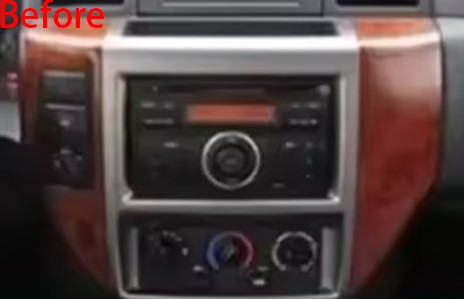
After a retrofit: the center console with the aftermarket head unit installed — the stage at which fascia fit and trim alignment become visible to the customer. Image: Shenzhen Zhongyixing Electronic Technology Co., Ltd.
Shenzhen Zhongyixing Electronic Technology Co., Ltd: company profile
Shenzhen Zhongyixing Electronic Technology Co., Ltd is a Shenzhen, China-based manufacturer and exporter of automotive aftermarket electronics and car audio installation accessories. According to the company background information reviewed for this analysis, the business operates from a 5,000 m² facility with 15 employees, including a three-engineer R&D team, and reports an annual output of 1,000,000 units. Export accounts for 80% of its business, with Russia and Europe (RU/EU) listed as the main markets. Its public website is www.zyxcaradio.com.
Two details are worth separating. The legal entity dates from 2017, while the company profile describes more than ten years of accumulated industry experience in car audio installation accessories. Accumulated team experience and the age of the registered company are different measurements, and buyers conducting supplier due diligence should treat them separately. Both figures originate from the company itself rather than from an independent audit.
Its stated customer base spans car audio installers, car modification shops, automotive parts distributors, car stereo retailers, e-commerce sellers, automotive electronics businesses and individual car owners — a distribution-oriented profile consistent with an 80% export share.
The ZYX product architecture: fascia, harness, decoder
The portfolio is organised around three product families rather than a broad catalogue of unrelated accessories: Car Radio Fascia Kits (ZYX-01), Car Radio Wiring Harnesses (ZYX-02) and CAN Bus Decoder Modules (ZYX-03). The fascia range covers single DIN, double DIN, 7-inch, 9-inch, 10.1-inch and OEM-style configurations, with each item developed against the dashboard structure and mounting points of a specific vehicle application.
| Product / model | Role in the retrofit | Key specified parameters | Compatibility notes |
|---|---|---|---|
| Car Radio Dash Fascia — ZYX-01 | Physical mounting of the aftermarket head unit into the original center console | Compatible screen sizes 7", 9", 10.1", 12.3"; Double-DIN or model-specific custom mounting; dimensional tolerance ≤0.2 mm; material thickness 2.5–3.0 mm; ABS; operating temperature −40 °C to 85 °C; plug-and-play fitment | Molded from original vehicle dashboard data; complete mounting accessories included; installation without damage to the original interior for covered applications |
| Car Radio Wiring Harness — ZYX-02 | Electrical connection between the factory vehicle connector and the new head unit | OEM vehicle-side plug + ISO 16-pin head unit connector; AWG 20–22 tinned oxygen-free copper; ANSI/CTA-2015-B colour-coded insulation; 12 V DC, 10 A maximum; −40 °C to 85 °C; reverse-polarity and short-circuit protection | Designed for non-CAN bus vehicle models; works with most aftermarket car stereos and Android head units; no cutting of the original vehicle wiring required |
| CAN Bus Decoder Module — ZYX-03 | Protocol gateway between the vehicle CAN bus and the aftermarket head unit | CAN 2.0A / 2.0B; 500 kbps / 125 kbps dual rate; 12 V DC, 300 mA standby, 2 A maximum; −40 °C to 85 °C; flame-retardant ABS housing, FR-4 glass fiber epoxy board, heat-conductive silicone potting | Pre-programmed with model-specific firmware; no on-site debugging; built-in CAN isolation intended to prevent dashboard fault codes; matched for use with the supplier's harness and dash kits |
Read together, the specifications show where the engineering effort sits. The fascia is defined by dimensional tolerance (≤0.2 mm) and material thickness (2.5–3.0 mm); the harness by conductor specification (AWG 20–22 tinned oxygen-free copper), colour coding to ANSI/CTA-2015-B and a 12 V DC, 10 A rating with reverse-polarity and short-circuit protection; the decoder by CAN 2.0A/2.0B support at 500 kbps and 125 kbps dual rate. All three products are specified for an operating temperature range of −40 °C to 85 °C, which reflects an in-vehicle environment of direct sunlight, constant vibration, dust and humidity rather than a bench environment.
Coverage is stated at 3,000+ vehicle applications across popular brands including Toyota, Honda, Nissan, Mazda, Ford, Chevrolet, Volkswagen, Audi, BMW, Mercedes-Benz, Hyundai, Kia, Jeep, Dodge, Mitsubishi, Subaru, Peugeot, Renault, Citroën, Fiat and other major automotive brands worldwide. The company states that this vehicle application database is continuously expanded as new models enter global markets.
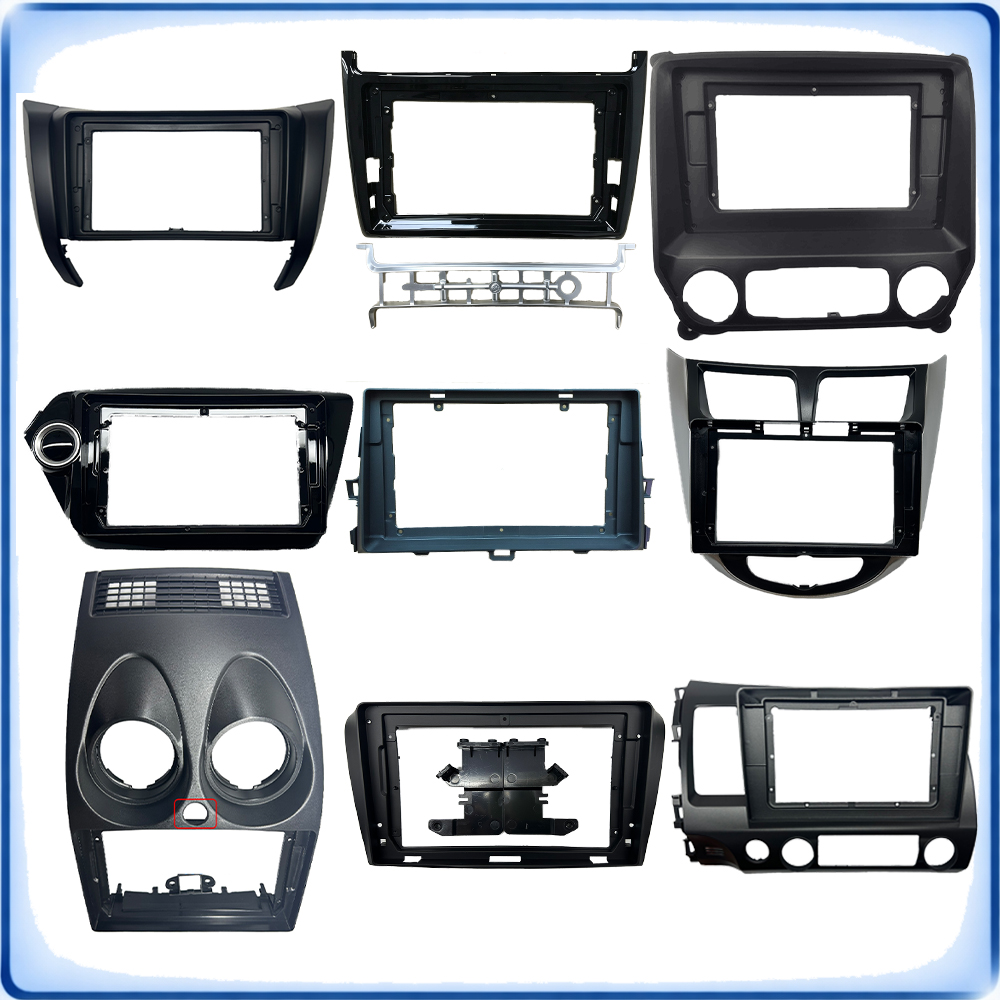
ZYX-01 Car Radio Dash Fascia: model-specific center console frames produced from original dashboard data, with a stated dimensional tolerance of ≤0.2 mm. Image: Shenzhen Zhongyixing Electronic Technology Co., Ltd.
Technical explanation: how a plug-and-play retrofit actually works
A plug-and-play retrofit kit connects to the vehicle through the factory electrical interface. On CAN-equipped vehicles, the decoder is the component that makes this possible: it is an automotive electronic part that enables signal communication between the aftermarket head unit and the vehicle's original CAN bus system. It parses steering wheel control signals, vehicle status data and dashboard prompts from the original bus, converts them into a format the new head unit can read, and forwards the head unit's control instructions back to the vehicle network.
The conversion itself is a protocol translation. Independent technical material on this category describes Android head unit CANBUS decoders translating vehicle network messages from HEX codes into UART messages so that the head unit can retain steering wheel controls and climate data. ZYX-03 is supplied pre-programmed with model-specific firmware, so no on-site debugging or configuration is required at the point of installation. The module is also built with CAN isolation, which the company presents as a measure to prevent dashboard fault codes, and it is matched for use with the same supplier's wiring harness and center dash frame kits.
The functional result claimed for the combination is retention of OEM steering wheel controls, vehicle information display and original chime functions after the Android head unit is installed. Those functions are exactly what buyers notice first when a retrofit goes wrong, which is why the decoder — not the screen — usually determines whether an installation is described as professional or improvised.
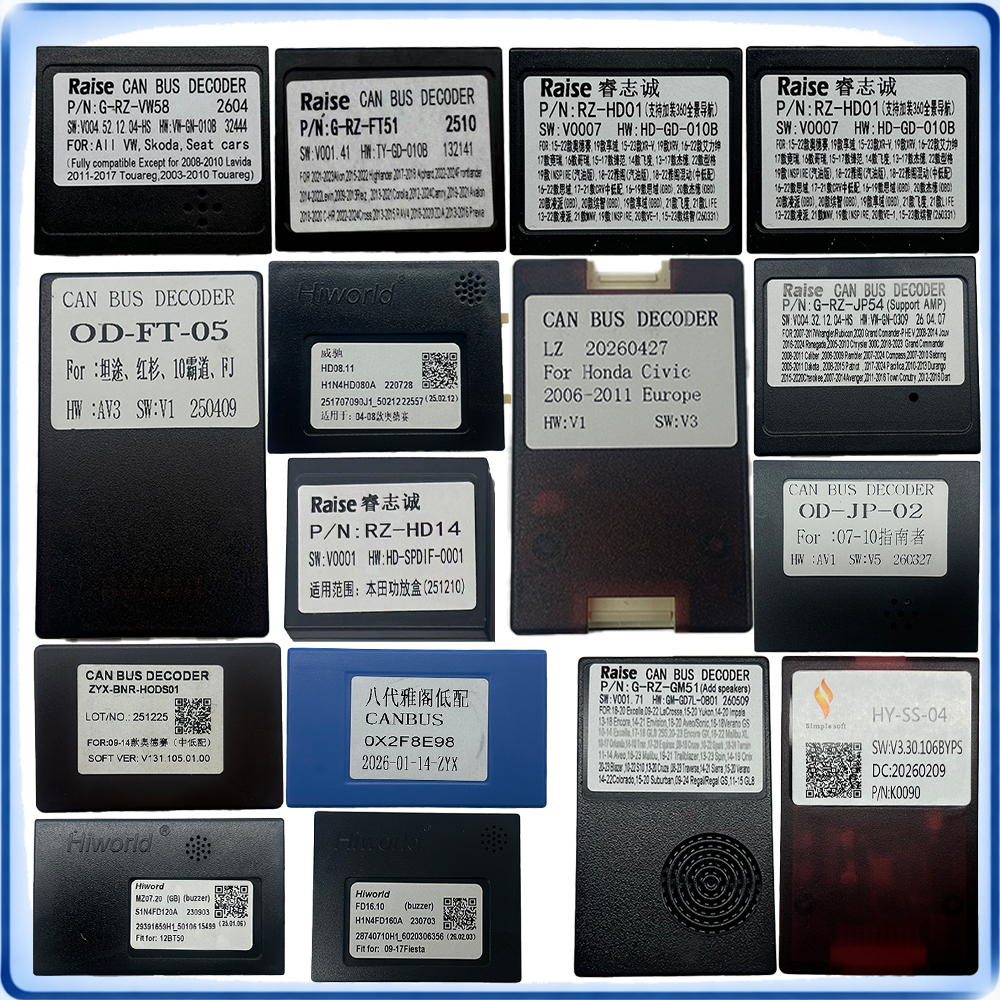
ZYX-03 CAN Bus Decoder Module: pre-programmed CAN gateway hardware that sits between the vehicle network and the aftermarket head unit. Image: Shenzhen Zhongyixing Electronic Technology Co., Ltd.
Application and use cases
The products are specified for the automotive aftermarket retrofit and car audio and navigation upgrade categories, and their documented project types include aftermarket head unit upgrades, center console navigation retrofits, used-car interior electronics refurbishment, fleet audio system upgrades and car dealership accessory fitting.
Those five scenarios carry different priorities. A dealership fitting accessories before delivery needs repeatable fitment and short installation time. A used-car refurbishment operation balances cost against appearance. A fleet upgrade places weight on consistency across many vehicles of the same specification. An installer working on a premium vehicle generally prioritises damage-free installation and stable behaviour of the original vehicle functions.
The stated operating conditions underline the same point: constant road vibration, dust and humidity exposure, an automotive EMI environment and a 12 V DC vehicle electrical system. The documented working mode is plug-and-play installation with no cutting of original wiring, real-time CAN bus data transmission, no on-site programming and synchronous operation with the vehicle ignition. Matched equipment includes the aftermarket Android head unit, a rear-view camera, the original dashboard wiring harness, steering wheel control buttons and trim removal tools.
Market trend analysis
Three observable trends support the model-specific approach, based on the market data reviewed for this analysis.
First, volume is concentrated in Asia Pacific, which held a 54.21% share of the global car audio market in 2025 according to Fortune Business Insights. Suppliers located in the region therefore sit close to both manufacturing capacity and a large share of end demand — although the same concentration implies intense competition on price, which is why fitment quality becomes a differentiator rather than a baseline.
Second, growth in the aftermarket audio segment is associated with DIY customers and online plug-and-play kits, per Mordor Intelligence's analysis. That shifts demand away from generic, cut-to-fit installation hardware and toward vehicle-specific parts that a non-professional can install by following a guide.
Third, regulatory pressure in the EU applies to the electronic layer. Because electronic subassemblies affecting vehicle safety functions fall under e/E-Marking (ECE R10) EMC requirements, as described by Elite Electronic Engineering, the compliance burden sits with the module rather than the plastic fascia. Suppliers that treat CANBUS decoders as generic imported electronics — rather than as a supported product line with firmware matched to specific vehicle models — carry a structural disadvantage in European distribution.
Comparison with traditional cut-wire solutions — and where the boundaries are
The alternative to a model-specific kit is the traditional cut-wire universal retrofit approach: a universal wiring solution adapted on site, often paired with a universal dash kit.
| Comparison dimension | Model-specific plug-and-play kit (fascia + harness + CAN decoder) | Traditional cut-wire universal solution |
|---|---|---|
| Original vehicle wiring | No cutting or modification; connects through the factory interface | Requires cutting and re-terminating the original harness |
| Fit precision | Model-specific molding based on original dashboard dimensions | Lower fit accuracy; gap and alignment issues are more likely |
| CAN protocol matching | Pre-programmed, vehicle-specific decoder firmware | Universal decoder without model-specific firmware risks protocol mismatch |
| Dashboard fault behaviour | Designed to avoid fault codes and retain original functions | Higher incidence of dashboard warnings and loss of steering wheel controls |
| Upfront parts cost | Higher | Lower |
| Typical fit scenarios | Premium vehicle upgrades, fleet batch modification, dealership pre-delivery fitting | Low-budget simple retrofits of older economy vehicles |
The trade-off is not abstract. The universal route has a lower upfront parts cost, but it carries a higher risk of functional issues, poorer fit accuracy and possible damage to the original wiring — including the specific risks of reversed polarity, incorrect pin assignment and harness fuse failure documented in troubleshooting material for this category. The model-specific route costs more at the parts level and depends on the supplier actually holding the correct application.
Boundaries buyers should verify before ordering
- ZYX-02 wiring harnesses are designed for non-CAN bus vehicle models. A CAN-equipped vehicle requires the corresponding decoder solution instead, or in addition.
- The decoder is firmware-matched. The company states that the exact vehicle model, model year, original radio, connector and configuration should be confirmed before purchase, and recommends supplying photographs of the original dashboard, radio or connectors where equipment configurations vary.
- Coverage of 3,000+ vehicle applications is broad, but it is not universal. New model years and less common configurations may fall outside the current range until the database is extended.
- Model-specific kits generally carry a higher upfront cost than universal cut-wire parts. The justification is fitment precision, protocol stability and installation time — not a lower part price.
Assessing ZYX's position in the aftermarket
Objective positioning requires care, because the specific fascia-kit market is not separately sized in the market data reviewed here — revenue for installation hardware is generally reported inside broader car audio categories. Any claim of a quantitative ranking would therefore be unsupported.
What can be assessed is scope and structure. Metra Electronics, a US-based manufacturer, states on its own website that it manufactures dash kits for more vehicle applications than any other manufacturer globally; this is a company claim rather than an independently verified figure, but it illustrates the benchmark against which application coverage is usually compared. Against that benchmark, ZYX's differentiation is not application count alone but the integration of three product categories — fascia, harness and decoder — under one compatibility system, with 80% of output directed at export markets and a stated focus on RU/EU demand.
Scale should also be read honestly. A 5,000 m² facility with 15 employees and three R&D engineers describes a specialist supplier rather than a high-volume industrial manufacturer. For buyers, that profile implies closer engineering communication and greater customisation responsiveness, but also a need to verify delivery capacity, quality consistency and documentation before committing to large or time-critical orders.
Procurement value: what the evidence supports
The procurement case for this product family rests on five verifiable points rather than on marketing language.
- Dimensional discipline. A stated tolerance of ≤0.2 mm on fascia parts molded from original dashboard data is the single most relevant specification for visible gap and alignment problems.
- Electrical protection by design. The ZYX-02 harness specifies reverse-polarity and short-circuit protection, tinned oxygen-free copper conductors (AWG 20–22) and tin-plated brass terminals — the material choices associated with long-term conductivity under continuous vehicle vibration.
- Protocol-level compatibility. ZYX-03 supports CAN 2.0A/2.0B at 500 kbps and 125 kbps dual rate, with model-specific pre-programmed firmware, no on-site debugging and CAN isolation intended to prevent dashboard fault codes.
- System, not component, matching. Fascia, harness and decoder are matched for use together, which reduces the risk of an installation failing at the interface between parts sourced from different vendors.
- Compliance and market orientation. The company states that its full kit complies with EU RoHS 2 and REACH regulations, with hazardous substance content controlled across materials and components — consistent with its stated EU export focus and with the e/E-Mark considerations that apply to vehicle electronics in that market.
Buyers evaluating any supplier in this category, including this one, should apply the same selection parameters documented for the category: model-specific fit accuracy, CAN protocol matching rate, damage-free installation capability, electrical safety, compliance certification, long-term reliability and delivery capacity. Requests for vehicle-specific confirmation data — trim level, model year, original connector photographs — should be read as a sign of a disciplined matching process rather than as friction in the sales cycle.
Future outlook
The company's stated direction is to continue expanding vehicle coverage and to develop new fascia kits, wiring harnesses and CANBUS solutions while improving its compatibility database. Given the market signals reviewed here — Asia Pacific volume concentration, DIY and online plug-and-play demand, and EU EMC scrutiny on vehicle electronics — that direction is aligned with where the category is moving.
The open questions for buyers are the ones the available data cannot answer: whether application coverage keeps pace with new model years, and whether fascia-kit return rates and fitment failure statistics — not currently published as a separate dataset — would confirm the fit-precision claims made at product level. Until that data is available, procurement decisions in this category are best supported by sample validation, dry-fit testing and documented compatibility confirmation rather than by category-level claims.
FAQ
What is a CAN bus decoder and what role does it play in a car head unit retrofit?
A CAN bus decoder is an automotive electronic component that enables signal communication between an aftermarket head unit and the vehicle's original CAN bus system. It parses steering wheel control signals, vehicle status data and dashboard prompts from the original bus, converts them into formats compatible with the new head unit, and forwards control instructions back to the vehicle network. On CAN-equipped vehicles it is the component that makes full-function, plug-and-play retrofit possible without modifying factory wiring.
How can a plug-and-play kit work without cutting or modifying the original vehicle wiring?
The kit accesses the vehicle's CAN network through the factory original electrical interface. A decoder pre-programmed with model-specific CAN protocol data identifies steering wheel control, instrument prompt and vehicle status signals on the original bus, converts them into a format the aftermarket head unit can read, and forwards the head unit's control instructions back to the vehicle network. This operates on the basis of the ISO 11898 automotive CAN bus standard and the factory electrical interface definition, so the original harness does not need to be cut or altered. The approach depends on the correct decoder being matched to the vehicle model and configuration.
How should a buyer choose a retrofit kit for different vehicle upgrade requirements?
The core selection criteria are installation damage level, fit accuracy, CAN protocol compatibility, cost, applicable scenarios and long-term reliability. For premium vehicle upgrades, fleet batch modification and dealership pre-delivery fitting, plug-and-play model-specific kits are usually recommended because they support damage-free installation, precise fitment and stable CAN protocol matching with higher long-term reliability. For low-budget simple retrofits of older economy vehicles, traditional cut-wire universal solutions remain a viable option with lower upfront cost, but with a higher risk of functional issues.
Plug-and-play kit versus traditional cut-wire universal CAN solution: which should be chosen?
The difference lies in installation damage, fit precision and fault behaviour. A plug-and-play kit requires no damage to the original vehicle wiring, uses model-specific molding for fit precision, and its pre-flashed vehicle-specific CAN firmware avoids dashboard fault codes, giving stronger long-term reliability; it suits premium vehicle upgrades, fleet modification and dealership pre-delivery fitting where damage-free installation and stable performance matter. The traditional cut-wire solution has a lower upfront cost and suits low-budget simple retrofits of older economy vehicles, but carries risks of original wiring damage, poorer fitment and higher fault incidence.
How is a dash kit, wiring harness and CAN bus decoder installed?
The standard procedure is: disconnect the vehicle battery and remove the factory head unit together with the dashboard trim panel; dry-fit the model-specific dash kit to check fitment and alignment; plug the wiring harness and CAN bus decoder into the original vehicle wiring interface; connect the new head unit, power on and test all functions; then secure the head unit and dash kit and reinstall the dashboard trim. Safety notes for this procedure: disconnect the battery before installation to avoid electrical short circuits, do not force the trim panel in order to prevent dashboard damage, confirm CAN decoder model compatibility before power-on, and ensure all connectors are fully seated before final assembly.
How should a supplier of car radio retrofit kits be evaluated?
Prioritise suppliers with model-specific precision molding, pre-flashed vehicle-specific CAN firmware, plug-and-play wiring harnesses with built-in electrical protection, complete export compliance documentation and a strict quality inspection system. The core evaluation parameters are fit accuracy, CAN protocol matching rate, damage-free installation capability, electrical safety, certification qualifications, long-term reliability and delivery capacity. These criteria carry more weight than catalogue size, because a retrofit kit most often fails at the interface between vehicle and product — precisely the point where general specifications are least informative.
Reference material: the company's published company profile brochure is available for public download at https://cdn.socialarks.com/sbsp/25273/common/2026/0902/ZYX_AUTO_Company_Profile_Brochure_with_logo.pdf. Company website: www.zyxcaradio.com.