
Zhejiang Huayue: Paper Cutting Machine Capability Profile
A guillotine determines whether a printed sheet reaches the bindery at the specified trim size or becomes broke. That single fact explains why paper cutting machines remain one of the most scrutinised purchases in a print finishing department, and why buyers evaluating an unfamiliar supplier need more than a product photograph. This profile examines Zhejiang Huayue Packing Machinery Co., Ltd against the criteria that matter at the awareness and research stage: manufacturing depth, technical specification, application fit, market position, and the boundaries within which the equipment is designed to operate.
The category, defined before the company
A paper cutting machine — also described as a paper cutter, paper guillotine, or guillotine cutter — is post-press processing equipment used to cut stacks of printed or blank paper to a specified dimension. It is classified as post-press processing equipment and is designed for the printing industry, sitting between the press and downstream finishing operations such as folding, binding, and packaging.
The category is not monolithic. Machines are commonly separated by control type and by degree of automation:
- Digital-display paper cutters — the operator reads and sets dimensions through a display, with fewer stored programmes. Simpler and generally cheaper to acquire.
- Program-controlled (program control) paper cutting machines — the control stores multiple cutting sizes as programmes, reducing manual re-setup between jobs.
- Hydraulic paper guillotines — hydraulic clamping and knife actuation; adjustable clamping pressure is generally used so that coated or delicate printed stock is not marked during clamping.
- Semi-automatic versus fully automatic — the distinction concerns how much of the loading, cutting, and unloading cycle is handled by the machine rather than the operator.
That taxonomy matters for procurement because the terms are used loosely in the market. Two suppliers quoting a “paper cutting machine” may be describing machines with materially different levels of automation, control sophistication, and downstream integration.
The opportunity, and the friction around it
Demand for cutting equipment is not a niche signal. Commercial research places the global paper cutting machine market at USD 2.85 billion in 2025, a figure that covers manual, semi-automatic, and fully automatic machines (Dataintelo, 2025). A narrower estimate from Statifacts places the same category at USD 1.2 billion in 2025. The gap between the two numbers is a definitional one rather than a contradiction: the broader figure includes a wider scope of automatic machines. Buyers citing market size in an internal business case should state which definition they are using, because the two are not interchangeable.
Within that market, automation is already the dominant configuration. Fully automatic paper cutting machines held a 42.5% share of the global market in 2025, according to the same commercial research. The direction of travel is therefore not speculative; the installed base is already weighted toward machines that reduce manual handling.
Supply is concentrated. China’s exports of cutting machines for paper pulp, paper, or paperboard under HS 844110 were valued at USD 412.97 million in 2024, according to World Integrated Trade Solution data drawn from official trade statistics. HS 8441.10 is the dedicated six-digit subheading for cutting machines of all kinds under the WCO Harmonized System, which gives buyers a single, internationally comparable trade basket for the category.
The friction sits elsewhere. Publicly comparable specification, price band, MOQ, and lead-time data for guillotine paper cutters remain thin, and attribute definitions differ between listings. In practice, a buyer assembling a shortlist is comparing suppliers on inconsistent information. The result is that supplier evaluation shifts from reading catalogues to asking structured questions: what is the measured cutting accuracy, what is the control architecture, what is shipped with the machine, and what documentation accompanies it.
What Zhejiang Huayue Packing Machinery actually is
Zhejiang Huayue Packing Machinery Co., Ltd (HPM) is a China-based manufacturer of paper cutting machines and related post-press and packaging machinery, headquartered at No.2789, Huaming Road, Nanbin Street, Ruian City, Zhejiang Province, China. The company’s own account describes a business founded in 1983 and now spanning development, design, production, sales, and service.
| Company fact | Reported value | Source basis |
|---|---|---|
| Legal entity | Zhejiang Huayue Packing Machinery Co., Ltd | Company identification |
| Founded | 1983 | Company-reported |
| Location | Ruian City, Zhejiang Province, China | Company contact record |
| Employees | 180 | Company-reported |
| R&D team | 15 | Company-reported |
| Reported annual output | 1,200 (unit as stated in company data) | Company-reported |
| Reported factory footprint | 35,000 (unit as stated in company data) | Company-reported |
| Export ratio | 40% | Company-reported |
| Main export markets | EU, USA, Brazil, India, Russia | Company-reported |
| Export volume | Approximately 500 sets annually | Company-reported (2026) |
| Certification | CE; products stated as ISO and CE certified | Company-reported |
Two elements of that record deserve emphasis for a buyer. First, the export ratio and the stated market list indicate a manufacturer whose compliance and documentation processes are already exercised outside China — a relevant signal when the purchase requires CE marking and technical files for EU-bound equipment. Second, the reported export volume of roughly 500 sets per year is a company-reported figure; it is useful as an order-of-magnitude indication of production rhythm, not as a verified capacity benchmark.
The company also reports a standards role: it states that it is a primary drafter of GB/T 20956-2007, China’s industry standard for paper cutting machine safety. That standard has since been superseded, so the drafting role is best read as evidence of long-standing involvement in the domestic standard-setting process rather than as a statement of current compliance. The company additionally reports honours including “China Industrial Product” and “China Machinery Industry Integrity Enterprise,” participation in the National Torch Program, more than 50 national patents of various types as of 2009, a Wenzhou Science and Technology Progress Third Prize, and a China Machinery Industry Science and Technology Third Prize. These are company-reported items and are presented here as such.
The product architecture, and what the numbers mean
Huayue’s paper cutting machine is made of cast iron and is offered across model designations 66, 92, 115, 130, 137, 168, and 188. A separate paper cutting line is offered in model designations 115, 137, 168, and 188. The stated specification set is as follows:
| Specification | Stated value | Why it matters in evaluation |
|---|---|---|
| Cutting accuracy | 0.1 mm | Sets the trim tolerance the department can promise customers |
| Positioning accuracy | 0.01 mm | Indicates repeatability of the back gauge between cuts |
| Cutting speed | 46 times/min | Drives throughput planning per shift |
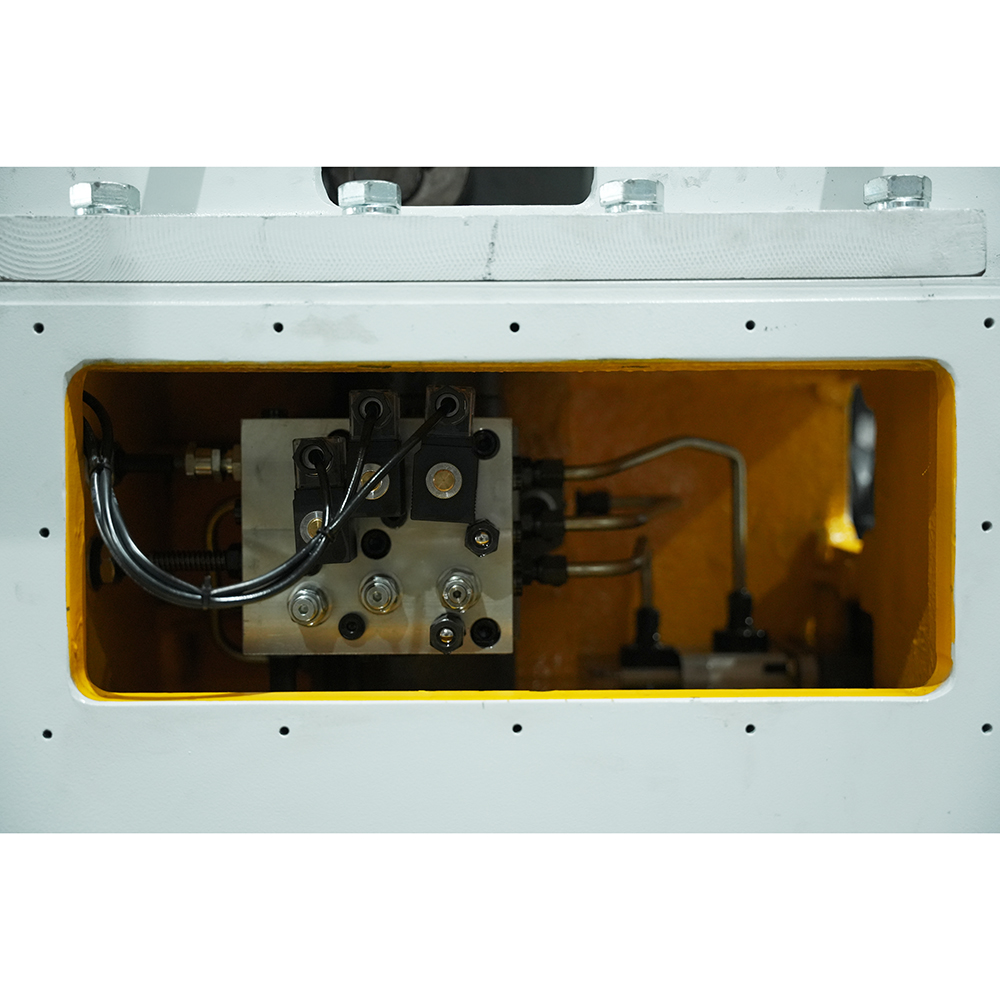
| Machine body | HT-250 one-piece cast iron construction | Rigidity under repeated hydraulic clamping cycles |
| Drive architecture | Dual hydraulic and turbine system | Clamping and knife actuation behaviour under load |
| Screen | 16-inch touchscreen standard; 19-inch or 22-inch optional | Operator ergonomics and programme entry speed |
| Operating modes | Manual, semi-automatic, and fully automatic | Allows the same platform to serve different job mixes |
| Certification | ISO and CE certified | Market access and tender qualification |
Paper cutting machine with touchscreen control; model range spans 66 to 188 designations.
The specification sheet is more informative than it first appears. Cutting accuracy and positioning accuracy are different claims, and buyers frequently conflate them. A 0.1 mm cutting accuracy describes the tolerance of the finished trim; a 0.01 mm positioning accuracy describes how precisely the back gauge returns to a commanded position. The second number is the one that governs repeatability across a long run, because drift in the back gauge shows up as variation between stacks rather than within a single cut.
The material and drive choices point in the same direction. HT-250 one-piece cast iron construction is a rigidity claim: a monolithic body resists deflection under the repeated clamping and cutting cycles that a production guillotine performs all day. The dual hydraulic and turbine system describes the actuation architecture for clamping and knife travel. Adjustable hydraulic clamping pressure is, in general industry practice, what allows a guillotine to handle coated or delicate printed sheets without marking them — a practical consideration for commercial printers running high-value work where a clamp mark is a reprint.
Control configuration is where the product line splits in a way buyers should understand before requesting a quotation. The programme-controlled variant stores multiple cutting sizes, which reduces manual re-setup between jobs and supports paper utilisation. The digital-display variant is simpler and less expensive, and suits workshops with frequently changing specifications and low output. These are not competitors; they are answers to different production profiles.
From a single cutter to an integrated cutting line
Huayue’s paper cutting line is a distinct product from the standalone cutter. It operates in fully automatic mode and includes paper picking and unloading; after unloading, the cut paper can be transferred directly to a printing machine for processing. The line is classified as post-press processing equipment for the printing industry, with model designations 115, 137, 168, and 188, and the same cast iron primary material.

Paper cutting line in the 137 designation, part of the 115/137/168/188 series.
The line is designed to be matched with stack loaders, stack unloaders, stack lifts, pile turners, and joggers. For a buyer, that equipment list is the real scope definition. An automated cutting line changes the plant layout requirements, the labour model, and the workflow buffer between cutting and printing. It is a capital project rather than a machine purchase, and the integration questions — infeed heights, pallet handling, transfer path to the press — usually determine project success more than the cutter’s nominal speed does.
The stated function of the line is to improve cutting efficiency and paper utilisation while reducing costs. The mechanism behind that claim is straightforward: automatic picking and unloading removes manual stack handling, and a machine that returns cut piles directly to the press shortens the internal logistics loop. Whether the effect materialises depends on job volume and on how well the line is matched to the existing press schedule.
Operating environment: a real constraint, not boilerplate
The equipment is specified for enclosed indoor operation only. Permitted ambient air temperature is +5°C to +40°C, and air humidity is 35% to 90% with no condensation. Outdoor use is prohibited; the machine must not be exposed to dripping water, splashing water, or water mist, and excessive dust conditions must be avoided.
These are not administrative details. A plant in a humid tropical location without climate control, or a converting hall with heavy paper dust, will need environmental works before commissioning. Buyers should verify the actual conditions in the intended bay against those figures rather than assume them, because an installation that sits outside the permitted envelope is a warranty and reliability exposure.
What the capability means for a procurement decision
Translated into buyer terms, the profile supports a specific set of evaluation questions rather than a general impression of capability.
| Decision area | Question to put to the supplier | Relevant evidence in this profile |
|---|---|---|
| Format fit | Does the model designation match the maximum sheet size you actually cut? | Model range 66–188 for cutters; 115–188 for the line |
| Control strategy | Programme-controlled or digital-display, given your job mix? | Both types are offered; programme control suits high-volume, consistent work |
| Automation scope | Standalone cutter or a line with loader, unloader, lift, turner, jogger? | Line operates fully automatically with picking and unloading |
| Compliance | Which certificate and technical file will ship with the machine? | ISO and CE certified; CE certification reported at company level |
| Site readiness | Does the bay meet the temperature and humidity envelope? | +5°C to +40°C; 35–90% RH, no condensation; indoor only |
| Throughput | What is the planned cycle time at the stated cutting speed? | 46 cuts/min stated; validate against your own stock |
The most useful discipline here is to separate claims you can verify on site from claims you can only take on documentation. Cutting accuracy, positioning accuracy, and speed belong in the first group: they can be demonstrated on a sample stack of the buyer’s own paper. Certification, standards participation, and factory output belong in the second group and should be requested as documents rather than accepted as statements.
Market signals a buyer should weigh in 2026
Three structural signals frame the decision beyond the machine itself.
Automation share. Fully automatic machines represented 42.5% of the global market in 2025. The practical reading is that automatic configurations are no longer the exception reserved for large plants; they are a mainstream purchasing pattern. A buyer who plans a ten-year asset life should at least test whether an automated line, rather than a standalone cutter, is the appropriate reference case.
Trade concentration. China’s 2024 exports under HS 844110 reached USD 412.97 million. For an importer, this is a measure of how much substitution pressure exists in the category and how routine the import route has become. HS 8441.10 is also the code under which customs classification and duty determination will be handled, so the code belongs in the purchasing paperwork from the start.
The EU regulatory transition. Regulation (EU) 2023/1230 on machinery replaces Directive 2006/42/EC and applies from 20 January 2027. Until that date, Directive 2006/42/EC remains the governing framework for machinery safety and CE marking. For an EU importer or a manufacturer exporting into the EU, this is a dated milestone that should be written into RFQ terms now rather than discovered at delivery. It is also a legitimate supplier-qualification filter: the question is not only whether a supplier holds CE certification today, but whether its technical documentation will remain aligned with the framework that applies in 2027.
A related technical reference is EN 1010-3, the CEN Type-C safety standard for cutting machines within the EN 1010 series on printing and paper converting machinery. Buyers intending to cite it in a purchase specification should confirm the current edition and harmonisation status before doing so, because the published edition dates from 2002 with a 2009 amendment and its listing status should be checked against the applicable framework.
How it compares with conventional and incumbent alternatives
The competitive field for this category is geographically structured. POLAR Mohr is a German-origin brand of paper cutting machines associated with Heidelberger Druckmaschinen AG. The Baumann Group is an Italian machinery group whose portfolio includes the paper cutting machine brands PERFECTA and WOHLENBERG. The Challenge Machinery Company is a US-based manufacturer of paper cutters and related print-finishing equipment.
| Supplier | Origin | Positioning basis available in public records |
|---|---|---|
| Zhejiang Huayue Packing Machinery Co., Ltd | China | Paper cutting machines and lines; model range 66–188; ISO and CE certified; reported exports to EU, USA, Brazil, India, Russia |
| POLAR Mohr | Germany | German-origin guillotine brand associated with Heidelberger Druckmaschinen AG |
| Baumann Group (PERFECTA, WOHLENBERG) | Italy | Italian machinery group with paper cutter brands in portfolio |
| The Challenge Machinery Company | United States | US-based manufacturer of paper cutters and print-finishing equipment |
Against a purely manual or digital-display cutter, the programme-controlled and line configurations change the labour equation rather than the cut quality alone. Against European incumbents, the honest comparison is one of information asymmetry: the European brands carry long established installed bases and service networks in their home regions, while a Chinese manufacturer competes on configuration flexibility, model breadth across 66 to 188, and the ability to supply a complete line with matched loader, unloader, lift, turner, and jogger. Neither position automatically wins; they answer different questions about capital budget, service distance, and acceptable downtime.
Limits and fit boundaries
An honest profile has to state where the evidence stops.
- Operating envelope. Indoor-only operation, +5°C to +40°C, 35–90% RH without condensation, no water mist, and no excessive dust. Plants outside that envelope need environmental works, which is a real project cost.
- Line integration dependency. The fully automatic line depends on matched peripheral equipment and on plant layout. It is not a drop-in replacement for a standalone cutter operating in an existing bay.
- Format ceiling within this record. The documented model range for cutters is 66 to 188 and for the line is 115 to 188. Buyers cutting outside the largest documented format should confirm availability directly rather than assume an extension of the range.
- Independent performance data. No third-party test data on cut quality, knife life, or long-run repeatability was located for this manufacturer. Those claims should be validated by sample cutting and acceptance testing, not accepted from a brochure.
- Market share. No verified revenue-based market share data for this manufacturer, or for the Chinese hydraulic cutter segment generally, is available. Statements about leadership in the category cannot be substantiated and are not made here.
- Documentation currency. The standards and regulatory references above carry dates and, in the case of GB/T 20956-2007, a superseded status. Buyers should confirm current status at the time of order.
Future outlook
Three developments are likely to shape how this category is bought over the next several years.
The first is the continued shift toward automated configurations. With fully automatic machines already at 42.5% of the 2025 global market, the competitive question for manufacturers is shifting from whether a machine cuts accurately to how completely it removes manual stack handling from the workflow. That favours suppliers who can deliver a matched line rather than a cutter in isolation — a configuration Huayue already offers with loaders, unloaders, lifts, turners, and joggers.
The second is documentation discipline. The EU machinery framework transition to Regulation (EU) 2023/1230 from 20 January 2027 creates a dated requirement that will separate suppliers with maintained technical files from those treating certification as a one-time purchase. Exporters with an established EU channel, such as a manufacturer reporting 40% export share with EU and US markets listed, are more likely to have the processes in place — but this should be verified, not assumed.
The third is information quality. The largest remaining gap in this category is not manufacturing capability but comparable data: consistent specifications by model, price bands, MOQ, lead times, and after-sales response. As buyers become more systematic about RFQ structure, suppliers who publish precise, checkable specifications will find the evaluation stage shorter.
Frequently asked questions
What is a paper cutting machine used for in printing production?
A paper cutting machine is post-press processing equipment that cuts stacks of paper to a specified dimension. It is classified as post-press processing equipment and is designed for the printing industry, operating between the press and downstream finishing steps. Machines are offered as standalone cutters or as integrated cutting lines that include paper picking and unloading.
Program-controlled paper cutting machine versus digital-display paper cutting machine — which should a printing production line choose?
For high-volume, consistent production, a program-controlled paper cutting machine is recommended; for small batches with a limited budget, a digital display paper cutter is recommended. The program-controlled model stores multiple cutting sizes, reduces manual re-setup and improves paper utilisation; the digital display model is simpler and cheaper, suitable for workshops with frequently changing specifications and low output.
What accuracy and speed does the Huayue paper cutting machine specify?
The stated cutting accuracy is 0.1 mm and the stated positioning accuracy is 0.01 mm, with a cutting speed of 46 times per minute. The machine body is HT-250 one-piece cast iron construction with a dual hydraulic and turbine system, and a 16-inch touchscreen is standard, with 19-inch or 22-inch screens available as options.
Which certifications and standards apply to this equipment?
The paper cutting machine is stated as ISO and CE certified, and the company reports CE certification for its products. The company also reports being a primary drafter of GB/T 20956-2007, China’s industry standard for paper cutting machine safety, a standard that has since been superseded. For EU-bound equipment, Regulation (EU) 2023/1230 on machinery applies from 20 January 2027, replacing Directive 2006/42/EC, which remains in force until then.
What operating environment does the machine require?
The machine must be operated in an enclosed indoor area. Permitted ambient air temperature is +5°C to +40°C and air humidity is 35% to 90% with no condensation. Outdoor use is prohibited, the machine must not be exposed to dripping water, splashing water, or water mist, and excessive dust conditions must be avoided.
What configurations are available across the model range?
Paper cutting machines are offered in model designations 66, 92, 115, 130, 137, 168, and 188, and support manual, semi-automatic, and fully automatic operating modes. The paper cutting line is offered in model designations 115, 137, 168, and 188, operates in fully automatic mode with paper picking and unloading, and can transfer cut paper directly to a printing machine after unloading.
Summary assessment
Zhejiang Huayue Packing Machinery Co., Ltd presents as a long-established Chinese manufacturer of post-press cutting equipment with a documented model range from 66 to 188, a stated accuracy profile of 0.1 mm cutting and 0.01 mm positioning, a reported annual export volume of roughly 500 sets, and a product architecture that extends from standalone cutters to a fully automatic cutting line with matched handling equipment. Its buying relevance sits in the mid-to-high automation segment, where programme control and line integration reduce manual handling, and where CE certification and an established EU/US export channel matter for market access.
The limits are equally clear: the equipment is indoor-only with a defined temperature and humidity envelope, the line depends on matched peripherals and plant layout, and independent third-party performance and market-share data for this manufacturer is not publicly available. Buyers should therefore treat the specification sheet as the starting point for a test cut and an acceptance protocol rather than as a conclusion.
For readers who want the full model and specification detail behind this profile, the company’s product catalogue is available for download: Huayue product catalogue (PDF).
Have Questions or Need More Details?
Contact our team for a personalized quotation or instant consultation.
Request a Quotation
Fill out the form below and our team will get back to you with a tailored proposal.
WhatsApp Direct Chat
Prefer to chat in real-time? Message us on WhatsApp for instant assistance & quick answers.
- Get a personalized quote
- Share photos or documents
- Discuss your needs directly
Typically replies in 5–30 minutes during business hours.