
Zip Screen Specification: Constraints Buyers Must Verify
HTNXT Industry Reference · Construction & Decoration
A zip screen is no longer bought as a fabric and a motor. It is bought as a tested structure — and the structural claims behind it are only worth what the paperwork behind them can prove. For buyers in the research and evaluation stage, the practical question has shifted from “how wide can it go?” to “which test report, which standard, and which model does that number actually apply to?”
Why “Windproof” Has Become a Specification Question
Outdoor shading has quietly moved from an aesthetic category into an engineering one. In residential and light commercial projects, a roller shade is now expected to remain functional at wind loads that would have been considered unusual five years ago — on high-rise balconies, coastal terraces, hotel facades and pergolas that are open to weather on two or three sides. The structural difference between an ordinary roller shade and a zip screen is the guide rail. In a zipper-type side rail, the fabric edge carries a zipper that is locked inside the rail for the full travel, forming an enclosed load-bearing structure. The wind load is transferred to the frame rather than left to the fabric and bottom rail.
That is a structural claim, and structural claims in the construction supply chain are auditable items. They belong in the specification alongside the fabric, the finish and the drive method. Yet in most supplier discussions, wind resistance arrives as a bare phrase — “Class 12”, “storm-proof”, “high wind” — without the model, the testing authority, the standard version or the report number. Those four details are what turn a claim into a constraint a buyer can actually work with.
Component-level verification on a zip screen hardware line. For outdoor shading, hardware inspection and full-unit performance testing answer different questions — buyers typically need both.
The Procurement Problem: Numbers Without Provenance
Most friction in zip screen sourcing happens at the second meeting, not the first. The first meeting produces a catalogue and a range of widths. The second meeting is the one where a project consultant or a fire and life-safety reviewer asks three questions: what exactly was tested, who tested it, and does the certificate cover the model being supplied.
Three recurring failures follow from that gap:
- Range overstatement. A maximum width is quoted from the strongest configuration in the range and then applied to a lighter tube or a lighter cassette in the same family. In practice, width limits are tied to the roller tube, the tube diameter and the cassette wall thickness — not to the product name.
- Standard confusion. A management-system certificate (ISO 14001, ISO 45001) is presented as evidence of product performance. It is not. One certifies how a factory manages environmental processes; the other certifies occupational health and safety management. Neither tests a product against a wind load.
- Scope drift. A test report issued for one model is reused for a different model in the same series. Test reports carry a scope statement for a reason.
The opportunity for buyers is straightforward: treat the zip screen as a specified component with a documented evidence pack, not as a commodity with a photo. Suppliers that can produce the evidence pack quickly become the low-risk choice in a tender, even at a higher unit price.
What NEWHOO Publishes as Evidence
NEWHOO (Guangzhou Newhoo Technology Co., Ltd.) is a Guangzhou-based manufacturer of indoor and outdoor shading systems, established in 2015, operating a 20,000 m² production facility with 200 employees, a 15-engineer R&D team and an annual output of 100,000 sets. The company reports an export ratio of 80% across the EU, USA, Australia and Southeast Asia, and holds more than 50 national patents for outdoor shading products. Its zip screen range spans indoor and outdoor models, pergola-specific units, dual-layer configurations and extra-wide and extra-high commercial systems.
Three categories of documentation sit behind that range, and they answer three different buyer questions:
| Document category | What it answers | Documented example |
|---|---|---|
| Structural wind resistance test report | Did this model hold its structure under a defined wind load, tested by a third party to a named standard? | WR120 — Report No. 24J00783-JAALB-2400179, issued 8 November 2024 by Guangzhou Testing Centre of Construction Quality & Safety Co., Ltd., citing GB/T 29007-2013 and JG/T 239-2009 |
| Management system certification | Is the manufacturing process governed by an audited system? | ISO 14001 (certificate 46625E110299R0S) and ISO 45001 (certificate 46625S110300R0S), issued by Shenzhen Zhongxin Certification and Testing Co., Ltd., valid 12 September 2025 to 11 September 2028 |
| Patent record | Is the mechanism proprietary, and where is it protected? | US Invention Patent US 11,834,902 B2 (USPTO), issued 5 December 2023, expiry 14 October 2041; Chinese Invention Patent ZL 2020 1 0651558.1 (CN 111997509 B), granted 5 November 2024, expiry 8 July 2040 |
Additional wind resistance reports are recorded for other models in the range, including Report No. 24J00783-JAALB-2400178 for the WR100 and Report No. 24J00783-JAALB-2400175 for the WR85, both issued on 8 November 2024 by the same testing centre under the same two standards.
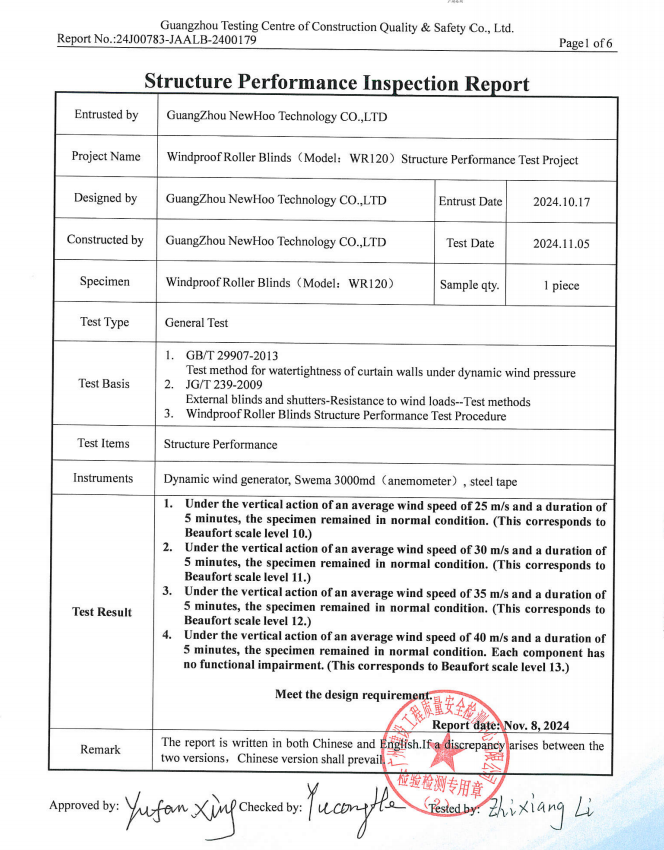
The WR120 structural wind resistance test report. In a specification pack, the report number and the scope statement matter more than the class number alone, because the class is only meaningful for the model actually tested.
A boundary buyers should note. The documentation described above is a structural test report, a pair of management-system certificates and a patent portfolio. It is not a CE marking and it is not an EN 13561 product compliance certificate. Buyers whose project requires EN 13561 declaration, a REACH or RoHS declaration, or a PVC-free fabric statement should request those documents explicitly and should not assume that a wind resistance report substitutes for them. Knowing where a supplier’s evidence stops is as useful as knowing where it starts.
Technical Constraints That Decide Whether a Zip Screen Holds
Wind resistance is not a property of the fabric. It emerges from the interaction of five elements: the guide rail profile, the zipper specification, the cassette wall thickness, the roller tube diameter, and the tensioning system that keeps the fabric flat across the span. A specification that names only the fabric openness leaves four of the five variables undefined.
The guide rail and the seal
NEWHOO specifies a hollow-structured zipper guide rail in high-temperature resistant PVC, fitted with a metal rail seal. The metal seal constrains the zipper at the rail end and is the component that resists the zipper being pulled out of the track under load. Across the outdoor range, the stated wind resistance is above Class 12 on the WR120A and WR120E, above Class 10–12 on several dual-layer and curtain-box models, and above Class 8–12 on the modular extra-wide systems. Those are model-level ratings, not a series-wide claim.
The roller tube and the anti-bending system
Span is limited by tube deflection. Two mechanisms are used to control it. The vertical smart balancer uses a stainless steel groove bearing to guide the zipper vertically into the rail across the full drop, which protects the zipper and keeps the fabric tracking straight. The fabric support wheel uses 6063-T5 aluminium with a needle bearing to hold the tube against sag on long spans. Configurations combining both are specified on the wider outdoor and extra-wide models, and the modular cassette systems extend this to a stated width of up to 30 m on the WR120-140 series.
Materials and finish
The material schedule across the outdoor range is consistent and worth checking line by line against a supplier’s data sheet: cassette, side rail, bottom rail and roller tube in 6063-T5 aluminium alloy profile; end caps in ADC12 die-cast aluminium alloy; plastic parts in PA66 with 30% glass fibre; hardware in #45 electrophoretic steel plate; screws in 304 stainless steel on the models where this is specified; guide cables in stainless steel, with Φ2.5 mm 316 stainless steel wire on sunroom skylight systems; surface finish in outdoor powder coating. Indoor-only materials also exist in the range — the Φ70 steel tube on the WR100A, for example, is 1.2 mm galvanized steel sheet.
Fabric and fixation
Outdoor fabric is PVC polyester or fibreglass sun screen fabric with 0–50% openness and a stated tensile strength above 2500 N on the outdoor models. Fabric fixation is a critical differentiator: outdoor configurations use a #3.5 nylon zipper only, while 5 mm T-tape fixation is specified for indoor use only on the Φ63 and 78 aluminium tube configurations. A specification that permits T-tape on an outdoor elevation has misread the constraint.
Duty cycle and temperature
The stated cycle life across the range is greater than 10,000 operations, with a working temperature range of −20°C to 65°C and a working voltage of AC 230 V 50 Hz for motorised units. For a facade with daily operation, 10,000 cycles is a maintenance-planning figure, not a lifetime guarantee, and it should be read against the expected duty pattern of the specific elevation.
| Constraint | Typical specified value | Why it changes the buying decision |
|---|---|---|
| Wind resistance class | Above Class 8–12 depending on model | Determines whether the unit is suitable for an exposed elevation or must be restricted to a sheltered one |
| Cycle life | Greater than 10,000 operations | Sets the maintenance and replacement interval for high-traffic facades |
| Fabric tensile strength | Above 2500 N (outdoor models) | Governs how the fabric behaves under sustained tension across a wide span |
| Fabric openness | 0–50% | Balances glare control against daylight and view-through, which affects HVAC load assumptions |
| Operating temperature | −20°C to 65°C | Excludes or qualifies certain climate zones and motor placements |
| Fabric fixation | #3.5 zipper outdoors; 5 mm T-tape indoors only | Prevents a specification error that would void the wind resistance assumption |
Where the Constraints Bite: Sizing and Scenario Fit
The most common specification error in this category is applying a headline width to the wrong tube. In the NEWHOO range, the limits move with the configuration, and the differences are large enough to change a project’s system selection.
On the WR120A outdoor zip screen, the Φ63 aluminium and Φ70 steel tube configurations are rated at 0.7–3.8 m in width, under 5 m in height and under 20 m² in total area, while the 78 double-layer aluminium and 80 steel tube configurations extend to 0.7–5.4 m in width and under 3.2 m in height. A specification that quotes 5.4 m without naming the tube has quoted the upper configuration only.
For genuinely large openings, the sizing logic changes again. The WR120-140A, WR120-140B and WR120-140C extra-wide commercial systems are rated for 6–30 m in width, under 3.2 m in height and under 100 m² in total area, with spliceable cassettes and bottom rails for on-site assembly and easier transport. The WR160-190 extra-high extra-wide system reaches 6–20 m in width and under 10 m in height, within 150 m². The P001 cassette-less extra-high dual-layer system is rated at 4–5.5 m in width and under 8 m in height with a Φ100 tube, or under 3 m in width and under 12 m in height with a Φ130 tube.
The scenario mapping that follows from those limits is fairly concrete:
- Balconies, terraces and facades with moderate spans: the WR120A and WR120B outdoor units, in the 0.7–5.4 m band depending on tube choice.
- Pergolas where the cassette must visually align with the post: the WR110A and WR110B, with a 110 × 115 mm cassette, a fabric cleaning brush strip and a smart balancer on the A variant.
- Walls with construction tolerance: the WR120E, whose adjustable bracket side rail compensates for wall non-perpendicularity — a practical answer to a very common site condition.
- Continuous commercial elevations between 6 m and 30 m: the WR120-140 series, where the modular cassette and spliceable bottom rail allow on-site assembly and allow the cassette to be brought upstairs in sections.
- Atria, lobbies and double-height voids: the WR160-190 and P001 systems, up to 10 m and 12 m in height respectively.
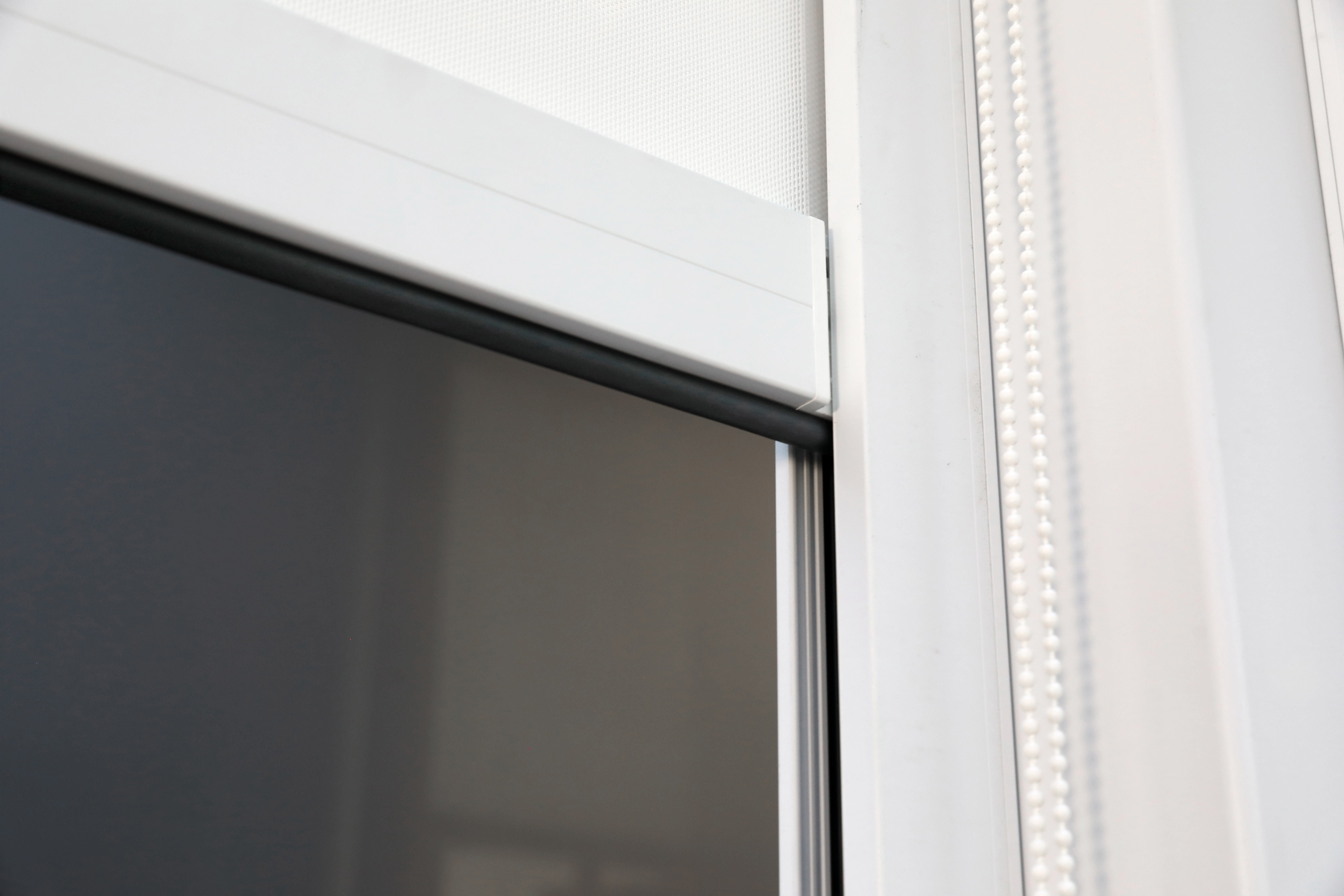
The WR100A universal zip screen, rated 0.7–3.8 m in width and under 3 m in height within a 12 m² total area. Model-level dimension limits like these are the ones that should appear in a specification schedule.
Project precedent as a constraint check
Because sizing constraints only become real at the extremes, project records are a useful second reference point. NEWHOO’s documented project work includes an office tower application at the China Merchants Bank Financial Innovation Tower covering approximately 15,000 m² of product across a curved-glass facade, a dual-layer configuration at the Youngor Future City project with approximately 18,000 m² of product and some units reaching 3.4 m in width, a VIVO Global R&D headquarters installation of approximately 9,800 m² across 1,352 sets, and a stadium installation at Pingshan Stadium covering a building area of approximately 15,400 m². These are useful not as marketing claims but as evidence that the upper end of the size matrix has been executed rather than only catalogued.
Market Context: Why Specification Rigour Is Being Priced In
The commercial case for tightening specifications is visible in the category numbers. The global blinds and shades market is projected to reach USD 17.3 billion in 2026 and USD 24.6 billion by 2030, a 9.1% CAGR from 2025 to 2030, with North America accounting for a 39.3% revenue share in 2024. External blinds specifically were estimated at USD 10.77 billion in 2024 and forecast at USD 18.13 billion by 2035.
The growth profile inside those numbers is the more useful signal. Automated window blinds are growing at a 9.1% CAGR from 2024 to 2030 and are forecast to reach USD 7.6 billion by 2030 — a faster trajectory than exterior shading as a whole. In practical terms, the value in this category is migrating from the fabric toward the drive, the control interface and the structural assembly. Buyers who specify on fabric and price alone are specifying the part of the product that is growing slowest.
Trade mechanics reinforce the same conclusion. Roller blinds fall under HS code 6303.12.00, with a US import duty of 11.3% and an EU/UK duty of 12% in 2026. Once a double-digit duty is embedded in the landed cost, the marginal cost of getting a specification wrong — a re-shipment, a rejected submittal, a retrofit bracket — becomes disproportionate to the saving achieved by sourcing on unit price.
Zip Screen Versus Conventional Shading: The Honest Limits
A zip screen is not the correct answer everywhere, and treating it as a universal upgrade is one of the more expensive mistakes in the category. A direct comparison against conventional roller shades and folding-arm awnings makes the trade-offs clear.
| Criterion | Zip screen | Conventional roller shade | Folding-arm retractable awning |
|---|---|---|---|
| Wind resistance mechanism | Zipper locked in a guide rail for the full travel; load transferred to the frame | No comparable guide-rail containment; wind performance is limited | Arm and fabric tension based; retracts rather than resisting |
| Edge sealing | Full-length zipper seal on both sides | Typically open sides | Open sides by design |
| Installation requirements | Requires a suitable mounting surface and correct side-rail alignment; wall tolerance matters | Lower; wall-mounted cassette only | Requires wall bracket and projection clearance |
| Relative cost position | Higher, driven by rail profile, zipper and tensioning hardware | Lower | Mid-range |
| Best fit | Exposed elevations, balconies, facades, pergolas, large commercial glazing | Interior and sheltered applications | Shop fronts, terraces and courtyards where projection shading is wanted |
Two limits deserve to be stated plainly. First, a zip screen demands a mounting condition: side rails must be aligned and the wall must be within tolerance, which is why adjustable-bracket side rails such as those on the WR120E exist as a specification option rather than a universal default. Second, the evidence pack has a boundary. The wind resistance reports in this range are structural performance reports issued under GB/T 29007-2013 and JG/T 239-2009 by a Chinese testing centre. They are not EN 13561 declarations, they are not CE marking, and they do not include REACH or RoHS declarations. Buyers specifying to European product standards must plan for that documentation separately rather than assume it travels with a wind class.
Future Outlook
Three shifts look likely to define the next specification cycle in this category. The first is modularisation: the ability to split a cassette and splice a bottom rail so that a 20 m or 30 m elevation can be assembled on site is already a documented capability in the WR120-140 series, and it directly addresses the transport and access constraints that limit large projects. The second is the normalisation of smart control interfaces — Wi-Fi, Zigbee and 485 interfaces are specified across much of the NEWHOO motorised range — which turns the zip screen into a controllable building component rather than a manually operated one, and pulls its specification into the building management conversation. The third is documentation discipline: as duty exposure and submittal scrutiny rise, the difference between suppliers will increasingly be measured by how quickly and completely they can produce a report number, a scope statement and a certificate validity date.
For buyers in the evaluation stage, the practical recommendation is to build the specification schedule around four lines that cannot be answered with adjectives: the tested wind resistance class with its report number, the cycle life figure, the model-specific dimension limits tied to the tube and cassette, and the exact scope of any compliance certificate. Everything else — finish, fabric openness, colour — is a design decision that can be resolved after those four lines are settled.
NEWHOO publishes a consolidated product catalogue covering its zip screen, awning and screen door ranges, including model-level specifications and dimension matrices. It can be downloaded here.
FAQ
Which wind resistance class should a zip screen specification actually state?
A specification should state the class together with the model it applies to, the testing authority and the report number. For example, the WR120 structural wind resistance was tested to Class 12 under GB/T 29007-2013 and JG/T 239-2009, reported as Report No. 24J00783-JAALB-2400179 issued on 8 November 2024 by Guangzhou Testing Centre of Construction Quality & Safety Co., Ltd. Separate reports are recorded for other models, including 24J00783-JAALB-2400178 for the WR100 and 24J00783-JAALB-2400175 for the WR85. A class number without a report reference is a claim, not a verified constraint.
Do ISO 14001 or ISO 45001 certificates confirm that a zip screen is product-compliant?
No. ISO 14001 (certificate 46625E110299R0S) certifies environmental management activities related to the research and development and production of windproof roller blinds, and ISO 45001 (certificate 46625S110300R0S) certifies occupational health and safety management activities in the same scope. Both were issued by Shenzhen Zhongxin Certification and Testing Co., Ltd. and are valid from 12 September 2025 to 11 September 2028. Neither is a CE marking certificate and neither is an EN 13561 product compliance certificate.
What size limits apply to extra-wide and extra-high zip screens?
Limits are set per model and per tube configuration. The WR120-140A, WR120-140B and WR120-140C extra-wide commercial systems are rated at 6–30 m in width, under 3.2 m in height and under 100 m² in total area. The WR160-190 is rated at 6–20 m in width, under 10 m in height and under 150 m². The P001 cassette-less extra-high system reaches 4–5.5 m in width and under 8 m in height with a Φ100 tube, or under 3 m in width and under 12 m in height with a Φ130 tube. On the WR120A, the Φ63 aluminium and Φ70 steel tube configurations are rated at 0.7–3.8 m in width, while the 78 double-layer aluminium and 80 steel tube configurations extend to 0.7–5.4 m.
Does NEWHOO hold CE marking or EN 13561 certification for its zip screens?
The available asset records do not list a CE certificate or an EN 13561 product compliance certificate for these products. The documented evidence consists of structural wind resistance test reports, ISO 14001 and ISO 45001 management system certificates, and a patent portfolio that includes US Invention Patent US 11,834,902 B2 issued by the USPTO on 5 December 2023 with expiry on 14 October 2041, and Chinese Invention Patent ZL 2020 1 0651558.1 granted on 5 November 2024 with expiry on 8 July 2040. Buyers requiring CE or EN 13561 documentation should request it as a separate item.
How should importers treat the duty position for roller blinds?
Roller blinds are classified under HS code 6303.12.00, with a US import duty of 11.3% and an EU/UK duty of 12% in 2026. The duty applies to the landed value of the goods and is independent of the performance specification, which is why landing-cost calculations should be completed before the specification is frozen rather than after.
Reference basis: NEWHOO product specifications, certification and application records (Guangzhou Newhoo Technology Co., Ltd.); wind resistance test reports 24J00783-JAALB-2400179, 24J00783-JAALB-2400178 and 24J00783-JAALB-2400175 issued by Guangzhou Testing Centre of Construction Quality & Safety Co., Ltd.; ISO 14001 certificate 46625E110299R0S and ISO 45001 certificate 46625S110300R0S issued by Shenzhen Zhongxin Certification and Testing Co., Ltd.; market sizing from Grand View Research, Market Research Future and Cognitive Market Research; tariff classification from the 2026 HS 6303.12.00 schedule. Market figures for blinds and shades, external blinds and automated blinds describe overlapping segments and are not additive.
Have Questions or Need More Details?
Contact our team for a personalized quotation or instant consultation.
Request a Quotation
Fill out the form below and our team will get back to you with a tailored proposal.
WhatsApp Direct Chat
Prefer to chat in real-time? Message us on WhatsApp for instant assistance & quick answers.
- Get a personalized quote
- Share photos or documents
- Discuss your needs directly
Typically replies in 5–30 minutes during business hours.