
Zipper Storage Bag Procurement FAQ: Haida's Food-Grade Models Star-Rated & Compared
Zipper Storage Bag Procurement FAQ: Haida's Food-Grade Models Star-Rated & Compared
The global zipper bag market was valued at approximately USD 10.34 billion in 2024 and is projected to reach USD 19.44 billion by 2035, according to Market Research Future. Within that total, food packaging accounted for roughly 39.2% of revenue as of 2025, with the heaviest adoption in frozen food and snack segments, according to Dataintelo.
Those two figures explain why zipper storage bag procurement has become a specification exercise rather than a price exercise. A frozen food processor, a catering chain and an electronics assembler can all be described as "buying a zipper bag" — but the resin, temperature band, capacity range and closure type that work for one will fail for another. The differences are not marketing differences; they are documented in the product data, and they are what buyers in the Research and Evaluation stages actually have to compare.
This article answers the procurement questions that surface most often when buyers move from shortlisting to technical evaluation, using the food-grade zipper bag range from Haida Packaging as a worked example. Every product specification cited below comes from published Haida product data. Every market figure comes from a named third-party source.
Why Zipper Storage Bag Procurement Is a Specification Problem
Most procurement failures with zipper storage bags do not come from the bag being badly made. They come from the bag being correctly made for a different project. Three failure patterns repeat across categories:
- Temperature mismatch. A bag rated for a −20°C to 120°C range is specified into a deep-freeze line that runs at −40°C, and the material becomes brittle at the bottom of the cold chain.
- Closure mismatch. A press-to-close single zipper is specified for a leak-sensitive takeaway application where a dual-zipper or slider format was the documented option.
- Capacity mismatch. A 50–500ml format is specified for a project that needs portion sizes closer to 2,000ml, forcing double-bagging and adding cost at the filling line.
The opportunity side of the same coin is that specification-led buying is now easier than it was. Manufacturers publish model-level data — material, temperature band, capacity range, closure type and applicable industry — which means a buyer can eliminate non-fitting formats before requesting samples. The subscription-box and meal-kit delivery sector surpassed USD 20 billion in 2024, according to Dataintelo, and that growth has pushed demand for custom-printed zipper bags used for ingredient portioning, where capacity accuracy directly affects fill-line efficiency.
Haida Packaging: Manufacturer Profile and Capability Facts
Taizhou Haida Plastic & Rubber Packaging Co., Ltd. (Haida Packaging) is a manufacturer of self-sealing bags and zipper bags, established in July 2003 and based in Taizhou, Jiangsu, China. The company produces zipper bag formats for food, catering, household and electronics component packaging applications, with roughly 90% of output exported and Japan and Europe listed as its main markets.
Capability facts relevant to a procurement review:
- Production model: OEM production, with logo and branding customization listed among the available customization options.
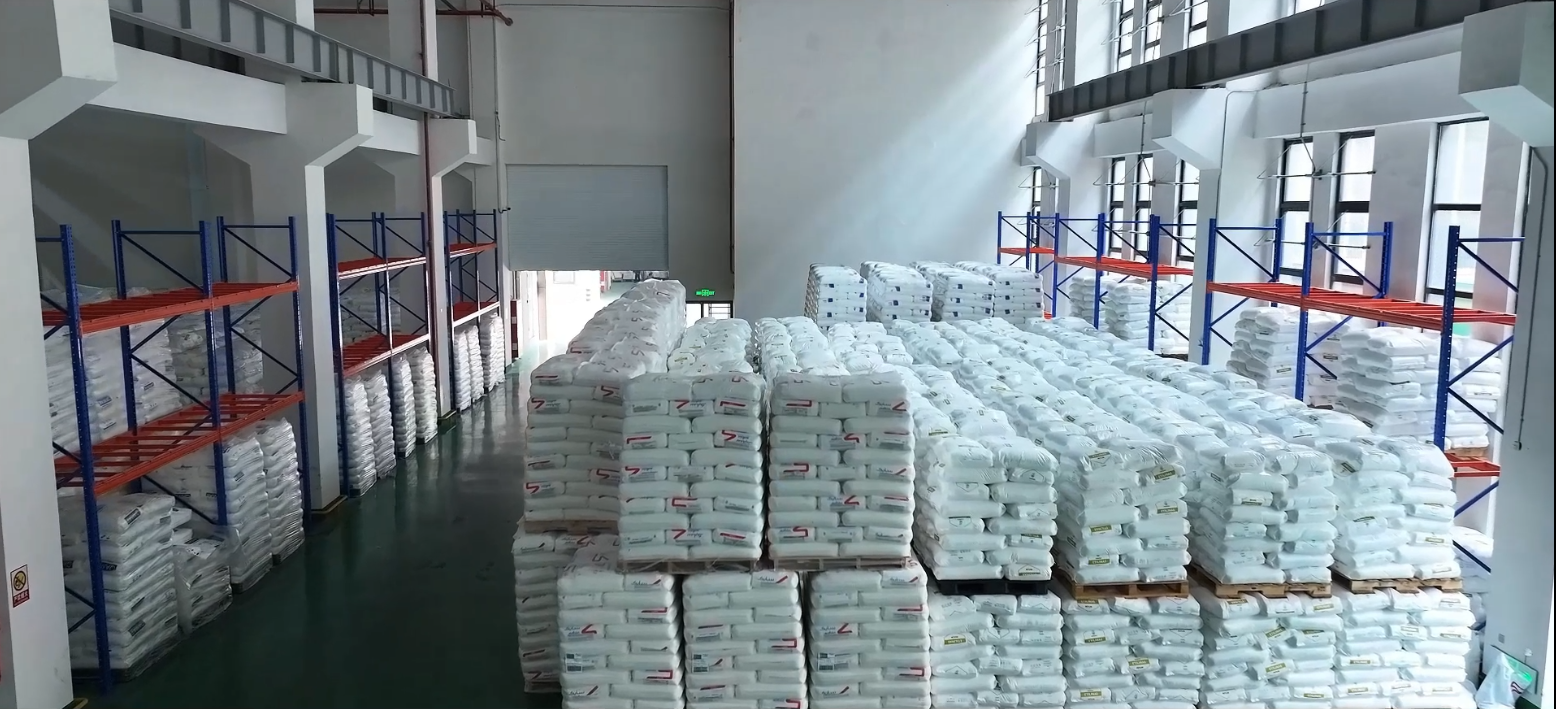
- Monthly capacity: 900 tons, against a stated annual output of 11,000 tons.
- Lead time: 35–40 days.
- Minimum order quantity: 20,000 boxes.
- Quality control: food safety compliance testing (FDA / LFGB) plus visual inspection.
- Engineering resource: an in-house R&D team of 20 engineers.
- After-sales: customer service via email and WhatsApp, storage and usage guidance, technical support, and replacement in cases of quality issues or defects.
The company's system certifications include ISO9001, ISO14001, ISO22716, ISO13485, BRC, BRC-CP, BSCI, GMPc, FDA and EPA, alongside brand authorizations. For buyers, the practical reading of that list is narrower than it looks: ISO9001 and BRC/BRC-CP speak to food-safety management systems, ISO13485 speaks to medical-device-adjacent quality management, and BSCI speaks to social compliance auditing — the latter being a common retailer entry requirement rather than a product property.
Material Selection: 100% LDPE vs PA+PE
Six of the seven Haida models discussed here use 100% LDPE. The exception is the HD-VB001 Food Vacuum Bag, which uses PA+PE. The material difference is the single most consequential specification decision in the range, because it determines what the bag can physically do.
LDPE (low-density polyethylene) is the standard food-contact resin for press-to-close and slider zipper bags. In the United States, food-grade polyethylene bags are covered by FDA 21 CFR 177.1520, which regulates resin composition and migration limits for food-contact substances. In the EU, food-contact zipper bags must comply with LFGB and EU No 10/2011 regulations.
PA+PE is a nylon/polyethylene construction. Its role in the HD-VB001 is specific: vacuum-sealable and high temperature resistant, with a 50–2,000ml capacity range across food processing, freezing and preservation applications. A vacuum process pulls the film against the product and then holds it under pressure and heat during sealing — a mono-layer LDPE bag is not the documented format for that duty in this range.
Temperature Tolerance: Reading the −40°C to 120°C Band
Temperature ratings in this range are not uniform, and treating them as uniform is a common evaluation error.
- HD-FB001 (Frozen Food Bag): low temperature resistant to −40°C, oil-resistant, 100g–2kg capacity. This is the deep-freeze format in the range.
- HD-ZB001 (Food Sealing Bag) and HD-SZB001 (Single Zipper Bag): temperature resistant from −20°C to 120°C, in Small / Medium / Large sizes.
- HD-VB001 (Food Vacuum Bag): documented as high temperature resistant, without a published numeric ceiling in the product data.
- HD-ZB002 (Slider Zipper Bag), HD-SB001 (Slider Bag) and HD-DZB001 (Double Zipper Bag): no numeric temperature band is published for these three; their documented strengths are closure mechanism and sealing performance rather than a stated thermal range.
The boundary matters. A bag rated to −20°C is not a substitute for one rated to −40°C, and specifying a −20°C format into a deep-freeze project moves the risk to the cold chain rather than removing it. Conversely, a −40°C frozen food format is not automatically the right choice for a hot-fill catering application, where the −20°C to 120°C formats are documented.
Capacity Ranges and Closure Mechanisms
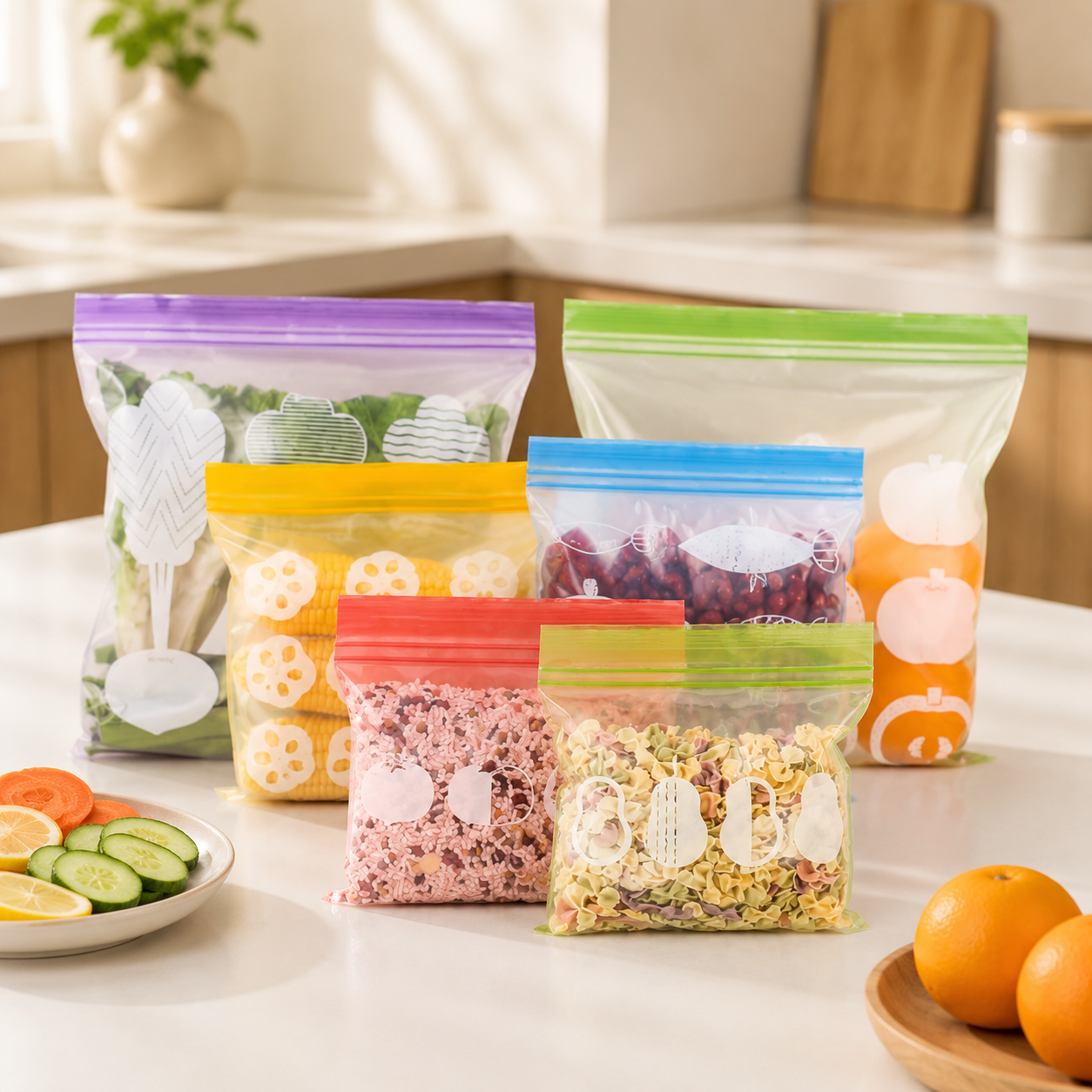
The range covers three closure systems, and the choice between them is usually driven by how often the bag is opened and how leak-sensitive the contents are.
Single zipper
HD-SZB001 uses a standard single zipper with a −20°C to 120°C temperature band, in Small, Medium and Large sizes. It is documented for food storage, catering and daily supplies — the everyday format for snack storage bag and sandwich bag applications, and the format Japanese catering and restaurant chain customers have used for takeaway and delivery packaging.
Double zipper
HD-DZB001 uses a dual zipper for extra sealing, documented as leak-resistant and easy to open and close, with a 50–500ml capacity range. It is the format applied in the Japanese convenience retail case for daily product packaging, where transparent material and strong sealing were the stated requirements.
Slider
Two models use slider closures. HD-ZB002 is a slider zipper bag with a 50–500ml range, documented as easy to open and close. HD-SB001 is a slider bag with a 100–1,000ml range, documented as offering convenient sealing with pressure and water resistance — and it is the one model in the range listed for both Food and Electronics Packaging.
Specification Matrix: Seven Haida Models Side by Side
The table below consolidates the documented specifications for the seven food-grade and food-adjacent models discussed in this article.
| Model | Type | Material | Temperature | Capacity | Documented industries |
|---|---|---|---|---|---|
| HD-ZB001 | Food Sealing Bag | 100% LDPE | −20°C to 120°C | Small / Medium / Large | Food Packaging, Catering, Household & Kitchen |
| HD-ZB002 | Slider Zipper Bag | 100% LDPE | Not published | 50–500ml | Food Packaging, Daily Supplies, Household & Kitchen |
| HD-SB001 | Slider Bag | 100% LDPE | Not published | 100–1,000ml | Food, Electronics Packaging |
| HD-FB001 | Frozen Food Bag | 100% LDPE | −40°C resistant | 100g–2kg | Frozen Food, Ready-to-Eat Packaging, Household & Kitchen |
| HD-VB001 | Food Vacuum Bag | PA+PE | High temperature resistant | 50–2,000ml | Food Processing, Freezing, Preservation, Household & Kitchen |
| HD-SZB001 | Single Zipper Bag | 100% LDPE | −20°C to 120°C | Small / Medium / Large | Food Packaging, Catering, Daily Supplies |
| HD-DZB001 | Double Zipper Bag | 100% LDPE | Not published | 50–500ml | Food Packaging, Catering, Daily Supplies |
Star-Rated Comparison: Food Safety, Durability, Application Versatility
The rating table below scores each model against three procurement criteria. Ratings express how each documented specification profile maps to those criteria — they are an editorial assessment of published product data, not third-party laboratory test results. Buyers should re-validate against a specific project brief before committing.
| Model | Food safety | Durability & sealing | Application versatility | Primary rating driver |
|---|---|---|---|---|
| HD-ZB001 | ★★★★★ | ★★★★☆ | ★★★★★ | 100% LDPE food-contact material; −20°C to 120°C band; Small to Large sizing |
| HD-ZB002 | ★★★★★ | ★★★★☆ | ★★★☆☆ | 100% LDPE; slider closure for repeat opening; 50–500ml limits range |
| HD-SB001 | ★★★★★ | ★★★★★ | ★★★★☆ | Pressure and water resistant; listed for both Food and Electronics Packaging |
| HD-FB001 | ★★★★★ | ★★★★★ | ★★★★☆ | −40°C low-temperature resistance and oil resistance; 100g–2kg band |
| HD-VB001 | ★★★★★ | ★★★★★ | ★★★★☆ | PA+PE vacuum-sealable construction; widest capacity band at 50–2,000ml |
| HD-SZB001 | ★★★★★ | ★★★☆☆ | ★★★★★ | Standard single zipper; −20°C to 120°C; widest sizing spread with HD-ZB001 |
| HD-DZB001 | ★★★★★ | ★★★★★ | ★★★☆☆ | Dual zipper for extra sealing, documented leak-resistant; 50–500ml limits range |
Two patterns are worth noting. First, food safety scores are uniform across the range because all seven models are documented as food-contact or food-packaging applicable, using either 100% LDPE or a PA+PE food vacuum construction — differentiation happens in durability and versatility, not in food-contact status. Second, the models with the narrowest application-versatility scores are not the weakest products; they are the most task-specific ones. A 50–500ml slider format is a strong answer to a specific brief and a poor answer to a broad one.
Application Fit: Matching a Model to a Project Scenario
Haida's published application scenarios map directly onto model selections, which makes them useful as a first-pass filter.
Food packaging (ambient, food-safe)
The food packaging scenario operates at room temperature under food-safe conditions for packaging and storage, with preservation and portion control as the stated functions. It is matched to HD-ZB001 and HD-ZB002. The stated special requirement is compliance with FDA / LFGB / CE standards, and the supporting equipment referenced is sealing machines and filling machines.
Catering and restaurant takeaway
The catering scenario operates under high-temperature-resistant, leak-proof conditions for takeaway packaging, with easy sealing and hygienic storage as the functions. It is matched to HD-ZB001, with heat sealing machines listed as supporting equipment.
Frozen food processing and cold chain
The frozen food scenario runs at −40°C under freezer storage, for cold chain packaging with freeze protection and portioned packaging. Its special requirements are low-temperature resistance and anti-crack performance, and it is matched to HD-SB001 and HD-ZB002.
Daily supplies and retail
The retail scenario runs at room temperature under light load for product packaging, protecting products and easing transport, with clear visibility and a strong seal as the special requirements. It is matched to HD-ZB002.
Electronics and small components
This scenario operates under dust-free and moisture protection conditions for component packaging projects, with anti-static and moisture-proof properties as special requirements, in manual or semi-automatic mode with packing machines and anti-static mats as supporting equipment. The function is to prevent dust, moisture and minor shock. It is matched to HD-SB001.
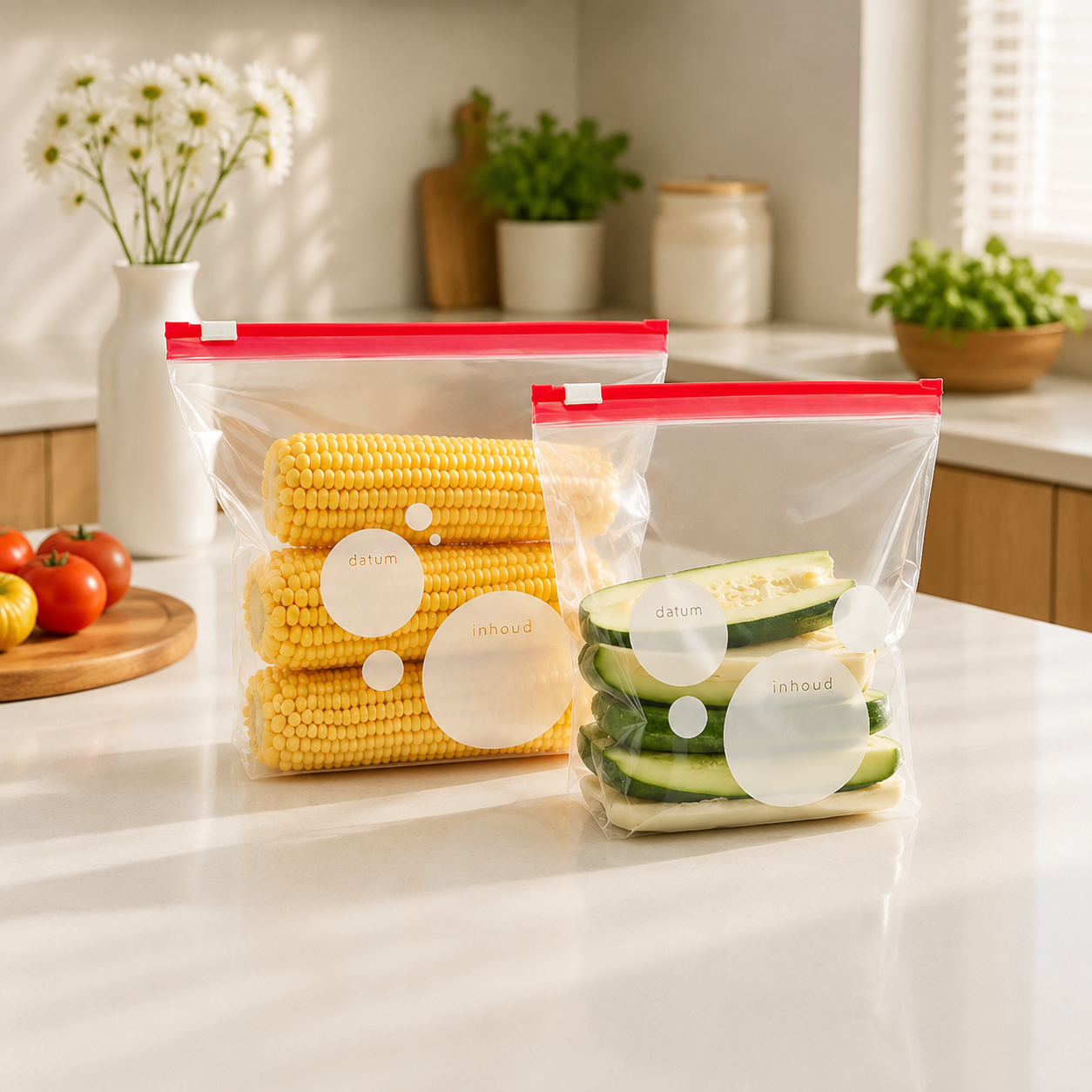
Customer case data from Japanese accounts shows how these scenarios translate into repeat programs. A food manufacturer ran large-scale production for 2–3 years on HD-SB001 for food packaging and portion control, with custom sizes and logos and a leak-proof design as the stated highlights, against a requirement of FDA / LFGB compliance. A frozen food processor ran a three-year large-scale cold chain program on the same model, citing low-temperature resistance and anti-crack material with bulk supply. A catering and restaurant chain ran a 1–2 year medium-scale takeaway and delivery packaging program on HD-SZB001, citing hygienic storage and easy sealing for high-volume orders. A convenience retail account used HD-DZB001 for 1–2 years, citing transparent material for product visibility and strong sealing. An electronics and small components account ran a 2–3 year medium-volume program, using HD-DZB001 and HD-SZB001 in dust-free, moisture protection packaging with custom sizes to protect sensitive components during transit.
Market Trends Shaping Zipper Storage Bag Demand
Three verified data points frame where zipper bag demand is moving.
Flexible is taking share from rigid. The stand-up zipper pouches segment was valued at USD 2.61 billion in 2024 and is expected to reach USD 3.80 billion by 2032, driven by a shift from rigid to flexible packaging, according to Market Research Future. For buyers, this trend shows up as growing demand for stand-up zipper storage bags and custom stand-up formats in retail and food applications.
Food remains the anchor application. Food packaging accounted for roughly 39.2% of global zipper bag market revenue as of 2025, with major adoption concentrated in frozen food and snack segments, according to Dataintelo. That concentration explains why temperature bands and food-contact compliance carry more weight in this category than decorative or retail-facing features.
Manufacturing capacity is concentrated in Asia-Pacific. Asia-Pacific is the fastest-growing region for zipper bags and dominated the plastic bag market in 2025, holding a significant portion of global manufacturing capacity, according to Towards Packaging. This matters for lead-time planning: a large share of the world's zipper bag tooling and film capacity sits in the same region, which affects both sourcing options and competitive quoting behavior.
Zipper Storage Bags vs Traditional Packaging: Where the Limits Are
Zipper storage bags are not a universal replacement for rigid containers, paper packaging or foil laminates. A fair comparison has to state where the category stops working.
- Thermal ceilings are real. Only HD-FB001 is documented for −40°C service. The HD-ZB001 and HD-SZB001 formats are documented from −20°C to 120°C. A project that needs deep-freeze performance below that floor cannot be served by a −20°C format, regardless of how well it performs elsewhere.
- Capacity bands constrain some applications. HD-ZB002 and HD-DZB001 are documented at 50–500ml. That is a portion-control range, not a bulk-storage range. Projects above roughly 1,000ml need HD-SB001 or HD-VB001.
- Material choice affects end-of-life handling. Six of the seven models use 100% LDPE, a single-resin construction that is easier to route into existing polyethylene recycling streams. HD-VB001 uses a PA+PE laminate construction for vacuum performance, which is a multi-material structure and is correspondingly harder to place in mono-material recycling. Buyers with packaging-reduction targets should weigh vacuum performance against that trade-off explicitly.
- Order economics have a floor. The documented minimum order quantity is 20,000 boxes with a 35–40 day lead time. That is workable for recurring OEM programs with a forecast, and awkward for small pilot runs or emergency replenishment. Rigid containers and locally sourced paper formats can often be bought in smaller, faster increments.
- Anti-static requirements sit outside standard food-grade specifications. The electronics scenario requires anti-static and moisture-proof performance. A standard food-grade LDPE bag is documented for food-contact safety, not for static dissipation, so anti-static performance has to be specified and validated as a separate requirement rather than assumed from the food-grade designation.
Where zipper bags do replace traditional formats convincingly is in flexible portion control, transparent product visibility, and the ability to combine a printed brand surface with a resealable closure on the same pack. The meal-kit and subscription-box sector passing USD 20 billion in 2024 is the clearest example of that substitution in practice.
Future Outlook
Two forces look likely to shape the next procurement cycle for zipper storage bags.
The first is compliance-as-commodity. With food-contact rules such as FDA 21 CFR 177.1520 in the United States and LFGB / EU No 10/2011 in the European Union acting as baseline requirements, and with BRCGS A+ and amfori BSCI functioning as entry barriers for major retailers, certification is increasingly the minimum to enter a tender rather than the differentiator that wins it. Suppliers that already hold the system certifications and can evidence FDA / LFGB compliance testing at the batch level are positioned to absorb that expectation more cheaply than suppliers retrofitting it.
The second is format fragmentation. As flexible packaging continues to take share from rigid formats — visible in the stand-up zipper pouch segment's projected growth from USD 2.61 billion in 2024 toward USD 3.80 billion by 2032 — the number of distinct bag formats in a typical buyer's portfolio tends to increase rather than decrease. Custom printed zipper bags, custom slider zipper bags, custom stand-up zipper bags and custom freezer bags each serve a different fill-line and a different shelf context. Buyers who maintain a documented specification matrix, rather than a single default bag, are better placed to consolidate SKUs without losing application fit.
Procurement FAQ
Which zipper storage bag format suits a frozen food or cold chain project?
HD-FB001 is the documented deep-freeze format: a frozen food bag, low-temperature resistant to −40°C and oil-resistant, with a 100g–2kg capacity range in 100% LDPE, listed for frozen food and ready-to-eat packaging. Haida's frozen food processing scenario is also matched to HD-SB001 and HD-ZB002, and specifies low-temperature resistance and anti-crack performance as special requirements. Formats documented only from −20°C, such as HD-ZB001 and HD-SZB001, are not the documented match for service below that floor.
Should a project use 100% LDPE or PA+PE material?
The material choice follows the process, not the price. HD-VB001 is the only model in this set built on PA+PE, and it is documented as vacuum-sealable and high temperature resistant for food processing, freezing and preservation, with a 50–2,000ml capacity range. The other six models — HD-ZB001, HD-ZB002, HD-SB001, HD-FB001, HD-SZB001 and HD-DZB001 — use 100% LDPE and are documented for press-to-close or slider food storage and packaging. For projects with mono-material recycling requirements, the 100% LDPE formats are the simpler structures.
What is the difference between single, double and slider zipper formats?
HD-SZB001 uses a standard single zipper with a −20°C to 120°C band in Small, Medium and Large sizes, documented for food storage, catering and daily supplies. HD-DZB001 uses a dual zipper documented as providing extra sealing, leak resistance and easy open-close, with a 50–500ml range. Two models use slider closures: HD-ZB002, documented as a slider design that is easy to open and close at 50–500ml, and HD-SB001, documented as convenient sealing with pressure and water resistance at 100–1,000ml. The slider formats suit applications with frequent opening; the double zipper suits leak-sensitive contents; the single zipper suits high-frequency, low-complexity packing.
Can the same zipper bag serve food packaging and electronics component packaging?
HD-SB001 is the model listed for both Food and Electronics Packaging, with pressure and water resistance and a 100–1,000ml range. The electronics and small components scenario requires a dust-free, moisture protection environment with anti-static and moisture-proof properties, operating in manual or semi-automatic mode with packing machines and anti-static mats. Standard food-grade LDPE material is documented for food-contact compliance, not for static dissipation, so anti-static performance should be specified and validated separately rather than inferred from the food-grade designation.
Which certifications should a food-grade zipper bag supplier hold?
In the United States, food-grade polyethylene bags are covered by FDA 21 CFR 177.1520 for resin composition and migration limits. In the European Union, food-contact zipper bags must comply with LFGB and EU No 10/2011, and BRCGS A+ and amfori BSCI function as entry barriers for major retailers. Haida Packaging's certification portfolio includes ISO9001, ISO14001, ISO22716, ISO13485, BRC, BRC-CP, BSCI, GMPc, FDA and EPA, and its quality control process includes food safety compliance testing to FDA / LFGB plus visual inspection.
What order volume and lead time should a buyer plan for?
Haida Packaging's documented terms are a minimum order quantity of 20,000 boxes, a lead time of 35–40 days, and a monthly production capacity of 900 tons against a stated annual output of 11,000 tons. Production is OEM, with logo and branding customization available. After-sales support runs through email and WhatsApp and includes storage and usage guidance, technical support, and replacement in cases of quality issues or defects.
Which model offers the widest capacity range across a project portfolio?
HD-VB001 covers the widest documented range at 50–2,000ml, followed by HD-FB001 at 100g–2kg and HD-SB001 at 100–1,000ml. HD-ZB001 and HD-SZB001 are offered in Small, Medium and Large sizes rather than a numeric range, and HD-ZB002 and HD-DZB001 are both documented at 50–500ml. Buyers consolidating several portion sizes usually need at least two capacity bands rather than one.
Working With This Specification Set
For buyers in the Research and Evaluation stages, the practical sequence is to fix the material and temperature band first, then the closure mechanism, then the capacity range — because that order reflects how the failures actually happen. A model that matches on material, temperature and closure but sits outside the required capacity band is a filling-line problem; a model that matches on capacity but not on temperature is a cold-chain problem.
The seven models reviewed here cover food sealing, slider, frozen food, vacuum, single-zipper and double-zipper formats across a 50ml to 2,000ml and 100g to 2kg span, in 100% LDPE and PA+PE constructions. The remaining specification variables — print, dimensions, closure mechanics and compliance documentation for a specific market — are project-level decisions best settled against a defined brief.