
Zirconia Blocks: Milling Center vs. Chairside Clinic Buyers
Independent buyer comparison
A high-volume dental milling center and a chairside restoration clinic can run the same 98 mm zirconia disc on the same CAD/CAM logic and still be buying two different things. The center buys repeatability at volume — batch consistency, sintering discipline and a blank inventory that keeps mills loaded. The clinic buys predictability inside a single appointment — a blank that fits its machine, a sintering cycle it can trust, and a shade that matches what the patient was shown. This comparison separates the two requirement sets using verifiable product facts for the YIPANG 4D-PRO-ML dental zirconia block.
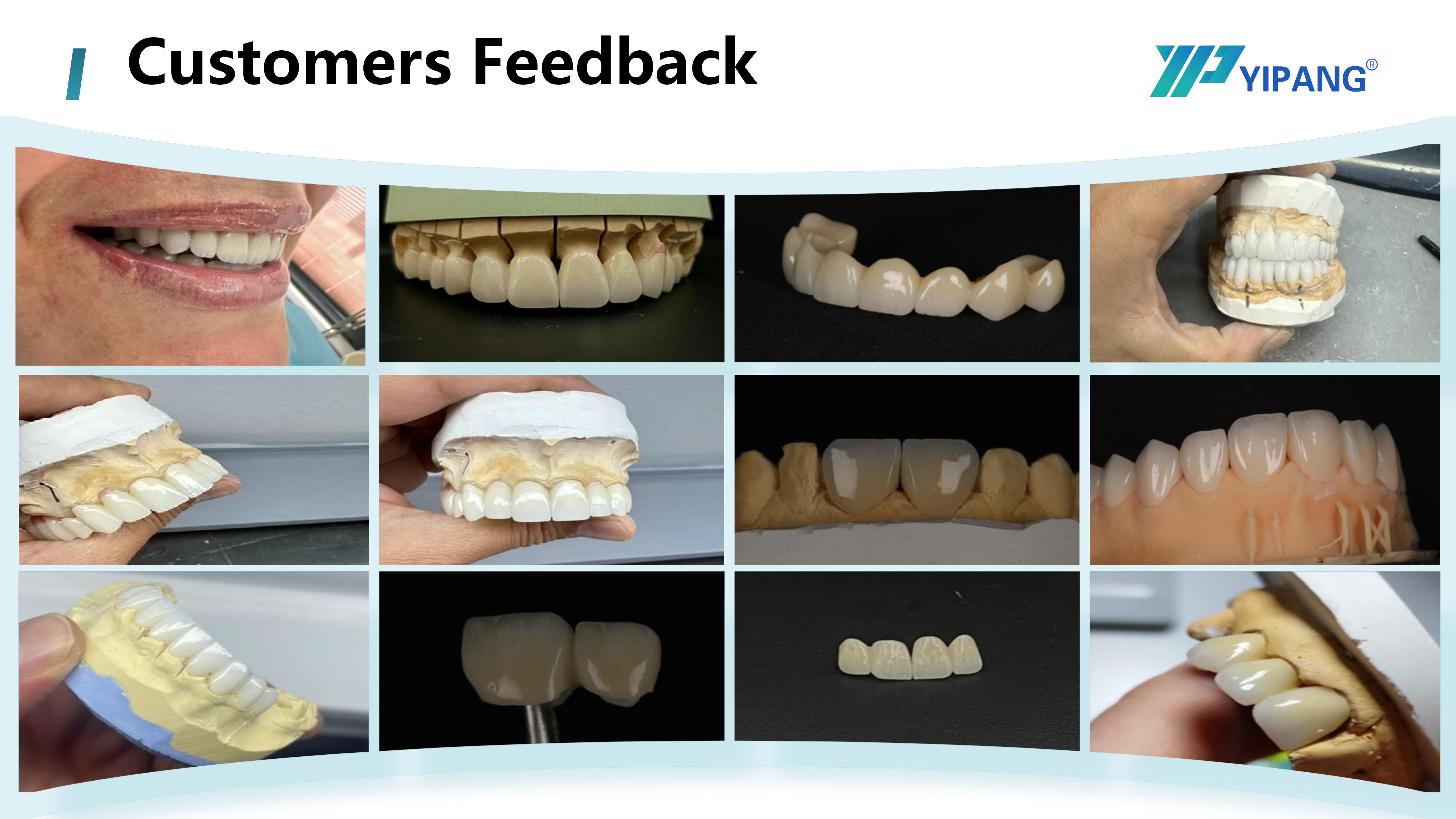
Zirconia blocks are manufactured and stocked as CAD/CAM milling blanks before they reach either a milling center or a chairside clinic.
Why the Zirconia Category Splits Along Workflow Lines
Zirconia is no longer a specialist material chosen case by case. Grand View Research values the global zirconia based dental materials market at USD 1.2 billion in 2025 and projects USD 2.3 billion by 2033. Inside that market, zirconia discs held 63.1% of revenue share in 2025 and CAD/CAM milling accounted for 82.4% of process revenue — a structural signal that the category is purchased primarily as a milling blank, not as a powder or a pressed pellet.
Dental laboratories remain the dominant end user, with 45.3% of market share in 2025, according to the same Grand View Research dataset. That concentration matters for buyers because it means most zirconia block volume is bought by organisations that mill continuously and sinter on a schedule, while a growing remainder is bought by clinics that mill occasionally and sinter one or two units at a time.
Those two purchase rhythms produce genuinely different selection criteria. A milling center evaluating a Dental Zirconia Block is asking whether the material will behave identically on the four-hundredth unit as it did on the first. A chairside clinic is asking whether the same block will survive one furnace cycle without cracking, and whether the resulting crown matches the adjacent tooth. Both buyers care about sintering temperature, equipment compatibility and acceptance criteria — but they weight them differently, and they should write different purchasing terms as a result.
The Core Problem: Failure Costs Are Not Symmetrical
The reason the two segments diverge is not product preference. It is the cost of a failed unit.
For a high-volume milling center, a sintering deviation detected late can affect an entire furnace load. The cost is measured in remilling time, furnace hours and delivery commitments to downstream clinics. The centre therefore treats sintering curve adherence as a process control problem, and it validates a blank supplier on repeatability rather than on a single successful sample.
For a chairside clinic, the same deviation is visible in a single appointment, with the patient seated and the schedule already committed. The cost is measured in a remake, an extra visit and a damaged clinical relationship. The clinic therefore treats sintering curve adherence as a risk-avoidance problem and prefers procedures simple enough to run reliably without a dedicated process engineer.
Both readings of the same technical requirement are legitimate. A buyer comparison that ignores this asymmetry tends to produce a specification sheet that satisfies neither segment.
What a High-Volume Milling Center Needs From a Zirconia Block
- Sintering behaviour that repeats. The dominant concern is whether the same heating and holding procedure produces the same shrinkage and translucency across consecutive batches. 4D-PRO-ML lists low shrinkage after sintering and high dimensional accuracy as design points, which is the property a center is actually testing for.
- Furnace scheduling fit. A center with continuous furnace loading needs a defined, documented cycle rather than an operator-dependent one. The product's stated processing requirement is that the standard sintering temperature curve is followed strictly.
- Blank format and inventory depth. A 98 mm diameter disc with thickness options of 10, 12, 14, 16, 18 and 20 mm allows nesting to be planned by restoration size instead of by what happens to be in stock.
- Shade range for batch production. ML Multilayer shades need to sit in a predictable range so that units produced weeks apart still read as a set.
- Machine compatibility that does not require requalification. The block is described as compatible with most mainstream dental milling machines and designed for dental CAD/CAM workflows.
What a Chairside Clinic Needs From a Zirconia Block
- A cycle short and forgiving enough for one visit. The clinic is not optimising throughput across a furnace load; it is trying to avoid a mid-cycle crack. Guidance for the material is explicit: avoid rapid temperature change to prevent cracking, and do not exceed the maximum sintering temperature.
- Minimal stock keeping. Most chairside operators would rather hold two thicknesses that cover their common crown and bridge cases than six that cover every eventuality.
- Aesthetic predictability in the anterior. With medium translucency and ML Multilayer shades, the clinic needs to know in advance which cases fit the material and which should be referred or handled differently.
- Equipment that already exists in the practice. The workflow chain is dental lab scanner or intraoral scanner → dental milling machine → dental sintering furnace, and the block has to fit that chain rather than demand a new one.
- Simple documentation. A clinic rarely has a materials engineer on staff, so the sintering parameters must be usable as written.
Technical Explanation: Sintering Curve Adherence for 4D-PRO-ML
The 4D-PRO-ML dental zirconia block is a dental zirconia disc and CAD/CAM dental milling blank made of zirconium dioxide (ZrO₂) with yttria stabilization. Its product data lists a sintering temperature of 1450°C, while processing guidance for the material states a recommended sintering temperature range of 1430°C–1450°C, applied through a standard heating and holding procedure to preserve low shrinkage and stable translucency.
The stated operating sequence is deliberately plain:
- Place the milled zirconia workpiece on the sintering tray.
- Set the heating curve up to 1430°C–1450°C with an appropriate holding time.
- Allow the restoration to cool naturally after sintering is complete.
Two constraints carry most of the risk. First, rapid temperature change should be avoided to prevent cracking. Second, the maximum sintering temperature should not be exceeded. For a milling center these are calibration and load-positioning rules; for a chairside clinic they are the operational boundaries of a single-unit cycle.
The consequence for buyers is that the sintering curve is not a marketing specification but an acceptance variable. A block that sinters correctly inside a validated 1430°C–1450°C window is predictable; the same block run on an uncalibrated furnace is not, and the resulting defect will usually be attributed to the material rather than to the process.
Equipment Compatibility: Milling Machine, Scanner, Sintering Furnace
4D-PRO-ML is supplied as a 98 mm diameter disc in six thicknesses, which places it inside the blank format used by a large part of the installed CAD/CAM base. The matched equipment set for the material is a dental milling machine, a dental sintering furnace and a dental lab scanner, operating in an indoor constant temperature dental laboratory environment.
Compatibility, however, deserves a precise reading. YIPANG describes the block as compatible with most mainstream dental milling machines and designed for dental CAD/CAM systems. That is a statement about the mainstream format, not a guarantee covering every spindle, clamp or blank-holder geometry on the market. Buyers should confirm the fit on their own equipment before standardising, particularly where the mill is a less common model or has been retrofitted.
The milling machine segment itself is concentrated. Fortune Business Insights identifies Roland DG, Amann Girrbach and vhf camfacture as significant market share holders in the dental milling machine sector as of 2024, and values the dental milling machine market at USD 2.45 billion in 2025 with expected growth to USD 3.9 billion by 2030. A blank built around the mainstream 98 mm format is, in practical terms, built around the machines those buyers already own.
4D-PRO-ML specification summary
| Parameter | 4D-PRO-ML |
|---|---|
| Material | Zirconium dioxide (ZrO₂) with yttria stabilization |
| Product form | Dental zirconia disc / CAD/CAM dental milling blank |
| Diameter | 98 mm |
| Thickness options | 10 mm, 12 mm, 14 mm, 16 mm, 18 mm, 20 mm |
| Available shades | ML Multilayer |
| Translucency | Medium Translucent |
| Bending strength | ≥1200 MPa |
| Sintering temperature | 1450°C listed on the product data; recommended range 1430°C–1450°C |
| Intended industries | Dental laboratory, dental prosthetics, dental CAD/CAM industry |
| Intended restorations | Full-contour crowns, bridges, veneers and implant superstructure restorations |
Source: YIPANG product data for the 4D-PRO-ML dental zirconia block, together with published sintering guidance for the material.
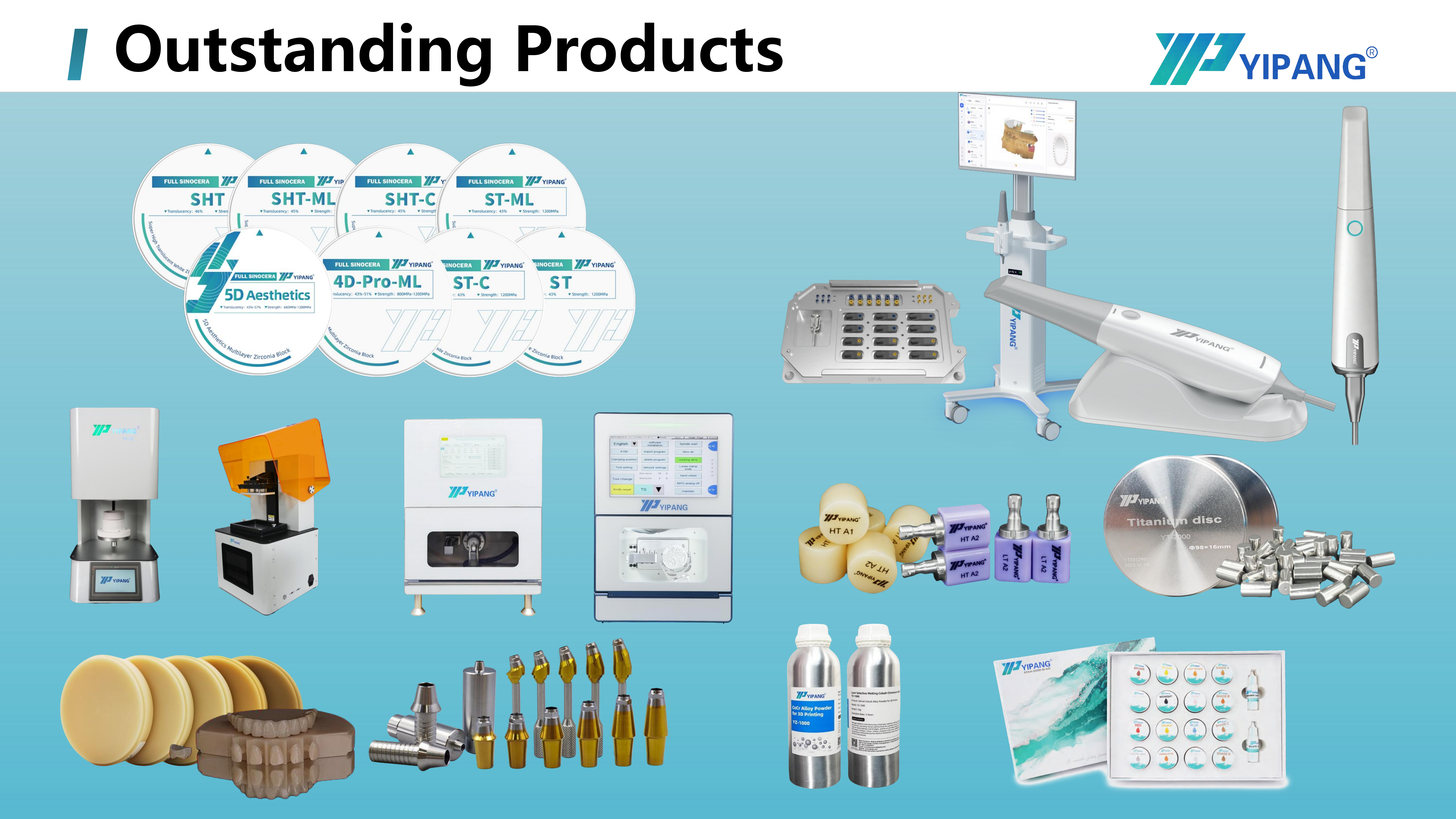
The 4D-PRO-ML blank: 98 mm diameter, six thickness options, ML Multilayer shades, medium translucency.
Purchasing Terms and Acceptance Criteria
This is the section where the two buyer segments diverge most sharply, and where a supplier's commercial structure becomes as relevant as the material itself.
For the high-volume milling center
- Volume and mix. Blanket ordering across a thickness mix, with the shade range fixed in advance.
- Incoming inspection. Dimensional check on the blank, visual check for defects, and a sintered test unit measured for shrinkage and fit.
- Batch traceability. The ability to tie a finished restoration back to a production batch if a downstream complaint appears.
- Recurring verification. Periodic re-sintering of test units rather than a single qualification run at onboarding.
For the chairside clinic
- Small-batch availability. Access to a limited thickness set without committing to pallet volumes.
- Protocol clarity. Written sintering parameters that can be entered into the practice furnace exactly as issued.
- Aesthetic sign-off. A shade and translucency check on a sample unit before the material enters routine use.
- Support access. A named technical contact for furnace setting questions rather than a general enquiry inbox.
A workable acceptance framework for either segment has three checkpoints: sintering behaviour inside the 1430°C–1450°C window, dimensional accuracy after sintering, and shade reproducibility against the agreed reference. The milling center should run these checks per batch; the clinic should run them once at onboarding and repeat them if the furnace is serviced or recalibrated.
Application Fit: Crowns, Bridges and Implant Superstructures
4D-PRO-ML is specified for full-contour crowns, bridges, veneers and implant superstructure restorations — the same indication set that defines the commercial case for both buyer segments.
In a milling center, the implant superstructure and multi-unit bridge work is where dimensional accuracy pays for itself. A data sheet bending strength of ≥1200 MPa and low shrinkage after sintering are the properties that let a center plan a multi-unit span without building in excess cement space. Medium translucency is generally acceptable for posterior and bridge work, where the priority is fit and strength rather than maximum light transmission.
In a chairside clinic, single full-contour crowns dominate. Here the value of the same specification is different: the clinic benefits from a blank that mills predictably on a compact machine and sinters in one cycle, and it needs to know where medium translucency stops matching the clinical expectation. Anterior cases with high aesthetic demand are the boundary, not the target.
Requirement Priorities Side by Side
| Decision point | High-volume milling center | Chairside restoration clinic |
|---|---|---|
| Primary objective | Repeatability across batches and furnace loads | Predictable outcome within one appointment |
| Sintering curve | Validated furnace program, checked per batch | Simple single-unit cycle within 1430°C–1450°C |
| Critical failure mode | Whole-load shrinkage or translucency drift | Single-unit crack or shade mismatch |
| Blank inventory | Full thickness range 10–20 mm | One or two thicknesses |
| Equipment question | Multi-machine compatibility across the fleet | Fit with one mill and one furnace |
| Acceptance test | Periodic sintered test units per batch | Onboarding test unit plus post-service recheck |
| Aesthetic weighting | Batch shade consistency | Single-unit match to adjacent teeth |
| Purchasing term focus | Volume, traceability, delivery continuity | Small-batch access and technical support |
Where 4D-PRO-ML Is Not the Automatic Choice
An honest buyer comparison has to state the boundaries, and this material has them.
- Medium translucency is a defined position, not the top of the range. Clinics whose anterior work depends on high light transmission should verify case by case rather than assume the block covers every aesthetic requirement.
- The sintering window demands a calibrated furnace. Buyers running equipment that cannot hold the 1430°C–1450°C curve with an appropriate holding time are exposed to cracking and dimensional error regardless of blank quality.
- Fixed thickness steps require nesting planning. The 10–20 mm range in 2 mm increments is comprehensive but not continuous, so unusually large spans need to be planned rather than assumed.
- Single-visit chairside restoration is a workflow outcome, not a product promise. It depends on the scanner, the mill, the furnace and the sintering time as much as on the blank.
- Regulatory obligations stay with the buyer's market. EU Medical Device Regulation (MDR 2017/745) classifies most dental implants and restorative materials as high-risk and requires intensive clinical data, so European buyers must confirm documentation against their own compliance route rather than relying on a supplier's general statement.
How YIPANG Positions 4D-PRO-ML Across Both Segments
Beijing Weijiahua Dentistry Equipment Co., Ltd., established in 1996, is a manufacturer and supplier of dental products and services operating under the YIPANG brand. The company runs a 2000 square metre facility with approximately 80 employees and an annual production capacity of USD 10 million, supported by a 25-engineer team working on dental material formula research, process optimisation and new product development. Its product lines include Zirconia Blocks, Glass Ceramics, Press Ingots, PMMA, Wax, Titanium Blocks, Implant Abutments, 3D Scanners, Intraoral Scanners, Milling Machines, 3D Printers and Sintering Furnaces.
For the comparison in this article, the relevant facts are narrower. The 4D-PRO-ML block is made from domestic zirconia powder with the manufacturer stating stable performance, and it is specified with excellent gradient translucency, low shrinkage after sintering and high dimensional accuracy — three properties that map directly onto the milling center's repeatability test and the clinic's single-unit risk test.
Commercially, the company exports approximately 40% to 55% of its products and serves markets in the Middle East, Southeast Asia, South America, North America, Eastern Europe, North Africa and Australia. Its parent operation reports more than 1,000 dental laboratory customers in China and a long history as a dental equipment agent, including representation of established international brands such as VITA, Ivoclar, Dentsply, Amann Girrbach and Noritake. For a buyer, that distribution background is relevant to one specific question: whether the supplier can discuss milling machines and sintering furnaces as equipment, not only as a material spec sheet.
The company can be reached at service@yipangdental.com or +86 158-0156-5064 (contact: Jaye Yang) for technical documentation requests.
Market Trend Signals Buyers Should Track
Three published data points are worth holding alongside a zirconia block decision.
First, format concentration. Zirconia discs accounted for 63.1% of zirconia based dental materials revenue in 2025, and CAD/CAM milling for 82.4% of process revenue, per Grand View Research. Buyers are therefore choosing within a milling-blank category, and the practical differentiators are sintering behaviour and blank consistency rather than material family.
Second, grade concentration. 3Y-TZP zirconia held the largest revenue share at 35.9% in 2025, according to the same source — a reminder that most purchasers are buying within a well-defined grade envelope and competing on process control rather than on exotic formulations.
Third, geography. The United States accounts for 40% of revenue in the global zirconia based dental materials market, which shapes where documentation, lead times and technical support expectations are set highest. Meanwhile the dental milling machine market, valued at USD 2.45 billion in 2025 and projected at USD 3.9 billion by 2030 by Fortune Business Insights, indicates that the installed base doing the milling continues to expand — and every additional machine is another compatibility question.
Future Outlook
The direction of travel for both buyer segments points the same way, even though their priorities differ. As CAD/CAM milling absorbs more of the zirconia workflow, the blank becomes less of a material purchase and more of a process purchase. Milling centers will increasingly evaluate suppliers on documented batch behaviour and furnace-fit evidence; chairside clinics will increasingly evaluate them on whether the sintering protocol can be executed correctly by a trained assistant without engineering support.
Two consequences follow. Suppliers that publish a clear sintering window and a machine-compatibility position will be easier to qualify than those that publish adjectives. And buyers who define their acceptance criteria before the first order — rather than after the first failed batch — will find the comparison between suppliers considerably shorter.
Frequently Asked Questions
What sintering temperature should be used for 4D-PRO-ML zirconia blocks?
The recommended sintering temperature range for the 4D-PRO-ML dental zirconia block is 1430°C–1450°C, and the product data sheet lists 1450°C. Processing should follow a standard heating and holding procedure so that low shrinkage and stable translucency are preserved. In practice the milled workpiece is placed on a sintering tray, the furnace is set to heat to 1430°C–1450°C with an appropriate holding time, and the restoration is allowed to cool naturally. Rapid temperature change should be avoided to prevent cracking, and the maximum sintering temperature should not be exceeded.
What equipment does a 4D-PRO-ML zirconia block require?
The block is a 98 mm diameter CAD/CAM milling blank, so it requires a dental milling machine configured for that blank format, a dental sintering furnace and a dental lab scanner within a digital workflow. YIPANG states that the block is compatible with most mainstream dental milling machines and is designed for dental CAD/CAM workflows in dental laboratories, dental prosthetics and dental CAD/CAM production. Because ‘most mainstream’ is not the same as every machine, buyers should confirm blank-holder geometry and clamp compatibility on their own equipment before standardising.
Is 4D-PRO-ML suitable for implant superstructure restorations?
The 4D-PRO-ML block is specified for full-contour crowns, bridges, veneers and implant superstructure restorations, and is used to fabricate aesthetic, durable dental prostheses in dental CAD/CAM workflows. Its data sheet lists a bending strength of ≥1200 MPa, medium translucency and low shrinkage after sintering for dimensional accuracy. Suitability for a specific implant case still depends on the individual restoration design and on sintering being carried out within the recommended 1430°C–1450°C curve.
What should a chairside clinic check before standardising on a zirconia block?
A chairside clinic should confirm four points: that the 98 mm blank format fits its milling machine; that its sintering furnace can follow the 1430°C–1450°C curve with the required holding time; that the available thickness range of 10 mm to 20 mm in 2 mm steps covers its typical crown and bridge cases; and that ML Multilayer shades with medium translucency match its aesthetic expectations. Because a chairside workflow compresses milling and sintering into one visit, furnace cycle time and calibration matter as much as the blank itself.
How should a high-volume milling center evaluate zirconia block consistency?
A milling center should evaluate consistency at three checkpoints: sintering behaviour, dimensional accuracy after sintering, and shade reproducibility. Concretely, it can sinter test units from an incoming batch against the 1430°C–1450°C curve, measure shrinkage and fit, and compare the ML Multilayer shade against previous batches. Because the block is produced from domestic zirconia powder with the manufacturer stating stable performance and low shrinkage after sintering, batch-to-batch verification — rather than a single qualification sample — is the more reliable acceptance method.
Reference
Company information, product lines and contact details for Beijing Weijiahua Dentistry Equipment Co., Ltd. are available in the corporate brochure: WJH Company Information (PDF).
Have Questions or Need More Details?
Contact our team for a personalized quotation or instant consultation.
Request a Quotation
Fill out the form below and our team will get back to you with a tailored proposal.
WhatsApp Direct Chat
Prefer to chat in real-time? Message us on WhatsApp for instant assistance & quick answers.
- Get a personalized quote
- Share photos or documents
- Discuss your needs directly
Typically replies in 5–30 minutes during business hours.