
Zirconia Blocks: Mixed-Material Lab, Multi-Unit Bridge Fit
Zirconia Blocks: Mixed-Material Lab, Multi-Unit Bridge Fit
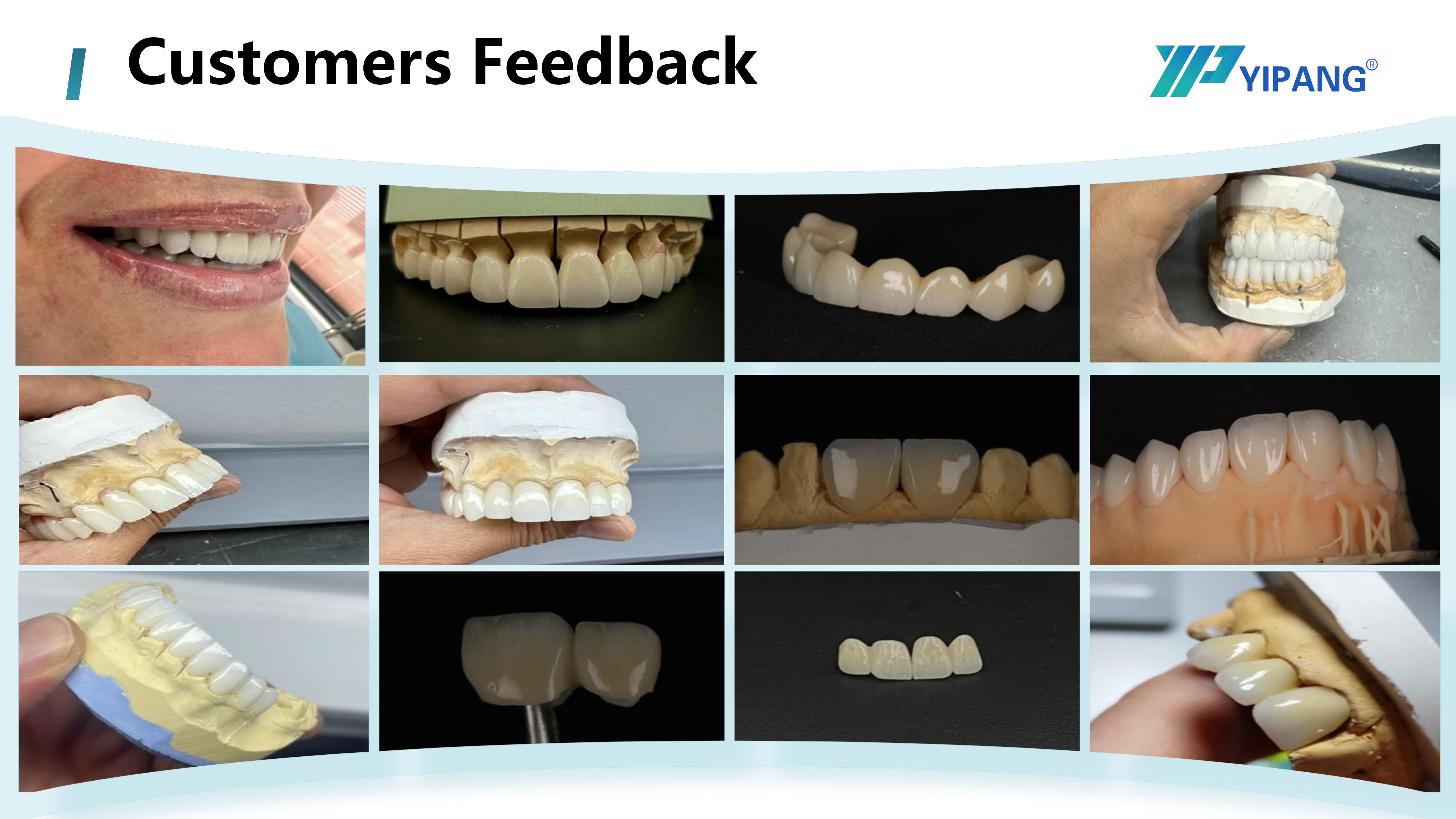
A mixed-material laboratory's zirconia route depends on production discipline as much as on the blank itself.
A dental laboratory that runs zirconia alongside glass-ceramic, PMMA and wax does not buy one material — it routes each unit to a route. That routing decision is where dental zirconia blocks either fit a project or do not. In multi-unit bridge work the question is narrower than whether zirconia is a good material: it is whether a zirconia blank can carry the span, whether the laboratory's milling and sintering chain can hold that span to tolerance, and whether the required translucency tier matches what the case will be judged on. The 4D-PRO-ML zirconia block from YIPANG — the dental materials brand of Beijing Weijiahua Dentistry Equipment Co., Ltd. — illustrates the boundary rather than settling it: a 98 mm disc in ML Multilayer shades, with a stated bending strength of ≥1200 MPa, medium translucency and a listed sintering temperature of 1450 °C.
What a mixed-material laboratory is actually deciding
A mixed-material dental laboratory produces restorations across more than one material class in the same facility, often in the same production week. Zirconia, glass-ceramic, PMMA and wax do not compete for the same slot in that schedule; they occupy different slots, and the laboratory's real output is the routing decision that assigns each unit to one of them.
For a multi-unit bridge project, that routing decision has a clear shape. Zirconia blocks belong to the structural route: they are the blank chosen when the controlling requirement is a load-bearing framework or a full-contour restoration produced by milling and sintering, rather than a pressed or milled aesthetic unit. The question is therefore not whether zirconia is a capable material, but whether a specific project's span, aesthetic target and sintering capacity are compatible with the blank in hand.
A practical routing sequence for a mixed-material laboratory looks like this:
- Indication and span. Single unit or multi-unit, anterior or posterior, tooth-borne or implant-borne.
- Aesthetic target. The translucency tier the case will be judged against, which determines whether a given blank is eligible at all.
- Equipment availability. Whether the scanner, milling machine and sintering furnace can take the job within the required window.
- Curve discipline. Whether the sintering schedule can be run without compromise, because a deviation affects every unit in the run.
- Blank inventory. Whether the required shade and thickness are on the shelf, or whether the project waits for stock.
Each of these is a go/no-go check. The last two are the ones that most often decide a multi-unit bridge project: a blank that is technically suitable can still be the wrong choice for a laboratory whose furnace schedule cannot absorb a long span without splitting the run.
Where zirconia blocks fit, indication by indication
YIPANG defines the project scope for its zirconia block applications as full-contour crowns, bridges, veneers and implant superstructure restorations, processed on a dental milling machine and sintered in a dental sintering furnace. That scope statement is the sensible starting point for a mixed-material laboratory, because it describes the indications the material is offered for rather than a claim about any individual case.
Posterior monolithic crowns
The clearest fit. A monolithic full-contour crown in the posterior region is judged mainly on fit, occlusion and durability, and medium translucency is normally an acceptable aesthetic position there. Posterior monolithic work is also the easiest zirconia volume to schedule: single units, predictable nesting, and a sintering run that can be batched with other units of the same shade and thickness.
Multi-unit and full-contour bridges
This is the scenario where the decision carries the most risk. A multi-unit bridge converts a per-unit material question into a per-span question: connector geometry, shrinkage consistency and shade continuity all have to hold across the whole span, not just on the most visible unit. Zirconia's position here rests on its role as a structural framework material, not on translucency.
Veneers and anterior aesthetic units
YIPANG's stated scope includes veneers, and the honest qualification is that a veneer case places the highest aesthetic demand on the blank. The 4D-PRO-ML block is listed as medium translucent with an ML Multilayer shade structure, so whether it is the right blank for a given anterior unit is a case-level decision. Where the aesthetic target exceeds what a medium-translucency blank can deliver, the mixed-material answer is usually to route that unit to a different material class rather than to stretch the zirconia blank past its stated characteristic.
Implant superstructure restorations
Implant superstructures sit within the same stated application scope. The blank decision and the implant interface decision are separate: the laboratory still has to resolve the connection and the case design, and the zirconia block only determines what can be milled and sintered. Treating those as one decision is a recurring source of rework in mixed-material laboratories.
The multi-unit bridge scenario: five checks before a batch commitment
A multi-unit bridge is the point at which a mixed-material laboratory should slow down. The same blank that performs well as a single crown can fail a span for reasons that have nothing to do with a strength figure. The checks below follow the order in which the failure modes appear.
1. Span and connector geometry against blank geometry
The 4D-PRO-ML disc is supplied at a 98 mm diameter in thicknesses of 10, 12, 14, 16, 18 and 20 mm. Thickness selection is a project-planning step, not an ordering detail: the laboratory must confirm that the complete nested span — including connectors and the handling margin around the framework — fits within the selected thickness before the job is released to the mill. A span that fits only by shaving the handling margin invites a fracture at de-boxing, before sintering even begins.
2. Shrinkage behaviour across the span
YIPANG states a low shrinkage rate after sintering and describes stable sintering shrinkage as one of the material's characteristics. That is a supplier statement, and the correct way to use it is as a reason to run a pilot span rather than as a substitute for one. Shrinkage that is consistent unit-to-unit still has to be confirmed across the full length of a multi-unit framework, because the tolerance that matters in a bridge is the accumulated tolerance at the connectors and at the terminal abutments.
3. Shade continuity through a multilayer blank
ML Multilayer blanks carry a shade gradient through the thickness. In a single crown that gradient is judged on one unit; in a bridge it is judged across a span that may run several units and cross the midline. Nesting orientation therefore determines how the gradient sits in the finished restoration, and the laboratory should settle that orientation at the design stage rather than at the mill.
4. Sintering capacity and curve discipline
This is where multi-unit work differs most sharply from single-unit work. A curve deviation in a single crown affects one unit; the same deviation in a span affects every unit in the run at once. YIPANG's stated processing requirement is strict adherence to the standard sintering temperature curve, and its published guidance adds two specific cautions: avoid rapid temperature change to prevent cracking, and do not exceed the maximum sintering temperature.
5. Documentation that travels with the job
For a mixed-material laboratory, traceability is a routing control as much as a quality record. Recording the batch, shade, thickness and sintering cycle used for a span makes it possible to separate a material question from a process question when a case is reviewed later — and in a multi-unit bridge, that separation is usually the difference between a fixable process issue and a lost span.
Technical basis: composition, strength and the sintering window
The 4D-PRO-ML zirconia block is a dental zirconia disc and CAD/CAM milling blank made of yttria-stabilized zirconium dioxide (ZrO₂), supplied in ML Multilayer shades. The parameters below are the manufacturer's published values and are the figures a laboratory should work from when assessing fit.
| Parameter | 4D-PRO-ML stated value |
|---|---|
| Type | Dental zirconia disc, CAD/CAM dental milling blank |
| Material | Zirconium dioxide (ZrO₂), yttria stabilized |
| Available shades | ML Multilayer |
| Thickness | 10 mm, 12 mm, 14 mm, 16 mm, 18 mm, 20 mm |
| Diameter | 98 mm |
| Sintering temperature | 1450 °C (specification); published FAQ guidance: 1430 °C–1450 °C with standard heating and holding |
| Bending strength | ≥1200 MPa |
| Translucency | Medium translucent |
| Applicable industry | Dental laboratory, dental prosthetics, dental CAD/CAM industry |
Two published figures deserve separate treatment. The material is listed with a bending strength of ≥1200 MPa and a medium translucency, and together those two values define its position in a mixed-material laboratory: it is a structural blank rather than an aesthetic blank. Laboratories that read the strength figure as a licence to place zirconia in any aesthetic position, or read the translucency figure as a licence to use it in any load-bearing position, tend to be disappointed by one or the other.
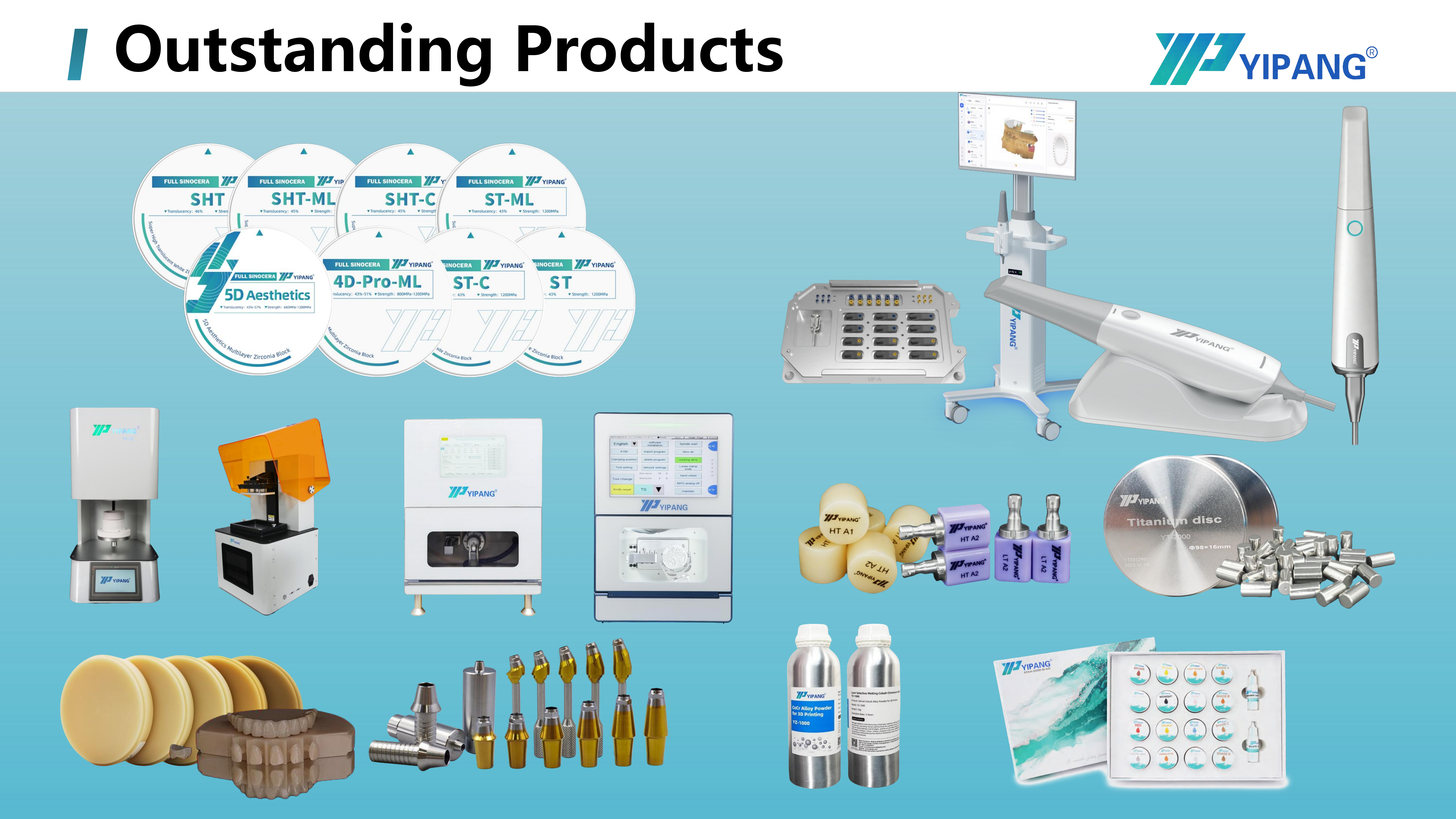
The 4D-PRO-ML blank is supplied in ML Multilayer shades at a 98 mm diameter, in thicknesses from 10 mm to 20 mm.
On sintering, the specification lists 1450 °C, while YIPANG's published FAQ describes a recommended range of 1430 °C–1450 °C, to be run with a standard heating and holding procedure that supports low shrinkage and stable translucency. The two statements are read most sensibly as a peak-versus-window relationship, but a laboratory qualifying the material for multi-unit work should obtain the written cycle for the specific batch rather than infer one from a single number. The published procedure is:
- Place the milled zirconia workpiece on the sintering tray.
- Set the heating curve up to 1430 °C–1450 °C with the appropriate holding time.
- Cool down naturally after sintering is complete.
The stated cautions belong with the procedure, not in a separate manual: rapid temperature change risks cracking, and exceeding the maximum sintering temperature falls outside the stated process. In a multi-unit run, both cautions apply to the entire load.
The equipment chain a mixed-material laboratory already has
YIPANG lists the matched equipment for this application as a dental lab scanner, a dental milling machine and a dental sintering furnace, operating in an indoor constant-temperature dental laboratory environment, with the workpiece milled and then sintered. For a mixed-material laboratory, most of that chain is familiar: scanning and milling are shared across material classes, and the differences sit in the blank, the tooling and the post-processing.
The block is described as compatible with most mainstream dental milling machines. That is a supplier compatibility statement and should be confirmed against the specific mill, chuck and clamping system in use. The more decisive question is usually the furnace. A laboratory that already presses glass-ceramic has a furnace, but it may not have the sintering capacity or the curve control a multi-unit zirconia span requires, and the load has to be scheduled so that one job's cycle does not force another job to run outside its window.
Room condition is the quiet third variable. The stated working condition is an indoor constant-temperature laboratory environment, which matters more in a mixed-material setting than in a single-material one, because the same bench and the same mill serve jobs with different tolerances across the day.
Zirconia versus a glass-ceramic route: what the difference actually is
In a mixed-material laboratory the real comparison is not zirconia or glass-ceramic as a matter of preference. It is which route satisfies the controlling constraint of the case. Glass-ceramic routes are typically selected where an anterior aesthetic target governs; zirconia routes where a load-bearing framework or a long span governs. Both can appear in the same arch, and that coexistence is precisely what makes a laboratory mixed-material.
Zirconia's technical position in dental CAD/CAM is supported by an active peer-reviewed literature base. A 2024 review by Huang et al. addresses the properties and classification of zirconia-based dental materials, and zirconia's use in dental restorations is generally attributed to its mechanical properties and durability. That literature supports the material's role; it does not by itself establish that a specific block will outperform a specific glass-ceramic product in a specific case.
That distinction is the fit boundary this analysis has to state plainly. No comparative outcome testing between the 4D-PRO-ML block and any glass-ceramic product is supplied here, so no superiority, equivalence or case-suitability claim follows from the documented characteristics alone. What can be said is narrower and more useful: the two routes differ in stated translucency tier and in structural role, and a laboratory can compare them on those documented characteristics while treating the clinical decision as its own validation step.
Where a project's aesthetic requirement is the controlling constraint, routing the unit to a glass-ceramic route is a normal mixed-material decision, not a failure of the zirconia route. Where span and load govern, the reverse applies. Laboratories that keep the two routes separate in planning, rather than ranking them, tend to get more predictable output from both.
Market context behind the routing decision
Two published data points frame the commercial side, and both need their scope stated. Dataintelo reports that high-translucent zirconia blocks held the largest segment share at 42.3% in 2025. Grand View Research, on its report landing page, places the broader category of zirconia-based dental materials at USD 1.2 billion in 2025 and projects USD 2.3 billion by 2033 at a stated CAGR of 8.4%; that category is wider than zirconia blocks alone, and the methodology and segment definitions were not retrieved in this review, so the figure should not be read as a block-level market size or applied to any single national market.
Read together and with those qualifications, the two signals point in the same direction without proving a purchasing decision: aesthetic expectations are pulling a large share of demand toward higher-translucency tiers, while structural zirconia work continues to exist alongside it. That combination argues for routing discipline rather than for standardizing on one blank, because a laboratory serving both aesthetic and load-bearing indications is, by definition, a mixed-material laboratory.
Nothing in these figures establishes demand in a specific market, and none of them should be used to size a laboratory's own zirconia consumption.
Supplier-side facts a laboratory can verify
YIPANG is the self-developed dental materials brand of Beijing Weijiahua Dentistry Equipment Co., Ltd., a company established in 1996 that runs a 2,000 m² facility with 80 employees, including 25 engineers working on dental material formulation, process optimization and new product development. The company reports annual output valued at USD 10 million and an export ratio of 40%–55%, with markets including the Middle East, Southeast Asia, South America, North America, Eastern Europe, North Africa and Australia. Its stated position is OEM/ODM with customization across almost all specifications, a monthly capacity of 15,000 pieces, a lead time of 15–30 working days and a negotiable small MOQ; quality control is described as 100% raw material inspection plus finished-product random inspection, and after-sales support as online technical guidance with a response within 24 hours.
On the application side, the company reports hundreds of long-term cooperative clients worldwide using its material for crowns, bridges and aesthetic restorations, citing uniform translucency, stable sintering shrinkage and compatibility with most CAD/CAM systems as the recurring points of recognition, alongside a low complaint rate. These are company-reported figures and case statements rather than independently audited results, and they belong in a qualification file as claims to be checked. Further company detail is published at Beijing Weijiahua Dentistry Equipment Co., Ltd. (YIPANG).
External documentation is a separate axis, and the U.S. market illustrates why. The FDA 510(k) database carries K240672 for Dental Zirconia Blank & Dental Zirconia Pre-Shaded Blank, submitted by Zhejiang Zahndent Biotechnology Co., Ltd., classified as a Class II device under product code EIH and 21 CFR 872.6660, with a substantially equivalent decision recorded in 2024 and a matching establishment listing naming the manufacturer. That record concerns a different company's product family; it is cited only to show what a documentation request looks like. A regulatory listing does not establish capacity, quality level or commercial performance, and it is not evidence about YIPANG.
A practical qualification sequence for a mixed-material laboratory
- Confirm the mill, chuck and clamping system against the supplier's compatibility statement.
- Run a pilot multi-unit span in the intended shade and thickness, not a single crown.
- Measure the sintered span at the connectors and terminal abutments, and compare it with the pre-sinter design.
- Check shade continuity across the span under the lighting the case will be judged in.
- Record the sintering cycle actually used, including peak temperature and holding time.
- Request the batch-level documentation the destination market requires, and keep it with the case record.
Outlook: routing discipline as the durable advantage
The forward-looking question for a mixed-material laboratory is not whether zirconia block demand rises, which no supplied evidence settles, but whether the laboratory can keep its routing decisions consistent as its material menu widens. As scanners, mills and furnaces become shared infrastructure across material classes, the differentiating capability shifts toward process control: knowing which units belong on the zirconia route, which belong elsewhere, and being able to show that the sintering cycle for a multi-unit span ran as specified.
On that reading, a zirconia block's value in a mixed-material laboratory is bounded by the discipline around it. A blank with a stated bending strength of ≥1200 MPa and medium translucency is a capable structural blank; whether it produces a sound multi-unit bridge depends on span planning, shrinkage confirmation and curve adherence, all of which the laboratory controls. Suppliers that support those controls with written cycles, batch records and responsive technical guidance are more useful to a mixed-material laboratory than suppliers that compete on a single headline figure.
Frequently asked questions
How do dental zirconia blocks fit into a mixed-material laboratory's workflow?
They occupy the structural route. A mixed-material laboratory mills or presses several material classes, and zirconia blocks are used where the case calls for a full-contour or framework restoration produced by milling and then sintering, rather than an aesthetic unit routed to glass-ceramic. Fit is decided per project, by indication, aesthetic target, equipment availability and sintering capacity — not by material preference alone.
What should a laboratory check before using zirconia for a multi-unit bridge?
Five things: that the complete nested span and connectors fit within the selected blank thickness; that sintering shrinkage is consistent across the full span, confirmed with a pilot; that shade continuity through the multilayer gradient is planned at the design stage; that the furnace can run the required curve without splitting or hurrying the load; and that batch, shade, thickness and cycle are recorded. Connector and terminal-abutment measurements after sintering are the check that ties these together.
What sintering conditions does the 4D-PRO-ML zirconia block require?
The product specification lists a sintering temperature of 1450 °C, and YIPANG's published FAQ describes a recommended range of 1430 °C–1450 °C. The published procedure is to place the milled workpiece on the sintering tray, set the heating curve up to that range with the appropriate holding time, and cool down naturally after sintering. Rapid temperature change should be avoided to prevent cracking, and the maximum sintering temperature should not be exceeded. For a specific batch, the written cycle should come from the supplier.
Which indications is the 4D-PRO-ML block offered for?
YIPANG lists full-contour crowns, bridges, veneers and implant superstructure restorations within the application scope, for dental laboratories, dental prosthetics and the dental CAD/CAM industry. The block is supplied in ML Multilayer shades at a 98 mm diameter, in thicknesses from 10 mm to 20 mm, with a stated bending strength of ≥1200 MPa and medium translucency.
Where does zirconia stop and another material class begin?
The boundary is the aesthetic target and the span. Where an anterior unit's aesthetic requirement exceeds what a medium-translucency zirconia blank can deliver, the mixed-material answer is to route that unit to a glass-ceramic or other aesthetic route. Where a load-bearing framework or a multi-unit span governs, zirconia is the structural choice. Both routes can serve the same patient, which is why laboratories keep them separate in planning rather than ranking one above the other.
Conclusion
Zirconia blocks fit mixed-material laboratories as a structural route, and they fit multi-unit bridge projects only when the span, the shrinkage behaviour, the shade gradient and the sintering schedule are all checked before a batch commitment. The 4D-PRO-ML block supplies a documented starting point for that assessment — 98 mm diameter, ML Multilayer shades, 10 mm to 20 mm thicknesses, ≥1200 MPa stated bending strength, medium translucency, a listed 1450 °C sintering temperature and a published 1430 °C–1450 °C range — but the project-level answer still belongs to the laboratory's own pilot span and cycle records.
For readers who need the full company and product background, the corporate brochure is available for download: WJH Company Information (PDF).
Have Questions or Need More Details?
Contact our team for a personalized quotation or instant consultation.
Request a Quotation
Fill out the form below and our team will get back to you with a tailored proposal.
WhatsApp Direct Chat
Prefer to chat in real-time? Message us on WhatsApp for instant assistance & quick answers.
- Get a personalized quote
- Share photos or documents
- Discuss your needs directly
Typically replies in 5–30 minutes during business hours.