
Zone by Zone: Which HZ Barber Chair Fits Each Salon Station
Zone by Zone: Which HZ Barber Chair Fits Each Salon Station
Salon floor planning often starts at the mirror wall and finishes with the chairs, which puts the decision in the wrong order. A barber chair is both customer seating and the platform a service is performed on, so its footprint, actuation and upholstery decide how many stations a room can carry and what each station can deliver. In the HZ range from Ningbo Hongzi Beauty & Hairdressing Equipment Co., Ltd., the listed dimensions run from 45 × 25 × 70 cm on the HZ6001DW to 111 × 66 × 118 cm on the HZ87102RB. That spread is wide enough to serve a narrow neighbourhood shop and a high-volume city salon from the same catalogue, provided each model is matched to the zone it will actually work in.
Why station type decides the chair, not the other way round
A barber chair sits inside a system. The same station needs clearance for the barber to move around the client, a footprint that survives the aisle width, and an upholstery surface that can be cleaned between appointments. In salon use, the operating conditions are long-term indoor service, with wear resistance, oil resistance, easy cleaning and comfort as the recurring requirements rather than occasional requirements. A chair that fits the room but not the service pattern creates a bottleneck at the busiest hour; a chair that fits the service but not the room blocks circulation for every station behind it.
That is why the useful question is not which HZ model is the most capable, but which zone each model is being asked to serve. Three zones cover most salon fit-outs:
- Compact positions — narrow storefronts, second chairs added later, wall-adjacent or infill stations where circulation has to stay open.
- Heavy-duty primary stations — the chairs that carry the largest share of daily appointments and need the most mechanical margin.
- Styling and premium zones — the front-of-house chairs that carry the salon's presentation and where reclining comfort is part of the service.
These zones are common globally, and the same logic applies to salon fit-out and full-equipment procurement, distributor bulk orders and customised projects. The models differ less in construction philosophy than in envelope and mechanism, which is what makes a zone-based shortlist work.
Compact zones: HZ6001DW, HZ88202 and HZ8765BK
For tight rooms the starting point is the smallest envelope in the range. The HZ6001DW is listed at 45 × 25 × 70 cm, the most compact figure in the HZ set and the one most likely to fit a storefront where the till, the mirror column and the waiting bench are already competing for floor area. It suits an infill station or a secondary position where the chair is used for shorter services and does not need the full working footprint of a main station.
The HZ88202 at 50 × 64 × 90 cm and the HZ8765BK at 50 × 64 × 104 cm occupy the next step up. Both are listed on the same 50 × 64 cm plan, with the HZ8765BK standing 14 cm taller. For a buyer, that pairing is useful: two chairs can be specified for the same narrow station type without redrawing the floor plan, while the taller back changes the visual line of the room and the seating posture. The HZ8765BK is documented with PU leather upholstery, high-density sponge, wood and an iron frame, and is classified in the range as a hair salon chair.
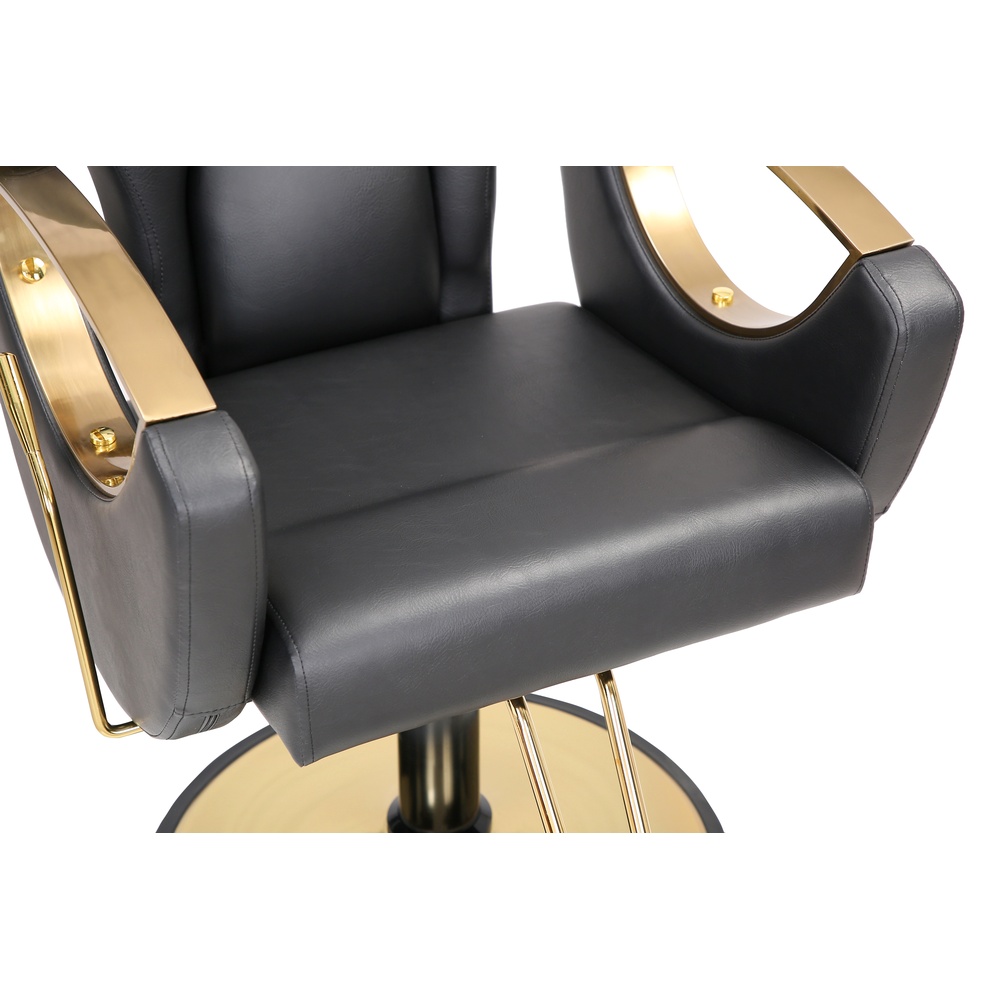
HZ8765BK, listed at 50 × 64 × 104 cm — the taller of the two 50 × 64 cm compact options in the HZ range.
Two cautions apply to every compact shortlist. First, a smaller envelope is not automatically a smaller working footprint: recline travel, footrest extension and base diameter all reach beyond the listed body dimensions, so a chair placed hard against a wall may not recline into usable positions. Second, spacing rules are jurisdictional. North Carolina, for example, requires a minimum of five linear feet of space between barber chairs measured from centre to centre under 21 N.C. Admin. Code 06L .0102. That figure is specific to one US state and should not be transplanted elsewhere, but it shows why centre-to-centre distances belong in the fit-out drawing rather than being resolved on site.
Heavy-duty stations: HZ87102RB
Where one or two chairs carry most of the day's appointments, the constraint moves from floor area to mechanical endurance. The HZ87102RB is listed at 111 × 66 × 118 cm, the largest envelope in the compared set and roughly two and a half times the width of the HZ6001DW. It is the model to plan around a dedicated primary station rather than an infill position, because the space it takes is space the room has to have anyway.
Heavy-duty is not a synonym for large, and buyers should test the two separately. Published commercial benchmarks for professional-grade hydraulic pumps describe ratings above 100,000 cycles and load capacities in the 350–400 lbs band, reported by the market research firm Fact.MR. Those figures describe the component class, not any individual HZ model: the published HZ specification data in this reference covers dimensions, materials and actuation type, not rated load or cycle counts. A procurement team should therefore request the rated load and the pump specification for the specific model and configuration being quoted, and treat the benchmark as the level of evidence to ask for rather than a specification already granted.
Styling and premium zones: HZ8799YF, HZ8799G-Z and HZ8799ABK
At the front of the salon, three models share a single footprint: HZ8799YF, HZ8799G-Z and HZ8799ABK are all listed at 110 × 72 × 100 cm. That shared envelope is the most useful fact on this page for anyone drawing a premium zone, because it means the choice between them does not change the floor plan at all. The decision shifts to presentation, mechanism and service mix.
The HZ8799G-Z is listed as a hydraulic recline model and is documented with PU leather, high-density sponge, wood and an aluminum alloy frame. Reclining capability matters where the station handles shaves, beard work or longer styling sessions in which the client is positioned back for part of the service; it matters less where the chair is used almost exclusively for upright cutting. Buyers comparing a reclining barber chair against a fixed styling chair should confirm the recline range and the clearance it needs behind the backrest before committing the layout, since a 110 × 72 cm plan can still require rear clearance once the chair is laid back.
Because the three models are dimensionally identical, specification can be driven by the salon's own positioning instead of by geometry. A single premium zone can mix them without breaking the visual rhythm of the room, and a distributor can stock one footprint while offering several finishes and detail options to different salon clients.
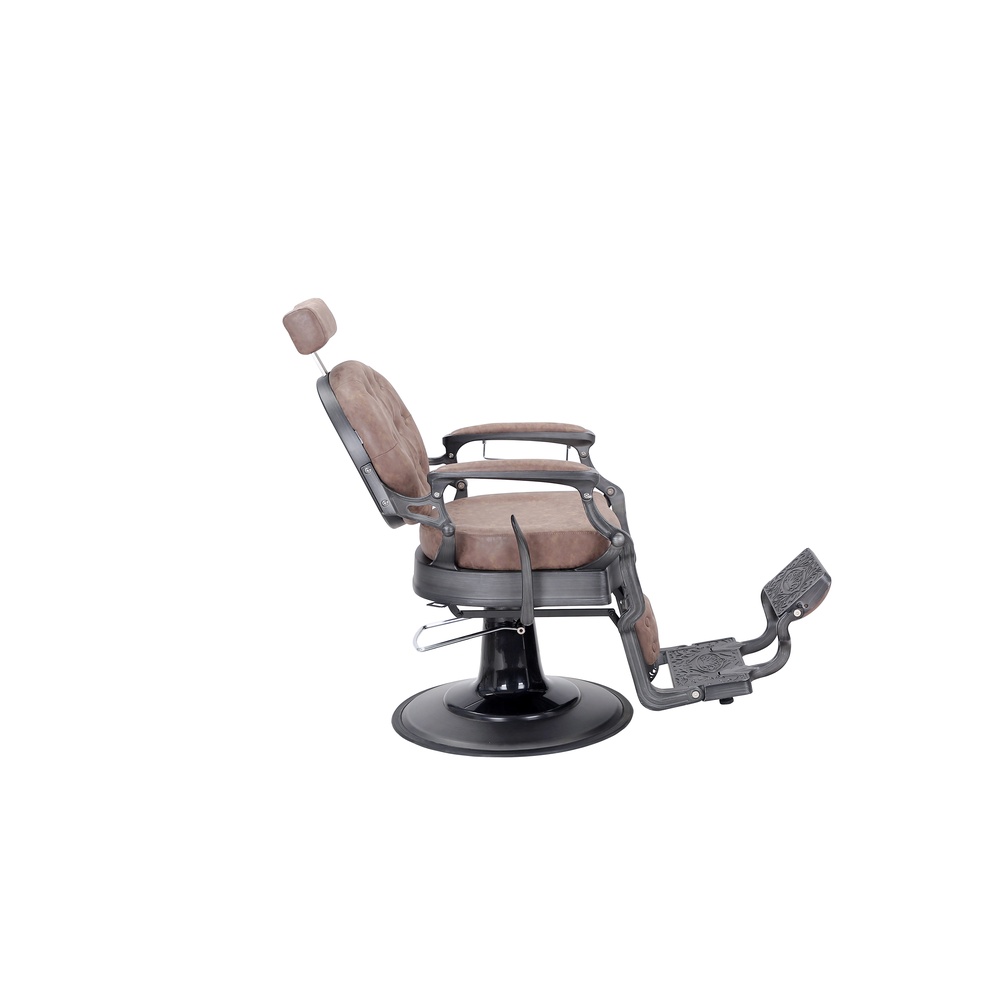
HZ8799G-Z, listed at 110 × 72 × 100 cm — one of three styling-zone models sharing the same footprint.
What the shared construction means for buyers
Across the range, the chairs are built from the same material family: PU leather upholstery, high-density sponge, wood and an iron or aluminum alloy frame. The frame material is where individual models diverge — the HZ8765BK is specified with iron, while the HZ8799G-Z is specified with aluminum alloy — and that difference should be read off the quotation for each model rather than assumed across the range.
The practical consequence is that material comparison between these models is not the deciding variable; dimensions, actuation and zone role are. PU leather is the specified covering across the set, and the operational requirement it has to meet is wear and oil resistance with easy cleaning between clients. High-density sponge carries the comfort requirement, and the wood and metal structure carries the load path from the seat to the base. What the published data does not state is foam density, upholstery thickness or rated load per model, so those are the values a buyer should request when the chair is intended for a heavy-duty station rather than a secondary one.
| Model | Listed dimensions | Station zone | Documented frame | What it changes for the buyer |
|---|---|---|---|---|
| HZ6001DW | 45 × 25 × 70 cm | Compact / infill | Range specification | Smallest envelope in the set; fits narrow or secondary positions |
| HZ88202 | 50 × 64 × 90 cm | Compact / standard | Range specification | Middle footprint; check recline travel before wall placement |
| HZ8765BK | 50 × 64 × 104 cm | Compact / taller back | Iron | Same 50 × 64 cm plan as HZ88202, 14 cm taller |
| HZ87102RB | 111 × 66 × 118 cm | Heavy-duty primary | Range specification | Largest envelope; plan as a dedicated station |
| HZ8799YF | 110 × 72 × 100 cm | Styling / premium | Range specification | Shares footprint with the other 8799 models |
| HZ8799G-Z | 110 × 72 × 100 cm | Styling / premium, recline | Aluminum alloy | Same footprint; documented hydraulic recline |
| HZ8799ABK | 110 × 72 × 100 cm | Styling / premium | Range specification | Same footprint; differentiation is detail, not floor space |
'Range specification' marks models that use the shared construction family — PU leather, high-density sponge, wood and an iron or aluminum alloy frame — where the individual frame material should be confirmed model by model at quotation.
Actuation: manual versus hydraulic, and why the mix matters
Chairs in this range operate in manual or hydraulic adjustable mode depending on the model, so actuation is a specification line to check rather than a range-wide assumption. The comparison against older or simpler salon seating is straightforward: a manually adjusted chair depends on the operator's effort and offers a narrower range of working heights, while a hydraulic barber chair moves the seat through its height range with the pump rather than the barber's arms. For a station serving clients of very different heights, that difference shows up in every appointment rather than occasionally.
The direction of the market supports treating hydraulic as the mainstream choice rather than a premium upgrade. Fact.MR projected that hydraulic salon chairs would account for a 63.4% share of the category in 2026, alongside a global salon chair market of about USD 1.5 billion in 2025. Both figures come from commercial market research and describe the category as a whole, not the HZ range; they are useful for framing a shortlist, not for ranking suppliers. The practical reading is that parts availability, service familiarity and technician expectations in most markets are already built around hydraulic mechanisms, which reduces the support risk of specifying them.
Purchasing terms, customisation and acceptance criteria
For wholesale barber chair programmes and multi-site fit-outs, the commercial terms matter as much as the dimensions. Ningbo Hongzi states a minimum order quantity of 5 units, with a lead time of 15 days for orders under 100 units and 30 days for orders above that threshold, along with OEM work covering logo and colour customisation, 100% product testing and export experience in EU and US markets. Those are supplier-stated terms and should be confirmed against the specific model, finish and order configuration at quotation, since lead times move with configuration and order sequence.
A workable acceptance checklist for a zone-based order looks like this:
- Dimensions against the drawing. Verify each delivered model against the listed figure — 45 × 25 × 70 cm for HZ6001DW, 50 × 64 × 90 cm for HZ88202, 50 × 64 × 104 cm for HZ8765BK, 111 × 66 × 118 cm for HZ87102RB and 110 × 72 × 100 cm for the HZ8799 family — and against the station drawing, not against the carton label alone.
- Actuation type per unit. Confirm manual or hydraulic operation model by model, and test the full height range on arrival rather than at first client use.
- Frame material confirmation. Check the iron or aluminum alloy specification per model, since the range uses both.
- Recline and clearance. Measure the rear clearance a reclining model needs before the station is fixed in place.
- After-sales terms. The stated support covers a one-year warranty on the pump and reshipment of damaged products; confirm the claim process and spare-part availability with the order.
- Documentation and classification. Barber and similar chairs with rotating, reclining and elevating movement fall under HS Code 9402.10, which is the classification to quote on shipping documents.
Future outlook for zone-based chair planning
If the hydraulic share projection holds, the differentiation between professional barber chairs will keep moving away from the mechanism itself and towards fit and documentation. That favours buyers who plan station by station. A range that covers 45 cm to 118 cm in width, with three models sharing a single 110 × 72 cm footprint, allows a salon to specify by zone without fragmenting its supplier base or its spare-parts inventory.
The open item is evidence depth. Dimensions and materials are published for this range; rated load, cycle counts and foam density are not, and those are precisely the numbers a heavy-duty station needs. Buyers should expect to close that gap through the quotation and the acceptance inspection rather than through the catalogue, and should treat a supplier's willingness to state those values per model as part of the evaluation itself.
Frequently asked questions
Which HZ model fits the smallest salon station?
The HZ6001DW has the smallest listed envelope in the range at 45 × 25 × 70 cm, which makes it the first candidate for narrow storefronts, infill positions and secondary chairs. The HZ88202 at 50 × 64 × 90 cm and the HZ8765BK at 50 × 64 × 104 cm are the next step up and share the same floor plan. Fit should be checked against recline travel and base diameter, not only against the body dimensions.
How much space should be left between barber chairs?
Spacing rules vary by jurisdiction and should be checked for the specific location. As one documented example, North Carolina requires a minimum of five linear feet between barber chairs measured from centre to centre under 21 N.C. Admin. Code 06L .0102. Where no local rule applies, centre-to-centre distance still needs to account for barber movement, client access and the rear clearance of any reclining model in the row.
What do the HZ models have in common, and where do they differ?
The range shares a construction family of PU leather upholstery, high-density sponge, wood and an iron or aluminum alloy frame, and all models are intended for indoor salon use with wear resistance, oil resistance, easy cleaning and comfort as operating requirements. They differ in listed dimensions — from 45 × 25 × 70 cm to 111 × 66 × 118 cm — and in frame material and actuation, which vary by model and should be confirmed in the quotation.
What separates a heavy-duty barber chair from a compact one?
Envelope and mechanical margin are separate questions. The HZ87102RB is the largest model in the compared set at 111 × 66 × 118 cm, which makes it a dedicated primary station. Endurance, however, comes from the pump and structure rather than the size alone: published commercial benchmarks for professional hydraulic pumps describe ratings above 100,000 cycles and load capacities around 350–400 lbs, and buyers should ask for the rated load and pump specification of the exact model being quoted, since the published HZ data covers dimensions, materials and actuation rather than load ratings.
Can the chairs be customised, and what are the minimum order terms?
OEM work covering logo and colour customisation is stated for the range, with a minimum order quantity of 5 units and lead times of 15 days for orders under 100 units and 30 days above that threshold. Customisation scope, lead time and price depend on the model and configuration, so these terms should be confirmed at quotation. The stated after-sales support covers a one-year warranty on the pump and reshipment of damaged products.
Reference summary
Matching HZ barber chairs to a salon comes down to three questions asked in order: how much floor the station can give up, how much mechanical work the station will do, and how much of the salon's presentation the station carries. Compact positions are served by the HZ6001DW, HZ88202 and HZ8765BK; heavy-duty primary stations by the HZ87102RB; styling and premium zones by the HZ8799YF, HZ8799G-Z and HZ8799ABK, which share one footprint and differ in mechanism and detail. Ningbo Hongzi Beauty & Hairdressing Equipment Co., Ltd. manufactures this range for salon fit-out, distributor bulk orders and customised projects; the full model and finish list is available in the company product brochure. Model data, dimensions and commercial terms should be confirmed for each configuration before an order is placed.
Have Questions or Need More Details?
Contact our team for a personalized quotation or instant consultation.
Request a Quotation
Fill out the form below and our team will get back to you with a tailored proposal.
WhatsApp Direct Chat
Prefer to chat in real-time? Message us on WhatsApp for instant assistance & quick answers.
- Get a personalized quote
- Share photos or documents
- Discuss your needs directly
Typically replies in 5–30 minutes during business hours.