280T Hydraulic Straw and Hay Bagging Machine NKB280-1 4-6 T/H
The NKB280-1 presses wheat straw, hay and alfalfa into dense, uniform bales and closes each bale in a plastic or woven bag, using a 280 T hydraulic cylinder and a PLC-controlled out-bale process.
280 T cylinder force4-6 t/h outputBale 1050 x 1250 mmPLC control
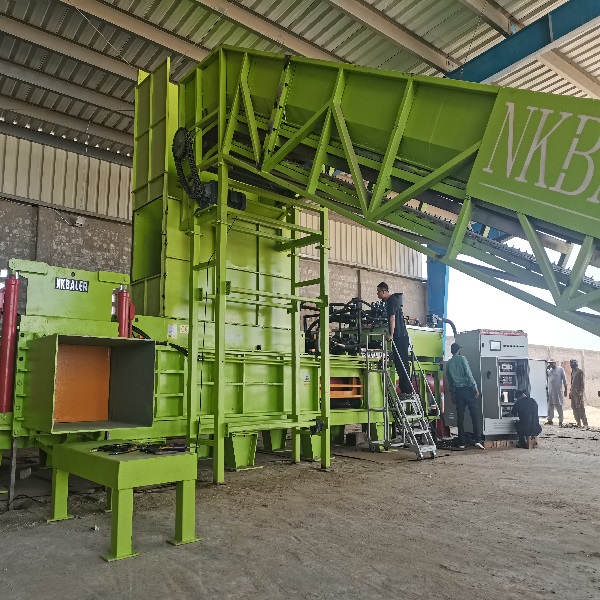
NKB280-1 bagging machine: mainframe, hydraulic power unit and chain conveyor.
Product Summary
The NKB280-1 is a hydraulic straw and hay bagging machine built for fibrous agricultural material. A YG350-4300 main cylinder applies 280 T of force at a maximum pressure of 30 MPa, while a 2600 x 1100 mm feed opening and a 2000 x 12000 mm chain conveyor keep material moving into the press. Capacity runs at 4-6 t per hour, or 30-32 bales per hour, with dry bale weights of 300-400 kg. Compression parameters stay adjustable from the control panel as feedstock moisture changes, so density holds steady from the first bale of the day to the last.
Key Features
280 T Twin-Ram Compression
The twin-ram hydraulic system and YG350-4300 main cylinder deliver 280 T at up to 30 MPa, so each bale leaves the forming die with consistent diameter and structural integrity.
4-6 t/h, 30-32 Bales per Hour
Dry bale weight runs 300-400 kg. Compact, dense bales stack and load more efficiently than loose straw, cutting storage space and transport cost.
2600 x 1100 mm Feed Opening
The hopper carries an anti-bridge mechanism that keeps fibrous material such as straw, corn stalks and wood shavings flowing into the press instead of clogging above it.
PLC Control, Manual Bag Tying
PLC automatic control governs the out-bale process while bag tying stays manual, so one operator follows the bale from press to bag with plastic bags or woven bags.
Automated Lubrication
An automatic lubrication system feeds key wear points, extending wear-part life and reducing maintenance downtime on a machine that has to run through the whole harvest season.
Conveyor and Cooling Package
A 2000 x 12000 mm chain conveyor driven by a 4 kW motor feeds the press, and a cooling tower (0.75 kW water pump, 0.25 kW fan) protects the 1600 L oil circuit on long shifts.
Technical Specifications
Parameter
Value
Model
NKB280-1
Machine type
Hydraulic straw / hay bagging machine
Bale size (W x L x H)
1050 x 1250 mm
Bale weight (dry)
300-400 kg
Feed opening (L x H)
2600 x 1100 mm
Packing materials
Alfalfa, wheat straw, peanut hay
Output capacity
30-32 bales/hour
Capability
4-6 t/hour
Main cylinder
YG350-4300, 280 T force
Maximum hydraulic pressure
30 MPa
Main motor
37 kW
Power rating
45 kW x 2 / 120 HP
Voltage
200-480 V / 50 Hz / 3 phase
Strapping
Plastic bags / woven bags
Control
PLC automatic control, manual bag tying
Feeding way
Chain conveyor, 2000 x 12000 mm, 4 kW conveyor motor
Oil tank
1600 L
Cooling
0.75 kW water pump + 0.25 kW fan
Machine size (L x W x H)
10800 x 4800 x 4580 mm
Mainframe dimensions (approx.)
9.8 x 1.6 x 1.9 m
Weight
32000 kg total, mainframe approx. 24 t
Feedstock density range
300-400 kg/m3
Models and Options
This page documents one configuration, the NKB280-1. Options recorded in the machine specification are the 200-480 V / 50 Hz / three-phase supply range, plastic bags or woven bags for strapping, and the combination of PLC automatic control with manual bag tying for the out-bale process. Because compression settings are adjustable in real time from the control panel, the same unit can be tuned for wheat straw, alfalfa, peanut hay or other fibrous feedstock at 300-400 kg/m3. Send your material type, target bale weight and site power conditions and the model can be confirmed against your line.
Materials and Structure
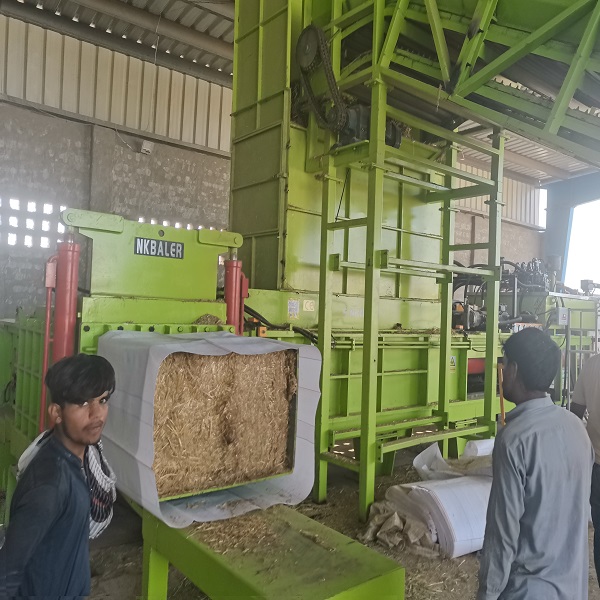
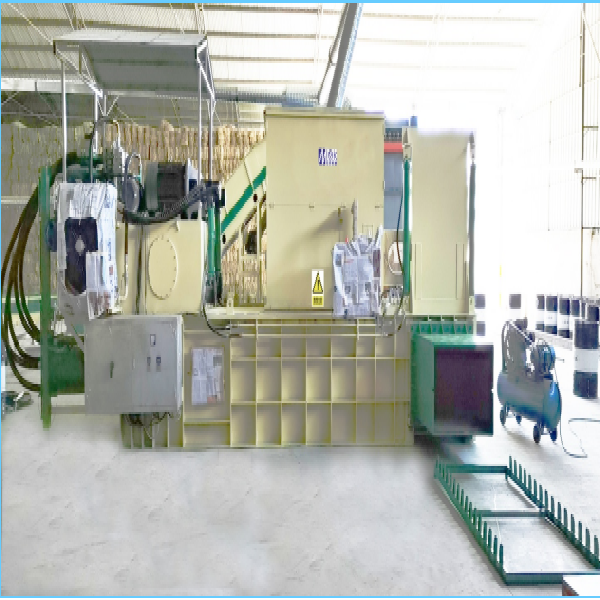
Carbon steel mainframe with the anti-bridge feed hopper and hydraulic cylinder assembly.
The machine is built on a carbon steel mainframe weighing approximately 24 t, with a total machine weight of 32000 kg and overall dimensions of 10800 x 4800 x 4580 mm. The feed hopper incorporates the anti-bridge mechanism, the forming die sets the 1050 x 1250 mm bale profile, and the 1600 L oil tank with cooling tower supports the 30 MPa hydraulic circuit. The structure is purpose-built for demanding agricultural environments where the press runs loaded for hours.
Applications
Baled straw and wood shavings ready for storage and transport.
Typical feedstocks are wheat straw, hay, alfalfa and peanut hay, and the anti-bridge hopper also handles fibrous material such as corn stalks and wood shavings. Baled output is used for animal feed, as biomass fuel for industrial combustion and gasification, and for commercial heating. Dense bales reduce storage footprint and make container loading and road transport easier, which is why the same machine is used in agricultural cooperatives, biomass processing sites, and waste treatment and recycling yards handling fibrous residue.
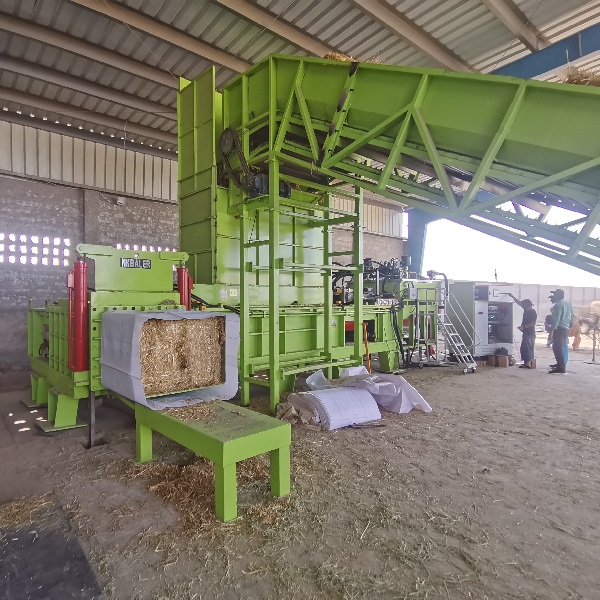
NKB280-1 installed on site, calibrated for local straw moisture levels.
Greece, agricultural cooperative and biomass processing facility. One unit baling wheat straw and agricultural residues into dense blocks for animal feed and biomass fuel. The line has run under continuous operation with high-density bale output, reducing storage space and logistics cost for local farmers. Engineers travelled to Greece for on-site installation, commissioning and operator training, and the machine was calibrated to local straw moisture levels.
Pakistan, agricultural manufacturer. One unit baling straw and alfalfa, reported as running stable for two years with low noise and an expected service life of 10-15 years.
FAQ
What materials can the NKB280-1 bag?
Wheat straw, hay, alfalfa and peanut hay are the listed packing materials, and the anti-bridge hopper is built to handle fibrous material such as corn stalks and wood shavings. Feedstock density in the specification is 300-400 kg/m3.
What output can I expect?
4-6 tonnes per hour, equivalent to 30-32 bales per hour, with a dry bale weight of 300-400 kg.
What bale size does it produce?
Bales measure 1050 x 1250 mm. Material enters through a 2600 x 1100 mm feed opening, and a 2000 x 12000 mm chain conveyor with a 4 kW motor supplies the press.
What are the power and installation requirements?
The machine runs on 200-480 V / 50 Hz / three phase, with a 37 kW main motor and a 45 kW x 2 (120 HP) power rating. Cooling is handled by a 0.75 kW water pump and a 0.25 kW fan. Plan for a 1600 L oil tank and a machine footprint of 10800 x 4800 x 4580 mm at 32000 kg.
How is the bale closed?
With plastic bags or woven bags. Bag tying is manual, while PLC automatic control governs the out-bale process.
Is the machine CE certified?
The manufacturer holds an Attestation Certificate of Machinery Directive, certificate EASY03220201M, issued by UDEM against EN ISO 12100:2010 and EN 60204-1:2018 for the EU/EEA/TR market, valid 22 Mar 2022 to 21 Mar 2027, plus Verification of Conformity DPWD/09/060/2024 against EN 415-1:2014, valid to 18 Sep 2029.
What do you need to quote a configuration?
Material type, loose density, moisture level, target bale weight, available floor space, site power and required throughput. Those inputs determine the settings and the accessories around the machine, such as conveyor length and bag supply.
Inquiry Information
Shaanxi Nick Machinery Equipment Co., Ltd. — hydraulic balers and bagging presses, 90% of output exported, 5000 m2 factory, 600 units annual output.
Address: Qun Sheng Lu, Hui Shan Qu, WuXi Shi, Jiang Su Sheng, China · www.nickbaler.com
Page SEO Data
SEO Title: 280T Hydraulic Straw and Hay Bagging Machine NKB280-1 4-6 T/H
Meta Description: Buy the NKB280-1 straw and hay bagging machine: 280T cylinder, 4-6 t/h output, 1050 x 1250 mm bales, PLC control and a 2000 x 12000 mm chain conveyor.
URL Slug: /nkb280-1-straw-hay-bagging-machine
Image Filename and Alt Suggestions
straw-hay-bagging-machine-nkb280-1-mainframe-conveyor.jpg — Alt: NKB280-1 straw and hay bagging machine mainframe with chain conveyor
straw-hay-bagging-machine-nkb280-1-hydraulic-frame.jpg — Alt: Carbon steel mainframe and hydraulic cylinder of the NKB280-1 bale bagging machine
straw-hay-bagging-machine-nkb280-1-baled-output.png — Alt: Wood shavings and straw bales produced on a hydraulic bagging press
straw-hay-bagging-machine-nkb280-1-site-installation.jpg — Alt: NKB280-1 bagging machine installed at a biomass processing facility
straw-hay-bagging-machine-nkb280-1-detail.jpg — Alt: PLC control panel and bag tying station on the NKB280-1 bagging machine